

Running on a Manual Treadmill for Optimal Health and Performance
Running on a manual treadmill is a transformative experience compared to a motorized machine. You are the engine. Your power, your effort, drives the belt, turning a simple run into a more intense, natural, and holistic workout that enhances both physical and mental wellness.
This self-propelled motion engages more muscle groups, leading to significant gains in strength, cardiovascular health, and overall well-being.
Unlocking a New Level of Health and Performance
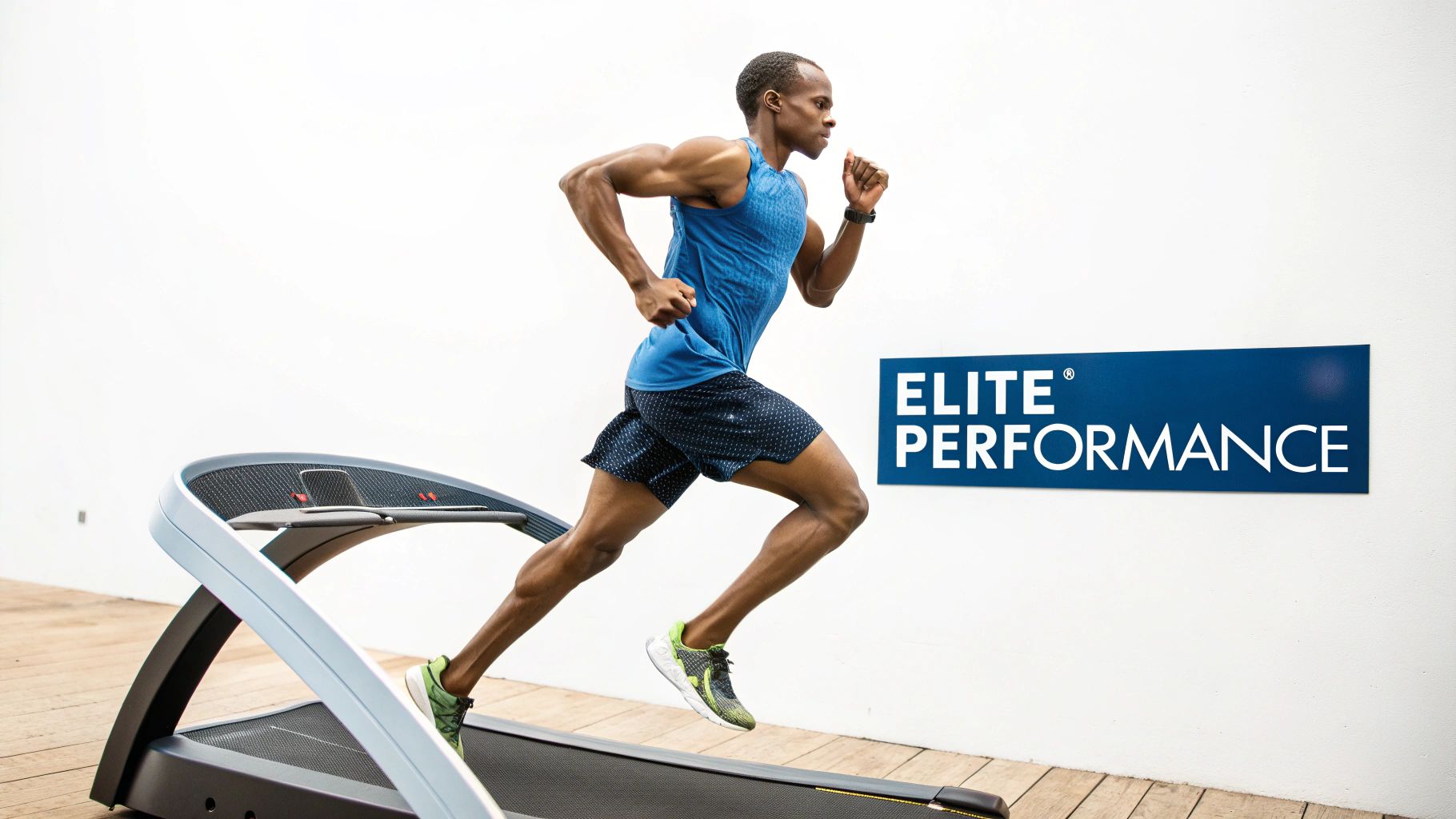
Forget passive cardio sessions. Elite athletes and wellness advocates are switching to manual treadmills because they demand more from your body, fostering a deeper mind-muscle connection. Unlike motorized treadmills that pull the belt for you, a manual treadmill—especially a curved model—forces you to generate every single bit of momentum.
This self-powered dynamic is its secret sauce. It transforms a run into a full-body conditioning session, challenging not just your legs but also your core, glutes, and hamstrings in ways a flat, motorized belt simply can't match. This heightened engagement is a cornerstone of functional fitness.
The Biomechanical and Health Advantage
That curved design on many manual treadmills isn't just for looks; it’s engineered to promote a more natural running form that benefits your long-term health. The unique shape encourages you to land on your mid-foot or forefoot, which helps you avoid the heavy, joint-jarring heel-striking that’s so common on traditional treadmills.
This biomechanical shift minimizes impact on your joints and maximizes your power output, leading to a safer and more effective workout.
This design also forces constant neuromuscular engagement. Your brain and muscles work in perfect sync to control your speed and maintain balance. That heightened coordination translates directly to better functional movement in daily life and improved performance in sports.
A manual treadmill offers a more honest workout. With no motor to assist, you can burn up to 30% more calories and achieve a higher heart rate at the same speed compared to a motorized treadmill, amplifying the cardiovascular health benefits.
The demand for this kind of health-focused gear is exploding. The global market for manual treadmills jumped from an estimated USD 1.3 billion in 2023 and is on track to hit USD 2.5 billion by 2032. This growth reflects a major shift in how people approach their training and overall wellness.
Manual vs Motorized Treadmill At a Glance
So, what are the core differences for your health and wellness goals? Let's break it down.
| Feature | Manual Curved Treadmill | Motorized Treadmill |
|---|---|---|
| Power Source | Self-propelled by the user | Electric motor |
| Speed Control | Controlled by user's stride | Set via console buttons |
| Workout Intensity | Higher; more muscle activation & calorie burn | Lower; motor assists movement |
| Health Impact | Promotes natural, low-impact running form | Can encourage high-impact heel striking |
| Cost & Maintenance | Higher initial cost, less maintenance | Lower initial cost, more maintenance |
| Best For | HIIT, functional strength, active recovery | Steady-state cardio, long runs |
Ultimately, the choice depends on your training goals, but the manual treadmill offers a more dynamic, challenging, and efficient workout for holistic health.
Beyond High-Intensity Training
While they’re phenomenal for pushing your limits, the health benefits of running on a manual treadmill extend to wellness and recovery. The machine’s responsive nature makes it an incredible tool for active recovery sessions.
A gentle walk or a light jog on a manual treadmill can boost blood flow to sore muscles, helping to flush out metabolic waste and accelerate the healing process. This is a key component of a sustainable fitness routine.
This dual-purpose functionality is why it’s a staple in both high-performance gyms and wellness clinics. You can go from an all-out sprint to a restorative walk without touching a single button, letting your body dictate the intensity. This makes it an invaluable asset for anyone building a complete wellness routine that balances exertion with renewal. To see how these machines stack up against other options, check out our guide on the benefits of a resistance treadmill. For more expert wellness advice, visit the MedEq Wellness Journal: https://medeqfitness.com/blogs/medeq-wellness-journal.
Mastering Your Form for a Powerful, Injury-Free Run
On a manual treadmill, you are the motor. That means your running form isn't just about efficiency—it dictates every single thing about your workout, from the speed of the belt to the health of your joints. Nailing your technique is the secret to unlocking the incredible wellness benefits of these machines.
Think of it this way: your body is a chain, and it all starts with your core. A solid, stable center is what allows you to transfer power down through your legs and drive that belt with real purpose.
Build a Strong Foundation with Posture and Core
Before you even think about moving, get your posture right. Stand tall. Pull your shoulders back and down, lift your chest, and keep your spine neutral. This isn't just about looking good; it's essential for balance and optimal breathing on the curve.
Now, brace your core. Just a light contraction, like you're about to get tapped in the stomach. This single move stabilizes everything, stopping your lower back from arching and keeping your hips from swaying—common energy leaks that lead to bad form and potential injury.
Your core is your anchor. It locks your pelvis and spine in place, freeing up your arms and legs to move powerfully. On a self-propelled belt, this stability is non-negotiable for joint health.
Perfecting Your Foot Strike and Cadence
One of the best health benefits of a curved treadmill is that it practically teaches you a better foot strike. The deck's shape naturally encourages you to land on your mid-foot, right under your center of gravity. This is a game-changer compared to the heavy, braking heel-strike many people fall into on motorized treadmills.
Fight the urge to overstride by reaching your foot way out in front. That's like hitting the brakes with every step, slowing the belt and hammering your knees and hips. The fix? Focus on quicker, lighter steps. A higher cadence—more steps per minute—ensures your feet land underneath you, creating a smooth, rolling momentum.
Harnessing Momentum with Arm Drive
Your arms aren't just passengers; they're co-pilots. They generate momentum, fine-tune your balance, and set your rhythm. A strong, coordinated arm swing adds directly to the force your legs put into the belt.
Bend your elbows to about 90 degrees and drive them straight back. A common mistake is letting them cross the centerline of your body, which causes you to twist and waste energy. Your hands should swing from your hip to your chin in a clean, rhythmic arc.
- Actionable Cue: Imagine you’re trying to elbow someone sneaking up behind you. This forces a powerful backward drive instead of a lazy forward swing.
- Gaze Level: Look straight ahead, at the horizon. Staring down at your feet makes you slouch, throwing your entire posture out of whack.
Correcting Common Form Mistakes
Even experienced runners can develop bad habits. Here are two of the biggest mistakes we see on manual treadmills and how to fix them for good.
1. Gripping the Handrails
The "death grip" on the handrails is an understandable instinct when you feel wobbly, but it kills your workout. It destroys your posture, turns off your core, and basically teaches your body all the wrong things.
- The Fix: Start slow. Get comfortable walking without holding on. If you need a confidence boost, just graze the rails with your fingertips instead of gripping them. Your stability will improve, and then you can pick up the pace.
2. Leaning Too Far Forward
A slight forward lean from the ankles is good running form. But bending at the waist is a different story. It puts a ton of strain on your lower back and makes it harder to breathe.
- The Fix: Use the cue "run tall." Squeeze your glutes and engage your core to push your hips forward, keeping your torso upright. This is the power position you need to maintain.
While manual treadmills are a unique beast, great footwear is still fundamental. For some solid advice, check out this guide on the best shoes for treadmill running. The right pair will give you the support to match your stellar form. And for more deep dives into wellness, be sure to visit our MedEq Wellness Journal: https://medeqfitness.com/blogs/medeq-wellness-journal.
Your First Week of Manual Treadmill Workouts
Hopping on a manual treadmill for the first time is a whole different ball game. It can feel a bit awkward, but with the right approach, you'll be in control and feeling confident in no time.
This isn't your generic "walk for 20 minutes" plan. We've structured a full week to help you get comfortable with the unique feel of a self-propelled deck. The goal here is simple: finish the week ready to tackle more, with a solid foundation under your feet.
Day 1 & 2: Get a Feel for the Belt
First things first: forget about speed or distance. Your only job for the first two days is to get comfortable starting, stopping, and holding a steady walk. Think of it as building a relationship with the machine.
- Day 1 Goal: Aim for 15-20 minutes. Focus on the push-off that gets the belt moving and how slowing your steps brings it to a smooth stop. Just walk at a comfortable pace.
- Day 2 Goal: Bump it up to 20-25 minutes. Keep practicing those smooth starts and stops. Start to play with your pace a little—speed up, slow down—and notice how your effort directly controls the belt's momentum.
This initial phase is more important than you might think. A motorized treadmill does the work for you, but here, it's all about the connection between your body and the machine. It’s a completely different dynamic. For a full breakdown, check out our comparison of manual treadmills vs electric models.
Day 3 & 4: Master Your Pace Control
Alright, you've got the basics down. Now it's time to work on changing gears. These next two days are about learning to transition smoothly from a walk to a light jog and back again.
Plan for about 25 minutes each day. Start with a 5-minute warm-up walk, then get into the main drill.
-
The Drill:
- Walk briskly for 2 minutes.
- Shift into a light, controlled jog for 1 minute.
- Repeat this cycle 5-6 times.
- Finish it off with a 5-minute cool-down walk.
The key here isn't speed—it's control. Pay close attention to how you adjust your stride length and cadence to speed up and slow down the belt. Nailing this skill is what makes manual treadmill running both safe and effective.
Day 5 & 6: Your First HIIT Session
You've built a great foundation. Now, let's tap into the real power of a manual treadmill with a simple High-Intensity Interval Training (HIIT) workout. This is where these machines truly shine, allowing for instant changes in speed for profound metabolic health benefits.
Set aside 20 minutes for this session.
- Warm-up: 5 minutes of easy walking.
-
The Work: 8 rounds of...
- 30 seconds of fast running (think a 7-8 out of 10 effort).
- 60 seconds of complete rest or a very slow recovery walk.
- Cool-down: 3 minutes of slow walking.
Before you ramp up the intensity, it's a good idea to refresh yourself on solid running mechanics.
As this image shows, good form is a full-body effort—from posture to foot strike to arm drive. These cues become even more important when you start pushing the pace.
To make it even clearer, here’s a simple table outlining what that HIIT session looks like.
Sample Beginner HIIT Workout Structure
| Segment | Action | Duration | Perceived Effort |
|---|---|---|---|
| Warm-Up | Easy Walking | 5 minutes | 2-3 / 10 |
| Interval 1 | Fast Run | 30 seconds | 7-8 / 10 |
| Recovery 1 | Slow Walk / Rest | 60 seconds | 1-2 / 10 |
| Repeat | (Repeat for 8 total rounds) | ... | ... |
| Cool-Down | Slow Walking | 3 minutes | 1-2 / 10 |
This structure gives you a clear target for each part of the workout, helping you manage your energy and get the most out of every interval.
Day 7: Active Recovery and Looking Back
You made it. Today is all about recovery and wellness. A light 15-20 minute walk on the treadmill will do wonders for boosting blood flow and easing any muscle soreness. It's the perfect way to cap off the week and support your body's natural healing.
This highlights the incredible versatility of manual treadmills. They’re beasts for high-intensity work but also fantastic tools for gentle, restorative movement. This dual-purpose capability is a big reason why the global market for unpowered treadmills, including curved models, hit a value of USD 571.63 million in 2023.
Think about how far you've come this week—from those first tentative steps to crushing a full HIIT workout. You've built the skills and confidence to make the manual treadmill a core part of your training and wellness routine. Nicely done.
Advanced Protocols to Shatter Performance Plateaus
Once you have the fundamentals locked in, the real fun begins. A manual treadmill opens the door to high-level training protocols that can smash through performance barriers and build some serious athletic power. These aren't just harder workouts; they're strategic methods designed to trigger specific physiological adaptations.
The magic is in the belt's instant responsiveness. Unlike a motorized treadmill with its slight lag, a self-powered belt lets you go from an all-out sprint to a dead stop in a fraction of a second. This makes it the perfect tool for pushing your anaerobic threshold and improving metabolic health.
Pyramid Sprints for Anaerobic Power
One of the most potent workouts you can do is the Pyramid Sprint. This protocol is built to systematically push your anaerobic limits, training your body to tolerate and clear lactate more efficiently. The result? A higher threshold, which means you can sustain intense effort for much longer.
The pyramid structure involves progressively increasing, then decreasing, the duration of your high-intensity intervals. This clever design challenges your body in different ways on the way up versus the way down.
Here’s a sample to get you started:
- Warm-Up: Get moving for 5-10 minutes with light walking and dynamic stretches.
-
Sprint Intervals:
- 30 seconds sprint / 60 seconds recovery walk
- 45 seconds sprint / 90 seconds recovery walk
- 60 seconds sprint / 120 seconds recovery walk
- 45 seconds sprint / 90 seconds recovery walk
- 30 seconds sprint / 60 seconds recovery walk
- Cool-Down: Ease off with 5 minutes of easy walking.
This type of training is incredibly demanding, but the payoff for your cardiovascular health is huge. The key is giving 100% max effort during each sprint. Use those generous recovery periods to get your heart rate back down before the next big push.
Sport-Specific Conditioning Drills
The versatility of a manual treadmill goes way beyond just running. Its unique, self-generated resistance makes it a powerful tool for building functional strength and power that translates directly to your sport.
For trail runners or hikers, simulating a steep hill climb is easy. Just lean forward, drive hard with your legs, and you can maintain a slow, grinding pace that feels just like a tough ascent. It builds incredible leg strength and endurance without ever needing a hill.
Another game-changing application is the resisted push.
- Resisted Sled Pushes: Grab the front handlebars, get low in an athletic stance, and drive the belt backward with powerful leg pushes. This drill is phenomenal for building explosive power in your glutes, quads, and calves—the kind that directly improves acceleration and speed in field sports.
This kind of functional training is a major reason why so many high-performers are adopting these machines. Manual treadmills are carving out a significant niche in the massive USD 5.75 billion global treadmill market. Their cost-effectiveness—often 40-60% lower than comparable motorized models—and superior training benefits are driving the trend. In North America, which holds a 39.47% market share, athletes are using them for HIIT sessions that torch up to 15% more calories by forcing self-paced resistance that builds true, explosive power. You can explore more about this growing market by reading the full industry analysis.
Over-Speed Drills for Maximum Velocity
Finally, to really sharpen your top-end speed, you can use Over-Speed Drills. This is all about using the momentum of the curved belt to encourage a faster leg turnover than you could probably achieve on flat ground.
Here’s how it works: start running near the front of the curve to get the belt moving fast, then let yourself drift back slightly as it picks up speed. This forces your legs to keep up with the faster-moving belt for a short burst, essentially training your neuromuscular system to fire more rapidly.
Keep these short and explosive—think 10-15 second bursts with full recovery in between. This isn't about endurance; it's about teaching your body a new level of speed. By integrating these advanced protocols, you can transform your manual treadmill from a simple cardio machine into a specialized performance tool.
To dive deeper into all things wellness, visit our MedEq Wellness Journal for more expert insights.
Integrating Smart Recovery for Sustained Performance
The real magic of training on a manual treadmill happens after you step off the belt. The hours and days following your workout are where your body adapts, gets stronger, and your wellness improves. Smart workout recovery connects that hard work to real, lasting gains.
Your manual treadmill is actually one of your best recovery tools.
Instead of just collapsing on the couch, active recovery uses gentle movement to speed up your body's repair processes. A slow walk on the curved belt is perfect for this. It gets blood flowing to your muscles, helping to flush out metabolic waste and ease that next-day soreness (DOMS).
Because you power the belt yourself, you can move at a slow, natural pace without fumbling with buttons. It's an incredible way to cool down right after a tough workout, letting your heart rate come down gradually while kicking off the recovery cycle.
Building a Holistic Recovery Stack
While that active recovery walk is a great start, the best results come from layering different recovery methods. Think of it as building a "recovery stack" that addresses everything from inflammation to cellular repair.
A powerful combination is pairing your treadmill cool-down with contrast therapy—alternating between hot and cold environments. This creates a "pumping" action in your blood vessels that flushes out inflammation and brings fresh, nutrient-rich blood right where you need it, significantly enhancing your workout recovery.
The point of a recovery stack isn’t just to feel better. It’s to create an internal environment that supercharges adaptation. This is how you train harder, more often, without burning out, leading to sustained wellness.
For example, after your gentle walk, try a cycle of sauna and cold plunge. The heat relaxes muscles and boosts circulation, while the cold plunge constricts blood vessels to crush swelling and inflammation.
Advanced Recovery Technologies
To really dial things in, you can add therapies that work on a deeper, cellular level. Red light therapy, for instance, uses specific light wavelengths to energize your mitochondria—the tiny power plants inside your cells.
By making your mitochondria more efficient, red light therapy helps reduce oxidative stress and ramp up ATP (cellular energy) production, which is essential for muscle repair. Just a 10–15 minute session after your workout can make a huge difference in how you feel the next day.
This approach creates a complete system for high performance:
- Active Recovery: Gentle walks on the manual treadmill to boost blood flow.
- Contrast Therapy: Sauna and cold plunge sessions to manage inflammation.
- Cellular Support: Red light therapy to enhance mitochondrial function.
To round out your strategy and ensure your body has the raw materials it needs, exploring effective supplements for muscle recovery is a smart move. This ensures you're recovering just as hard as you train. For a deeper dive into building out your own recovery setup, check out our guide on the best recovery tools for athletes.
When you treat recovery with the same focus as your training, you build a resilient foundation for long-term progress. Every piece of the stack works together to turn hard work into real results.
Your Questions, Answered
Jumping onto a new piece of equipment like a manual treadmill always brings up a few questions. It’s a totally different animal than the motorized versions most people are used to, so it’s smart to get the full picture.
Let's break down the most common things people ask before they decide if a self-powered treadmill is right for their training.
How Loud Are These Things?
Surprisingly quiet. One of the first things you'll notice is the absence of that familiar electric motor hum.
The only real sounds are the soft whir of the belt gliding over the bearings and your own footfalls. This makes it a great option if you're in an apartment or need to get a workout in while the rest of the house is asleep.
Can a Beginner Really Use This?
Absolutely. While you see elite athletes using them for sprint work, manual treadmills are fantastic for beginners. You just have to start smart.
The machine forces you to power every step, which naturally teaches good form and pacing right from the start. It builds a solid running foundation and scales with you—as you get fitter, you can push harder. It meets you where you are.
Is It Better for Burning Fat?
It can be a game-changer for weight loss and metabolic health. Since you're the engine, your body has to work significantly harder to move the belt.
Research and real-world results consistently show you can burn up to 30% more calories on a manual treadmill compared to running at the same speed on a motorized one. That extra work and higher muscle engagement make it a seriously powerful tool for fat loss.
Can I Do My Long Sunday Run on It?
This is where it's important to understand what this machine is built for. While you can technically run long distances, it’s not its sweet spot. The continuous effort needed to keep that belt moving can become incredibly taxing over a long, steady run.
Where a manual treadmill truly shines for health and wellness:
- High-Intensity Interval Training (HIIT): Nothing beats it for quick, all-out sprints.
- Acceleration Drills: The instant feedback is perfect for working on your explosive power.
- Active Recovery: A gentle, self-paced walk is easy to control and great for recovery.
- Warm-ups & Cool-downs: Ideal for getting your body ready for work or winding down after.
For marathon training, a motorized treadmill might still be your go-to for those long, steady-state miles. But for building power, boosting your metabolism, and overall conditioning, the manual treadmill is in a class of its own.
For more deep dives into optimizing your training and recovery, check out the MedEq Wellness Journal.
At MedEq Fitness, we bridge the gap between exertion and renewal with science-backed equipment. Our physician-led team curates the best manual curved treadmills, cold plunges, saunas, and more—all designed to help you recover faster and perform better.
Discover our collection of high-performance recovery tools today.


