
Best Recovery Tools for Athletes to Unlock Peak Performance and Wellness
When you think about the best recovery tools for athletes, what comes to mind? Is it the basics like stretching and a good night's sleep, or do you picture high-tech gear like compression boots and cold plunge tubs?
The truth is, it's a mix of both. Your real athletic potential isn't unlocked during the final rep or the last mile; it's forged in the moments of rest and repair that follow. Effective workout recovery is the cornerstone of sustainable health and peak performance.
Why Proactive Recovery Is Your Ultimate Wellness Edge
The old 'no pain, no gain' mindset is obsolete. Today, the smartest performers know that strategic, intentional recovery is the most critical part of any serious training program. Pushing your body to its limits is only half the equation. The other half—the part that really matters—is giving it the right tools and time to rebuild stronger than before, promoting overall wellness.
Think of your body like a high-performance engine. You can redline it all day, but without the right maintenance, quality fuel, and essential pit stops, it's going to break down. Proactive recovery is your dedicated pit crew, working tirelessly to repair muscle micro-tears, flush out metabolic byproducts, and calm your entire nervous system down for better health.
Beyond Just Resting: The Health Benefits
Don't confuse recovery with just sitting on the couch. That’s passive rest. Proactive recovery means using specific tools and techniques to actively speed up your body's natural healing processes. This isn't just about feeling less sore tomorrow; it's about building a sustainable system for peak performance, longevity, and overall wellness.
A smart recovery strategy offers significant health benefits:
- Prevent Overuse Injuries: By managing inflammation and keeping muscle tissue pliable, you dramatically lower the risk of common strains and tears.
- Combat Burnout: Real recovery helps regulate your stress hormones, improving both mental and physical resilience so you can keep showing up.
- Elevate Performance: When your body is fully restored, you can train harder and more consistently. That's where the real results come from.
The market reflects this massive shift in thinking. The global sports recovery technology market is already valued at an estimated USD 3.1 billion in 2025 and is on track to hit USD 10.5 billion within five years. As you can see in these stats on recovery tech growth, athletes at every level are investing in smarter recovery and wellness.
The goal is to work smarter, not just harder. By integrating dedicated recovery practices, you build a foundation for consistent improvement and longevity in your sport.
Let's dive into the core categories of recovery tools, from the absolute fundamentals to advanced therapies. This guide will give you a clear roadmap to finding what works for you and gaining a durable competitive advantage.
Athlete Recovery Modalities at a Glance
To get started, here’s a quick overview of the main types of recovery tools we'll be covering. This graphic serves as a cheat sheet for understanding the different ways you can support your body's repair process and enhance your wellness journey.
| Recovery Tool Category | Primary Mechanism | Key Health Benefit | Best For |
|---|---|---|---|
| Cryotherapy/Cold | Vasoconstriction & reduced inflammation | Reduced muscle soreness & swelling | Post-workout, acute injuries, endurance athletes |
| Compression | Increased circulation & lymphatic drainage | Accelerated waste removal, reduced DOMS | All athletes, especially post-endurance or HIIT |
| Photobiomodulation | Cellular energy production (ATP) | Enhanced cellular repair & reduced pain | Targeted injuries, chronic pain, skin health |
| Thermotherapy/Heat | Vasodilation & muscle relaxation | Increased blood flow, improved flexibility | Pre-workout, chronic muscle tightness, general relaxation |
| Percussion/Massage | Myofascial release & increased blood flow | Reduced muscle knots & improved range of motion | All athletes, for both warm-up and recovery |
| Pressure Therapies | Increased oxygen saturation & circulation | Systemic healing & reduced inflammation | Serious athletes, injury recovery, performance optimization |
This table gives you a high-level look, but the real magic is in understanding how and when to use each tool for maximum effect on your workout recovery. Let's get into the details.
Mastering the Foundations: Sleep and Active Restoration
Before we dive into the world of high-tech recovery tools, let's get one thing straight. The most powerful, effective, and non-negotiable recovery methods are completely free. We're talking about sleep and active restoration—the pillars of any effective wellness routine.
Think of these as the concrete foundation of your performance and wellness house. All the cool gadgets and therapies we'll discuss later are the high-end finishes, but without a solid base, the whole structure is compromised. They amplify recovery; they don't create it from scratch.
When you train hard, you're essentially creating tiny, controlled tears in your muscle fibers. The real growth doesn't happen in the gym—it happens when your body gets the signal to rebuild, bigger and stronger than before. Sleep is primetime for that reconstruction project.
Why Sleep Is the Ultimate Recovery Tool
During the deep stages of sleep, your body isn't just resting; it's running a full-scale repair operation. Your brain floods your system with growth hormone, a key health benefit for repairing muscle tissue and strengthening bones. This is also when your mind gets to work, cementing the motor skills you practiced and locking in that muscle memory for your next session.
Skimp on sleep, and you're essentially telling the repair crew to stay home. Your stress hormone, cortisol, stays elevated, inflammation lingers, and your physical and mental performance takes a nosedive. Making 7-9 hours of quality sleep a priority is the single biggest win you can achieve for your workout recovery. For a deeper look into optimizing those crucial hours, check out our guide on how to increase deep sleep.
Sleep isn't passive downtime. It's an active, dynamic state of physiological renewal. Neglecting it is like trying to build a skyscraper without letting the concrete set between floors—eventually, the entire structure will weaken.
Embracing Active Restoration
The other side of this foundational coin is active restoration, often just called active recovery. It’s all about low-intensity, low-impact movement on your off days or right after a brutal workout. Think of it as the perfect middle ground between going all-out and doing nothing at all, focusing on wellness.
The goal here is simple: get the blood flowing without adding more stress to your tired body. Gentle movement acts like a pump, pushing nutrient-rich blood to your tissues and helping to flush out the metabolic junk, like lactate, that makes you feel sore.
Getting this right isn't complicated. It’s just about choosing an activity that moves your body without taxing it. Some of the best options include:
- A leisurely walk: Simple, accessible, and amazing for circulation.
- Gentle swimming or water aerobics: The water takes all the stress off your joints, letting you move freely.
- Light cycling: A steady, low-resistance spin on a stationary bike can do wonders for tired legs.
- Restorative yoga or dynamic stretching: These are fantastic for releasing muscle tension and calming your nervous system.
By mastering consistent sleep and weaving in gentle active restoration, you build a powerful, self-sustaining recovery engine. These practices ensure your body is always ready to adapt, rebuild, and come back stronger, which makes every other tool you use that much more effective.
Using Temperature to Command Your Recovery
Temperature therapy is one of the oldest, simplest, and most powerful tools in an athlete's recovery arsenal. By strategically applying cold and heat, you can take direct control over your body’s inflammatory response, shut down pain signals, and kickstart tissue repair, offering profound health benefits.
Think of it as managing the traffic on your body’s internal highways. Sometimes you need to slow things down to prevent a pile-up, and other times you need to open all lanes to speed up deliveries.
Cold Therapy: The First Responder
Cold therapy, or cryotherapy, is your go-to immediately after a brutal workout or an acute injury. When you take the plunge into an ice bath or even just apply a cold pack, you trigger vasoconstriction—a rapid tightening of your blood vessels.
This process is like pinching a garden hose. It instantly slows down blood flow to the affected area, which is exactly what you want when your body is trying to flood the scene with inflammatory fluid.
The immediate health benefit is a huge reduction in swelling and inflammation. By limiting that initial rush of fluid, you minimize secondary damage from the body's overzealous response and effectively numb pain signals, giving you instant relief. This makes cold the undisputed champion for the first few hours after intense effort.
How Athletes Apply Cold Therapy
For a serious athlete, cryotherapy is a bit more sophisticated than just grabbing a bag of frozen peas. Modern methods are far more targeted and effective for workout recovery.
- Cold Plunge Tubs and Ice Baths: Fully immersing your body in cold water (usually between 50-59°F or 10-15°C) is the gold standard for taming systemic, full-body inflammation. This is a favorite ritual for endurance athletes and anyone who just finished a punishing, all-out strength session.
- Localized Cryotherapy: Sometimes, you just need to put out a specific fire. Devices that deliver a focused stream of cold air or a specialized pack can zero in on a single joint or muscle, like an angry knee or a screaming shoulder, without shocking your entire system.
- Whole-Body Cryotherapy (WBC): This is a different beast entirely. It involves spending a few minutes in a chamber chilled to unbelievably low temperatures, which is designed to provoke a massive anti-inflammatory response from your central nervous system.
While cold is the master of immediate damage control, its counterpart—heat—is the master of long-term repair.
The Deep Healing Power of Heat Therapy
If cold therapy slams the gates shut, heat therapy throws them wide open. Applying warmth to your muscles triggers vasodilation, the expansion of your blood vessels. This is like opening up a superhighway for your circulation, flooding sore tissues with the oxygen and nutrient-rich blood they desperately need to repair and rebuild.
Heat is best applied to chronic tightness, stiffness, and the kind of deep, nagging soreness that isn't accompanied by fresh swelling. It’s a fantastic way to prep your muscles before a workout by making them more pliable, and it’s a godsend for soothing aches on a dedicated recovery day.
Think of heat therapy as an express delivery service for your muscles. It rushes in all the raw materials needed for repair while hauling away the metabolic junk left over from your last workout.
Many athletes find that regular sauna sessions not only accelerate muscle recovery but also provide a profound sense of mental calm and stress relief, a major wellness benefit. The deep, penetrating warmth offers systemic benefits that you just can't get from a simple heating pad. To go deeper on this, you can explore the many sauna benefits for athletes in our dedicated guide.
Contrast Therapy: The Best of Both Worlds
So, cold for "now," heat for "later." Simple enough. But what if you could have the best of both?
Enter contrast therapy, the practice of alternating between hot and cold. This powerful technique creates a "pump" effect in your circulatory system that neither modality can achieve on its own, significantly improving workout recovery.
The cold constricts your vessels, then the heat immediately expands them. This rapid switching forces blood and lymphatic fluid through your system, aggressively flushing out metabolic waste like lactate and crushing inflammation. It’s a more advanced protocol that can seriously accelerate your body's natural cleanup cycle. A common approach is one minute in a cold plunge followed by three minutes in a hot tub or sauna, repeated for several rounds.
To help you choose the right tool for the job, we've put together a quick guide comparing these three powerful modalities.
Cold vs Heat Therapy a Practical Guide
Choosing between hot and cold can be confusing, but it doesn't have to be. This graphic breaks down the key differences to help you make the right call based on your specific needs—whether you're dealing with a fresh injury, chronic stiffness, or just looking to speed up recovery after a tough session.
| Feature | Cold Therapy (Cryotherapy) | Heat Therapy (Thermotherapy) | Contrast Therapy |
|---|---|---|---|
| Primary Effect | Vasoconstriction (narrows vessels) | Vasodilation (widens vessels) | Alternating constriction & dilation |
| Best For | Acute injury, post-workout soreness | Chronic pain, muscle stiffness, warm-ups | Reducing DOMS, flushing metabolites |
| When to Use | Immediately after training | Before training or on rest days | 24-48 hours after intense training |
| Example Tools | Ice baths, cold plunge pools | Saunas, hot packs, warm whirlpools | Alternating between hot/cold tubs |
Ultimately, understanding how to wield temperature is a game-changer. By listening to your body and applying the right therapy at the right time, you can turn a simple recovery day into a powerful catalyst for your next performance.
Using Pressure for Deep Tissue Relief and Circulation
Beyond playing with temperature, applying targeted pressure is one of the oldest and most effective ways to flush out metabolic waste and release deep-seated muscle tension. Think of your circulatory and lymphatic systems as the body's cleanup crew. After a tough workout, they’re often overwhelmed. Pressure-based tools are the reinforcements that help them get the job done faster.
This approach really breaks down into two distinct methods. The first uses dynamic air compression to give your entire system a circulatory boost. The second involves direct, manual pressure to break up specific knots and adhesions in your muscle tissue. For any serious athlete, both are essential parts of a well-rounded recovery and wellness plan.
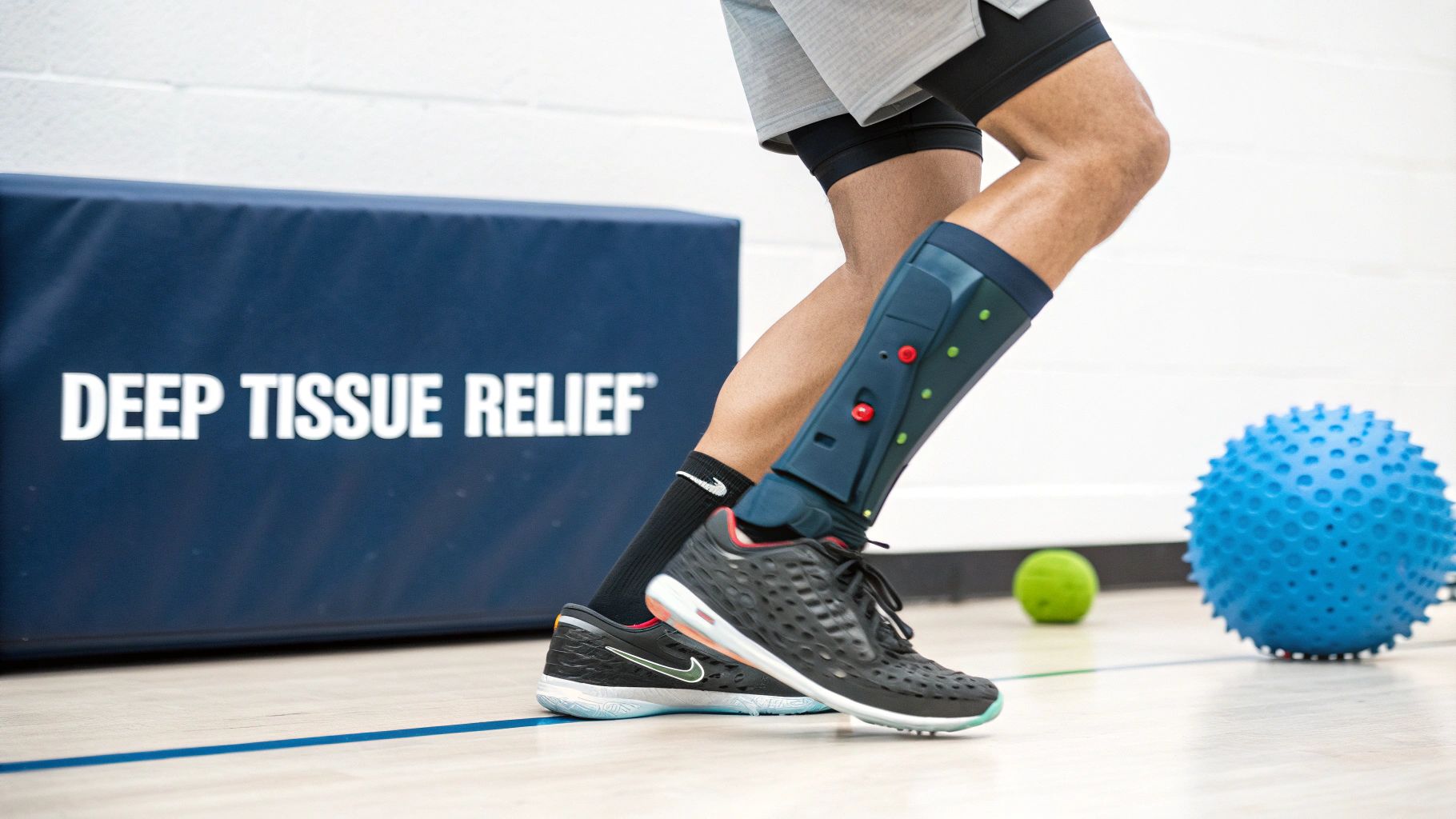
Pneumatic Compression: The Rhythmic Flush
If you’ve ever seen an athlete chilling out in a pair of massive, inflatable boots that seem to be breathing on their own, you’ve witnessed pneumatic compression. These devices—which also come as sleeves for arms and hips—use dynamic air compression to create a powerful, yet gentle, circulatory boost.
The process is surprisingly simple but incredibly effective. Chambers inside the boots inflate and deflate in a sequence, starting at the furthest point (like your foot) and methodically working up toward your core. This creates a rhythmic "milking" action that physically squeezes deoxygenated blood and lymphatic fluid out of your limbs.
This directed pressure helps your body clear out the metabolic junk that makes you sore and tired, making it one of the best recovery tools for athletes after a brutal endurance session or a heavy leg day.
Manual Pressure Tools: Releasing Muscle Knots
While pneumatic compression gives you that fantastic systemic flush, manual pressure tools offer the targeted relief needed to hunt down specific problem areas. These tools are all about self-myofascial release, a fancy term for applying direct pressure to break down painful muscle knots, or adhesions.
Picture your muscle fibers as a bundle of uncooked spaghetti—straight, smooth, and parallel. Intense training can cause some of those fibers to get tangled and "stuck" together, forming a painful knot. Manual pressure tools physically break apart these adhesions, restoring normal movement and getting rid of the pain.
By going after these trigger points directly, you're not just putting a band-aid on the pain. You’re restoring the muscle tissue to its healthy, pliable state, which is crucial for preventing future injuries and maintaining your overall wellness.
These tools are your first line of defense against the tightness that can completely derail a training plan. The key is to use them with slow, controlled movements and to breathe into the discomfort, which helps the muscle finally let go.
Common Manual Pressure Tools and Their Uses
Different tools are built for different jobs. Having a small arsenal of them lets you tackle just about any muscular issue with real precision.
- Foam Rollers: These are the workhorses of myofascial release. They’re perfect for big muscle groups like your quads, hamstrings, glutes, and back. Their wide surface area lets you cover a lot of ground quickly.
- Massage Balls: For pinpoint accuracy, nothing beats a massage ball (a simple lacrosse or tennis ball works great, too). They’re ideal for digging into hard-to-reach spots like the piriformis deep in your glutes, your pecs, or the arches of your feet.
- Percussion Massagers (Massage Guns): These handheld devices deliver rapid, concentrated pulses deep into the muscle. They're fantastic for driving blood flow to a specific area before a workout or for breaking up those extra-stubborn knots afterward. Research shows that percussive therapy can significantly improve short-term range of motion and speed up recovery.
By combining both pneumatic compression for a systemic clear-out and manual tools for targeted release, you create a truly comprehensive pressure-based strategy. This dual approach ensures your body not only clears out metabolic debris efficiently but also maintains the tissue mobility you need for peak performance and injury prevention.
Specialized Therapies for Targeted Recovery
Beyond the world of temperature and pressure, a handful of recovery tools offer incredibly targeted benefits, digging deep into stubborn issues and even working at the cellular level. And while technology gives us some powerful new options, sometimes there's just no substitute for the human touch.
A skilled massage therapist or stretching coach provides something no machine can: diagnostic feedback. They can feel the unique landscape of your muscles, pinpointing those specific imbalances and stubborn knots. This hands-on approach gets to the root cause of pain and immobility, creating a recovery plan that’s truly built for your body.
The Irreplaceable Value of Hands-On Therapies
There's a reason professional massage and assisted stretching are still pillars of athletic recovery. These methods are masters at releasing deep muscle adhesions, improving tissue pliability, and restoring functional movement in ways that are tough to replicate on your own.
The numbers back this up. The global market for fitness recovery services sits at around USD 8.2 billion. By 2025, massage and stretching are expected to make up a whopping 34.2% of that market. That USD 2.8 billion slice of the pie shows just how essential these hands-on therapies are for everyone from weekend warriors to elite pros. You can discover more insights about the fitness recovery market and see where it's headed.
Red Light Therapy: Energizing From Within
Now let’s shift from manual work to cellular repair with red light therapy, also known as photobiomodulation. This non-invasive tech uses specific, safe wavelengths of light that penetrate the skin to give your cells a direct jolt of energy. It’s like giving your body’s internal repair crews a power-up.
Think of the mitochondria in your cells as tiny engines. Red light acts like a high-octane fuel, kicking them into gear to produce more adenosine triphosphate (ATP)—the energy currency for every cell in your body. This surge in cellular energy has a massive impact on workout recovery and wellness.
Red light therapy doesn't just mask symptoms; it works from the inside out. By boosting ATP production at the cellular level, it gives your body the fundamental energy it needs to heal faster, reduce inflammation, and regenerate tissue more effectively.
For an athlete, this delivers a powerful one-two punch of health benefits. First, it helps dial down inflammation by reducing oxidative stress. Second, that extra ATP directly fuels tissue repair, helping you bounce back faster from tough sessions.
While red light therapy zeros in on cellular energy, other specialized tools can support healing on a more systemic level. To see how another advanced modality works, check out our guide covering the benefits of hyperbaric chambers for athletes.
These specialized therapies, from the diagnostic touch of a pro to the cellular boost of red light, offer targeted solutions for complex recovery needs. They are fantastic additions to any athlete's toolkit, perfect for tackling stubborn problems and optimizing healing from the ground up.
How to Build Your Personalized Recovery Stack
Knowing which recovery tools exist is one thing. Knowing how to combine them into a powerful, personalized routine is where you gain a real competitive edge.
The best recovery plan isn’t some one-size-fits-all checklist. It's a strategic "stack" of modalities you build around your specific sport, training intensity, budget, and wellness goals.
Think of it like putting together a custom toolkit. A plumber and an electrician both need tools, but they definitely don't carry the same gear. In the same way, a marathon runner’s recovery needs are worlds apart from a powerlifter’s. The goal is to move past simply collecting gadgets and start intelligently integrating them into a system that actually works for you.
Start With Your Primary Need
First things first: what's your biggest recovery roadblock? Are you constantly fighting off that deep, aching delayed onset muscle soreness (DOMS)? Or is your main battle against joint stiffness and nagging inflammation?
This simple decision tree graphic can help you visualize where to focus your efforts.
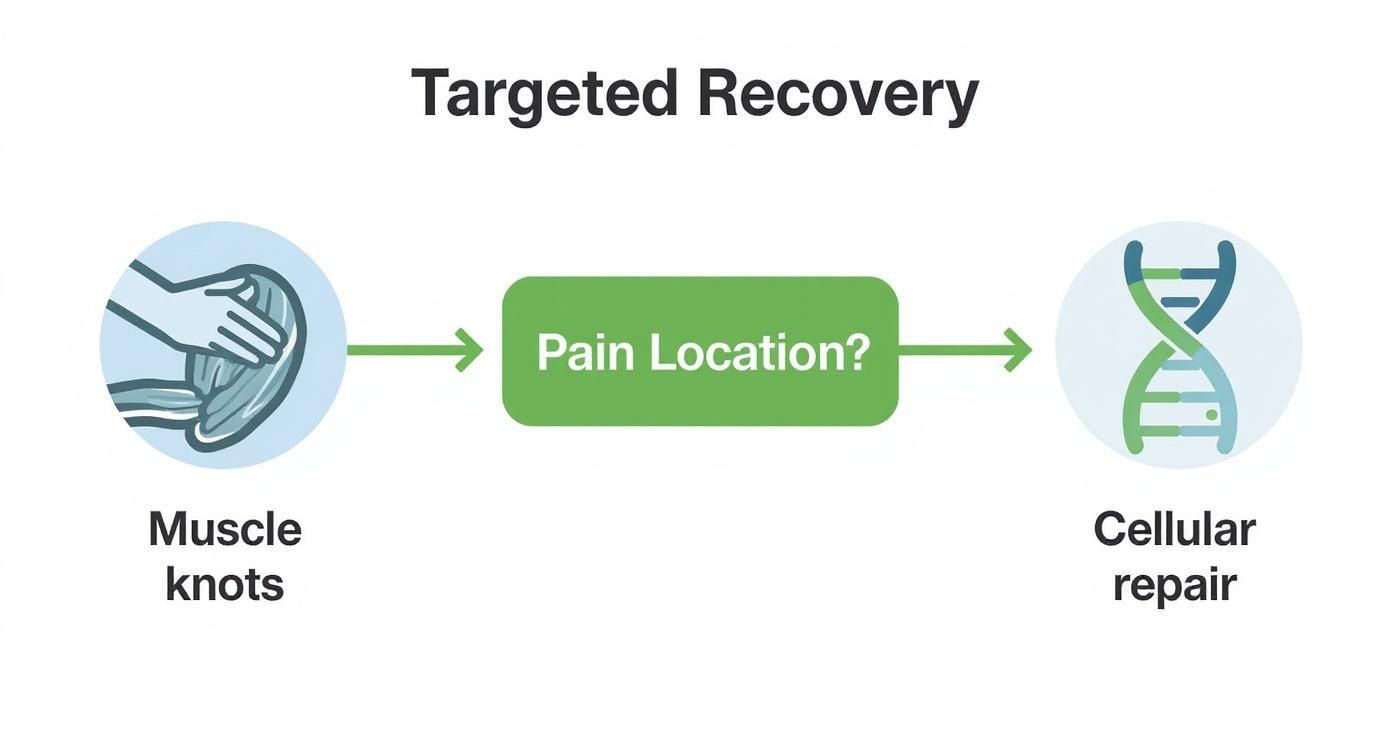
As the chart shows, if you’re dealing with localized muscle knots, direct pressure is your best bet. But for systemic issues like widespread inflammation, you need tools that support repair at a cellular level. Answering this one question sets the entire direction for your strategy.
For example, if you're a weightlifter with deep muscle knots in your back and shoulders, a percussion massager and foam roller should be the cornerstones of your stack. But if you’re a triathlete dealing with systemic inflammation after a grueling session, a cold plunge and pneumatic compression boots are going to give you a much bigger bang for your buck.
Sample Recovery Stacks for Different Athletes
To bring this all to life, let’s look at how a few different athletes might build their ideal recovery stack. Think of these as blueprints you can tweak to fit your own routine.
The Endurance Athlete (Marathon Runner, Cyclist)
- Core Challenge: Systemic inflammation, heavy-legged muscle fatigue, and cellular stress from incredible training volume.
- Foundation: A post-run cold plunge to immediately shut down inflammation, followed by pneumatic compression boots in the evening to flush out metabolic waste from the legs.
- Secondary Tool: A massage ball for targeted release work on the plantar fascia and glutes.
The Strength Athlete (Powerlifter, CrossFit Enthusiast)
- Core Challenge: Central nervous system (CNS) fatigue, deep muscle adhesions, and serious joint stress.
- Foundation: A powerful percussion massager for targeted myofascial release on big muscle groups, combined with regular sauna sessions to boost blood flow and calm the nervous system.
- Secondary Tool: Red light therapy focused on overworked joints like the shoulders and knees to support cellular repair right where it's needed.
Your recovery stack should directly address the primary demands of your sport. Don't just follow trends; choose tools that solve your specific problems.
The Weekend Warrior (Team Sports, HIIT Classes)
- Core Challenge: Acute soreness after sporadic, all-out efforts and general muscle tightness.
- Foundation: A versatile foam roller for all-over muscle maintenance and contrast therapy (alternating hot and cold showers) to manage soreness and inflammation.
- Secondary Tool: Prioritizing active recovery—like a walk or some light stretching—the day after a tough game or workout.
When you start with your unique needs and build from there, you create a recovery system that's not just effective, but sustainable. You don’t need every gadget on the market; you just need the right ones for the job.
Common Questions on Athlete Recovery Tools
Diving into the world of recovery tech can feel overwhelming. Let's clear up some of the most common questions we hear, so you can build a smarter, more effective routine. We'll stick to concise, actionable advice that cuts through the noise.
When Should I Use Recovery Tools After a Workout?
Timing is everything. For tools that tackle acute inflammation, like an ice bath or cold plunge, you want to jump in fast. The sweet spot is within the first one to two hours after your workout to shut down swelling before it really takes hold.
On the other hand, modalities that promote relaxation and blood flow—think compression boots or a good sauna session—are often better used later. Hitting them a few hours post-training, or even on a dedicated rest day, helps soothe muscle soreness and supports system-wide repair without blunting the initial, helpful inflammatory signals your body needs for adaptation.
Can I Stack Different Recovery Tools on the Same Day?
Absolutely. In fact, combining methods is a pro-level strategy. A classic stack is using a massage gun to work on specific muscle knots before slipping into compression boots for a full-system circulatory flush. It's a one-two punch that addresses both targeted tightness and general fatigue.
Just be smart about the order. You generally don't want to follow intense heat with intense cold, or vice-versa, unless you're doing a specific contrast therapy protocol. That structured back-and-forth is designed to create a "pump" effect for your circulation. Always listen to your body.
What Are the Best Budget-Friendly Recovery Tools?
You don't need to break the bank for world-class recovery. Seriously. The most powerful recovery tool on the planet is free: getting 7-9 hours of quality sleep every night. Nothing else even comes close. Staying hydrated is a solid number two.
For your actual toolkit, you can build a fantastic, low-cost setup:
- Foam Roller: The undisputed champ of affordable self-myofascial release. Great for rolling out large muscle groups.
- Lacrosse Ball: Perfect for digging into those deep, stubborn knots in your glutes, shoulders, and feet that a foam roller can't reach.
- Stretching: A consistent routine costs nothing and is foundational for maintaining flexibility and easing muscle tension.
- Cold Showers: It's not a full-blown ice bath, but finishing your shower with a blast of cold water is a great way to reduce a bit of inflammation and fire up your nervous system.
These fundamentals prove that smart recovery is about consistency, not cost.
At MedEq Fitness, we believe professional-grade recovery technology is key to unlocking your true potential. Our curated lineup of science-backed tools—from cold plunge pools to hyperbaric chambers—is designed to help you recover faster and perform better. Explore our collection and build your ultimate recovery stack today at https://www.medeqfitness.com.