Resistance Treadmill: Your Guide to a More Powerful Workout and Enhanced Wellness
Ever hopped on a treadmill and felt like you were just along for the ride? A resistance treadmill flips that script entirely. It's a motorless machine, meaning it's powered entirely by your own effort. You are the engine.
This simple change turns a passive jog into an active, strength-building challenge that engages more muscle, torches more calories, and boosts your overall wellness from the inside out.
Redefining Your Run: What Is a Resistance Treadmill?
Think of it like this: a regular motorized treadmill is an escalator. The belt moves for you, and your job is to simply keep up.
A resistance treadmill is a steep hill. It doesn't move an inch until you push off and drive the belt backward with your own strength.
This is the fundamental shift from passive to active running, and it's what makes these machines so incredibly effective for your health. Since there’s no motor, you're working against a resistance mechanism—usually magnetic, air, or friction-based—with every single stride. Your entire posterior chain (glutes, hamstrings, and calves) has to fire up to get the belt moving, transforming a cardio session into a true power and wellness workout.
You Are The Power Source
It's helpful to see a direct comparison to understand just how different the experience is from standard treadmill exercises. The key difference boils down to power and control.
To get a clearer picture, let's break down the core mechanics of a resistance treadmill versus its motorized counterpart.
Resistance Treadmill vs Motorized Treadmill At a Glance
| Feature | Resistance Treadmill | Motorized Treadmill |
|---|---|---|
| Power Source | 100% user-powered. You move the belt. | Electric motor. The belt moves you. |
| Speed Control | Instant and intuitive. Sprint, jog, or walk by changing your stride. | Manual adjustments via console buttons. |
| Workout Focus | Strength, power, high-intensity intervals (HIIT), and wellness. | Steady-state cardio and endurance. |
| Muscle Activation | High engagement of glutes, hamstrings, and core. | Primarily targets quads and calves. |
Ultimately, the choice comes down to your training goals. Resistance treadmills are built for raw power, intensity, and holistic health benefits, while motorized treadmills excel at controlled, endurance-focused cardio.
This shift in mechanics leads to some massive performance benefits:
- Self-Propelled Motion: You're in complete command. Want to go faster? Push harder and move up the deck. Need to slow down? Just ease up and drift back. The response is instant.
- Increased Muscle Activation: Forcing the belt to move recruits far more muscle fibers, especially the powerful ones in your glutes and hamstrings. This naturally improves your running form and builds functional strength.
- Enhanced Caloric Burn: All that extra work pays off. Studies have shown you can burn up to 30% more calories compared to running at the same speed on a motorized treadmill.
This diagram helps visualize the concept perfectly. On a motorized treadmill, an external engine provides the speed. On a resistance treadmill, you are the engine generating the force.
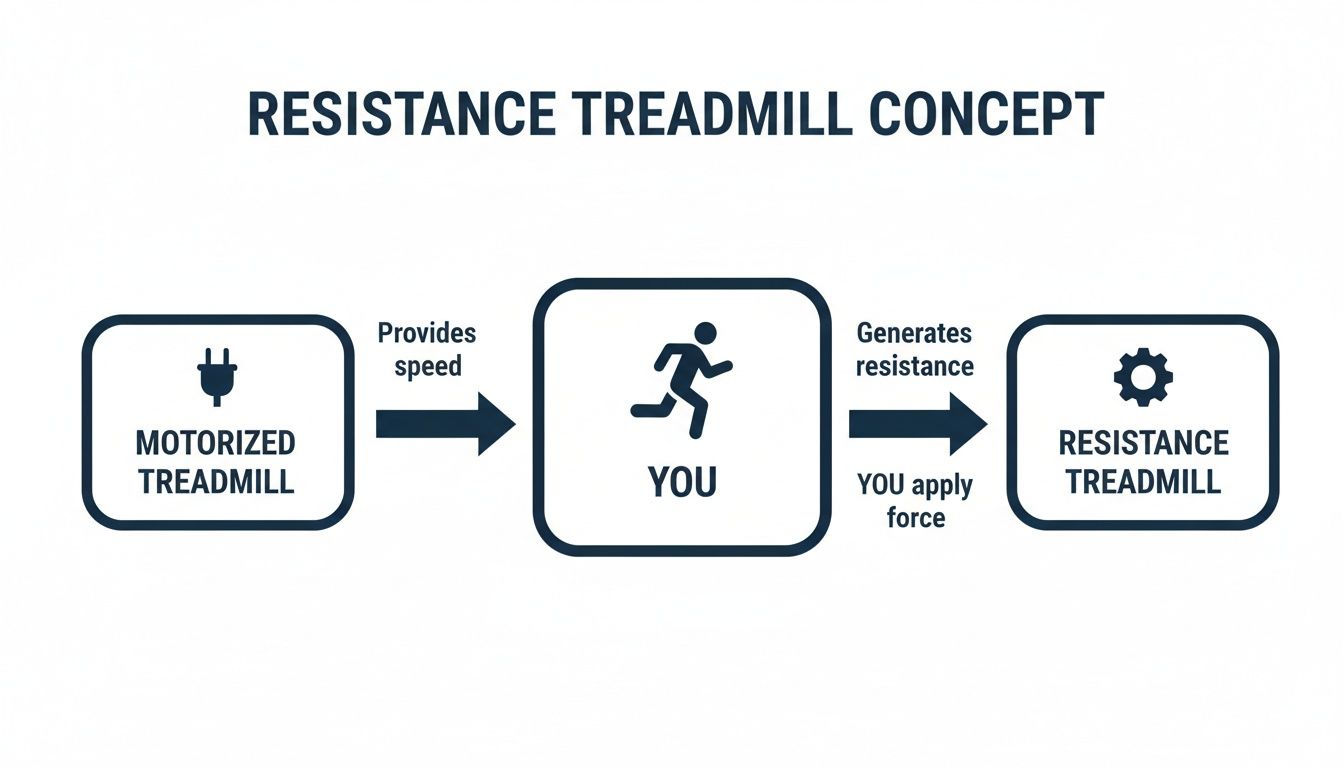
It’s a simple but powerful distinction. With a resistance treadmill, your effort directly translates into output, putting you in the driver's seat of your workout’s intensity.
The Science of a Superior Workout
A workout on a resistance treadmill feels completely different for a simple reason: it is different. You’re no longer just keeping up with a moving belt; you become the engine. This fundamental shift from passive jogging to active running kicks off a chain reaction of physiological benefits that makes every minute on the machine count for your overall wellness. The magic is all in the science of self-propulsion.

To get the belt moving, you have to forcefully drive your legs backward. This single action fires up your posterior chain—all those powerful muscles in your glutes, hamstrings, and calves—in a way a motorized treadmill just can't. On a standard machine, these muscles are mostly along for the ride. Here, they're doing all the work, which is why a resistance treadmill session often feels more like a full-body strength day than a simple cardio jog.
Activating More Muscle for a Greater Burn
This demanding, all-in effort doesn't just build real-world strength; it also torches an incredible amount of energy. By forcing you to overcome inertia with every single step, your body has no choice but to recruit more muscle fibers from head to toe. The result is a much higher metabolic demand.
That extra effort pays off in a big way, directly translating to more calories burned. In fact, user-powered manual resistance treadmills can help you burn 20-30% more calories from self-propulsion alone. It's no surprise they are the fastest-growing treadmill category, projected to grow at a CAGR of 8.2% from 2025 to 2033. They're especially popular with the 40% of consumers who are looking for sustainable, electricity-free fitness equipment.
This heightened calorie burn isn't just a number on a screen. It's proof of a more intense and efficient workout. You're getting more done in less time because your body is working harder from the first step to the last.
The Afterburn Effect and Improved Form
The intensity of a resistance treadmill workout also triggers a powerful "afterburn effect," known in the science world as Excess Post-exercise Oxygen Consumption (EPOC). Put simply, your metabolism stays revved up for hours after you’re done, continuing to burn calories as your body works to recover.
Better yet, the mechanics of powering the belt yourself naturally clean up your running form. The constant need to generate forward momentum encourages a better mid-foot strike and a more upright posture, which can help correct common gait problems. You’ll also develop superior proprioception—your body’s internal GPS for knowing where it is in space. This is critical for improving balance, coordination, and preventing injuries down the road. It’s a complete training stimulus that passive running simply can't match.
For a deeper dive into building functional strength, check out our guide on resistance training powered by you.
Unlock Key Health and Wellness Benefits
Okay, let's move past the science and talk about what this really means for you. The benefits of a resistance treadmill go way beyond just a higher calorie count on a screen. This is about building genuine, functional health and strengthening your body in ways that actually show up in your daily life and athletic goals.
Because you’re the one powering the machine, every workout becomes a full-body wellness session.
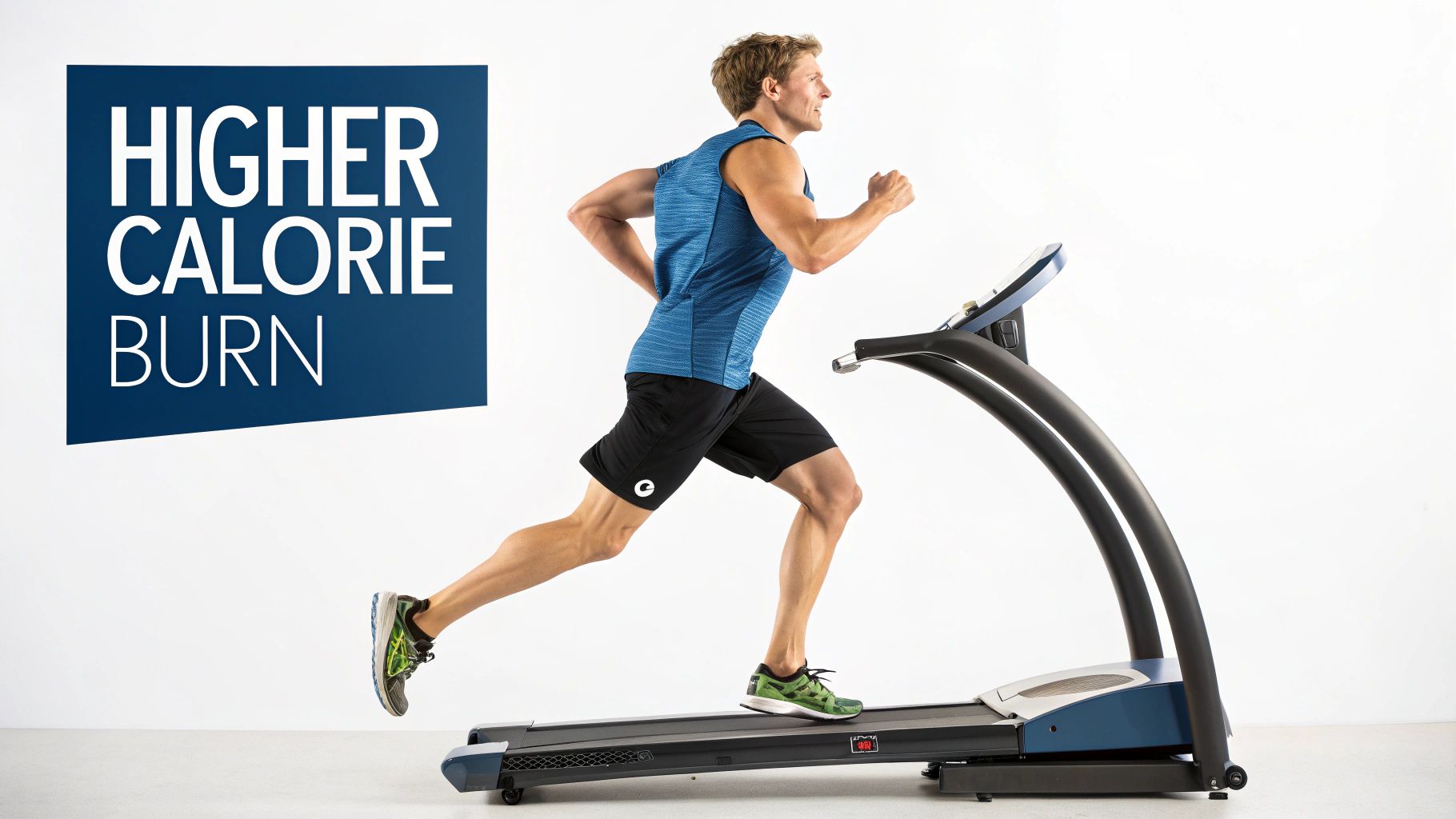
This is where High-Intensity Interval Training (HIIT) gets a serious upgrade. You’re in complete control of the belt’s speed, which means you can go from a dead stop to a full-blown sprint in a single step. There’s no waiting for a motor to catch up. That instant response is perfect for those explosive bursts of effort followed by quick recovery—the exact recipe for supercharging your cardiovascular fitness and overall wellness.
Enhancing Heart Health and Functional Strength
The constant push required to keep that belt moving is a serious challenge for your heart and lungs. Stick with it, and you’ll see significant improvements in your VO2 max, which is basically the top speed of your body's oxygen-processing engine. A higher VO2 max is one of the clearest signs of great cardiovascular endurance and overall health.
But this isn’t just about getting your heart rate up; it’s about building strength that actually matters.
The simple act of driving the belt with every stride is a masterclass in developing functional strength in your glutes, hamstrings, and core. This is the kind of real-world power you use to climb stairs, haul groceries, or explode off the starting line.
Unlike a motorized treadmill where you’re just keeping up, a resistance treadmill workout seamlessly blends strength and cardio. You’re not just running; you’re building a more powerful, resilient, and athletic body with every single step.
This integrated approach doesn't stop at your major muscle groups. It also sharpens:
- Balance and Coordination: You're constantly making micro-adjustments to stay centered on a self-powered belt, which is incredible for your proprioception and stability.
- Metabolic Function: The high-intensity nature of these workouts is fantastic for improving insulin sensitivity and giving your overall metabolic rate a nice boost.
- Joint Health: Many resistance treadmills have a curved deck. This design encourages a more natural mid-foot strike, which can significantly reduce the harsh impact on your knees, hips, and ankles compared to pounding pavement or a flat treadmill.
Smarter Workout Recovery for Better Wellness
Let's be real: these workouts are intense. Because you're recruiting more muscle and pushing yourself harder, recovery becomes absolutely critical. Learning how to manage muscle soreness is the key to staying consistent and making progress. A smart recovery plan is a cornerstone of any effective wellness routine.
For anyone new to this level of training, figuring out your post-workout routine is essential. You can get a head start by reading our guide on how to reduce muscle soreness after intense exercise. One powerful technique is contrast therapy, which involves alternating between hot and cold temperatures (like a hot shower followed by a cold rinse). This process can help flush out metabolic waste, reduce inflammation, and speed up muscle repair, getting you ready for your next session faster.
By pairing these powerful workouts with smart recovery, you’re not just getting fitter—you’re building a more robust and capable body, ready for whatever you throw at it.
Why The Pros Swear By Resistance Treadmills
It's not just home gym enthusiasts getting excited about resistance treadmills. These machines are popping up everywhere, from elite sports performance labs and physical therapy clinics to high-end wellness centers. When professionals put their trust in a piece of equipment, it’s because it delivers real, reliable results in the most demanding settings.
A big reason for this is the motorless design. In a busy commercial gym, that’s a massive plus. With no engine to burn out and no complex electronics to glitch, these treadmills are built like tanks and barely need any maintenance. This means they can handle back-to-back HIIT classes or the daily grind of athlete conditioning without the constant fear of breakdowns and expensive repairs.
The Go-To Tool for Rehab and Recovery
In the clinical world, a resistance treadmill can be a total game-changer for rehabilitation and physical wellness. Physical therapists love them because the user-powered design helps patients recover safely and effectively. The ability to control your own speed and resistance with natural movement is everything.
Imagine someone rebuilding strength after surgery. The treadmill lets them take slow, deliberate steps that fire up stabilizing muscles without the jarring, unnatural pull of a motorized belt. This controlled environment is perfect for:
- Fixing Gait Mechanics: Patients can relearn a proper walking or running pattern entirely at their own pace.
- Safely Building Strength: The resistance helps strengthen leg muscles and improve coordination without any risk of the belt running away from them.
- Speeding Up Recovery: By allowing for controlled, weight-bearing exercise sooner, therapists help patients get their mobility and confidence back faster.
Proving Their Worth in Commercial Fitness
The commercial fitness industry is definitely catching on, with a huge swing towards these versatile resistance models. The commercial segment was valued at a massive USD 5.9 billion in 2024 and is expected to grow at a CAGR of 8.1% through 2033. To put it in perspective, back in 2022, multifunctional resistance treadmills were the top pick in 62.3% of new commercial gym setups. Their adaptability for both elite athletes and dynamic group classes makes them a no-brainer. You can dive deeper into these numbers in this commercial treadmill market report from Future Data Stats.
When elite trainers and medical professionals both choose the same piece of equipment, it’s the ultimate endorsement. Their reliance on the resistance treadmill speaks volumes about its effectiveness, durability, and ability to deliver tangible results—whether for hitting peak performance or rebuilding foundational health.
This trust from the pros should tell you everything you need to know about the value a resistance treadmill can bring to anyone serious about their fitness. To explore more ways to elevate your health, check out our MedEq Wellness Journal.
Your First Resistance Treadmill Workouts
Ready to see what a resistance treadmill can really do for your health and wellness? The beauty of these machines is that you're in total control from the first step. The trick is to start with the basics, get a feel for the self-propelled motion, and then you can start pushing the intensity.
These workouts are designed to get you started, no matter your fitness level. Just remember to focus on your form: keep your chest up, brace your core, and use your legs to drive that belt.
Beginner Endurance Walk
This is the perfect starting point for your first few sessions. The whole idea is to build confidence and get comfortable maintaining a steady, controlled pace.
- Warm-up: Start with a slow 3-minute walk. Really concentrate on the feeling of pushing the belt with every step.
- Main Set: Settle into a consistent, moderate walk for 15-20 minutes. You should be able to hold a conversation without getting too breathless.
- Cool-down: Ease off with a slow 2-minute walk to let your heart rate come down naturally.
Intermediate Fat-Burning HIIT
Once you've got the hang of it, High-Intensity Interval Training (HIIT) is where this machine becomes a total game-changer. The belt responds instantly, making it perfect for those all-out bursts of effort.
- Warm-up: 5 minutes of light walking, slowly picking up the pace.
-
HIIT Protocol: Go through this cycle 8-10 times:
- 30 seconds: All-out sprint. Drive hard with your legs and pump your arms.
- 60 seconds: Slow recovery walk. Use this time to catch your breath.
- Cool-down: 5 minutes of easy walking to help flush out any lactic acid.
Advanced Power Sled Push
This one is for the advanced user. It mimics a heavy sled push—an incredible way to build explosive power and raw strength in your lower body. You'll want to grip the front handlebars and lean into it.
Grab the stationary front handlebars, drop into an athletic stance, and drive the belt with powerful, deliberate steps. Speed isn't the goal here; it's all about generating maximum force with each push. You’re turning the treadmill into a pure strength-building tool.
- Warm-up: A light 5-minute jog.
-
Main Set: Perform 5 rounds of the following:
- 45 seconds: Sled Push. Focus on pushing as hard as you can.
- 90 seconds: Complete rest. Step completely off the treadmill.
- Cool-down: 3-5 minutes of slow, easy walking.
Don't Forget Workout Recovery
Workouts this demanding mean recovery is non-negotiable if you want to make progress and stay injury-free. A proactive approach to workout recovery is a vital part of a holistic wellness strategy. One of the most effective techniques you can add to your routine is contrast therapy.
It's as simple as it sounds: you alternate between hot and cold exposure after your workout. Think switching between a hot shower and a cold shower, or a sauna and a cold plunge. This rapid temperature change causes your blood vessels to constrict and then dilate, creating a "pump" that helps flush out metabolic waste and reduce muscle soreness. This graphic shows how it works.
Getting the most out of your resistance treadmill training means your recovery has to be as intentional as your workout. Implementing essential post-workout recovery tips is just as critical as the work itself. For more wellness insights, visit our blog at https://medeqfitness.com/blogs/medeq-wellness-journal.
How to Choose the Right Resistance Treadmill
Shopping for a resistance treadmill can feel a bit like navigating a maze, but it all gets simpler when you know what to look for. The trick is to match the machine's features to your specific goals, whether you're outfitting a home gym, training elite athletes, or managing a wellness clinic. You want a treadmill that works for you, not one you have to fight against.
Before you even start comparing models, let's nail down the most important decision: the resistance mechanism. Each type completely changes the feel of the workout and the control you have over it.
Resistance Types: Magnetic vs. Air
The two main players here are magnetic and air resistance. Magnetic systems give you a smooth, quiet, and incredibly consistent drag that you can dial in manually. This makes them perfect for anyone who wants precise control for steady-state cardio or heavy, grinding sled pushes.
Air resistance, on the other hand, is all about dynamic response. The faster you run, the more resistance the fan blades create. This is the sweet spot for high-intensity interval training (HIIT) because the machine instantly scales with your effort. The trade-off? They tend to be a bit louder. For a deeper dive into these systems, check out our comparison of manual vs. electric treadmills.
Curved vs. Flat Belt Design
Next up is the shape of the deck itself. The curved treadmill is what most people picture when they think of self-powered models. Its ergonomic arc naturally encourages a better running form, promoting a mid-foot strike that can be a lot kinder to your joints. That curve also helps pull the belt along as you move, making it intuitive to speed up or slow down just by shifting your weight.
Flat-belt manual treadmills are less common but serve a different purpose. They often feel more like you're pushing a weighted sled from a dead stop, demanding a ton of force to get going. This makes them incredible tools for building raw, explosive power.
Ultimately, choosing between a curved or flat deck is a matter of training style. A curved deck is built for better running mechanics and smooth speed transitions, while a flat belt is king for brute-force strength conditioning.
Key Features to Look For
Finally, let's talk about the nuts and bolts. A few key features can make or break your experience.
- Build Quality and Footprint: Look at the weight capacity and frame. A solid steel frame that doesn't wobble is a sign of durability. Just as important, pull out the measuring tape and make sure it will actually fit in your space.
- Handlebar Design: Multi-grip handlebars are a huge plus. They give you different hand positions for stability, whether you're walking, sprinting, or leaning into a heavy push.
- Digital Display: At a minimum, you want a simple console that tracks time, distance, speed, and calories. Some higher-end models will throw in Bluetooth connectivity and more granular performance data.
The entire treadmill market is booming, with some analysts projecting it will hit USD 7.2 billion by 2035. Resistance models are a huge part of that trend, especially as smart tech finds its way into more machines—a full 35% of new installations now come with interactive displays. You can find more details in this global treadmill market analysis.
Got Questions? We've Got Answers
Thinking about bringing a resistance treadmill into your gym or home? You probably have a few questions. Let's clear them up so you can feel good about your decision.
Are They Actually Better for Weight Loss?
Yes, they're a fantastic tool for it. Since you're the one powering the belt, you fire up more muscles and can torch up to 30% more calories than you would on a motorized treadmill doing a workout of the same length. This high-intensity effort not only supports weight loss but also enhances your overall metabolic health.
Can a Beginner Handle a Resistance Treadmill?
Absolutely. It might seem intimidating, but you are always in total control. The belt only moves when you do, and it stops when you stop.
You can start with a slow, deliberate walk to get the feel of it. The machine literally can't get away from you, which makes it a surprisingly safe and accessible starting point for any fitness level and a great tool for building confidence.
The key takeaway is that the user dictates the intensity. The treadmill won't run away from you, making it a surprisingly safe option for those just starting their fitness journey.
Are These Things Loud or a Pain to Maintain?
Nope, they're typically much quieter. With no motor humming away, the only real sound is your feet on the belt.
Maintenance is a breeze, too. It usually just comes down to a simple wipe-down and maybe lubricating the belt once in a while. Fewer moving parts means fewer things can break.
For more wellness tips and deep dives into fitness tech, check out the MedEq Wellness Journal at https://medeqfitness.com/blogs/medeq-wellness-journal.