manual treadmills vs electric: Best option for your health and wellness goals
The biggest difference between a manual treadmill and an electric one boils down to a single question: who's in charge of your wellness journey? You, or the machine?
Manual treadmills are entirely self-powered. It’s your body, your effort, and your stride that moves the belt. This creates an incredibly raw, natural-feeling workout focused on functional strength and metabolic health. On the flip side, electric treadmills rely on a motor to drive the belt at a consistent speed you set, giving you a structured, predictable training session perfect for sustained cardiovascular health and controlled workout recovery.
Choosing Your Ideal Treadmill for Home Fitness
Picking the right treadmill is a significant step in your wellness journey. It’s not just about a piece of equipment; it’s about choosing a partner for your health. The machine you select will shape your workouts, your motivation, and ultimately, your physical and mental well-being. This guide is here to help you understand which one truly aligns with your training style and long-term health benefits.
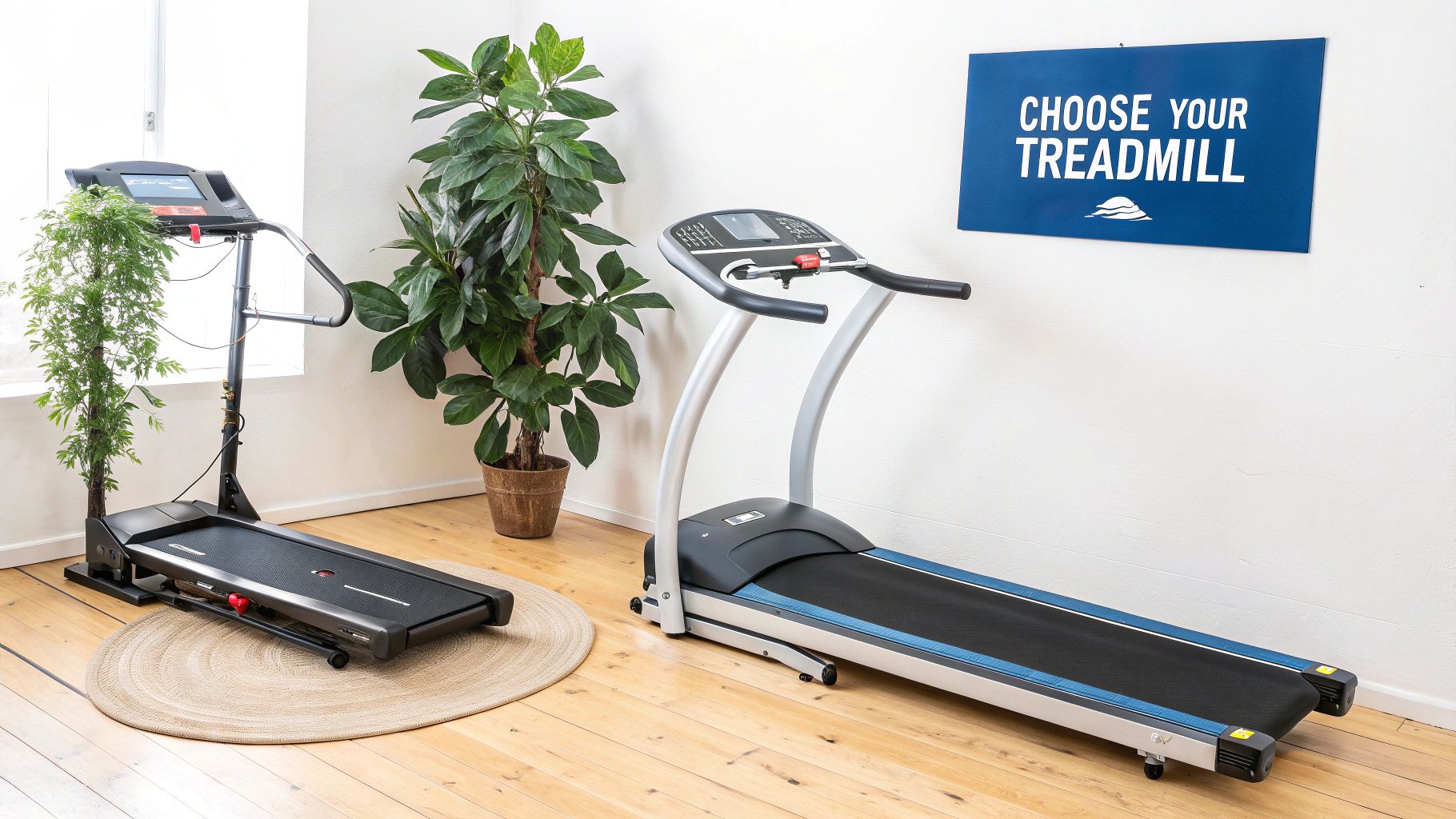
Whether you’re a competitive athlete chasing explosive power or looking for a joint-friendly way to improve your heart health, there’s a perfect treadmill for you. It all starts with understanding their core differences and how they contribute to your overall wellness. For more insights, visit our MedEq Wellness Journal.
Foundational Differences in Design and Function
The most glaring distinction is the power source. A manual treadmill, like the self-powered MedEq R900 Curved Manual Treadmill, is driven entirely by your own physical output. You push, it moves. This design forces you to fire up your entire posterior chain—glutes, hamstrings, and calves—which often leads to a much higher calorie burn and greater functional strength.
Electric treadmills, however, create a controlled and predictable environment. You dial in the speed and incline, and the machine takes over, keeping you at a steady pace. This makes them fantastic for building cardiovascular endurance, managing heart rate for optimal health benefits, and supporting specific workout recovery protocols where consistency is key.
Key Takeaway: Your choice really comes down to your wellness philosophy. Manual treadmills put you in the driver's seat for raw, effort-based workouts that build functional health. Electric models offer a structured, feature-rich experience for hitting precise cardiovascular and recovery targets.
The table below breaks down the key characteristics of each type, which will set the stage for a deeper dive into how they impact performance, health, and workout recovery.
| Feature | Manual Treadmill (Curved) | Electric Treadmill |
|---|---|---|
| Power Source | Self-propelled (user-powered) | Motorized (AC/DC motor) |
| Speed Control | Instantaneous; controlled by user effort | Button-controlled; consistent pace |
| Primary Health Focus | HIIT, metabolic health, functional strength | Cardiovascular endurance, joint protection |
| Muscle Engagement | Higher; activates posterior chain | Lower; motor assists movement |
| Workout Feel | More natural, mimics outdoor running | Controlled and cushioned |
Ultimately, one type emphasizes pure athletic output and metabolic demand, while the other excels at providing a stable platform for sustained effort and safe, guided recovery. As we dig deeper, you'll see how these distinctions affect everything from your biomechanics to your long-term wellness.
How Each Treadmill Impacts Your Body and Health
Choosing between a manual and electric treadmill is about more than just preference—it’s a decision that fundamentally changes how your body moves, which muscles you use, and the long-term impact on your joints. Getting this right means matching the machine’s biomechanics to your specific health and wellness goals, whether you’re chasing peak performance or simply aiming to protect your knees and boost heart health.

Manual treadmills, particularly the curved ones, work on one simple rule: you are the engine. This self-propelled design forces you to drive the belt with every step, lighting up your posterior chain—glutes, hamstrings, and calves. The health benefit? A workout that burns up to 30% more calories at the same speed as an electric model and builds real-world functional strength.
This user-powered mechanic also naturally refines your running form. The subtle curve of the deck encourages a midfoot or forefoot strike, reducing the jarring impact on your joints that often comes from over-striding. This leads to a healthier, more sustainable running gait.
Fostering Functional Strength and Natural Movement
The constant demand to generate force on a manual treadmill builds functional strength that translates to everyday life, improving balance, coordination, and power. You control the pace entirely, sharpening your neuromuscular coordination and body awareness.
This is a stark contrast to an electric treadmill, where the motor assists your movement. The moving belt takes some of the propulsive burden off your muscles. That’s not a flaw—it's a feature designed for a different wellness goal.
The real difference in body impact comes down to control versus support. A manual treadmill demands higher muscle activation for building strength, while an electric treadmill provides a controlled, low-impact platform for sustained cardio and safe workout recovery.
Protecting Joints and Supporting Workout Recovery
When it comes to joint health, the cushioned deck on a quality electric treadmill is its standout wellness feature. The combination of a multi-layer belt and advanced shock absorption is designed specifically to reduce stress on your ankles, knees, and back.
This makes electric models the clear winner for:
- Long-duration cardio: Running for extended periods is more comfortable and sustainable, promoting excellent heart health.
- Individuals with joint sensitivity: Anyone managing arthritis can exercise with more confidence and less pain.
- Active workout recovery: A slow, controlled walk on a cushioned deck is perfect for promoting blood flow to sore muscles without adding stress, accelerating healing.
This emphasis on shock absorption is non-negotiable for long-term joint wellness. While a manual treadmill can improve your mechanics, the forgiving surface of an electric machine is invaluable if you're prioritizing joint preservation or rehabbing an injury.
The Role of Contrast Therapy in Advanced Wellness and Recovery
For athletes and fitness enthusiasts aiming to optimize workout recovery, integrating both treadmills through contrast therapy offers significant health benefits. This method involves alternating between high-intensity and low-intensity work to stimulate circulation and speed up muscle repair.
Here’s a sample protocol:
- High-Intensity Burst: A 60-second sprint on a manual curved treadmill to spike heart rate and recruit maximum muscle fibers.
- Active Recovery: Immediately switch to an electric treadmill for a slow, steady walk (around 2.0 mph) for 2-3 minutes. This allows your heart rate to come down while flushing metabolic byproducts from your muscles.
This advanced technique leverages the manual treadmill’s explosive potential and the electric model’s gentle, controlled environment to enhance both performance and workout recovery. It's a powerful way to push your limits while actively helping your body heal. For a deeper dive into recovery science, check out the MedEq Wellness Journal.
Comparing Training Performance and Workout Outcomes
When it comes to the nitty-gritty of your workouts, the differences between manual and electric treadmills are night and day. This isn't just about a motor versus your own two feet; it's about how each machine fundamentally shapes your training and, ultimately, your health outcomes. One is built for raw, explosive power, while the other is the master of controlled, steady-state endurance.
Choosing the right one means matching the machine's core mechanics to what you want to achieve for your wellness.
There’s a clear reason why self-powered machines are gaining so much traction. The global manual treadmills market was valued at around USD 1.3 billion in 2023 and is on track to hit USD 2.5 billion by 2032. This reflects a growing recognition of their unique performance and health benefits.
The Manual Treadmill: Built for Explosive Power and HIIT
If your workouts revolve around high-intensity interval training (HIIT), the manual curved treadmill is in a league of its own. You are the motor. That means your speed changes are instantaneous—you can go from a dead stop to a full-blown sprint in a single, powerful step.
This immediate responsiveness is perfect for metabolic conditioning. Trying to nail a Tabata protocol (20 seconds on, 10 seconds off) is nearly impossible on an electric model. On a manual, the timing is all you.
Consider this wellness application:
- The Athlete: A functional fitness competitor looking to boost anaerobic threshold for better overall health and performance.
- The Workout: They use a curved treadmill for 8 rounds of 30-second max-effort sprints followed by 60 seconds of slow walking.
- The Health Benefit: The machine demands maximum power from the glutes and hamstrings, improving explosive output and conditioning the body's metabolic systems for rapid bursts of energy.
A manual treadmill provides an unfiltered workout. Your output is a direct measure of your effort, making it the ultimate tool for pushing your metabolic limits in short, intense bursts for maximum health benefits.
The Electric Treadmill: The Champion of Structured Endurance
On the flip side, an electric treadmill is all about control and consistency. The motorized belt holds a perfect, unwavering pace, which is exactly what you need for building cardiovascular endurance. If your plan calls for holding a specific heart rate zone for an hour, an electric treadmill executes it flawlessly.
This precision is a game-changer for anyone training for long-distance events or focusing on heart health. You can program exact paces or simulate rolling hills with automated incline changes, allowing you to build specific muscular endurance and mental grit in a safe, controlled manner.
Here's a health-focused example:
- The Runner: A marathoner training for a race, focused on building sustained cardiovascular health.
- The Workout: They set their electric treadmill to their target race pace and run a pre-programmed workout that mimics the race's elevation profile.
- The Health Benefit: The runner builds endurance at a consistent effort level, strengthening their heart and lungs while systematically preparing their legs for the climbs.
Deciding between the two really comes down to what you're trying to accomplish for your wellness.
Manual vs Electric Treadmill Suitability for Health Goals
| Health & Training Goal | Manual Treadmill Suitability | Electric Treadmill Suitability | Key Reason |
|---|---|---|---|
| HIIT & Metabolic Health | Excellent | Poor | Manual treadmills allow for instant speed changes, critical for effective interval training and boosting metabolism. |
| Cardiovascular Endurance | Fair | Excellent | Electric treadmills maintain a precise, consistent pace, ideal for long-duration, heart-healthy workouts. |
| Functional Strength | Excellent | Fair | The self-powered nature of a manual treadmill forces maximum muscle recruitment, building real-world strength. |
| Pace & Heart Rate Control | Poor | Excellent | Electric treadmills let you lock in a specific speed, perfect for training in target heart rate zones. |
| Active Workout Recovery | Good | Excellent | Electric models offer very slow, controlled speeds perfect for promoting blood flow without adding stress. |
| Joint Protection | Fair | Excellent | The cushioned decks of electric treadmills provide superior shock absorption, protecting joints during exercise. |
| General Wellness | Good | Good | Both are effective; the choice depends on whether you prefer interval-based or steady-state workouts for your wellness routine. |
Ultimately, this table shows there's no single "best" option—only the best option for your specific health and wellness needs. For more articles on achieving your fitness goals, visit the MedEq Wellness Journal.
Cost, Upkeep, and Living With Your Treadmill
Beyond specs and workout data, the day-to-day reality of owning a treadmill is what really matters for your wellness journey. The initial price, ease of use, and upkeep will decide if it becomes a core part of your routine or a very expensive coat rack. This is where practical differences between manual and electric models really show.
Electric treadmills are famous for their plug-and-play simplicity. You hit a button, pick a speed, maybe adjust the incline, and you're off. This direct, no-fuss operation is perfect for beginners or anyone who wants a straightforward, guided workout without a learning curve.
Manual treadmills ask for a little more from you upfront. It takes a few runs to get the feel for propelling the belt yourself. But once you find that rhythm, it's incredibly intuitive and feels like a natural extension of your body's own movement.
Breaking Down the Total Cost of Ownership
The price tag is just the first chapter. To understand the true cost, you have to look at the entire life of the machine. When you do, manual treadmills start to look like a much smarter financial move.
- Initial Investment: A high-quality curved manual treadmill often costs more than a basic electric model, but its price is right in line with premium, gym-quality motorized units.
- Electricity Consumption: Here's the big one. Manual treadmills use zero electricity. That means every run is free. An electric treadmill's motor can make a real dent in your utility bill.
- Repair Costs: Simpler machines break less often. With no motor, electronics, or complex wiring, manual treadmills have far fewer parts that can fail, keeping repair costs to a minimum.
The total cost of ownership for a manual treadmill is almost always lower over time. You’re not paying for electricity or expensive repairs, which means any higher upfront cost pays for itself in the long run.
Maintenance and Long-Term Durability
The story is similar when it comes to maintenance. The minimalist design of a manual treadmill makes upkeep a breeze. You’ll mostly just need to wipe it down and maybe check the belt tension once in a while. That's it.
Electric treadmills need more love to keep running smoothly. Their motors and complex systems require regular attention, including:
- Lubricating the deck to keep the belt moving freely.
- Routinely checking and tightening bolts and hardware.
- Keeping the motor housing clear of dust and debris.
These tasks aren't difficult, but they are necessary. And if a major part like the motor or control board gives out, you're looking at a pricey call to a technician. The rugged, simple build of a manual treadmill just makes it a more resilient, low-maintenance partner for the long haul.
Usability and Practical Home Considerations
In a home gym, every square foot counts. Electric treadmills tend to be bigger, heavier, and need to be parked near an outlet. Their impressive tech features are a major reason for their popularity—in fact, the electric treadmill market is expected to grab a massive 67.79% market share globally by 2025, driven by demand for things like touchscreens and automatic incline. You can read more about these trends in this report from Fortune Business Insights.
But manual models are often built for real-world home use. They’re typically lighter, more compact, and since they don't need a plug, you can put them anywhere. That kind of flexibility is a huge win for anyone working with limited space. For more insights on building a wellness-focused space, check out our MedEq Wellness Journal.
Applications in Rehabilitation and Workout Recovery
When your goal shifts from chasing a personal best to careful, deliberate workout recovery, the choice between a manual or electric treadmill becomes absolutely critical. These machines are specialized tools for healing, each fitting a different recovery philosophy and offering distinct health benefits.
The Clinical Standard: Electric Treadmills
Electric treadmills have long been the go-to in physical therapy and cardiac rehab for one simple reason: control. A therapist can dial in a precise speed, a specific incline, and a set duration, creating a perfectly safe and repeatable environment for a patient. This predictability is non-negotiable for tracking progress and ensuring safety.
The ability to maintain very slow, consistent speeds is a game-changer for health and wellness. It allows for gentle mobilization that promotes blood flow and keeps muscles active without putting stress on healing tissues, which is key for effective workout recovery.
Manual Treadmills and Athlete Workout Recovery
On the flip side, manual treadmills—especially curved models—are making a name for themselves in sports performance and athletic rehab. Their self-powered design forces active engagement of the posterior chain (glutes and hamstrings), which does wonders for promoting a natural, powerful gait and rebuilding functional strength after injury.
Because the belt only moves when you push it, it's nearly impossible to over-stride, a classic cause of running injuries. This forces athletes into better posture and a more efficient foot strike, making it an incredible tool for functional rehab where the goal is returning to sport-specific movements safely.
Key Insight: For workout recovery, think of it this way: electric treadmills offer a controlled, supportive environment perfect for clinical rehab and gentle recovery. Manual treadmills provide a raw, responsive tool for rebuilding natural biomechanics and functional strength.
Using Both for Advanced Workout Recovery Protocols
The most innovative recovery programs don't pick one or the other—they use both. A really effective strategy is contrast therapy, where you alternate between high and low-intensity efforts to supercharge the recovery process. An athlete might do a short, explosive sprint on a manual treadmill, then immediately step onto an electric treadmill for a slow, controlled cool-down walk.
This approach gives you the best of both worlds for your health:
- Manual Treadmill: Perfect for quick, intense bursts that boost your metabolic rate and recruit fast-twitch muscle fibers.
- Electric Treadmill: Provides a gentle, low-impact zone for active workout recovery, helping to flush out lactic acid and ease muscle soreness.
Dealing with post-workout aches is fundamental to any smart training plan. If you're looking to really dial in your recovery, we've got detailed strategies in our guide on how to reduce muscle soreness. The right equipment, combined with solid recovery science, is what lets you train hard and bounce back even faster.
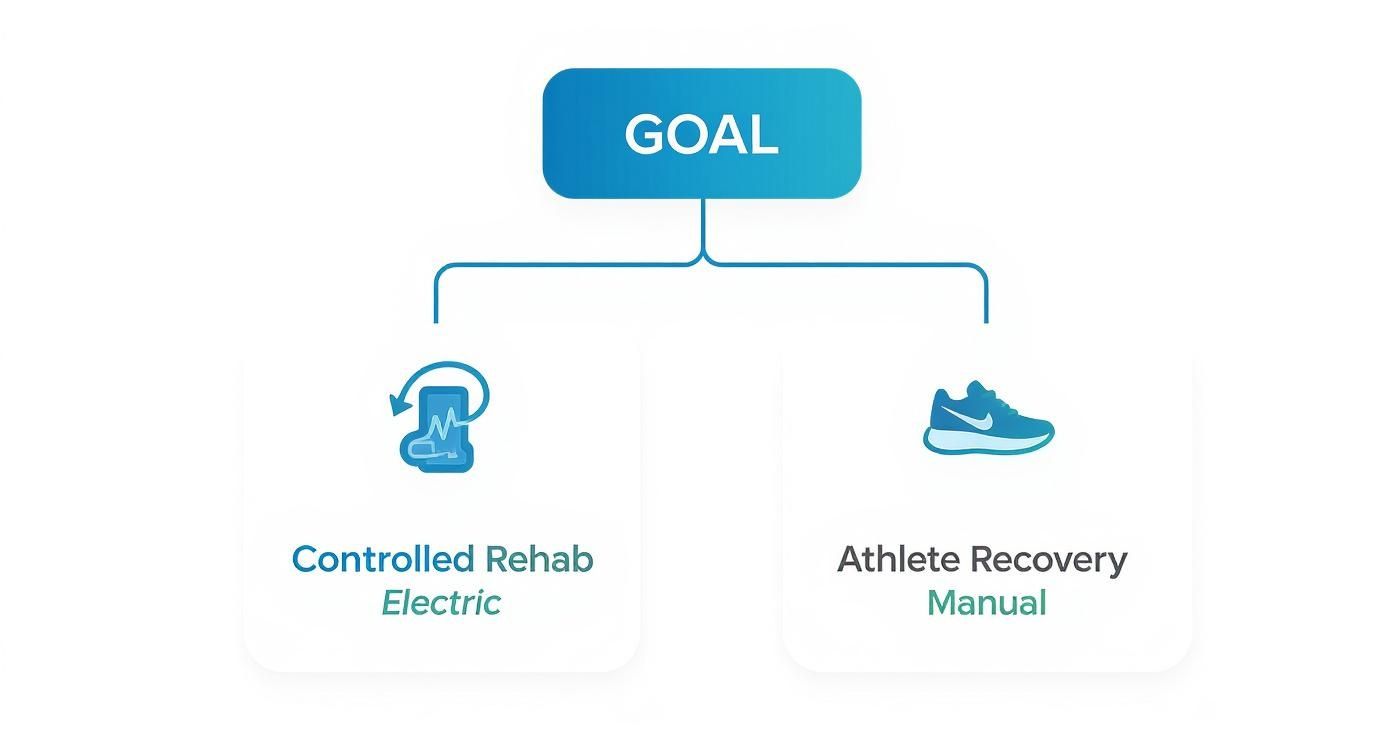
Ultimately, the right choice in a rehab or workout recovery setting comes down to the mission. For controlled, measurable progress, the electric treadmill is king. But for rebuilding functional power and refining movement patterns, the manual treadmill offers a unique, powerful advantage.
So, Which Treadmill Is Right for You?
The whole manual vs. electric treadmill debate boils down to one simple question: which machine fits your body, your wellness goals, and your life? It’s not about finding the "best" treadmill out there, but the best one for you.
Let's cut through the noise and get specific. Instead of broad comparisons, think about your primary training style and health objectives. Once you identify which of these profiles sounds most like you, the right choice becomes a lot clearer.
Matching the Machine to Your Wellness Mission
Your workout style is the single most important factor. See where you fit in.
-
The HIIT Athlete: If your training is all about explosive sprints followed by recovery, the manual curved treadmill is a no-brainer. Its motorless design responds instantly, providing a powerful metabolic conditioning health benefit that you just can't get without the lag of a motor.
-
The Marathon Trainer: If you’re logging serious miles and focused on cardiovascular endurance, the electric treadmill is your workhorse. It delivers the unwavering consistency you need to lock into a specific pace and hold it for miles, building heart and lung strength effectively.
-
The Active Senior or Rehab Patient: Here, it’s all about safety, control, and joint protection. The electric treadmill provides a stable, predictable surface with great cushioning. It's the perfect tool for building strength and cardiovascular health with total confidence.
Be honest about your main wellness goal—whether it's explosive power, steady endurance, or safe mobility. When you do, you align the machine’s core strengths with your personal wellness vision.
To dig deeper into advanced recovery techniques and other wellness topics, explore our insights on the MedEq Wellness Journal.
Frequently Asked Questions
When you're trying to decide between a manual treadmill and an electric one, a few common questions always seem to pop up. Let's clear the air so you can feel confident about which machine is right for your health and wellness.
Are Manual Treadmills Better For Weight Loss?
They can be, especially if your goal is to burn fat quickly. Because you're the engine, a manual treadmill forces more of your muscles to get involved, which can seriously ramp up your calorie burn. This makes them perfect for high-intensity interval training (HIIT), one of the best ways to improve metabolic health and torch calories.
But remember, the best tool for weight loss is the one you actually stick with. Electric treadmills make it easy to settle in for longer, steady-state cardio sessions. Those workouts are also fantastic for creating the consistent calorie deficit you need to see results over time.
Can You Walk On a Curved Manual Treadmill?
Absolutely. People think of them as sprinting machines, but curved treadmills deliver a fantastic walking workout that really elevates the wellness benefits.
The self-propelled design makes you actively engage your glutes and hamstrings way more than you would on a motorized belt. You’re in total control of every single step, turning a simple walk into a surprisingly tough workout that builds functional strength and improves balance.
The real difference is how much you have to work. Walking on a curved treadmill is an active, muscle-building exercise for overall wellness. Walking on an electric treadmill is more of a controlled, low-impact activity, great for steady cardio or gentle workout recovery.
Is an Electric Treadmill Safer For Beginners?
For most people just starting out, yes. The controlled environment of an electric treadmill offers a much safer entry point for anyone new to fitness, older adults, or people working on their balance.
The key health and safety benefits are predictability:
- Consistent Speed: The motor keeps the pace steady, so there are no surprises.
- Supportive Handrails: You have sturdy handrails to grab onto for stability.
- Emergency Stop: The safety key lets you shut everything down instantly if you need to.
This setup helps build confidence by letting you focus on your form and breathing without also having to manage the belt speed. It’s the ideal platform for getting comfortable and making progress safely. For more tips on building a solid fitness routine, check out the MedEq Wellness Journal.