Red Light Therapy Before or After Workout: Best Timing for Peak Wellness
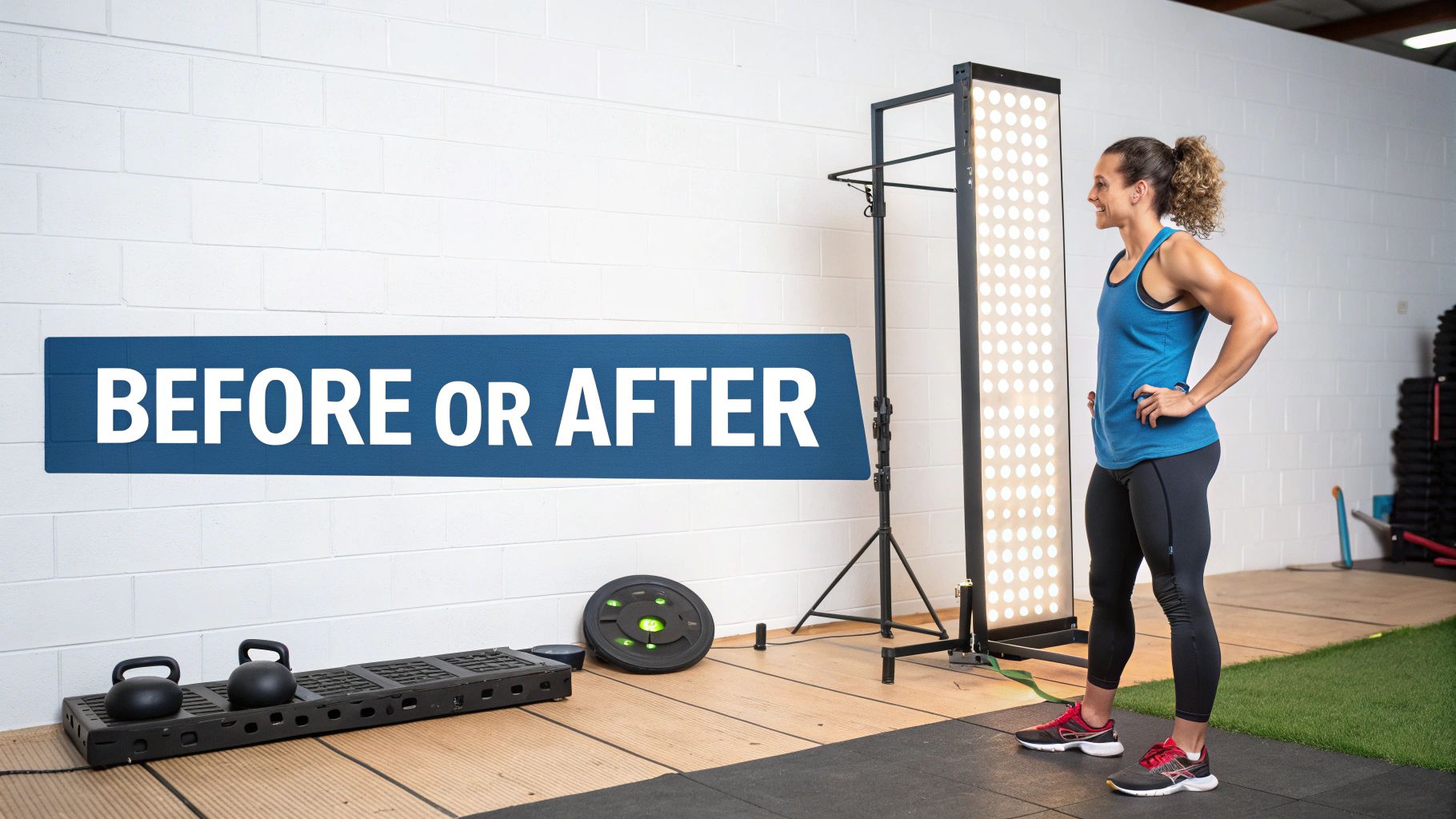
So, you’re ready to add red light therapy to your fitness routine, but one big question remains: should you use it before or after your workout?
The answer isn't a simple one-size-fits-all. It really comes down to your wellness goal for that specific day. Are you aiming to crush a new personal record? Use it before. Need to bounce back faster for tomorrow's session and focus on workout recovery? Use it after.
Choosing Your Timing for Optimal Red Light Therapy
Deciding when to schedule your red light session is all about strategy. Think of it less as a "right vs. wrong" choice and more about aligning the therapy's health benefits with your immediate fitness goals. The science behind it, known as photobiomodulation, uses specific light wavelengths to supercharge your cells—either for peak performance or for rapid repair.
Let's unpack the science for both approaches. We'll give you clear, actionable advice to help you seamlessly integrate red light therapy into your wellness routine for the best possible results. If you want to dive deeper into the cellular mechanics, we have a full breakdown of how does red light therapy work on a biological level.
Goal-Oriented Application
Your primary goal is your guide. First, ask yourself what you need most from your session today.
- For Performance Enhancement: Using red light before you train acts as a biological primer. It gets right to work stimulating your mitochondria to produce more ATP (cellular energy), essentially pre-loading your muscles with the fuel they need to perform.
- For Workout Recovery: A post-workout session helps your body manage the aftermath of a tough workout. It’s fantastic for calming inflammation, minimizing that dreaded delayed onset muscle soreness (DOMS), and boosting circulation to clear out metabolic waste.
Red light therapy is a versatile wellness tool. Using it before a workout is like giving your muscles a head start, while using it after is like calling in an expert repair crew for optimal workout recovery.
Quick Guide Red Light Therapy Timing for Your Fitness Goal
To make things even simpler, here's a quick at-a-glance guide. Use this table to match your RLT session to your desired outcome for the day.
| Your Primary Goal | Optimal RLT Timing | Key Health Benefit |
|---|---|---|
| Maximize Strength & Endurance | Before Workout | Increased cellular energy for better performance. |
| Reduce Muscle Soreness (DOMS) | After Workout | Decreased inflammation and faster tissue repair. |
| Prevent Exercise-Induced Damage | Before Workout | Pre-conditions muscles to better handle stress. |
| Accelerate Overall Workout Recovery | After Workout | Enhanced circulation to clear waste products. |
By being strategic with your timing, you can turn your red light therapy device into a precision tool for hitting your wellness and performance goals. For more insights into your wellness journey, visit the MedEq Wellness Journal.
Priming Your Muscles with Pre-Workout Red light Therapy
Using red light therapy before a workout is like giving your muscles a biological head start. You can think of it as a cellular-level primer, preparing your body for the stress and demand of intense physical activity. This strategy, known as pre-conditioning, is all about optimizing performance and preventing damage before it even has a chance to start.
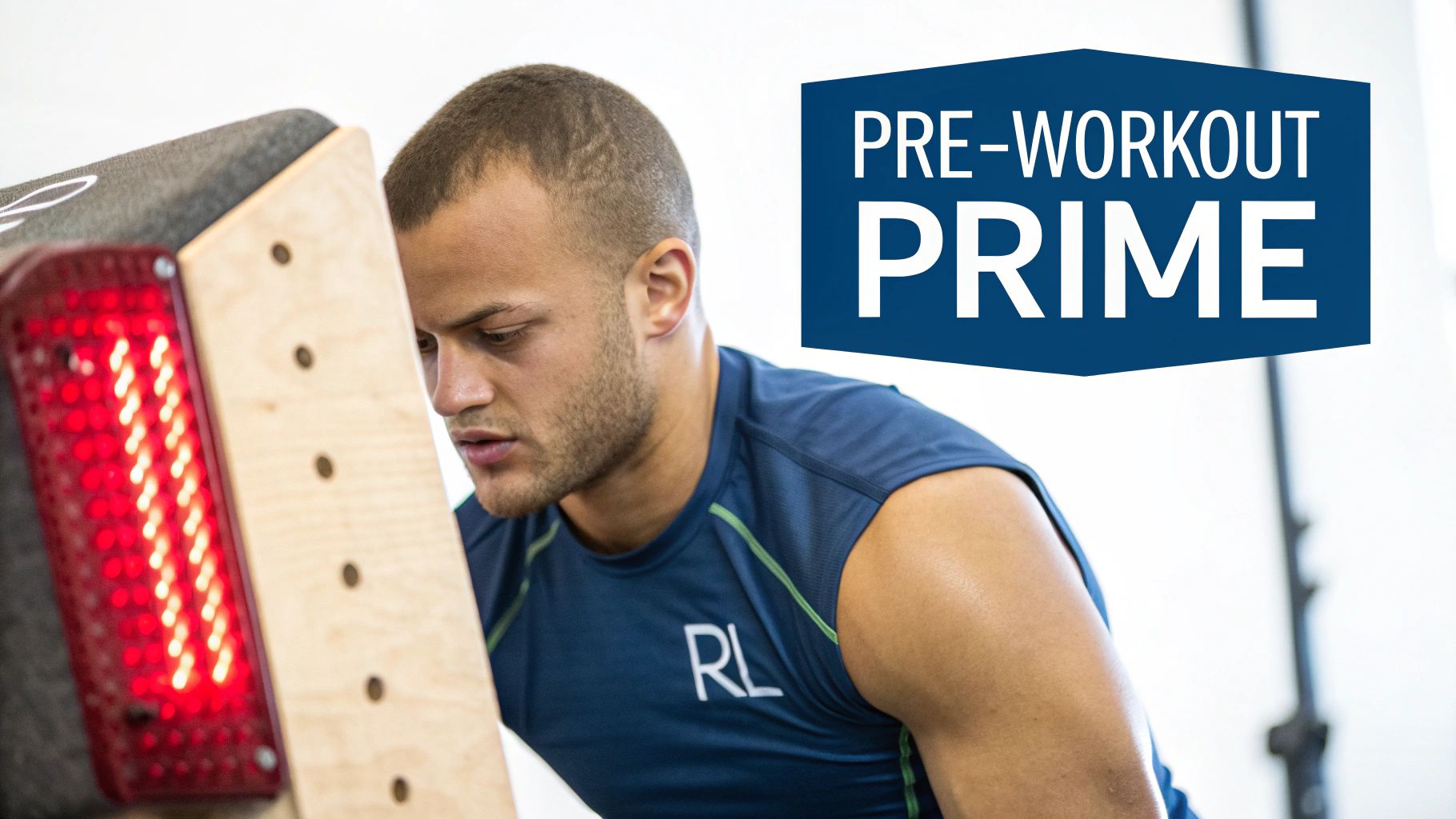
The real magic of pre-workout RLT is its ability to boost cellular energy production. Specific wavelengths of red and near-infrared light go deep into your tissues, where they’re absorbed by the mitochondria—your cellular power plants.
This process kicks the mitochondria into a higher gear, prompting them to generate more adenosine triphosphate (ATP). Since ATP is the direct fuel your muscles burn for every contraction, lift, and stride, you’re essentially pre-loading them with the energy needed to perform at their absolute peak.
Boosting Strength and Endurance
When your muscles have more ATP ready to go, the health benefits are tangible. You might find you can push harder, lift heavier, or last longer during a tough cardio session. It's not just a feeling; it's a measurable physiological edge.
This increased energy availability delays the onset of muscle fatigue. Instead of hitting that wall, your muscles have the fuel to keep firing efficiently, which can translate to an extra set, a few more reps, or shaving critical seconds off your time.
A pre-workout RLT session essentially builds a bigger fuel tank for your muscles. It creates a state of heightened readiness, allowing for greater power output and improved muscular endurance throughout your entire training session.
The research backs this up. One key study found that athletes who used red light therapy before exercising could perform 15% more repetitions and sustain their workout duration 20% longer than the control group. It’s a direct link between pre-conditioning with light and enhanced physical capacity.
Protecting Muscles from Damage
Beyond performance gains, pre-workout red light therapy also plays a critical protective role. Intense exercise naturally creates microscopic tears in muscle fibers, which leads to inflammation and soreness. A pre-workout session helps fortify your muscles against this breakdown.
This protective effect is often tracked using biomarkers like creatine kinase (CK), an enzyme that leaks from damaged muscle cells. Elevated CK levels are a clear sign of muscle stress. Pre-conditioning with red light has been shown to significantly reduce this response.
Reducing Key Markers of Muscle Stress
The light seems to trigger a mild, beneficial stress response in the cells, which in turn ramps up the production of protective antioxidant enzymes. This process, called hormesis, makes your cells more resilient and better equipped to handle the much larger stress of a workout.
As a result, your muscles experience less damage during the exercise itself. This shows up as lower post-workout CK levels and, for you, less severe delayed onset muscle soreness (DOMS). A comprehensive 2021 systematic review confirmed this, showing that pre-exercise RLT slashed CK levels by an average of 25% compared to placebo groups. You can learn more about how red light therapy supports muscle health at University Hospitals.
Ultimately, using red light therapy before you train is the ideal strategy for anyone looking to gain a competitive edge. It simultaneously boosts your performance capacity and reduces injury risk, creating the perfect foundation for a powerful and effective workout. To keep exploring new wellness strategies, visit the MedEq Wellness Journal.
Accelerating Recovery with Post-Workout Red Light Therapy
If your main goal is to bounce back faster and improve workout recovery, hitting the red light after you train is the undisputed champion. While a pre-workout session gets your muscles primed for action, the post-workout application is all about repair. It’s like calling in an elite cleanup crew for your cells to rebuild tissue and cut down on soreness.
This approach gives your body’s natural healing processes a serious boost right when they're needed most. After you've pushed your limits, your muscles are inflamed and full of metabolic byproducts like lactic acid. Post-workout red light therapy gets straight to work counteracting all of that.
Reducing Inflammation and Soreness
One of the biggest health benefits of post-workout RLT is its powerful anti-inflammatory effect. The light gets deep into your muscle tissue, calming the cellular stress that inevitably follows a hard session.
This has a direct impact on delayed onset muscle soreness (DOMS)—that all-too-familiar ache that creeps in 24 to 48 hours after a workout. By getting ahead of that inflammatory cascade, RLT makes the whole recovery process feel less painful and way more efficient. For a deeper look at managing that post-exercise ache, check out our guide on how to reduce muscle soreness.
A post-workout RLT session is like hitting the fast-forward button on workout recovery. It helps your body shift from a state of stress and breakdown to one of repair and regeneration much more quickly, setting you up for your next workout.
This isn't just about feeling better, either. It’s about real, measurable healing that happens faster. The science backs it up, showing that RLT can significantly cut the time it takes to get back to 100%.
Speeding Up Cellular Repair and Waste Removal
Beyond just taming inflammation, post-workout red light therapy kicks your circulation into a higher gear. This improved blood flow is a huge deal for two reasons: it rushes more oxygen and nutrients to damaged muscle fibers, and it helps flush out all the metabolic junk that builds up during exercise.
Think of it as opening up express lanes for your body's repair crews. This boost in circulation clears out the debris, making way for faster, more effective tissue regeneration. The result is a recovery cycle that's both quicker and more thorough.
The impact of this accelerated repair is well-documented. For instance, a landmark 2016 pilot study on university athletes revealed that those who received red light therapy after an injury returned to play 30% faster than their teammates. The RLT group's average time to get back in the game was just 7.2 days, compared to 10.3 days for the control group. You can learn more about the findings in athlete recovery.
How Post-Workout RLT Complements Contrast Therapy
For anyone building a serious recovery stack, post-workout RLT plays incredibly well with other wellness practices like contrast therapy. When you combine them, you can create a synergistic effect that takes your workout recovery to another level.
- Step 1 Red Light Therapy: Start with RLT to fire up cellular energy (ATP) production and boost circulation deep within the tissue, kickstarting the repair process.
- Step 2 Cold Plunge: Follow it up with a cold plunge to tackle systemic inflammation and constrict blood vessels, which helps flush metabolic waste out of the muscles.
- Step 3 Hot Sauna (Optional): Alternating with a sauna can push circulation even further and promote deep relaxation, rounding out the recovery cycle.
This combination uses the unique strengths of each tool. RLT gets the deep cellular repair going, while contrast therapy handles surface-level inflammation and circulation, creating a truly robust recovery protocol. By speeding up recovery this effectively, you can train more often and with more consistency—which is the key to long-term progress. For more advanced wellness strategies, be sure to visit the MedEq Wellness Journal.
Comparing Pre-Workout and Post-Workout Application
The big question isn't whether red light therapy is "better" before or after you train—it's about what you're trying to accomplish. Your specific wellness goal is what really dictates the best timing. Instead of just listing pros and cons, let's break down each approach based on real-world fitness objectives to help you decide.
This isn't a one-size-fits-all situation. We'll look at how timing your RLT session impacts everything from raw muscle performance to how sore you feel the next day, helping you match your protocol to your training demands.
For Maximizing Muscle Performance
If your goal is to hit peak performance from the moment you start your workout, the choice is easy: pre-workout red light therapy is your best bet. Think of it as priming your muscles for the work ahead, giving you an edge at a cellular level.
It’s a bit like pre-heating an oven. When you apply red light before training, you’re telling your mitochondria to kick ATP production into high gear. This gives your muscles a surplus of cellular energy, translating directly into more strength, power, and endurance right from your first set. Post-workout RLT is fantastic for repair, but it won’t give you that immediate performance boost.
For an immediate bump in performance and the ability to handle more volume during your training session, pre-workout RLT is the clear winner. It primes your muscles for maximum output.
For Accelerating Recovery Speed
When you’re focused on enhancing workout recovery, post-workout red light therapy is second to none. Your body naturally goes into repair mode after a tough workout, and RLT acts like a catalyst to supercharge that entire process.
It boosts circulation, helping to clear out metabolic waste like lactic acid, and it dials down the inflammatory response that leads to muscle breakdown. While a pre-workout session can help limit some of the damage, its main job is performance. The post-workout window is the critical moment to tackle recovery head-on.
As this shows, if you're feeling the burn of muscle soreness or just need to shrink your recovery timeline, a post-workout session is the most direct and effective strategy you can use.
For Preventing Injury
This one is a little more nuanced, but pre-workout RLT has a slight edge for proactive injury prevention. By "pre-conditioning" your muscles, you make them more resilient to the stress you're about to put them through. The light exposure helps fire up your body's own antioxidant and anti-inflammatory defenses before the workout even starts.
This can lead to a significant drop in key muscle damage markers, like creatine kinase. Post-workout therapy is more reactive—it helps fix the damage that’s already been done. A pre-workout session is proactive, aiming to stop that damage from becoming a real problem in the first place.
For Reducing Muscle Soreness (DOMS)
To fight off that dreaded delayed onset muscle soreness (DOMS), post-workout RLT is the most effective tool in the box. DOMS is the result of inflammation and the tiny micro-tears in muscle fibers that happen during intense exercise.
A post-workout session gets to work right away, calming that inflammatory response and kickstarting cellular repair. A pre-workout session can definitely lessen the severity of the damage and soreness later on, but the post-workout treatment targets the problem right at its source, offering more noticeable relief from post-workout aches.
Head-to-Head Comparison RLT Timing Protocols
To make your decision even easier, this graphic and table give you a detailed breakdown comparing pre- and post-workout RLT to guide your decision-making process based on specific needs.
| Performance Metric | Pre-Workout RLT | Post-Workout RLT | Recommended For |
|---|---|---|---|
| Immediate Strength | Excellent. Increases ATP for more power. | Minimal Impact. Focus is on repair, not output. | Athletes on competition day or during heavy lifting sessions. |
| Endurance | Excellent. Delays muscle fatigue. | Minimal Impact. Does not affect energy during the workout. | Individuals training for long-duration events or HIIT. |
| Soreness Reduction | Good. Reduces initial muscle damage. | Excellent. Directly targets inflammation and repair. | Anyone prone to severe DOMS after intense training. |
| Recovery Speed | Good. Less initial damage means less to repair. | Excellent. Directly accelerates the body's repair cycles. | People training multiple days in a row or on a tight schedule. |
At the end of the day, the ultimate strategy might just involve using both. An athlete could use RLT before a heavy lifting day to max out performance, then hit it again afterward to jump-start recovery. For general wellness, you might just alternate based on what your body is telling you. For more deep dives into health and wellness topics, visit the MedEq Wellness Journal.
Practical Red Light Therapy Protocols for Your Routine
Knowing the science is one thing, but putting it into practice is where you see the results. To get the most health benefits from every session, you need a clear, consistent protocol. This comes down to dialing in the details—how long your session is, your distance from the device, and which muscle groups you’re focusing on.
Whether you're a competitive athlete chasing peak performance or just someone focused on staying fit and feeling good, a structured routine removes all the guesswork. Let's translate the research into actionable steps you can start using today.
Key Parameters for Every Session
No matter when you use red light therapy, a few core principles will make sure you’re getting an effective dose. Consistency is everything, so start by making these habits your foundation.
- Session Duration: The sweet spot for both performance and recovery is between 10 to 20 minutes. Too short, and you won't deliver enough energy to the cells. Too long, and you start hitting a point of diminishing returns.
- Distance from Device: Position yourself or the target muscle group about 6 to 12 inches from the panel. This distance is ideal for letting the light penetrate deep into the tissue without being too intense or too spread out.
- Targeting Muscle Groups: Concentrate the light on the main muscles you’re about to use or just finished working. If it’s leg day, that means your quads, hamstrings, and glutes. For an upper-body day, hit your back, chest, and shoulders.
Sample Routine for a Competitive Athlete
For an athlete, every detail matters. The goal here is to maximize performance while slashing recovery time to handle a high training volume. This routine uses both pre- and post-workout sessions for a powerful, stacked effect.
Goal: Boost power output for a heavy squat day and accelerate workout recovery for the next session.
Pre-Workout Protocol (30-60 minutes before training):
- Duration: 10-15 minutes.
- Distance: 6-8 inches from the panel.
- Focus: Aim the light directly at the major muscle groups for your workout—quads, glutes, hamstrings, and lower back. This primes the muscles, boosting ATP for immediate strength.
Post-Workout Protocol (within 1 hour after training):
- Duration: 15-20 minutes.
- Distance: 8-12 inches from the panel.
- Focus: Go for a broader application, hitting the same muscle groups to fight inflammation and kick-start the repair process. This helps minimize DOMS and gets the body ready for tomorrow.
This two-a-day approach gives you the best of both worlds. The pre-workout session primes the muscles for peak exertion, while the post-workout session acts as an immediate recovery tool, cutting down your downtime significantly.
Sample Routine for a Fitness Enthusiast
If you're focused on general wellness, consistency and convenience are the name of the game. The aim is to feel better, recover smoothly, and stick to a regular exercise schedule without feeling burnt out or overly sore. This routine puts the focus squarely on post-workout recovery.
Goal: Reduce muscle soreness after a full-body workout and improve overall wellness.
Post-Workout Protocol (within 1-2 hours after training):
- Duration: 15 minutes.
- Distance: 10-12 inches from the device.
- Focus: Set yourself up for a full-body treatment. Stand or sit in front of your panel, treating the front of your body for about 7-8 minutes, then turn around and do the back for another 7-8 minutes. This approach tackles systemic inflammation and promotes a more holistic recovery.
This simple protocol is incredibly effective and easy to slot into a busy schedule. You can learn more about building a consistent routine with our complete guide to using red light therapy at home. Stick with it, and you’ll notice a huge difference in how your body feels day-to-day, helping you stay on track with your fitness goals.
Integrating RLT with Other Wellness Practices
Red light therapy is a powerhouse on its own, but it truly shines when you stack it with other recovery methods. Think of it less as a solo act and more as a key player in a strategic, holistic wellness plan.
Before you jump in, a quick word on safety. Always use proper eye protection—the light is intense. And if you're new to RLT, start with shorter sessions to see how your skin responds. Listen to your body.
Creating a Powerful Recovery Stack
The real magic happens when you pair RLT with other science-backed practices to create a synergistic effect. It’s all about layering modalities to target different physiological systems for a more complete workout recovery.
Here are a few combinations that work incredibly well:
- RLT and Foam Rolling: Hit a muscle group with red light before you foam roll. The increased blood flow warms up the tissue, making myofascial release more effective and a lot less uncomfortable.
- RLT and Targeted Stretching: Applying RLT pre-stretch can make your tissues more elastic. This helps you get a deeper, safer stretch, improving flexibility and range of motion more efficiently.
The most powerful recovery stacks often involve layering thermal stressors. Combining the deep cellular repair from red light therapy with the systemic health benefits of hot and cold therapies creates a robust framework for managing inflammation and accelerating healing.
This is where something like contrast therapy comes in. Imagine this: you finish a workout and immediately use RLT to kickstart cellular repair. Then, you follow it up with a cold plunge. The RLT is working on deep tissue repair, while the cold water tackles systemic inflammation and flushes out metabolic waste.
Add a sauna session afterward, and you’ve completed a comprehensive recovery cycle that boosts circulation and promotes deep relaxation.
By thoughtfully combining these practices, you can make a significant impact on your workout recovery and overall wellness. For more expert wellness tips and strategies, explore the MedEq Wellness Journal.
Still Have Questions? Your RLT + Exercise FAQ
Even with all the science, you might have some practical questions about fitting red light therapy into your wellness routine. Let's clear up the most common ones so you can get started with confidence.
Can I Use Red Light Therapy Both Before and After the Same Workout?
Absolutely. In fact, it's a powerful strategy many athletes swear by. Think of it as "stacking" the health benefits.
A quick 10-minute session beforehand gets your muscles primed and ready for action. Then, follow up with a longer 15-20 minute session after you cool down to kickstart the repair process. This approach gives you the best of both worlds—better output during your workout and a faster, more efficient workout recovery afterward.
How Often Should I Use RLT for Fitness?
Consistency is everything. For the best results, aim to use your device four to five times per week, especially on days you're training hard.
Whether you're using red light therapy before or after a workout, regular sessions keep your cells energized and inflammation low. It’s this steady use that builds up over time, leading to real, measurable gains in both your performance and how quickly you bounce back.
A single session can definitely help with things like immediate soreness, but it's the cumulative effect of consistent use that truly unlocks your fitness potential and overall wellness.
How Long Until I See or Feel Results?
You’ll likely feel some immediate effects, like less fatigue right after a tough session. That's the easy part.
The more significant changes—like a real drop in muscle soreness (DOMS) and feeling like you can push harder for longer—usually start showing up after two to four weeks of consistent use. For the deep, long-term health benefits like visible muscle growth and improved resilience, you’re looking at several months. Stick with it; the payoff is worth it.
For more expert advice on wellness and recovery, check out the MedEq Wellness Journal.
At MedEq Fitness, we build equipment that closes the gap between exertion and renewal. Our physician-led selection of red light therapy devices and recovery tools is designed for anyone serious about their performance, whether at home or in the clinic. Explore our collection at MedEq Fitness.