How Red Light Therapy Works: A Science-Backed Wellness Guide
At its core, red light therapy is like a charger for your cells. It uses very specific wavelengths of light—think of it as a refined, targeted form of sunlight without the damaging UV rays—to kickstart your body’s natural healing, energy production, and overall wellness.
This whole process is called photobiomodulation, and it's a completely safe, non-invasive way to give your cells the precise kind of light they need to function at their best, enhancing your health from the inside out.
So, How Does Red Light Actually Work?
It might seem strange that just shining a light on your body can have such a major impact, but the secret is what happens deep inside your cells. The real magic takes place in tiny powerhouses called mitochondria.
Red light therapy delivers concentrated wavelengths of red and near-infrared (NIR) light that penetrate your skin and tissues. When this light energy is absorbed, it sets off a powerful chain reaction. It energizes the mitochondria, telling them to ramp up production of adenosine triphosphate (ATP)—the essential energy molecule that powers everything your body does, from flexing a muscle to repairing damaged tissue for better workout recovery.
From Light Photons to Cellular Fuel
The whole system is incredibly efficient. As red and NIR photons hit your cells, they interact with a special light-sensitive enzyme inside the mitochondria. This little nudge helps your cells use oxygen more effectively to generate energy.
The result is a cascade of health benefits that you can actually feel. It’s why so many athletes rely on it for faster workout recovery and why it’s become a go-to for skin health and pain relief. By boosting energy at a cellular level, your body can more effectively reduce inflammation, improve blood flow, and speed up its own repair processes.
By stimulating the foundational energy systems within our cells, red light therapy addresses the root causes of dysfunction, rather than just masking symptoms. This makes it a powerful tool for proactive wellness and optimized performance.
This isn't just a surface-level fix. It's about supporting your body’s own healing mechanisms from the inside out. Understanding that core principle is key to seeing why it has such a wide range of applications for everything from athletic performance to overall vitality and wellness.
To put it all together, here’s a quick snapshot of how the different pieces of red light therapy work in tandem.
Red Light Therapy At A Glance
This table breaks down the core components, from the science behind the light to the real-world health benefits you can expect.
| Component | Description | Key Takeaway |
|---|---|---|
| Light Source | Medical-grade LEDs emit specific, non-invasive red and near-infrared wavelengths. | The light is precisely calibrated to interact with your body's cells safely and effectively. |
| Cellular Target | The light is absorbed by mitochondria, the "power plants" inside your cells. | This targets the very source of cellular energy production for systemic wellness benefits. |
| Primary Effect | Boosts the production of ATP, the body's main energy molecule. | More ATP means your cells have more fuel to repair damage, reduce inflammation, and perform their functions. |
| Key Benefits | Reduced inflammation, accelerated muscle recovery, improved skin health, and pain relief. | The therapy supports a wide range of wellness goals by enhancing natural biological processes. |
As you can see, each element plays a critical role in making red light therapy a powerful tool for health, wellness, and recovery.
For more deep dives into health and recovery, explore the MedEq Wellness Journal.
The Cellular Science of Photobiomodulation
To really get what’s happening when you use red light therapy, we need to zoom way in—past the skin and right into your individual cells. This is where the magic happens, specifically inside tiny organelles called mitochondria. You might remember them from high school biology as the "power plants" of your cells.
Think of your body like a high-performance engine. Your mitochondria are the spark plugs, igniting the fuel that keeps everything running. If those spark plugs get dirty or weak, the whole engine sputters. This is where photobiomodulation—the scientific term for this process—steps in to enhance your wellness.
When specific wavelengths of red and near-infrared light hit your body, they don't just warm the skin. These photons travel deep into your tissues and are absorbed by a special enzyme inside the mitochondria called cytochrome c oxidase. This single interaction is the starting gun for a whole cascade of positive health benefits.
Supercharging Your Cellular Engines
Imagine your mitochondria have a dimmer switch. When you're stressed, injured, or just fatigued, that switch is turned way down. Red light acts as the hand that cranks that dimmer switch all the way up to full blast.
This jolt of light energy helps the mitochondria use oxygen more efficiently, which kicks the production of adenosine triphosphate (ATP) into high gear. ATP is pure cellular fuel. It’s the energy currency your body uses for literally everything, from contracting a muscle during a lift to repairing damaged tissue after a workout.
Simply put, more ATP means your cells have more power to do their jobs. This translates directly into faster healing, better physical performance, and more resilience.
The Ripple Effect of Cellular Energy
But the health benefits don't stop at just making more fuel. That initial interaction with cytochrome c oxidase triggers two other critical things that are huge for workout recovery and overall health.
- A Nitric Oxide Boost: The light helps release a molecule called nitric oxide that can sometimes "clog" the mitochondrial machinery. Once freed, it enters the bloodstream and acts as a natural vasodilator, meaning it helps your blood vessels relax and expand. Better blood flow means more oxygen and nutrients can get to your cells, which is exactly what you need to recover and thrive.
- Helpful Stress Signals (ROS): The process also creates a very small, controlled amount of what are called reactive oxygen species (ROS). While too much ROS is a bad thing (think oxidative stress), this tiny, temporary spike is actually beneficial. It acts as a crucial signal that tells your cells to ramp up their own antioxidant defenses, reduce inflammation, and kickstart repair processes.
This graphic breaks down how these pieces fit together—light, cells, and energy—to create real-world results.
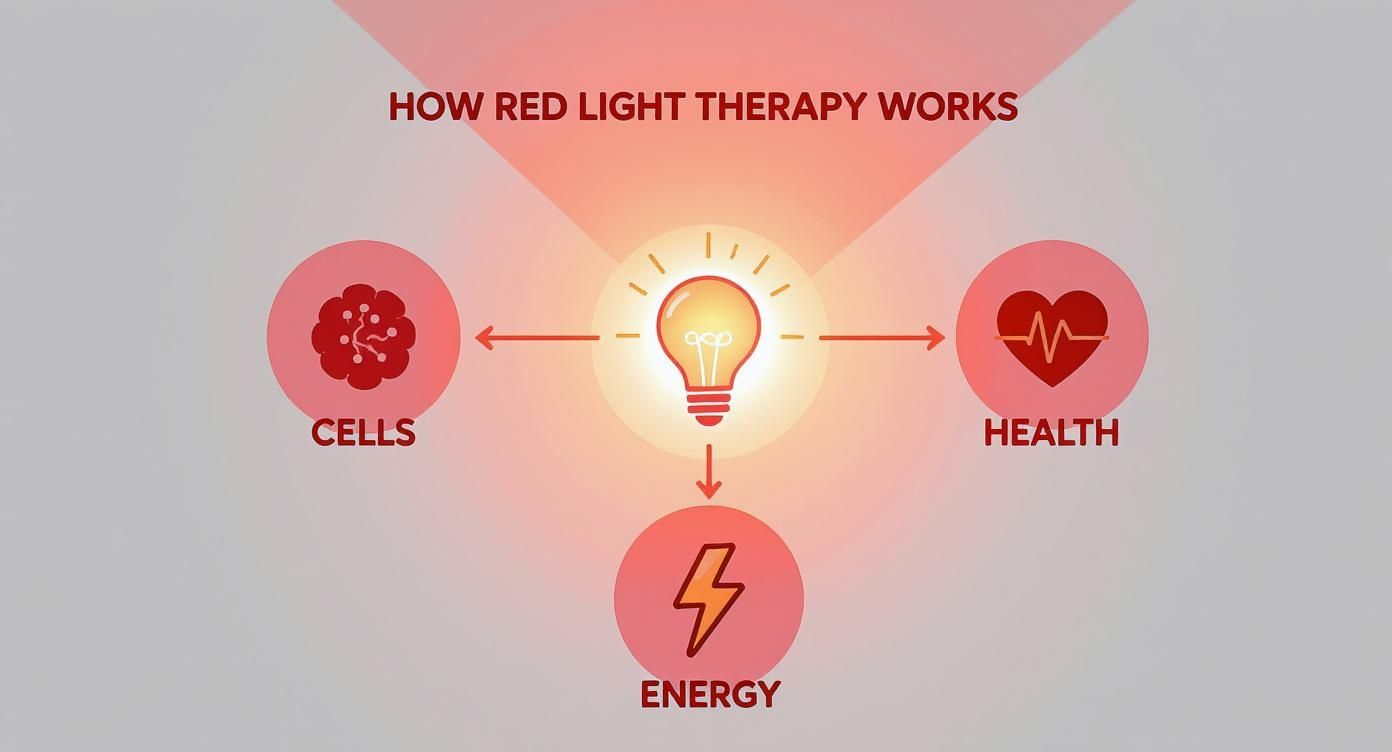
As you can see, it all starts with light absorption. This directly kicks cellular activity into a higher gear, boosts energy production, and sets off a chain reaction that improves your health from the inside out.
Your Body's Biological Blueprint
This whole process—from light photon to cellular energy—is the engine behind red light therapy. By using specific wavelengths of light in the red and near-infrared spectrum (typically 600 to 1300 nm), we can directly influence how our cells function without heat or invasive procedures.
The beauty of it is that we're not adding a foreign substance or forcing a process. We're giving the body a natural signal that helps its own systems run more efficiently.
This fundamental support is why red light therapy has such a wide range of applications and health benefits. Whether you’re looking to speed up muscle recovery, improve your skin’s appearance, or ease joint pain, the core principle is the same: you’re giving your cells the energy they need to perform at their best.
It's a powerful way to build a foundation for any wellness routine. To see how you can bring this technology into your own life, check out our guide on implementing red light therapy at home.
Why Wavelengths and Dosing Are So Important
Getting real, tangible results from red light therapy isn't as simple as just flipping a switch. It’s a game of precision. The effectiveness of your sessions comes down to two critical details: the specific wavelengths of light being used and the exact dose your body receives.
Nailing these two factors is what separates an effective wellness routine from just wasting your time.
Think of it like tuning an old-school radio. You have to dial in the exact frequency to get a clear signal, otherwise all you hear is static. For red light therapy, that perfect signal is found within the therapeutic window—a specific range of light that our cells are uniquely wired to absorb and respond to for maximum health benefits.

This window is almost entirely made up of red and near-infrared (NIR) light. Why? Because these specific wavelengths have a unique talent for slipping past the surface of the skin and deep into our tissues without getting soaked up by water or blood along the way.
Targeting Different Depths for Different Goals
The most effective and heavily researched wavelengths have distinct jobs, and it all depends on how deep they can travel into the body. This is the key to how a single therapy can deliver such a wide range of health benefits, from skin health to deep muscle recovery.
- Red Light (around 660nm): This wavelength is shorter, so it gets absorbed by the upper layers of your skin. It's the go-to for cosmetic goals—think boosting collagen to smooth out fine lines, evening out skin tone, and helping surface-level wounds heal faster.
- Near-Infrared Light (around 850nm): This longer wavelength is invisible to our eyes and it travels much, much deeper. It can reach into muscle tissue, joints, ligaments, and even bone. This makes it the powerhouse for reducing inflammation, soothing joint pain, and speeding up deep tissue repair after a brutal workout.
When a device combines these wavelengths, you get the best of both worlds. It can rejuvenate the skin on the surface while simultaneously promoting workout recovery in the muscles and joints underneath.
The Prescription for Light: Dosing Explained
Once you’ve got the right wavelengths, the next piece of the puzzle is the dose. Just like a medical prescription, the amount of light energy delivered to your cells dictates the outcome. Too little, and you get no effect. But too much can actually backfire.
Dosing isn’t just about how long you stand in front of the light; it’s a precise calculation of light intensity and time. Getting this right is absolutely fundamental to achieving consistent, powerful results for your health and performance.
The right dose is a product of a few key factors:
- Irradiance (Power Density): This is just a technical term for light intensity—how much energy is hitting a specific area every second. Higher irradiance means a more powerful device, which means you can get an effective dose in less time.
- Treatment Time: The length of your session, which typically falls between 10 to 20 minutes.
- Frequency: How often you use the therapy. For consistent results, most protocols recommend daily use or at least several times per week.
These elements work together to determine the total energy delivered, which is measured in joules. The goal of every session is to hit that optimal number of joules. This is why high-quality devices, like the VitalGlow Professional 360 Multi-Spectrum System, are engineered to deliver precise, clinically-backed doses.
Finding the Sweet Spot: The Biphasic Dose Response
This brings us to one of the most important concepts in this field: the biphasic dose response. It’s a scientific principle that basically says there’s an optimal dose range for benefits. Fall below this range, and the light isn't strong enough to kickstart your cells. Go above it, and the positive effects can actually shrink or even disappear entirely.
It’s a bit like watering a plant. Too little water, and it wilts. Give it just the right amount, and it thrives. But if you drown it in too much water, you’ll rot the roots and kill it. Red light therapy works the same way. The goal is to give your cells just enough energy to fire up ATP production and repair without completely overwhelming the system.
This is exactly why following the recommended guidelines for your specific device is so critical for getting safe and effective treatments.
From Ancient Sunlight to Modern LEDs
Using light for healing isn't some new wellness trend—it's a practice that goes way back. Long before we had the science to explain how it worked, ancient cultures knew there was a powerful link between sunlight and health. This journey, from basking in the sun to using sophisticated, science-backed LED devices, shows that red light therapy is built on centuries of observation and decades of focused research.
This isn't just a fun history lesson. It's important because it proves that today's advanced therapies aren't just a passing fad. They stand on a solid foundation of discovery, evolving from the broad-spectrum light of the sun to the highly specific, targeted wavelengths we use today to optimize our health and wellness.
From Ancient Heliotherapy to Scientific Breakthroughs
The story really starts thousands of years ago. The earliest roots of red light therapy can be traced back to ancient civilizations like the Egyptians, who practiced heliotherapy—literally, using sunlight to treat all sorts of ailments. Of course, they didn't know about specific wavelengths, but they saw that sunlight had profound healing effects. This was the very first step toward understanding light's medical potential.
The real leap from observation to scientific proof started in the 20th century. A huge milestone was the use of phototherapy to treat skin diseases like lupus vulgaris, a breakthrough so significant it earned a Nobel Prize and cemented light's place in modern medicine. This foundational work paved the way for researchers to dig deeper into how different parts of the light spectrum affect the body. Want a great overview? Check out this deep dive into the history of light-based therapies and their scientific validation.
NASA’s Pivotal Role in LED Therapy
The next great leap forward came from a pretty unexpected place: outer space. In the 1990s and early 2000s, NASA scientists had a unique problem on their hands. Astronauts in microgravity were experiencing delayed wound healing and muscle atrophy. They needed a safe, effective way to boost tissue growth and speed up recovery while they were millions of miles from Earth.
This is where LEDs entered the picture. NASA began experimenting with red and near-infrared LED light and discovered it could significantly accelerate healing and kickstart cellular activity.
NASA’s research was a game-changer. It not only validated the biological effects of specific light wavelengths but also proved that LEDs were a viable, powerful, and safe way to deliver this energy, moving the technology from the lab into practical application.
This pioneering work gave us the hard data showing that light could trigger the body’s own natural repair mechanisms. It was the discovery that led directly to the advanced red light therapy devices we all use today, proving that photobiomodulation was a reliable tool for enhancing workout recovery and cellular health.
From the sun-worshipping Egyptians to astronauts orbiting our planet, the evolution of light therapy has been a remarkable journey. What started as an intuitive practice has become a precise science, allowing us to harness specific frequencies of light for everything from workout recovery to overall vitality.
For more wellness insights grounded in science, explore the MedEq Wellness Journal.
Boosting Workout Recovery and Performance
All that cellular science we talked about? It translates directly into results you can actually feel, especially when it comes to your workout recovery. For athletes or anyone who loves to stay active, this is where the theory hits the gym floor. It's about connecting the dots from more ATP to less muscle soreness and better endurance.
When you push yourself hard, you're creating tiny micro-tears in your muscle fibers and kicking off an inflammatory response. That's a normal part of getting stronger, but it's also what leaves you feeling sore and drained. Red light therapy comes in to supercharge this natural repair process, helping your body get back to 100% faster.
By giving your cells the extra energy they need to rebuild, you can seriously cut down on your recovery time. This means less downtime between sessions and a better ability to show up and perform at your best, day in and day out.
Accelerating Muscle Repair and Reducing Soreness
The biggest health benefit for workout recovery is the way red light therapy dials down inflammation. Near-infrared wavelengths sink deep into muscle tissue, calming the inflammatory signals that trigger swelling and pain. At the same time, that surge in ATP gives your muscle cells the raw fuel needed to patch up those micro-tears with impressive speed.
This one-two punch is incredibly effective at minimizing Delayed Onset Muscle Soreness (DOMS)—that all-too-familiar ache that sets in a day or two after a tough workout. Instead of being sidelined, you can get back to your routine feeling fresh and ready for whatever's next.
By tackling both inflammation and cellular energy, red light therapy doesn't just put a band-aid on the pain. It gets to the root of muscle recovery, leading to real, lasting improvements in how your body adapts to training.
This faster recovery cycle is exactly what lets athletes train harder and more consistently, which is the key to unlocking better gains in strength and endurance over time.
The Synergy of RLT and Contrast Therapy
If you're looking to build a truly robust recovery routine, red light therapy pairs incredibly well with other modalities, especially contrast therapy. This is the practice of alternating between hot and cold, like a sauna and a cold plunge.
Contrast therapy works by forcing your blood vessels to rapidly constrict (from the cold) and then dilate (from the heat), creating a natural "pumping" action. This flushes out metabolic byproducts like lactic acid and drives fresh, oxygen-rich blood into your tissues.
When you bring red light therapy into the mix, you get a powerful synergistic effect:
- Contrast Therapy: Clears out cellular junk and improves circulation on a macro level.
- Red Light Therapy: Supercharges cellular energy (ATP) and quiets inflammation on a micro level.
Together, they form a complete recovery system that hits healing from two different, yet perfectly complementary, angles. You’re clearing the path for repair with contrast therapy, then flooding the zone with the energy needed to get the job done with red light. This combination can be a cornerstone of any serious wellness and workout recovery plan.
Red Light Therapy Protocols For Peak Performance
Getting red light therapy into your routine is straightforward. The trick is to time your sessions around your workouts to get the most bang for your buck, whether you're looking to prime your muscles beforehand or kickstart recovery afterward.
Here are some practical guidelines for integrating RLT into your workout routine for optimal energy and recovery.
| Protocol Timing | Goal | Recommended Session Time | Key Benefit |
|---|---|---|---|
| Pre-Workout | Prime muscles and boost energy | 5-10 minutes | Increases blood flow to muscles, enhances ATP production for better immediate performance, and may help prevent injury. |
| Post-Workout | Accelerate recovery and reduce soreness | 10-20 minutes | Reduces inflammation and oxidative stress, speeds up muscle repair, and minimizes delayed onset muscle soreness (DOMS). |
By following these simple protocols, you can make red light therapy a consistent and powerful part of your training. To dive deeper into advanced recovery strategies, be sure to check out the MedEq Wellness Journal.
More Than Just Recovery: The Broader Health Benefits of Red Light Therapy
While red light therapy is a phenomenal tool for workout recovery, its power doesn't stop at the gym door. By energizing the body's most fundamental cellular functions, it becomes a versatile ally for a whole host of health and wellness goals.
Think of it this way: the same mechanisms that accelerate muscle repair—more cellular energy and less inflammation—also work wonders for other parts of your body, like your skin.
That energy boost helps kickstart fibroblasts, the tiny factories in your skin responsible for producing collagen and elastin. These two proteins are the very scaffolding that gives your skin its firmness and structure. More collagen means a visible reduction in fine lines and wrinkles, while improved circulation helps even out skin tone for a healthy, natural glow.
Enhancing Skin Vitality and Appearance
The health benefits for skin are among the most studied and celebrated. Regular sessions essentially give your skin cells the fuel they need to kickstart their natural healing and rejuvenation processes.
Clinical studies are pretty compelling here, with over 90% of participants reporting noticeable improvements in skin softness, reduced redness, and more even pigmentation after consistent use. Of course, results vary, but it's widely seen as a safe and effective approach with minimal side effects.
Soothing Joint Pain and Inflammation
Just as near-infrared light can penetrate deep into muscle, it also reaches your joints and connective tissues. This makes it a fantastic tool for managing the aches and pains from chronic conditions like osteoarthritis.
The light works in two ways: it helps dial down inflammation right at the source and boosts blood flow to the joint. That increased circulation delivers more oxygen and nutrients needed for repair, providing real relief from stiffness and pain. The end result is better mobility and a higher quality of life.
Supporting Sleep and Circadian Rhythms
New research is also shedding light on red light therapy's ability to improve sleep. It turns out that exposing yourself to certain wavelengths, especially in the evening, can help recalibrate your body's internal clock, or circadian rhythm.
By helping your body relax and lowering the systemic stress that often messes with our sleep, red light therapy can make it easier to fall asleep faster and get more of that deep, restorative rest your body craves.
Good sleep is the foundation of everything, from mental clarity to physical recovery, making this a powerful wellness benefit.
This incredible range of applications shows just how versatile red light therapy is as a holistic wellness tool. To dive deeper, check out our complete guide covering the benefits of red light therapy.
Got Questions? We've Got Answers.
Let's tackle some of the most common questions people have before they get started with red light therapy. I want to make sure you have the practical, science-backed answers you need to feel totally confident in this wellness tool.
Is Red Light Therapy Safe for Your Eyes?
The LEDs are incredibly bright, so while the light itself is safe, you should never stare directly into them during a session. It’s just common sense.
Any reputable device will come with protective eyewear. Think of it as non-negotiable, especially for facial treatments. Pop them on, and you’re good to go.
How Long Until I Actually See Results?
This is the big one, and the honest answer is: it depends. Everyone's body and wellness goals are different. Some people feel a noticeable drop in pain or a boost in energy within just a few sessions.
For deeper work, like repairing muscle tissue for workout recovery or stimulating collagen for skin health, you need to be patient. These kinds of changes happen at the cellular level and can take several weeks of consistent use before they become visible.
Consistency is far more important than session length. Think of it like watering a plant. A little bit every day builds on itself, letting those cellular benefits compound over time for real, lasting results.
Can I Do Red Light Therapy Every Day?
Absolutely. Daily use is not only safe but often recommended, particularly when you’re first getting into a routine. A 10-20 minute session is the sweet spot for most people.
Remember, sticking to a consistent daily habit is much more effective than doing sporadic, marathon sessions. Overdoing it can actually reduce the benefits because of that biphasic dose response we talked about.
Will Red Light Therapy Give Me a Tan or Burn?
Nope, not at all. Red light therapy panels produce zero UV light—the kind of light from the sun that causes tanning and burning. The therapy is also non-thermal, which is just a technical way of saying it doesn't produce heat that can damage your skin's surface.
For more deep dives into wellness tech and practical guides, head over to the MedEq Wellness Journal.
At MedEq Fitness, our mission is to equip you with science-backed tools to crush your recovery and performance goals. See our full lineup of professional-grade red light therapy panels and other recovery gear at https://www.medeqfitness.com.