How to Improve HRV: 7 Daily Habits for Better Health & Wellness
If you want to improve your HRV, you need to focus on the fundamentals that support your overall wellness: high-quality sleep, a smart balance between training and recovery, staying hydrated, and actively managing your stress with practices like slow, deliberate breathing.
These aren't just wellness buzzwords; they're direct inputs that support your autonomic nervous system. Think of it as fine-tuning your body's internal engine for peak performance, better workout recovery, and long-term resilience.
What Is HRV and Why It Matters for Your Health
Heart Rate Variability (HRV) is simply the natural, healthy fluctuation in time between your heartbeats. You might think a perfectly steady, metronome-like heart rate is a good thing, but it’s actually the variability that signals a resilient, adaptive, and healthy nervous system.
A higher HRV is a fantastic sign. It's a key indicator of overall wellness, telling you your body is well-rested, recovered, and ready to take on whatever you throw at it—both physical and mental stress.

Your HRV is like a personalized dashboard for your body’s readiness. It gives you a real-time peek into the balance of your autonomic nervous system (ANS), which is split into two main branches:
- Sympathetic (Fight-or-Flight): This is your gas pedal. It ramps up your heart rate and gets your body primed for action and stress.
- Parasympathetic (Rest-and-Digest): This is your brake pedal. It slows your heart rate down, promoting recovery, digestion, and all-around calm.
When your HRV is high, it shows your parasympathetic system has the reins, meaning your body is in a state of recovery and wellness. On the flip side, a consistently low HRV suggests your sympathetic system is in overdrive. That could be from overtraining, getting sick, a terrible night's sleep, or chronic stress.
The Science Behind the Numbers
Tracking your HRV gives you objective data to make better health decisions. For instance, after a killer workout, your HRV will naturally take a dip as your body gets to work on repair and adaptation. Seeing it bounce back to—or even above—your baseline is a clear signal that your workout recovery was effective.
This metric is so powerful it’s used to predict major health outcomes. One of the key metrics, SDNN (standard deviation of NN intervals), gives a snapshot of your nervous system's balance. Cardiovascular studies that monitor HRV over 24 hours show that an SDNN value above 100 ms is considered healthy.
In one study, heart attack survivors with an SDNN over 100 ms had a 5.3-fold lower risk of dying than those with an SDNN below 50 ms. That's a massive health benefit. You can dive into the full findings from these prognostic cardiovascular studies to see the data for yourself.
To help you make sense of what your wearable is telling you, it helps to understand the lingo. The most common metrics you'll see are RMSSD and SDNN.
Your Guide to Common HRV Metrics
This table breaks down the common HRV metrics you'll find on wearables and apps, explaining what each one measures in simple terms.
| HRV Metric | What It Measures | What It Indicates |
|---|---|---|
| RMSSD | The root mean square of successive differences between normal heartbeats. | Primarily reflects short-term, rapid changes influenced by the parasympathetic (rest-and-digest) system. A higher RMSSD often signals better recovery and readiness. |
| SDNN | The standard deviation of the interval between normal-to-normal heartbeats. | Reflects overall variability over a longer period (often 24 hours). It captures both sympathetic and parasympathetic activity, providing a broader view of your autonomic health. |
While both are useful, many consumer wearables lean on RMSSD for daily readiness scores because it’s sensitive to immediate stressors and recovery.
What HRV Reveals About You
When you start monitoring your HRV, you begin to connect the dots between your lifestyle choices and your body's internal state. This knowledge is crucial for optimizing your health and wellness.
Here’s a glimpse of what it can tell you:
- Recovery Status: Are you actually ready for that heavy lift day, or would you be better off with active recovery?
- Stress Levels: See the real physiological toll of that stressful meeting or argument you had.
- Sleep Quality: Get an objective look at how well your body is actually restoring itself overnight.
- Potential Illness: A sudden, unexplained plunge in your HRV can be an early warning that your immune system is fighting something off.
By learning to read these signals, you can stop guessing and start knowing. You'll be equipped to make smarter choices that boost your health and performance every single day. For more insights like these, check out the MedEq Wellness Journal.
How to Accurately Measure and Read Your HRV Data
If you want to improve your HRV, you first have to get an accurate reading. Think of it as listening to your body—if the signal is full of static, you're going to miss the message. A consistent, reliable measurement is the bedrock for any plan to boost your wellness, resilience, and dial in your recovery.
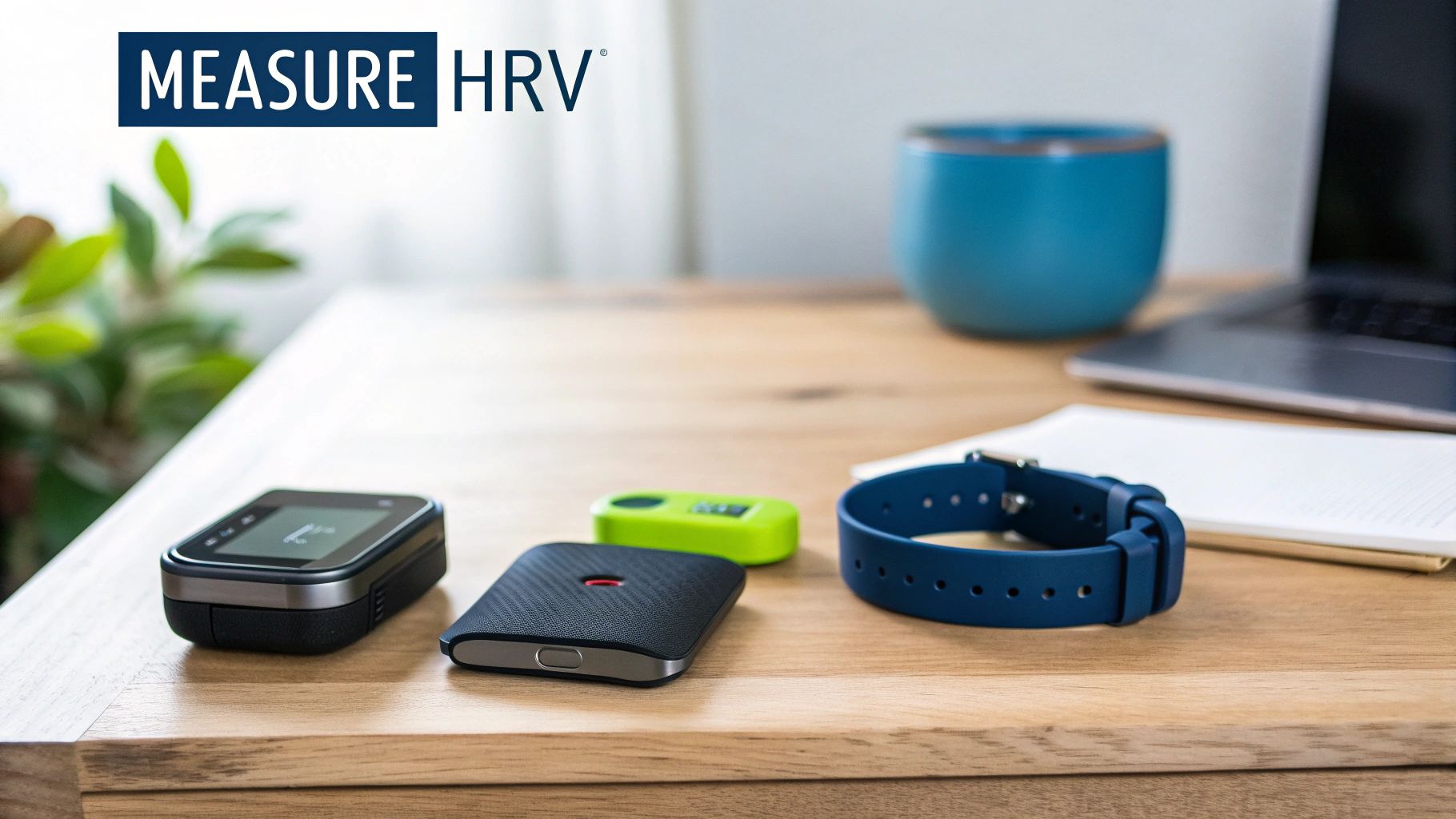
There’s a whole world of devices out there, from chest straps to smart rings, and each has its own place. The right one for you really comes down to your lifestyle, your budget, and what you plan to do with the data.
Choosing Your HRV Tracking Tool
The "best" device isn't the most expensive one; it's the one you'll actually use every single day. Let's look at the most common options.
- Chest Straps (e.g., Polar H10): These are the gold standard for a reason. They use ECG to measure the heart's electrical signals directly, giving you the most precise beat-to-beat data possible. They’re perfect for a dedicated morning reading but aren't something you'd wear 24/7.
- Wearable Bands (e.g., WHOOP): The huge advantage here is continuous, around-the-clock monitoring. These bands use optical sensors (PPG) to track your HRV while you sleep, giving you a full picture of your overnight recovery without you having to lift a finger.
- Smart Rings (e.g., Oura Ring): Much like bands, rings are fantastic for tracking sleep and recovery. They're incredibly comfortable and low-profile, which makes them ideal for gathering high-quality overnight data to see how ready you are for the day ahead.
- Smartwatches (e.g., Apple Watch): Most new smartwatches can record HRV, either through a "mindfulness" app or by taking readings automatically at rest. While they're super convenient, the measurements aren't always as consistent as what you'd get from a dedicated recovery tracker.
For a deeper dive into the latest recovery tech, the MedEq Wellness Journal is a fantastic resource. You can check it out here: https://medeqfitness.com/blogs/medeq-wellness-journal.
Establishing a Reliable Baseline
Got your device? Great. Now, consistency is everything. A single HRV number is just a snapshot; the real health benefits come from tracking trends over time. To get clean, useful data, you need a solid routine.
The gold standard protocol is simple: take your HRV measurement first thing in the morning. I mean immediately after waking up—before you grab your phone, before you drink coffee, even before you get out of bed. This strips away all the other variables and gives you a true resting baseline.
Do this for 1-2 weeks to establish your personal average. This baseline is your new reference point. From here, you can start to understand what the daily ups and downs really mean for your wellness.
How to Interpret Your HRV Trends
The key is not to obsess over a single number. You're looking for patterns.
An HRV that's higher than your baseline is generally a green light—you're recovered, adapted, and ready to take on a tough workout. A lower HRV, on the other hand, is your body's check engine light. It's asking you to pay attention.
A sudden drop in your HRV could be a signal of a few things:
- Overtraining: You went too hard yesterday and your body is still catching up.
- Poor Sleep: Maybe you got your hours in, but a low HRV can tell you that sleep wasn't truly restorative.
- Upcoming Illness: Your immune system might be fighting something off before you even feel the first symptom.
- High Stress: A brutal day at work or personal stress can absolutely crush your HRV.
- Dehydration or Bad Nutrition: What you eat and drink directly impacts your nervous system's balance.
Once you learn to read these signals, you can start making smarter, proactive decisions for your health. Maybe today's high-intensity session becomes a light yoga flow. Or perhaps you make it a priority to get to bed an hour earlier. This is how you use data to actively improve your HRV and build a more resilient system.
Simple Daily Habits for an Immediate HRV Boost
You don't need to completely overhaul your life to improve your heart rate variability. In fact, some of the biggest health benefits come from small, deliberate habits you can build into your day right now. Think of these as quick wins—foundational practices that give your nervous system an almost immediate boost and set you up for long-term resilience and better workout recovery.

It sounds almost too simple, but starting your day with a glass of water is a surprisingly powerful lever for your HRV and overall wellness. Even slight dehydration makes your blood thicker, which means your heart has to work harder. This extra strain nudges your autonomic nervous system into a more stressed state. Rehydrating first thing helps restore blood volume, easing that cardiovascular load before your day even gets going.
Master Your Breath to Master Your HRV
If you want a direct line to your nervous system, look no further than your breath. A simple five-minute breathing exercise can instantly shift you out of "fight-or-flight" and into "rest-and-digest" mode, which has a direct and measurable impact on your HRV. The technique is often called resonant frequency breathing, and it's a game-changer for wellness.
This isn't just a wellness trend; it's backed by a ton of data. One massive global study looked at 1.8 million user sessions and found that guiding people to breathe slower and deeper helped them find their personal resonant frequency. The result? Significantly higher HRV coherence scores and more stable nervous systems. You can read up on the findings on paced breathing biofeedback to see just how effective this is on a huge scale.
Your 5-Minute Breathing Protocol:
- Find a quiet, comfortable spot where you can sit or lie down.
- Set a timer for five minutes.
- Inhale slowly through your nose for a count of four seconds, letting your belly expand.
- Hold gently at the top for two seconds.
- Exhale slowly for a count of six seconds, feeling your belly fall.
- Keep this cycle going until the timer goes off.
This is an incredibly powerful tool. Use it before a big meeting, after a hard workout, or right before bed to wind down.
Anchor Your Day with Sunlight and Mindful Eating
Here's another easy win: get some sunlight in your eyes within the first hour of waking up. This simple act helps lock in your circadian rhythm—your body's internal clock that manages sleep-wake cycles and hormone release. A well-regulated clock is absolutely essential for getting the restorative sleep your body needs to repair itself and raise your HRV. We get into the nitty-gritty in our guide on how to increase deep sleep.
Finally, take a look at your last meal of the day. Eating a big, heavy meal too close to bedtime means your digestive system is still cranking away when it should be resting. This can keep your sympathetic (stress) nervous system fired up and suppress your HRV while you sleep. A good rule of thumb is to finish eating at least two to three hours before you plan to go to bed.
By layering these small, consistent habits into your daily routine, you'll start a powerful positive feedback loop for your nervous system. For more strategies to build a resilient system, check out the Medeq Wellness Journal.
Long-Term Plays: Building a Resilient Nervous System
Quick daily habits give you an immediate HRV boost, but building a sustainably high HRV is a long game. This isn't about quick fixes; it's about constructing a rock-solid foundation for your wellness and workout recovery.
The goal is to move beyond isolated actions and create a lifestyle that consistently puts your body in a state of rest, recovery, and adaptation. We're training your system to spend less time in a frantic "fight-or-flight" state and more time in the restorative "rest-and-digest" mode. That's the real secret to a high HRV baseline month after month.
Sync Your Training to Your HRV
One of the most powerful strategies you can adopt is using your HRV data to guide your workouts. This is often called HRV-guided training, and it's your best defense against overtraining while maximizing your gains and promoting better workout recovery.
Forget rigidly sticking to a pre-planned schedule. Let your body's readiness dictate the day's effort.
When your HRV is at or above your baseline, it’s a green light. Your nervous system is recovered and ready for a high-intensity session—go for it. But when your HRV is low, your body is signaling that it needs more time. Pushing through will only dig you deeper into a recovery hole. Those are the days for active recovery, mobility work, or just taking a day off.
For a deeper dive, our guide on smarter strength training shows you how to align effort with your body’s signals for much better results.
Fuel Your Nervous System
Your diet plays a massive role in your nervous system's health, which directly impacts your HRV. Certain nutrients are non-negotiable for supporting your parasympathetic ("rest-and-digest") system.
- Omega-3 Fatty Acids: Think fatty fish like salmon, plus walnuts and flaxseeds. These fats are critical for brain health and have been shown to help regulate heart rate and dial up that parasympathetic tone.
- Magnesium: This powerhouse mineral is involved in over 300 different processes in the body, including muscle relaxation and calming the nervous system. You'll find it in leafy greens, nuts, seeds, and even dark chocolate.
Consistently getting these foods into your diet gives your body the raw materials it needs to manage stress effectively, contributing to better overall wellness.
Get Proactive with Stress Management
Chronic stress is the enemy of high HRV. It keeps your sympathetic system stuck in overdrive. To build long-term resilience, you need proactive stress management, not just reactive damage control.
The science here is clear. Research using wearable tech has shown a direct inverse relationship: as people report feeling more stressed, their HRV tanks. This data confirms that HRV isn't just a fitness metric; it's a reliable biomarker for psychological stress. The good news? The same research validating HRV as a stress biomarker shows that biofeedback training can effectively increase it.
Simple practices like daily journaling or spending time in nature—sometimes called "forest bathing"—can powerfully shift your nervous system into a more relaxed state, boosting your HRV over time.
These aren't passive hobbies; they're active recovery for your mind. They help you process the day's stressors and teach your nervous system that it's safe to power down. For more ideas on how to weave these into your routine, check out the Medeq Wellness Journal.
Using Advanced Recovery Tools To Boost Your HRV
While the fundamentals are non-negotiable, adding advanced recovery tools can give your HRV a serious edge. These aren't just for pro athletes anymore; they're becoming go-to practices for anyone looking to optimize their resilience, accelerate workout recovery, and enhance their overall wellness by directly influencing the autonomic nervous system.
One of the most powerful approaches is contrast therapy—alternating between hot and cold. Think of it as doing sprints with your nervous system.
That jolt from a hot sauna to a cold plunge is a potent stimulus for the vagus nerve, which is the master control for your parasympathetic "rest-and-digest" system. By forcing this rapid switch, you're training your body to get better and faster at shifting from stress back to calm. That’s a high HRV in a nutshell.
Diving Into Temperature Therapy Protocols
To get the health benefits without just adding more stress to your system, you need to be smart about it. The magic is in the timing and temperature.
Here are a few science-backed protocols to get you started:
- Sauna: Spend 15-20 minutes in a sauna heated to 175-195°F (80-90°C). This is the sweet spot for relaxing muscle tissue and getting blood flowing.
- Cold Plunge: Get into water that’s between 50-59°F (10-15°C) and stay for 1-3 minutes. Yes, it’s a shock, but that’s what kicks off the powerful nervous system response we're after.
The key is the quick transition. Going straight from the heat into the cold creates a vascular "pump" and sends a strong signal to the vagus nerve, conditioning it to improve your HRV over time. This makes contrast therapy an excellent tool for enhancing workout recovery and overall wellness.
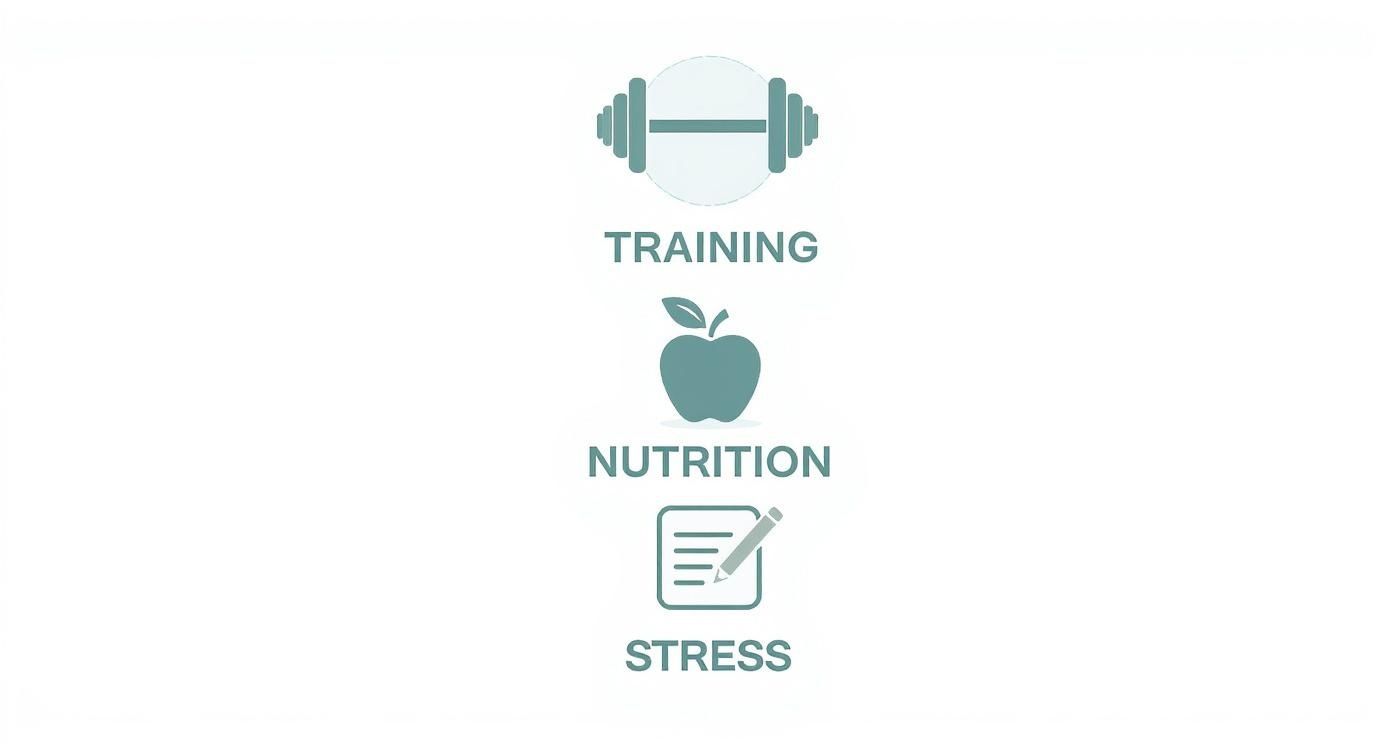
This approach perfectly complements the other pillars of resilience: smart training and dialed-in nutrition.
Exploring Light Therapy For Cellular Health
Beyond temperature, light is another potent tool in the recovery arsenal. Specifically, red light therapy (also called photobiomodulation) uses certain wavelengths of light to penetrate deep into your tissues and fire up your mitochondria.
When your cellular powerhouses work better, they help reduce systemic inflammation and accelerate repair.
By lowering the overall inflammatory load on your body, you free up your nervous system to chill out and shift into a recovery state. A higher HRV is the direct result of that internal calm.
If you want to dig deeper, this table breaks down how some of these popular tools stack up.
Comparing Advanced Recovery Tools for HRV
This table breaks down popular recovery modalities, outlining how they improve HRV, typical protocols, and who can benefit most.
| Modality | How It Boosts HRV | Typical Protocol | Best For |
|---|---|---|---|
| Cold Plunge | Stimulates the vagus nerve, reduces inflammation, and forces a strong parasympathetic response. | 1-5 minutes at 50-59°F (10-15°C), 2-4 times per week. | Athletes with high training loads, anyone looking to build mental and nervous system resilience. |
| Sauna | Promotes relaxation, improves circulation, and reduces stress hormones like cortisol. | 15-20 minutes at 175-195°F (80-90°C), 3-5 times per week. | Individuals with high stress, muscle soreness, or those seeking general wellness and detoxification. |
| Red Light Therapy | Lowers systemic inflammation by improving mitochondrial function and cellular energy production. | 10-15 minute sessions on targeted areas, 3-5 times per week. | People with chronic inflammation, slow-healing injuries, or skin health concerns. |
| HBOT | Increases oxygen saturation in all tissues, accelerating repair and reducing oxidative stress. | 60-90 minute sessions at 1.5-2.0 ATA, protocol varies widely based on goals. | Anyone recovering from significant injury, surgery, or looking for peak cognitive and physical performance. |
Each of these tools offers a unique pathway to a more resilient nervous system.
Incorporating these advanced modalities can truly supercharge your efforts. For those ready to build a dedicated recovery stack at home, our guide to the best recovery tools for athletes is a great place to start.
Common Questions About Improving HRV
As you start working on your HRV, a few questions always come up. Getting clear on the answers will help you set the right expectations and stick with the process for long-term health benefits.
How Long Does It Take to See a Real Change?
This is usually the first thing people ask. While a single slow breathing session can give you a temporary bump, building a new, higher baseline HRV is a long game.
Think weeks and months, not days. It generally takes several weeks of consistent effort—dialing in your sleep, managing stress, and training smart—to see a meaningful upward trend. The real goal is building long-term nervous system resilience, not just chasing a high score for a day.
Is a Higher HRV Always Better?
It's a fair question. Can your HRV be too high?
For the vast majority of us, a higher HRV is exactly what we're after. It's a clear sign of a recovered, adaptable, and resilient system. It's one of the best indicators of positive health and wellness.
However, in very rare cases, an abnormally high HRV paired with an unusually low resting heart rate can be a flag for certain heart arrhythmias. This is not a concern for most healthy people. But if your numbers look extreme and you feel "off," it's always smart to check in with your doctor.
Context is everything. For healthy, active individuals, a rising HRV trend is one of the best indicators you'll find for improved fitness, recovery, and overall well-being.
What's the Single Most Impactful Way to Raise HRV?
If you had to pick just one thing to focus on, what moves the needle the most for your health?
While everything is connected, the answer for almost everyone is high-quality sleep.
Sleep is when your parasympathetic "rest-and-digest" system takes over to handle deep repair and recovery. Nailing your sleep hygiene provides the foundation that all your other efforts are built on. Without it, you're fighting an uphill battle.
A very close second? Consistent, slow-paced breathing. Like sleep, it directly stimulates the vagus nerve to calm your system down. Combining these two—great sleep and a daily breathing practice—is the most powerful one-two punch for improving your HRV.
For more answers to your wellness questions, explore the expert insights on the MedEq Wellness Journal.
Ready to take control of your recovery with professional-grade tools? At MedEq Fitness, we provide science-backed equipment like cold plunges, saunas, and red light therapy devices to help you optimize your health from home. Explore our collection and elevate your wellness journey today.