Pilates for Rehabilitation: Your Guide to Recovery, Strength, and Wellness
Pilates isn't just another workout; it's a powerful method for rebuilding the body from the inside out. When used for rehabilitation, it offers a low-impact, highly controlled way to regain strength, restore flexibility, and correct the movement patterns that get thrown off after an injury. This focus on mindful movement and core strength makes it a cornerstone of modern wellness and workout recovery.
The core idea is to strengthen the deep stabilizing muscles—the ones that act like a natural corset for your spine and joints. By focusing here, Pilates provides a rock-solid foundation for long-term recovery and injury prevention, teaching your body to move smarter, not just harder, and enhancing your overall sense of well-being.
How Pilates Transforms Injury Recovery
Getting back to full strength after an injury or surgery is rarely a straight line. Your body, in its attempt to protect itself, often creates workarounds. Stronger muscles compensate for weaker ones, leading to imbalances that can cause chronic pain or even set you up for another injury down the road. This is where the health benefits of Pilates truly shine.
Pilates cuts right to the heart of this problem. It's all about precision and control, essentially retraining your body to move the way it was designed to.
Think of it like rebuilding a house from the foundation up. Instead of just patching up the one leaky spot (the injury), Pilates reinforces the entire structure—your core. When every movement starts from a stable center, your vulnerable joints are protected, and the right muscles do the heavy lifting. It's this methodical, foundational approach that makes pilates for rehabilitation a go-to for so many physical therapists.
The Core Principles of Healing
What makes Pilates so well-suited for a therapeutic setting are its guiding principles. These aren't just abstract ideas; they're the active ingredients that make the exercises so safe and effective for healing and promoting wellness.
- Control: Every single movement is deliberate. There's no room for jerky, uncontrolled motions, which ensures that healing tissues are never pushed too far, too fast.
- Precision: It's all about quality over quantity. Correct form and alignment are everything, helping to unwind the faulty movement habits that might have led to the injury in the first place.
- Breath: The breath isn't an afterthought; it's synced with every movement. This does more than just deliver oxygen for muscle repair—it helps fire up your deep core stabilizers and soothes the nervous system, which can actually help dial down pain.
- Centering: Every exercise flows from your "powerhouse," or core. A strong, engaged center creates a stable platform for your arms and legs to move from, taking unnecessary strain off areas like the low back, hips, and shoulders.
Pilates isn't just about building muscle; it’s about creating intelligent, efficient movement. It re-establishes that crucial mind-body connection, giving you the power to move with confidence and without pain. It turns recovery into a journey of rediscovery.
While Pilates provides targeted movements, pairing it with broader recovery knowledge can make a huge difference. You can explore effective strategies to recover faster from workouts to round out your rehabilitation plan.
This unique blend of mindful movement and deep stabilization makes Pilates an incredibly versatile tool, whether you're recovering from surgery or managing chronic back pain. To dive deeper into holistic wellness, check out our MedEq Wellness Journal.
The Science Behind Healing Through Movement
So, what makes Pilates such a powerful tool for rehabilitation? It all comes down to its unique ability to rewire the brain-body connection, offering profound health benefits. At its heart, Pilates is a sophisticated form of neuromuscular re-education, essentially teaching your body how to find efficient, pain-free movement patterns again after an injury throws everything off kilter.
This whole process kicks off by sharpening your proprioception—think of it as your body's internal GPS. It’s that sense that lets you know where your arms and legs are without having to look at them. After an injury, this system often gets scrambled, leading to clumsy movements and instability. The slow, deliberate motions in Pilates systematically recalibrate this sense, restoring your body's natural coordination and awareness.
Activating Your Body's Central Command
Imagine your core—that deep web of muscles in your abs, back, and pelvic floor—as your body's central command center. When it's strong and responsive, it provides a stable foundation for every single thing you do. An injury often forces other muscles to work overtime to compensate, creating imbalances that can spiral into chronic pain and dysfunction.
Pilates methodically zeroes in on this central command, strengthening it from the inside out. Every exercise flows from an engaged core, which naturally helps realign the spine and stabilize the pelvis. This creates a supportive "internal corset" that protects vulnerable joints and makes sure the right muscles are firing at the right time. It's a fundamental reason why pilates for rehabilitation is so trusted by physical therapists.
This simple concept map shows how the core tenets of Pilates come together to support recovery.
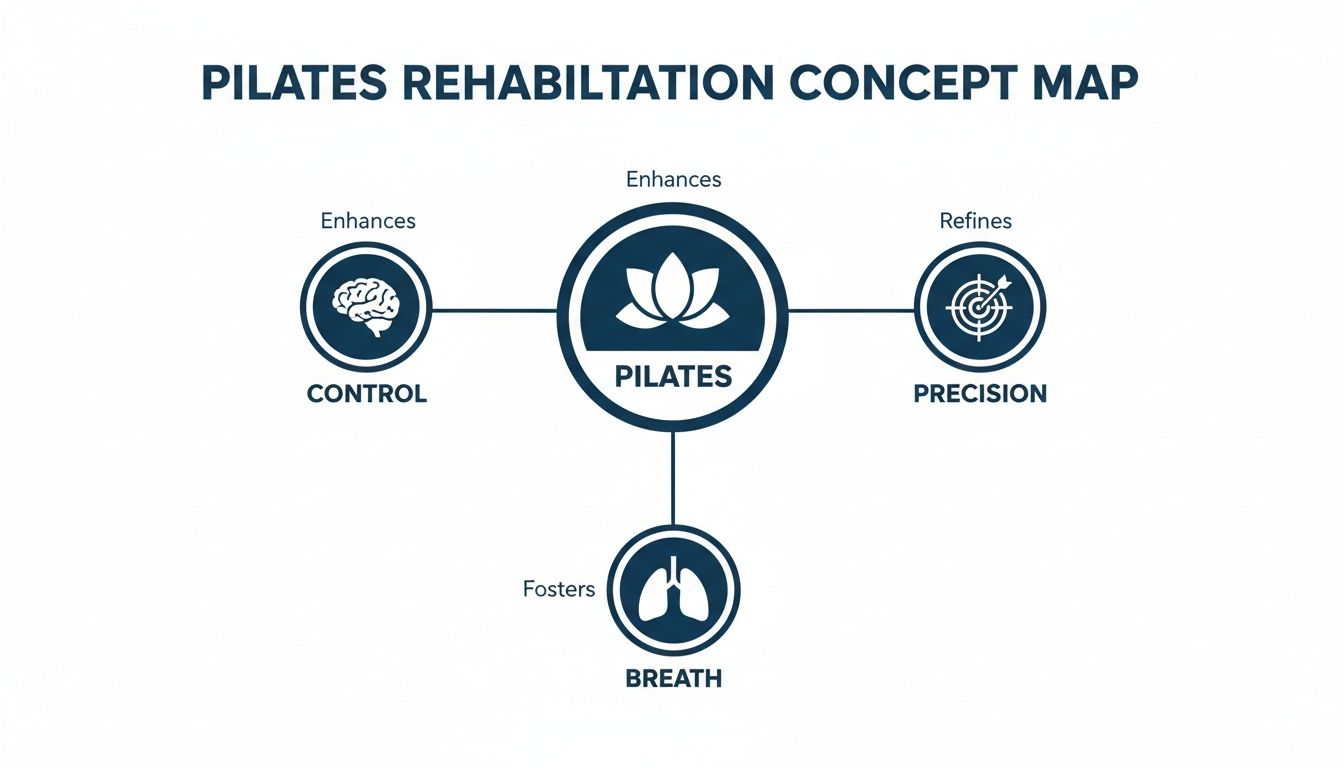
As you can see, the synergy between control, precision, and breath creates a powerful therapeutic effect that goes way beyond just building muscle.
To better understand how these foundational ideas translate into real-world recovery, let's break down the core principles of the method.
How Pilates Principles Support Rehabilitation
| Pilates Principle | Application in Rehabilitation | Health & Wellness Benefit |
|---|---|---|
| Centering | Activates the deep core muscles ("powerhouse") to stabilize the spine and pelvis, creating a solid base for all movement and reducing strain on injured areas. | Improves posture and reduces chronic back pain. |
| Control | Emphasizes slow, deliberate movements, preventing jerky or compensatory patterns and ensuring that the correct muscles are doing the work safely. | Prevents re-injury and promotes mindful movement. |
| Concentration | Requires complete mental focus on each movement, enhancing mind-body connection and re-educating neural pathways for more efficient function. | Reduces stress and increases body awareness. |
| Precision | Focuses on the exact placement and alignment of the body, correcting faulty movement patterns that may have contributed to the initial injury. | Enhances functional movement for daily activities. |
| Breath | Uses deep, coordinated breathing to oxygenate tissues, release unnecessary tension, and facilitate core engagement. | Calms the nervous system and improves circulation. |
| Flow | Links exercises together into smooth, continuous sequences, promoting dynamic stability and functional movement patterns that mimic real-life activities. | Builds stamina and improves coordination. |
Each of these principles works together, creating a holistic approach that doesn't just isolate a single muscle but retrains the entire system to move intelligently.
Gentle Resistance and Safe Strengthening
One of the biggest hurdles in early rehab is strengthening weak muscles without overloading healing tissues and joints. This is where specialized equipment, like the Pilates reformer, truly shines. The reformer uses a spring system to provide gentle, finely-tuned resistance, allowing you to build strength in a supported, non-weight-bearing position.
This controlled environment is a game-changer for post-surgical recovery or for anyone with conditions like arthritis. You can safely isolate and fire up specific muscle groups, promoting balanced development and preventing the muscle atrophy that so often follows an injury. This focus on safe, progressive loading is key not just for restoring function but for building long-term resilience against future problems.
The clinical success of this approach is fueling incredible growth in the wellness world. The rehabilitation sector is supercharging the Pilates reformer market, making these spring-loaded machines essential for clinics and home gyms everywhere. Valued at $628.88 million in 2025, the market is projected to nearly double to $1,107.25 million by 2032, with clinical rehab as the main driver. Healthcare pros love its ability to rebuild mobility and core strength post-op without stressing the joints.
By combining mindful awareness with precise physical execution, Pilates doesn't just heal an injury—it rewires the very way you move, creating a more efficient and resilient body.
This principle of targeted activation for cellular repair isn't unique to Pilates. If you're curious about complementary therapies, you can read more about how red light therapy works to enhance cellular function and support muscle recovery. For more wellness tips, visit the MedEq Wellness Journal.
Ultimately, the science behind Pilates for rehabilitation is about bringing back intelligent movement. It teaches your body to work as a single, integrated system where strength is balanced, motion is fluid, and the core provides unwavering support.
Targeted Pilates Workouts for Common Injuries
Pilates isn't a one-size-fits-all solution, especially in a rehab setting. Its real strength is how it can be molded to fit the exact biomechanical needs of a specific injury. Think of it less like a generic workout and more like a surgical tool for healing, where every movement is chosen to restore function safely and enhance overall wellness.
This level of customization is everything. The exercises needed to stabilize a weak lower back are worlds apart from those used to regain mobility in a post-op shoulder. A skilled instructor or PT can dial in the focus, targeting weak muscles, releasing tight ones, and rewriting bad movement habits with incredible precision.
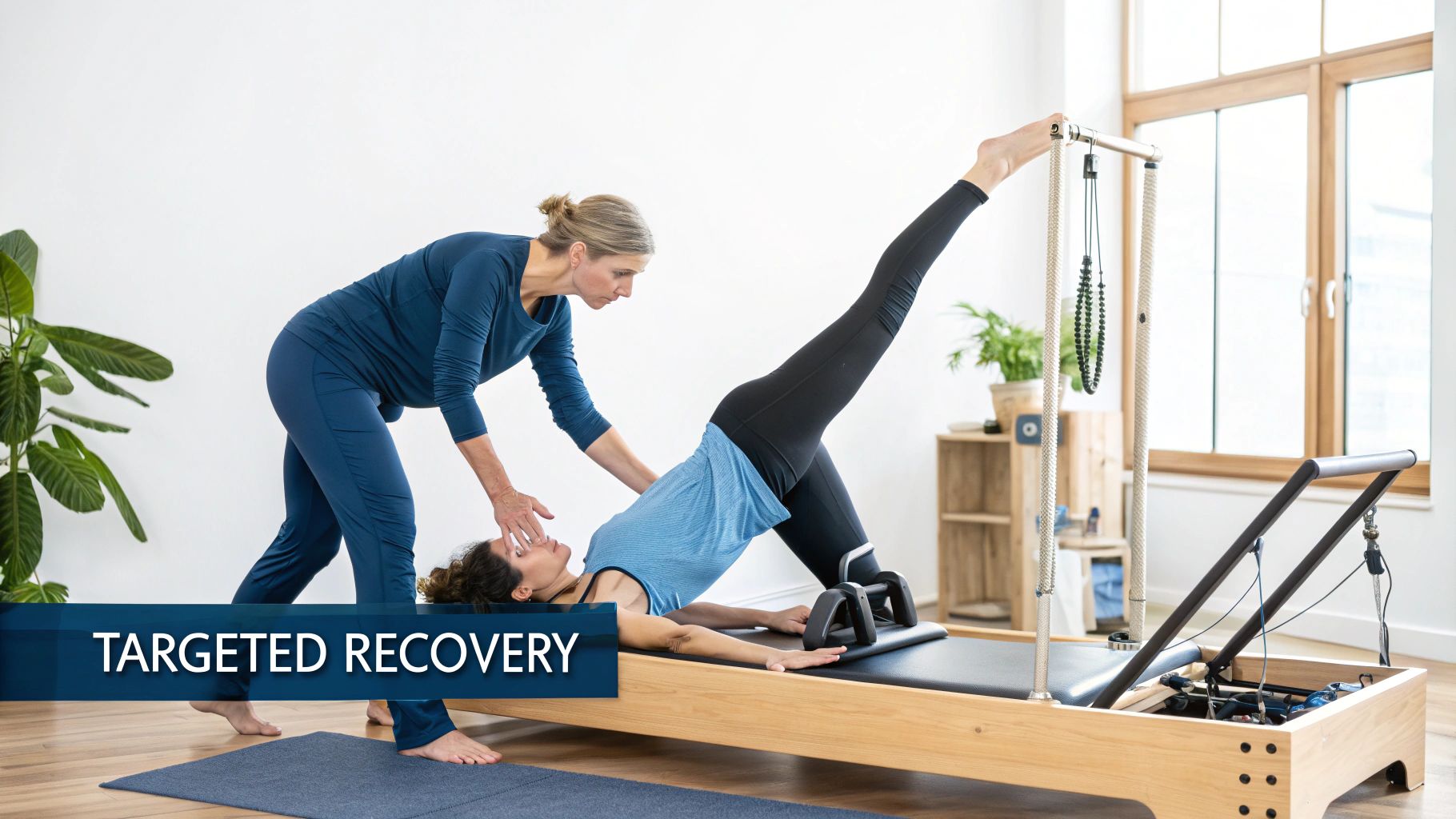
This targeted approach means healing tissues get the support they need without being pushed too far too soon. It’s the key to successful rehab—working smarter to guide the body back to balanced, pain-free movement.
Healing Chronic Low Back Pain
Stubborn low back pain often comes down to two culprits: a weak core and sleepy glutes. When these major support muscles check out, the smaller muscles in the lower back have to pick up the slack. The result? Strain, fatigue, and chronic pain. Pilates wakes up the body’s natural support system to fix this exact imbalance.
Exercises like Bridging are a perfect example. Lying on the mat with knees bent, you slowly lift your hips, focusing on a powerful glute squeeze to drive the movement. This simple action retrains the glutes to fire correctly, taking a massive load off the lumbar spine. Another go-to is the Pelvic Tilt, which gently mobilizes the low back while teaching you to engage the deep transverse abdominis—your body’s built-in corset.
By methodically strengthening the core and activating the glutes, Pilates provides the lumbar spine with the stability it needs to function without pain. It’s like building a supportive scaffold around a vulnerable area, allowing it to heal while the rest of the body learns to carry the load correctly.
This focused approach has turned Pilates into a rehabilitation powerhouse. A 2017 review from Macquarie University in Australia looked at multiple clinical trials and found that Pilates consistently reduced pain and physical impairments for people recovering from injuries. It’s no wonder the equipment market is booming—you can read more about the research driving these market growth insights.
Post-Operative Hip and Knee Recovery
After hip or knee surgery, the game plan is simple: restore range of motion and rebuild strength without hammering the new joint. This is where the Pilates reformer truly shines. Its spring-loaded carriage creates a supported, non-weight-bearing environment that’s perfect for the early days of rehab.
Footwork on the reformer is a classic for a reason. Lying on the carriage, you place your feet on the footbar and press away.
- Controlled Resistance: The springs offer smooth, adjustable resistance, letting you strengthen the quads, hamstrings, and glutes without the jarring impact of gravity.
- Alignment Focus: The carriage guides your movement, ensuring the knee and hip track properly and preventing you from developing funky compensation patterns.
- Gentle Mobilization: The fluid motion helps reduce swelling and stiffness by encouraging healthy movement through the joint.
This controlled environment lets patients start strengthening far earlier and more safely than with traditional exercises, giving the recovery process a serious head start.
Addressing Shoulder Impingement
Shoulder impingement is usually a story of imbalance—overly tight chest muscles overpowering weak upper back muscles, all combined with poor shoulder blade control. Pilates is brilliant at fixing this by strengthening the small, stabilizing muscles around the shoulder and cleaning up your posture.
Exercises that cue scapular retraction and depression are the answer. Using light springs on the reformer or Cadillac for moves like Rowing or Chest Expansion trains the rhomboids and lower traps to pull the shoulder blades down and back. This simple adjustment creates more space in the shoulder joint, which relieves the pinching that causes all that pain.
This precision work retrains the shoulder to operate from a stable, properly aligned base. It gets to the root cause of the impingement, not just the symptoms. For more deep dives into targeted recovery strategies, be sure to visit the MedEq Wellness Journal.
Pairing Pilates with Advanced Recovery Tools
Think of your active recovery with Pilates as the essential work of retraining movement patterns and rebuilding strength from the inside out. It's incredibly powerful on its own. But to create a truly comprehensive healing environment, we can layer in advanced passive recovery tools to accelerate the process and amplify the results. This is key for holistic workout recovery and overall wellness.
This combination bridges the gap between the intentional work of your Pilates session and the deep, cellular renewal your body needs to thrive.
Imagine your Pilates workout is the skilled carpentry—carefully realigning and strengthening your body's framework. The recovery tools are the specialized crew that comes in after, speeding up the cleanup and applying the finishing touches. They help manage inflammation, boost circulation, and prime your cells for repair, creating the perfect conditions for the health benefits from your Pilates practice to truly set in.
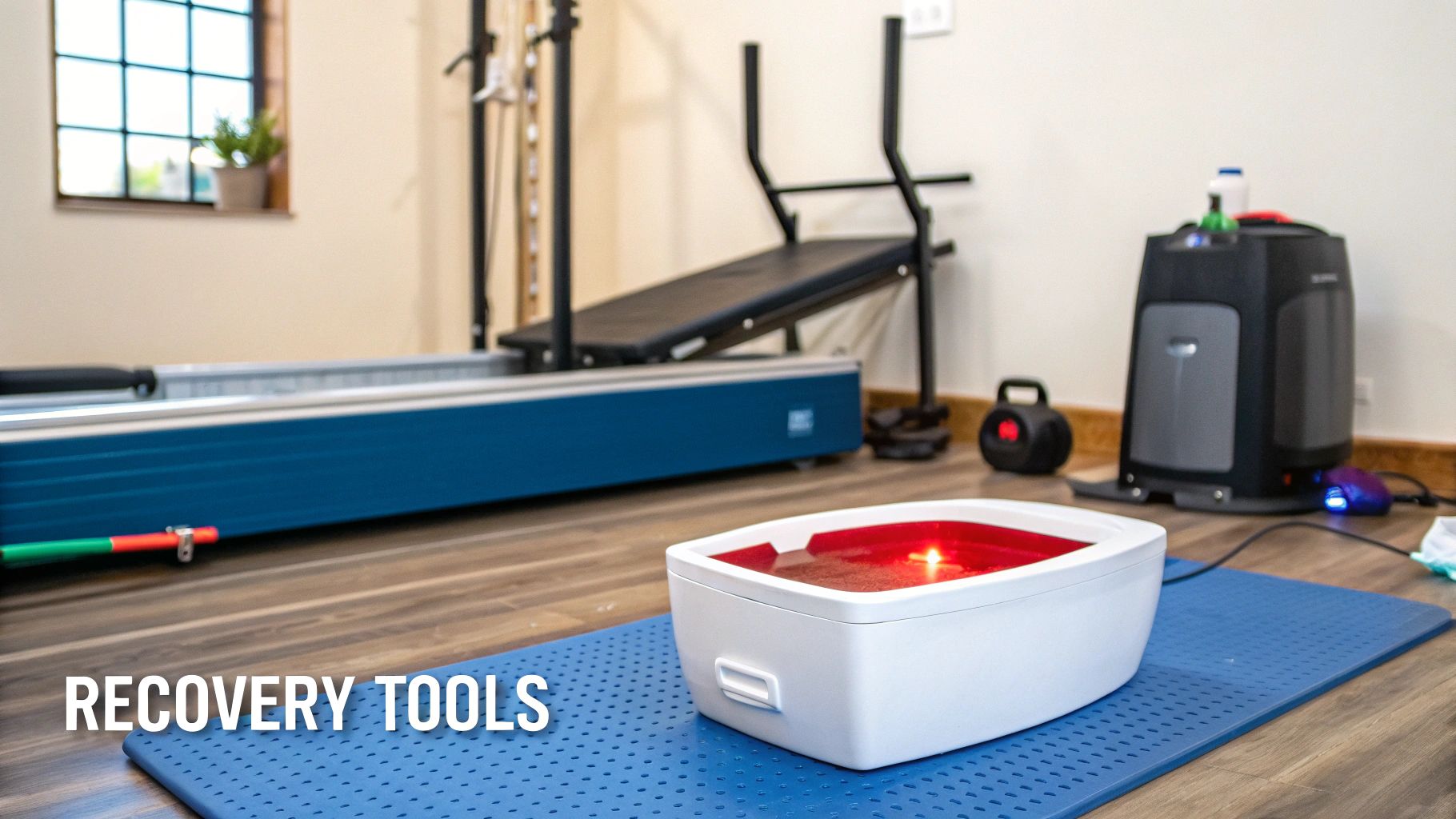
This kind of holistic strategy means you're addressing every piece of the recovery puzzle, from neuromuscular re-education during your session to cellular repair during your downtime.
The Power of Contrast Therapy Post-Pilates
One of the most effective ways to supercharge recovery after a focused Pilates session is contrast therapy. It’s a simple concept: you alternate between hot and cold environments, usually a sauna and a cold plunge. This rapid temperature shift creates a "pump" effect throughout your circulatory system, and the therapeutic benefits for wellness are immense.
Here’s a quick breakdown of how it works for workout recovery:
-
Heat Exposure (Sauna): Stepping into a sauna causes vasodilation, which is just a fancy word for your blood vessels widening. This dramatically increases blood flow, rushing oxygen and nutrients to the muscles you just challenged.
-
Cold Exposure (Cold Plunge): The immediate switch to a cold plunge triggers vasoconstriction, where your blood vessels narrow. This process is fantastic for flushing out metabolic byproducts, like lactic acid, that build up during exercise.
This cycle of expansion and contraction is a potent way to reduce inflammation and muscle soreness. By tacking on a contrast therapy routine after your Pilates workout, you can dramatically shorten your recovery time, ease that post-session stiffness, and get your body ready to come back even stronger.
Priming Your Body with Red Light Therapy
While contrast therapy is a fantastic tool for after your workout, red light therapy is a game-changer when used before you even start. This non-invasive therapy uses specific wavelengths of light to penetrate deep into your tissues, essentially firing up your cellular engines.
Think of it as waking up your cells and giving them a full tank of gas before you even start moving. By pre-treating the muscles you plan to target in your Pilates session, you can improve their flexibility, strength, and endurance right from the first exercise.
Using red light therapy before a rehab-focused session can:
- Boost Cellular Energy: It stimulates the mitochondria in your cells to produce more ATP (adenosine triphosphate)—your body's core energy currency. This helps muscles work more efficiently and fight off fatigue.
- Improve Blood Flow: Much like heat, it enhances local circulation, ensuring your muscles are well-nourished and prepped for controlled movement.
- Reduce Inflammation: It can help lower baseline inflammation, which is a huge plus when you're working around a sensitive or healing injury.
This proactive step primes your body for peak performance, making your rehabilitation work more effective and comfortable from the get-go. To see how these modalities fit into a bigger picture, check out our guide to the best recovery tools for athletes.
When you combine the precision of Pilates with the cellular benefits of these tools, you create a powerful synergy that addresses healing from every possible angle. For more insights on building a complete wellness plan, visit the MedEq Wellness Journal.
Choosing Your Pilates Rehabilitation Equipment
Picking the right tools is a foundational step when using Pilates for rehabilitation. While you can get a lot done on a mat, the specialized equipment offers a level of support and finely tuned resistance that’s often non-negotiable in the early stages of recovery. This gear helps guide movements, takes the load off sensitive joints, and ensures you maintain proper form when your body is at its most vulnerable.
Think of the equipment as a highly skilled training partner. It provides a helping hand when you need it and adds just enough resistance as you get stronger, paving the way for a safe, progressive return to function. This supportive environment is precisely why equipment-based Pilates is the go-to choice in clinical settings, especially for post-operative patients or those with serious movement limitations.
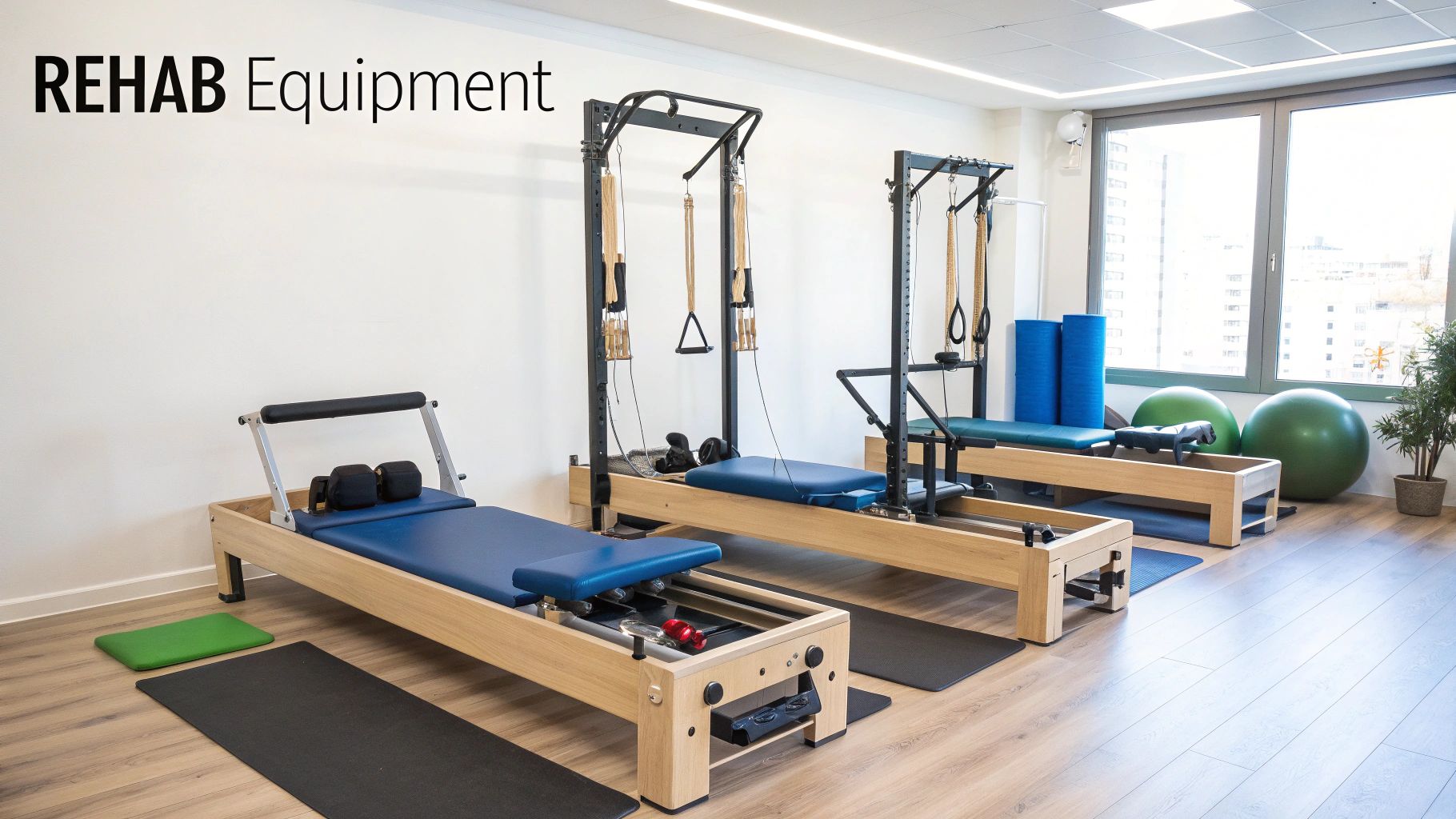
The Reformer: The Foundation of Rehab
The Pilates Reformer is easily the most famous and versatile piece in the studio. It’s built with a sliding carriage, springs for resistance, and a system of straps and bars. Its design is brilliant for providing adjustable, non-weight-bearing support to injured limbs.
For someone coming back from knee surgery, the Reformer lets them strengthen their leg muscles while lying down, completely removing the stress of gravity. The spring system offers incredibly nuanced resistance that can be dialed up bit by bit as their strength returns. If you want to get into the nuts and bolts of how it works, you can learn more about the Pilates Reformer in our detailed guide.
The Cadillac and Wunda Chair: Specialized Support
While the Reformer is the workhorse, other pieces offer unique advantages for specific rehab scenarios.
-
The Cadillac: This large, stable apparatus looks a bit like a four-poster bed frame, rigged with various springs, bars, and straps. Its height and sturdiness make it perfect for anyone with significant mobility issues or balance problems. It offers incredible support for complex spinal exercises and helps severely deconditioned patients start moving again safely.
-
The Wunda Chair: This is a much more compact piece, but it’s a powerhouse for challenging balance and building functional, weight-bearing strength as recovery progresses. It’s perfect for exercises that mimic everyday movements like stepping up or pushing off, making it a critical tool for bridging the gap from the rehab clinic back to daily life.
Each piece of equipment serves a distinct purpose in the rehabilitation journey. The choice depends on the specific injury, the stage of recovery, and the ultimate functional goals of the individual.
The proven effectiveness of these tools is driving huge growth in the market. As Pilates’ reputation in rehabilitation grows, so do studio memberships and equipment sales. The equipment market alone is projected to shoot up from $116.8 million in 2022 to $281.6 million by 2034. This surge shows just how much demand there is for rehab-focused tools, with North America leading the charge at 37.7% of this growth. You can explore more on the Pilates market trends to see the data for yourself. For more guides on fitness equipment, visit the MedEq Wellness Journal.
Building Long-Term Resilience and Performance
Any good rehab program gets you past the injury. A great one makes sure it never happens again. The goal isn’t just to heal; it’s to build a body that’s smarter, stronger, and fundamentally more resilient, which is the essence of true wellness.
This is where Pilates becomes so essential in a modern recovery strategy. It doesn't just patch the problem—it rebuilds your entire foundation for movement, ensuring you don’t just recover, but actually evolve.
By zeroing in on core stability, muscular balance, and precise control, Pilates essentially re-educates your body’s movement patterns from the ground up. This methodical approach gets to the heart of why the injury happened in the first place, whether it was a hidden imbalance or just plain bad biomechanics.
Ultimately, it’s about giving you the confidence to move freely again, knowing you’ve built a body that can handle it.
From Recovery to Lasting Strength
The principles you internalize during pilates for rehabilitation—things like centering, control, and precision—stick with you for life. They show up in how you lift groceries, play tennis, or even just sit at your desk. This heightened body awareness is your best long-term defense against future setbacks.
When you make Pilates a regular part of your routine, you continuously reinforce the strong foundation built during your recovery. It creates a powerful feedback loop:
- A stronger core acts like a natural corset, protecting your spine and joints during more demanding activities.
- Improved flexibility and mobility mean your body can move through its full, intended range without strain or compensation.
- An enhanced mind-body connection lets you catch and correct funky movement patterns before they have a chance to cause trouble.
This is how rehabilitation moves from being a temporary fix to a permanent upgrade for your body's operating system. You don’t just learn to manage an injury; you build a more durable and efficient machine.
The ultimate goal is not simply to return to your pre-injury state but to emerge stronger and more resilient than before. Pilates provides a clear pathway to achieving this, turning a setback into an opportunity for profound physical improvement.
Recovery is a journey of continuous growth. To dive deeper into building a resilient body and achieving optimal health, explore more insights at the MedEq Wellness Journal.
Got Questions About Pilates for Rehab? We've Got Answers.
When you’re looking at a new path to recovery, it’s natural to have questions. Using Pilates for rehabilitation is a big decision, so let’s clear up a few common points to help you move forward with confidence.
Is Pilates Safe for Every Single Injury?
While Pilates is incredibly versatile, it’s not a magic bullet for every single injury right out of the gate. The secret to its safety and power lies in one word: personalization. This is why working with a qualified professional—like a physical therapist or a certified instructor who specializes in rehab—is non-negotiable.
These experts know exactly how to modify exercises for your specific situation, whether you're dealing with a disc herniation, recovering from a joint replacement, or nursing a soft tissue tear. They'll make sure every movement supports healing tissue and prevents further strain by focusing on perfect alignment.
The bottom line on safety? It all comes down to expert guidance. A skilled practitioner designs a program that respects your body’s current limits while gently nudging it to rebuild strength and function.
How Soon After Surgery Can I Start Pilates?
This is a question for your surgeon and physical therapist, period. They're the only ones who understand the ins and outs of your specific procedure and what your healing timeline looks like.
That said, you might be surprised how early gentle, supervised Pilates can be introduced. In those initial stages, it’s not about getting a workout. The focus is on fundamentals: improving circulation to speed up healing, preventing the muscles around the surgical site from weakening, and activating your deep core to create stability without stressing the repaired area.
What's the Real Difference Between Rehab Pilates and a Regular Class?
This is a crucial distinction. Think of it like this: a regular fitness class and a clinical rehab session might use the same equipment, but their purpose and approach are completely different.
- Regular Fitness Class: This is built for a group of generally healthy people. The instructor guides everyone through a set routine focused on overall conditioning, toning, and flexibility. It’s a workout.
- Rehabilitation Pilates: This is a highly individualized, often one-on-one, program. It’s designed by a clinical professional to target your specific injury, fix the movement patterns that caused it, and safely get you back to full function. Every single exercise has a therapeutic goal.
In short, rehabilitation Pilates is a precise clinical tool. A fitness class is for general wellness.
At MedEq Fitness, we're committed to providing the best tools for a full, lasting recovery. Our curated wellness equipment is designed to support you at every stage of your healing journey. Explore our collections and see how you can build a stronger, more resilient body. For more expert-led insights, check out our MedEq Wellness Journal.