A Guide to the Best Low-Impact Cardio Machines for Health and Wellness
Picture this: you get a fantastic, heart-pounding cardio workout that boosts your wellness, but without the harsh, jarring impact on your knees and ankles. That's the simple, powerful promise of low-impact cardio machines. They're designed to help you build serious endurance and improve your health while being incredibly kind to your joints.
It’s like the difference between gliding smoothly across a surface versus pounding the pavement. Both get you moving, but one is a whole lot more forgiving and beneficial for your body's long-term wellness.
Why Your Joints Will Thank You For Low-Impact Cardio
The real magic of low-impact cardio is how it separates intensity from impact, prioritizing your health. Think about running on a sidewalk. With every single step, significant ground reaction forces shoot up through your ankles, knees, and hips. Over time, that repetitive stress can lead to joint pain, inflammation, and nagging overuse injuries.
But equipment like an elliptical or a rowing machine changes the game entirely. These machines guide your body through a smooth, controlled range of motion, which all but eliminates that jarring shock. This means you can get your heart rate soaring and really challenge your muscles without punishing your joints, making fitness a sustainable—and enjoyable—part of your wellness journey for the long haul.
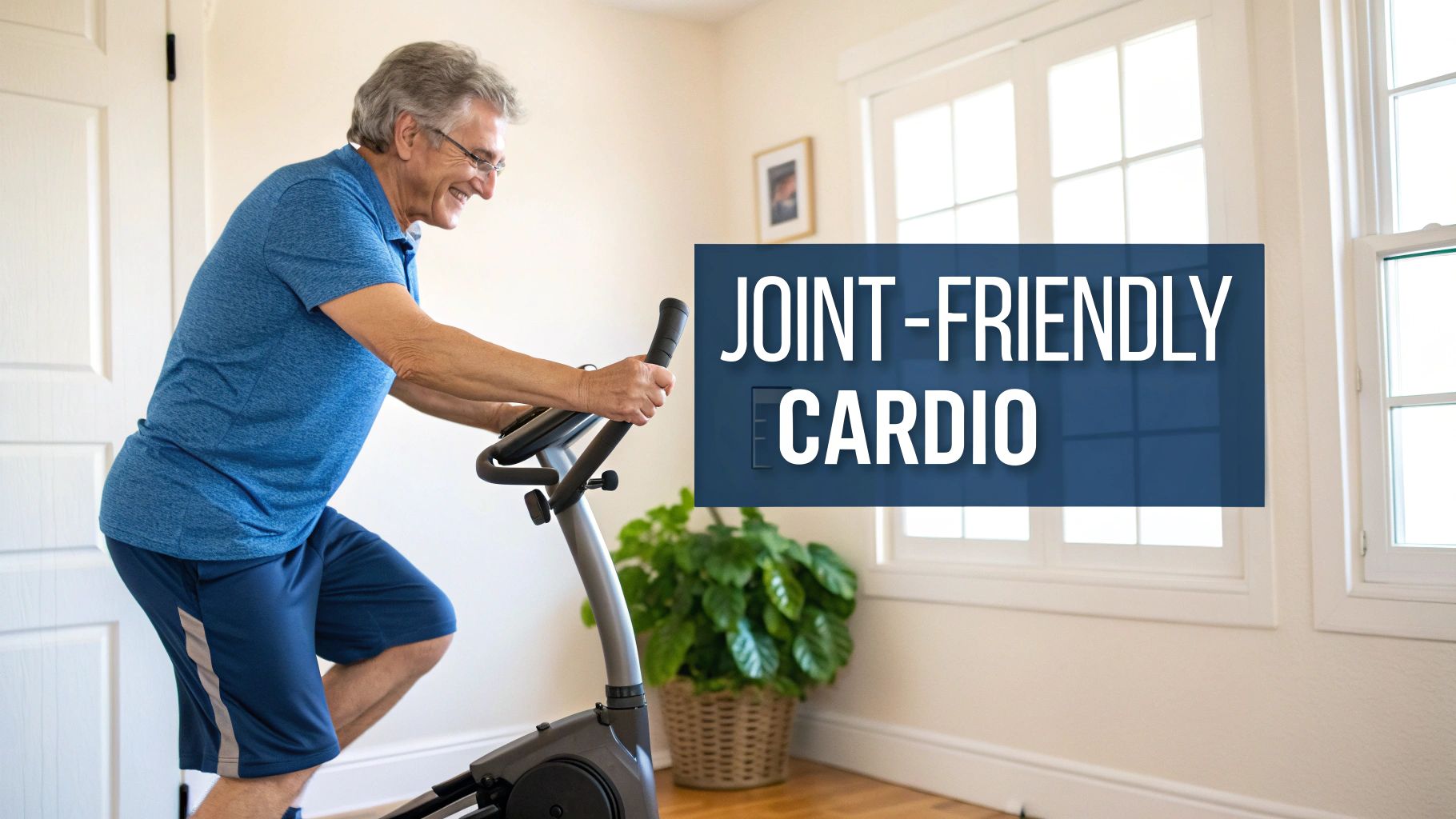
To quickly see why these machines are such a game-changer for your health, check out this summary.
Quick Health & Wellness Benefits of Low-Impact Cardio
| Benefit | Impact on Your Body | Ideal For |
|---|---|---|
| Joint Preservation | Reduces stress on knees, hips, and ankles by eliminating jarring movements. | Individuals with arthritis, joint pain, or recovering from injury. |
| Sustainable Wellness | Allows for consistent, long-term training without the risk of overuse injuries. | Anyone seeking a lifelong approach to health and wellness. |
| Improved Recovery | Boosts blood flow to muscles, aiding in faster workout recovery and reducing soreness. | Athletes in active recovery and beginners building a fitness base. |
| Injury Rehabilitation | Provides a safe way to maintain cardiovascular health while recovering from an injury. | Physical therapy patients and individuals with chronic conditions. |
Ultimately, low-impact machines offer a smarter, more sustainable path to achieving your fitness goals without compromising your long-term joint health.
A Smarter Path to Fitness and Workout Recovery
There's a common myth that "low-impact" means "low-intensity" or "low-results." Nothing could be further from the truth. These machines are incredibly versatile. You can easily crank up the resistance, increase your speed, or add incline to push your cardiovascular system and build serious stamina.
This makes low-impact cardio a powerful tool for promoting overall health and wellness:
- Athletes and High-Performers: They use these machines for active recovery, helping to flush out metabolic waste and promote healing on off-days without adding more stress to their bodies.
- Individuals in Rehabilitation: For anyone coming back from an injury or managing a chronic condition like arthritis, these machines offer a safe and effective way to get moving again.
- Wellness Enthusiasts of All Ages: Anyone focused on long-term health can use low-impact training to build a resilient body that feels great, day in and day out.
The Growing Demand for Sustainable Wellness
People are moving away from the "no pain, no gain" mindset and embracing smarter, more sustainable fitness. The numbers back it up: the home cardio market is projected to hit nearly USD 25.8 billion by 2025. This shift is driven by a desire to avoid the overuse injuries that sideline 20-30% of runners every year.
Machines like ellipticals, which can slash joint impact by a staggering 90% compared to running on pavement, are at the heart of this wellness movement. It’s especially true as we see fitness participation among the over-50 crowd grow by 25% since 2010.
Just like with indoor machines, ensuring a proper bicycle fit is crucial for joint health and comfort, which is what makes cycling another highly effective low-impact choice. When you prioritize your joint health, you’re not just picking a piece of equipment—you’re adopting a smarter approach to your lifelong fitness journey.
For more insights on building a balanced and sustainable wellness routine, be sure to check out our MedEq Wellness Journal.
Your Guide to the Top Low-Impact Cardio Machines
Stepping into the world of low-impact cardio can feel like trying to decipher a new language. Every machine has its own dialect—its own unique way of moving your body and benefiting your health. Getting fluent in these differences is the secret to finding the equipment that truly speaks to your wellness goals, whether you're chasing raw power, building endurance, or focusing on gentle workout recovery.
This guide is your translator. We'll break down the most popular and effective machines out there, exploring how they work, what muscles they target, and what makes each one a serious tool for your health. By the end, you'll know exactly which machine fits your body's language.
The Rowing Machine: A Full-Body Powerhouse
The rowing machine is often crowned one of the most efficient low-impact machines on the planet, and for good reason. It’s a total-body workout that delivers incredible health benefits. Forget the old myth that rowing is just an arm exercise. A proper stroke actually fires up an estimated 86% of your muscles, with the real force coming from your legs and core.
The movement itself is a fluid, powerful sequence: you push with the legs, brace with the core, and finish with a strong pull using your back and arms. This rhythm doesn't just get your heart rate soaring; it builds functional strength and cardiovascular wellness from head to toe.
- Primary Muscles Targeted: Quadriceps, hamstrings, glutes, core, lats, and biceps.
- Key Health Benefit: It masterfully blends cardio conditioning with strength training into one smooth motion. That’s efficiency at its best.
For those who love when function meets form, a handcrafted wooden water rower adds an almost meditative quality to the workout. The gentle sloshing of the water creates a soothing rhythm, and the design alone can elevate any home gym or wellness space. To learn more, check out our deep dive on the rowing machine.
The Elliptical Trainer: Smooth and Gliding Motion
There’s a reason the elliptical is a fixture in nearly every gym—it perfectly mimics the feeling of running, but without any of the jarring impact. Your feet stay planted on the pedals as they glide along a long, oval path, making this movement exceptionally kind to your knees, hips, and ankles.
Many ellipticals come with moving handlebars, giving you the option to bring your upper body into the action for a more complete workout. By pushing and pulling with your arms, you can improve cardiovascular health while toning your chest, back, and shoulders all at once.
Compared to running on pavement, an elliptical can slash joint impact by as much as 90%. This makes it a fantastic option for anyone with sensitive joints or those on the road to recovery.
The Recumbent Bike: Comfort Meets Conditioning
When it comes to pure comfort and joint protection, the recumbent bike is in a class of its own. The defining feature is its laid-back, chair-like seat, which offers incredible back support. This design lifts virtually all the stress off your lower back and joints, making it one of the most approachable low-impact machines you can find for long-term wellness.
It’s the perfect starting point for beginners, people recovering from an injury, or anyone managing chronic back or knee pain. And don’t let the comfort fool you—while it mainly works the lower body, cranking up the resistance delivers a seriously challenging cardio session that benefits your heart health.
- Primary Muscles Targeted: Quadriceps, hamstrings, glutes, and calves.
- Key Health Benefit: The supportive seat lets you settle in for longer, more comfortable workouts, which is ideal for building endurance without the strain.
Air Bikes and Manual Treadmills: The Intensity Specialists
Ready to kick things up a notch? Air bikes and manual curved treadmills are here to challenge you. An air bike uses a fan to create resistance—the harder you pedal and pump your arms, the more resistance it pushes back. It’s a beautifully simple design that’s perfect for high-intensity interval training (HIIT).
A manual curved treadmill, on the other hand, is powered entirely by you. You are the motor. Every stride you take propels the belt, which forces you to engage more muscles—especially your glutes and hamstrings—and can burn up to 30% more calories than a standard motorized treadmill. Both machines are low-impact, but they are built for high-intensity effort.
For shared low-impact cardio machines in any setting, keeping them sanitary is non-negotiable. Knowing how to choose and use effective workout equipment wipes is key to maintaining a safe and hygienic space.
Discover more ways to build a complete wellness routine at the MedEq Wellness Journal.
Unlock Better Workout Recovery with Low-Impact Exercise
We often think of fitness in terms of pushing our limits, but the real secret to getting stronger is how well you recover. Low-impact cardio machines are absolute game-changers here, bridging the gap between intense workouts and deep, restorative rest that enhances overall wellness.
Think of a gentle session on one of these machines as active recovery. You’re boosting blood flow to those tired, aching muscles without piling on more stress. This increased circulation is like a cleanup crew for your body, flushing out metabolic waste products—like lactic acid—that make you feel sore. The result? You heal faster, experience less muscle soreness, and feel ready for your next session sooner.
This graphic breaks down the key players in the world of low-impact cardio and how they support a well-rounded fitness and wellness plan.
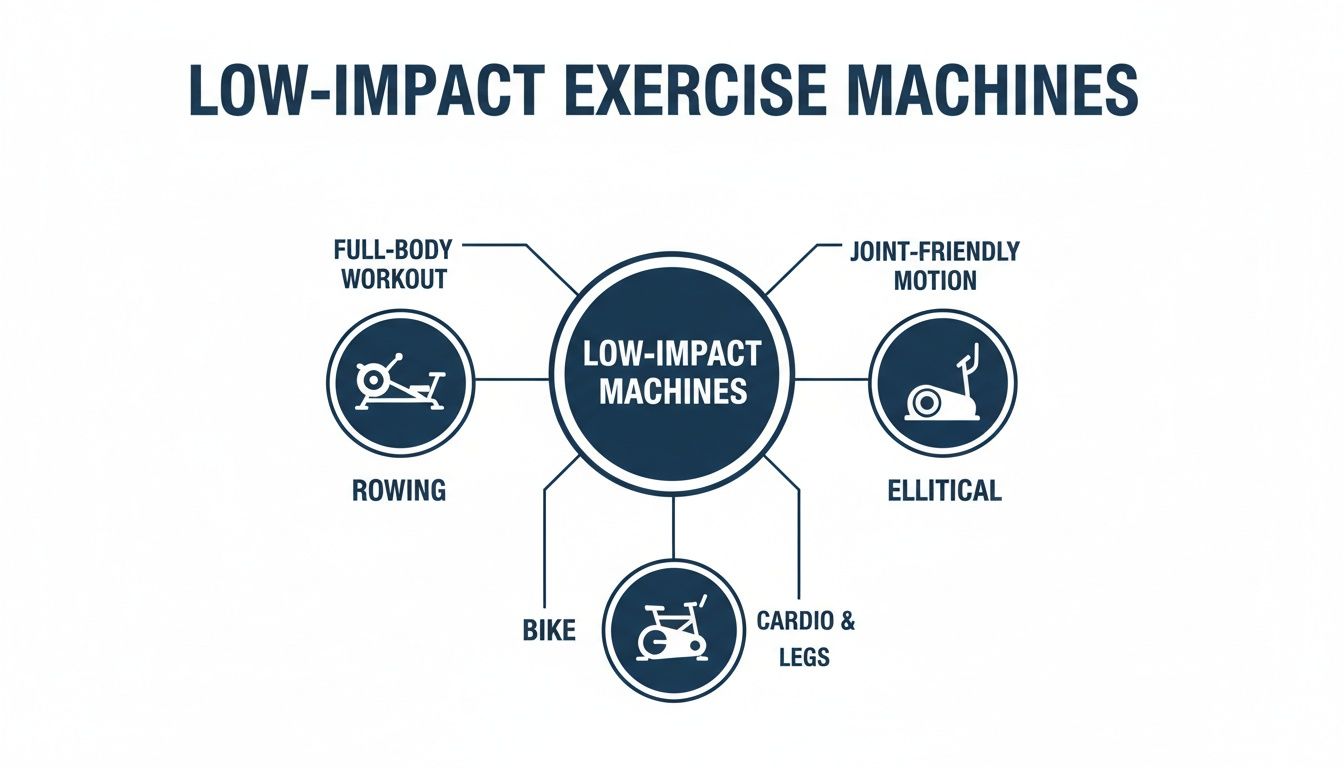
As you can see, each machine gives you a different way to get fit without hammering your joints, targeting various muscle groups while always keeping workout recovery front and center.
Elevate Wellness and Track Your Progress
It’s not just about feeling better; incorporating low-impact cardio delivers measurable wins for your overall wellness. Key metrics like Heart Rate Variability (HRV), which is a fantastic indicator of your body's readiness to perform, often see a big boost from consistent, gentle movement. It’s not uncommon for people to see 20-30% improvements in their HRV scores, a clear sign that their nervous system is more balanced and recovered.
This has a direct, positive health benefit on your sleep. By helping your body wind down and repair itself more effectively, low-impact exercise often leads to deeper, more restorative sleep—the true foundation of any solid fitness routine.
True workout recovery isn't passive—it's an active process. Using low-impact cardio machines to gently move your body on rest days accelerates healing, reduces inflammation, and prepares you for your next big effort.
Pair Cardio with Contrast Therapy for Peak Recovery
Want to take your workout recovery to the next level? Try pairing your low-impact cardio session with contrast therapy. This wellness practice involves alternating between hot and cold temperatures, such as spending time in a sauna and then taking a cold plunge. This creates a powerful "pump" effect in your circulatory system, which can dramatically reduce inflammation and kickstart tissue repair.
Rowing machines are perfect for this. They engage up to 86% of your major muscle groups with almost zero stress on the joints, which is why they’re a staple for physical therapists and wellness centers. In fact, the global commercial fitness market—where this equipment is king—is expected to hit USD 18,106.23 million by 2032, all because more people are prioritizing their health and recovery.
When you start integrating these practices, workout recovery stops being a passive break and becomes an active strategy to boost your performance and long-term health. For a deeper dive, check out our guide on how to speed up muscle recovery for more pro tips.
How to Structure Your Low-Impact Workouts
Having the right machine is just the start. Knowing how to use it is what separates aimless movement from real, measurable health benefits.
The true magic of low-impact equipment is its versatility. You can dial in your workouts for specific wellness goals, whether that’s building serious endurance, chipping away at body fat, or just helping your body bounce back after a tough session.
Structuring your sessions properly is the key to getting the most out of every minute. This means moving beyond just hopping on and going until you get bored. It’s about using proven protocols that line up with what you actually want to achieve for your health.
Tailoring Workouts to Your Goals
Your primary health objective completely changes how you should approach your workout. Someone training for fat loss is going to program their sessions very differently from an athlete focusing on workout recovery.
Here are three tried-and-true training styles you can use on any low-impact machine to get the job done:
-
Low-Intensity Steady-State (LISS): This is all about finding a consistent, moderate pace and holding it for a longer duration. It’s fantastic for building a solid aerobic base and improving cardiovascular health without hammering your joints.
-
High-Intensity Interval Training (HIIT): The polar opposite of LISS. HIIT involves short, all-out bursts of effort followed by brief recovery periods. It's incredibly efficient for boosting your metabolism and cardiovascular fitness in a fraction of the time.
-
Active Recovery: Think of these as light, gentle sessions designed to get blood flowing and help your muscles repair. The goal isn't to push yourself—it's to speed up the healing process and enhance wellness on your off days.
Sample Low-Impact Workout Protocols
Let's make this real. The following guide offers a clear, actionable plan for structuring your workouts on low-impact machines based on common wellness goals. We'll use the Rate of Perceived Exertion (RPE) scale, where 1 is sitting still and 10 is an all-out sprint you can't hold for more than a few seconds.
Sample Low-Impact Workout Protocols
| Goal | Machine Example | Duration | Intensity (RPE 1-10) | Frequency |
|---|---|---|---|---|
| Cardiovascular Health (LISS) | Recumbent Bike | 30-45 minutes | 4-5 RPE: A pace where you can hold a conversation. | 3-5 times per week |
| Endurance (Intervals) | Rowing Machine | 25 minutes |
Warm-up: 5 min at 3 RPE Intervals: 8 rounds of 1 min at 8 RPE, 1 min at 4 RPE Cool-down: 4 min at 3 RPE |
2-3 times per week |
| Active Recovery | Elliptical | 15-20 minutes | 2-3 RPE: Very light effort, just getting the body moving. | 1-2 times per week (on rest days) |
For example, a session focused on heart health could be a chill 40-minute ride on a recumbent bike while you listen to a podcast, just keeping your effort steady. For a lung-busting endurance workout, you might jump on an air bike for a 20-minute HIIT session, going all-out during your "on" intervals.
By bringing structure to your cardio, you start moving with purpose. Every session becomes another step toward your wellness goals. For more expert-led insights on fitness and recovery, check out the MedEq Wellness Journal.
Choosing the Right Machine for Your Space and Goals
Bringing a low-impact cardio machine into your home is a huge step for your long-term health. But with so many choices out there, it’s easy to feel overwhelmed. Let’s break it down with a practical checklist to help you find the perfect machine that actually fits your life and your wellness goals.
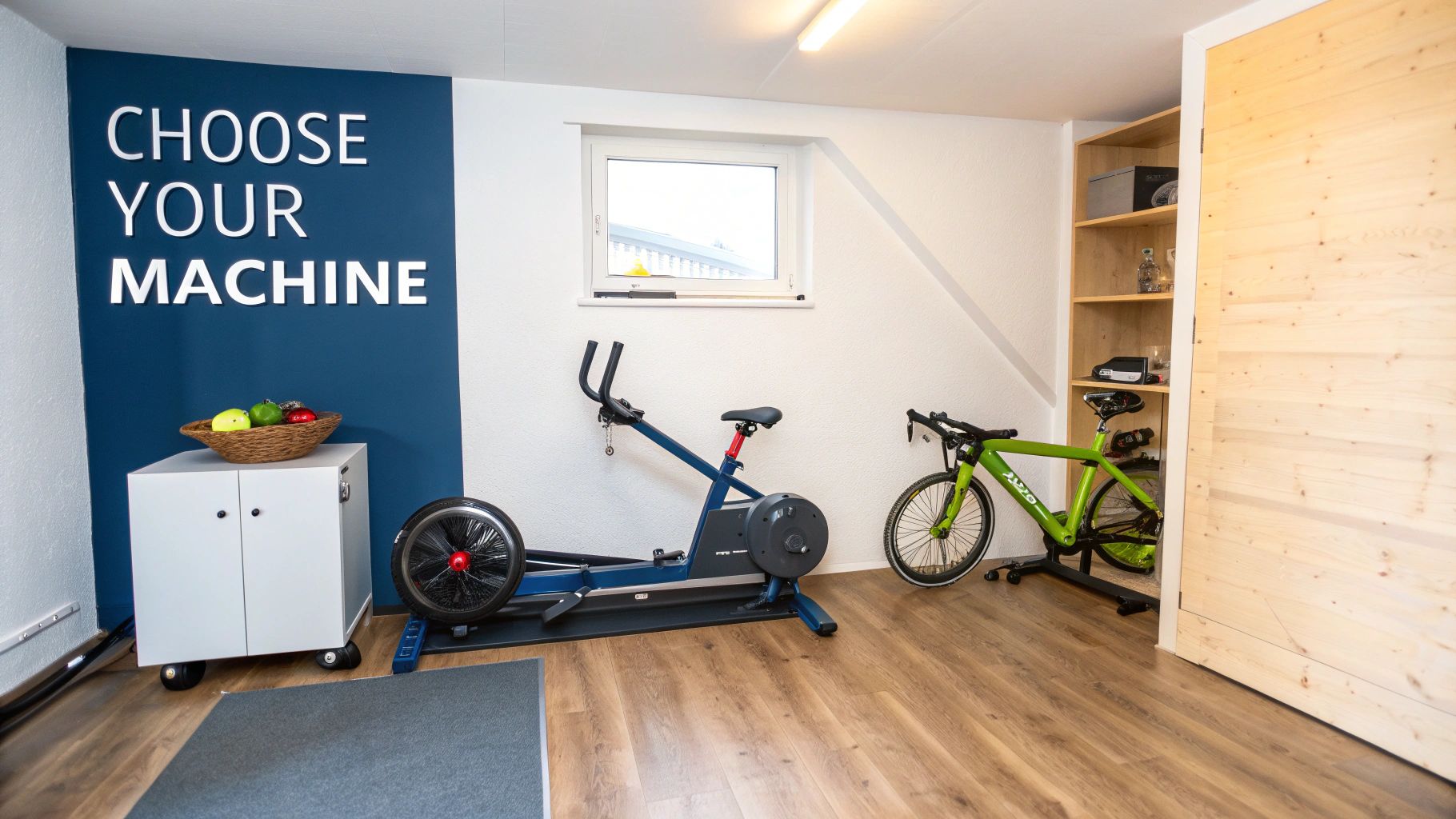
After all, the best machine is the one you’ll be excited to use day after day—not one that ends up as a clothes rack.
Assessing Your Space and Environment
First things first: grab a tape measure. A fantastic machine is worthless if you can’t fit it in the room. Remember to measure not just the machine's footprint but also the extra space you'll need around it for safe movement, like a rower's full slide or an elliptical's arm swing.
Noise is another big one that people often forget. If you’re in an apartment with paper-thin walls or plan on early morning workouts, a quiet machine is non-negotiable.
- For Small Spaces: Look into a foldable rower. You can tuck it away vertically after you're done. Compact recumbent bikes are also a great option with a small footprint.
- For Dedicated Home Gyms: If you’ve got the room, you can go bigger with something like a heavy-duty elliptical or a manual curved treadmill.
- Noise Considerations: Water rowers have a really pleasant, whooshing sound, while good ellipticals are built to be almost silent. Both are perfect for shared living spaces.
Aligning Equipment with Your Health & Wellness Objectives
What are you actually trying to achieve for your health? Your main goal should be the biggest factor in your decision. Are you aiming for a full-body thrashing, or do you need the gentlest option possible for rehab and workout recovery?
Your wellness objective is your compass. A machine built for high-intensity training is worlds apart from one designed for comfortable, steady-state cardio. Pick the one that points straight to where you want to go.
An air bike, for example, is king for high-intensity interval training. But a recumbent bike offers incredible comfort for building endurance without putting any stress on your back or knees.
And if you want to build functional strength while getting your cardio in, a rowing machine that hits 86% of your muscles is the clear winner for comprehensive health benefits.
If a treadmill is on your mind, it's worth knowing the difference between the main types. Our guide on manual treadmills vs electric breaks it all down to help you choose wisely. Matching the machine to your goals from the start is the key to sticking with it.
Your Foundation for Sustainable Fitness and Wellness
Choosing low-impact cardio isn't just about picking a piece of equipment. It's a strategic move for your long-term health, performance, and ability to keep showing up.
As we've covered, these machines are a game-changer. They protect your joints, let you train consistently without burnout, and seriously upgrade your workout recovery process. Whether you end up with a rower, an elliptical, or a curved treadmill, you’re investing in a fitness journey that can actually last.
This is simply a smarter way to train—one that closes the gap between hard work and smart recovery. It’s an approach that’s clearly catching on, too. The market for home cardio equipment is projected to hit USD 19.79 billion by 2032, according to recent market analysis reports. People are investing in their health at home, and they're choosing tools that are built for lasting wellness.
Ready to find the right fit for your goals? Explore our full collection and keep learning with us. For more deep dives into building a resilient body and mind, head over to the MedEq Wellness Journal.
Frequently Asked Questions
Let's tackle some of the most common questions that come up when people are considering low-impact cardio. These are the practical, real-world concerns that can help you find the perfect fit for your fitness and wellness routine.
Can You Really Get an Intense Workout?
Absolutely. It’s a common misconception that “low-impact” means low-intensity. The term only refers to the amount of force going through your joints, not the effort you put in. You are always in the driver's seat when it comes to workout intensity and health benefits.
On any quality low-impact machine, you can dial up the challenge by adjusting a few key variables:
- Resistance: Cranking up the resistance makes your muscles work harder with every single push, pull, or pedal stroke, shooting your heart rate up fast.
- Speed: Simply moving faster—increasing your cadence or pace—is a guaranteed way to make any session more demanding.
- Intervals: This is where the real magic happens. By alternating between all-out sprints and short recovery periods, you can build incredible fitness without ever pounding your joints.
Which Machine Torches the Most Calories?
If we're just talking pure numbers, machines that demand a full-body effort—like rowers and air bikes—tend to have a slight edge. Why? Because they recruit more muscle groups at once, and more working muscle means your body needs more energy (calories) to keep going.
But here’s the thing: the most important factor for getting results isn't the machine, it's consistency. A machine you actually enjoy using and come back to day after day will always be better for your long-term wellness than a "higher-output" one that just sits in the corner collecting dust. The best machine is the one that fits your goals and makes you want to work out.
What Are the Best Options for a Small Apartment?
Living in a tight space doesn't mean you have to give up on your fitness goals. Far from it. Many of today's best low-impact machines were designed specifically with compact living in mind.
A common myth is that you need a huge, dedicated home gym for effective cardio. Modern, space-saving designs prove that a fantastic workout can fit just about anywhere.
The key is to look for smart, space-saving features. Foldable rowing machines, for example, are brilliant because they can be stored vertically in a closet or corner when you're done. Many stationary and recumbent bikes also have a surprisingly small footprint, making them a perfect choice when every square foot counts.
At MedEq Fitness, our entire focus is on providing the right tools for sustainable health and lasting performance. We invite you to explore our collection of professional-grade, low-impact machines built for both demanding clinical environments and dedicated home users.
Find the perfect solution for your wellness journey at MedEq Fitness.