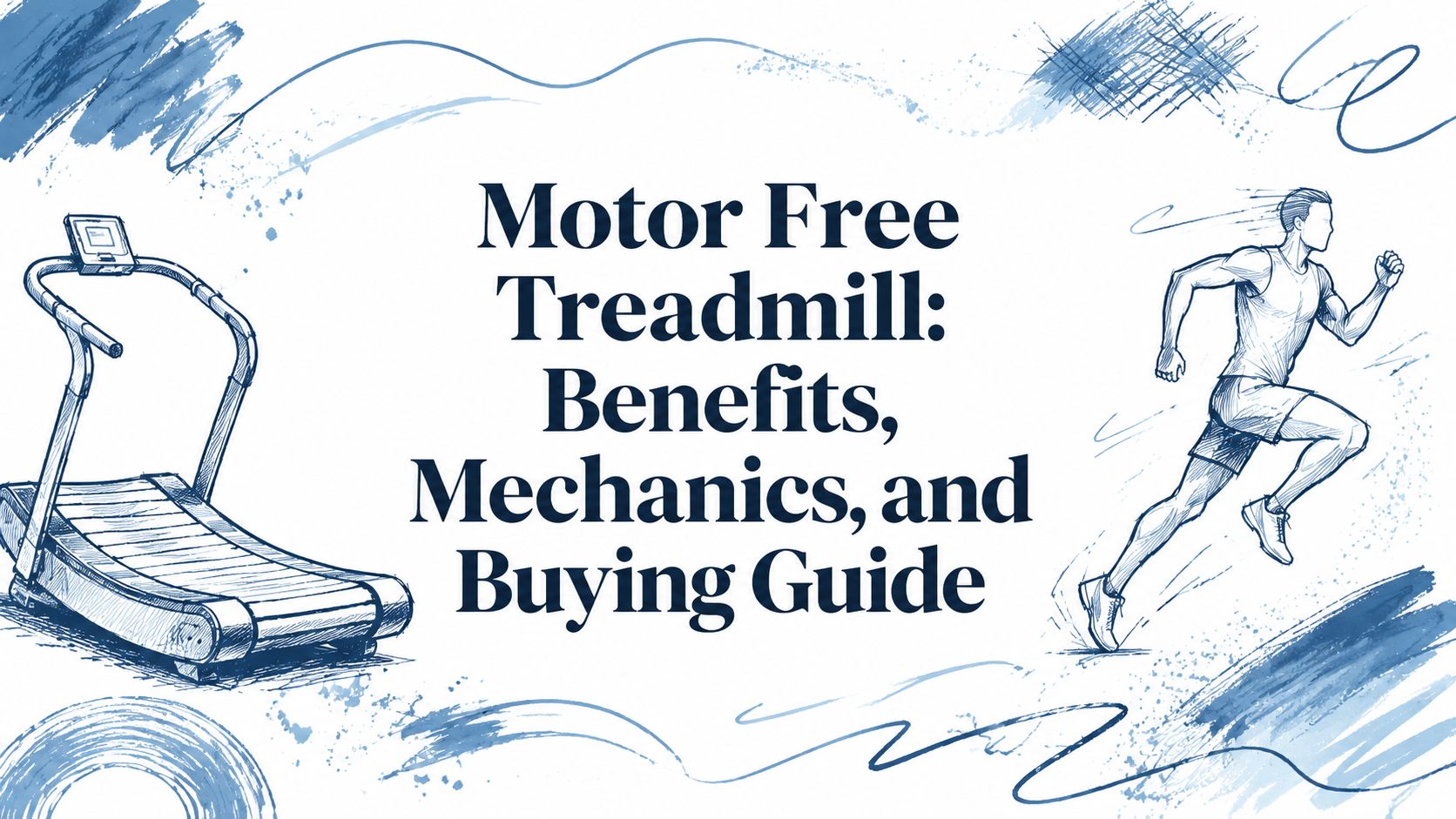
Motor Free Treadmill: Benefits, Mechanics, and Buying Guide
What if the question isn't whether a treadmill without a motor burns more energy, but whether that extra demand is the right demand for your body, your coaching plan, or your recovery stage? A motor free treadmill is not just a simpler treadmill. It creates a different running environment, and that difference can help one user a lot while making another user's training less precise.
For athletes, clinicians, and home users, the smartest choice starts with the goal. If you want a harder conditioning tool, a self-powered deck can be useful. If you need steady pacing, gait comparison, or a lower-stress return to running, the answer may be different. A practical starting point is to choose a manual treadmill that matches your space, your body, and your program.
Is a Motor Free Treadmill the Right Choice for You
The first decision isn't brand or price, it's fit. A motor free treadmill can be a strong match for runners who want a demanding conditioning session, coaches who need a self-powered tool for intervals, and facilities that want equipment without electrical dependence. It's less obvious for beginners, heavier users, or anyone coming back from injury and needing predictable pace control.
A good screening question is simple. Do you want the belt to respond to your effort, or do you want the machine to set the pace for you? If you're chasing harder cardio, the self-propelled design can be a feature. If you're trying to standardize pace, monitor symmetry, or build confidence after injury, that same design can become a limitation.
Practical rule: if the goal is training stress, a motor free model may fit. If the goal is consistent mechanics, a motorized option may fit better.
That distinction matters in wellness too. Some users pair harder cardio with recovery tools like cold plunge, sauna, or hyperbaric work, while others need the treadmill session itself to stay conservative. For a broader recovery and equipment lens, a motorless treadmill for wellness makes more sense when the focus is on exertion plus renewal rather than effortless mileage.
How a Motor Free Treadmill Works
A motor free treadmill is mechanically simple and biomechanically different. The belt moves because you move it. Your stride applies force, the deck responds, and the belt keeps moving only as long as you keep driving it. That is why there is no plug, no wiring, and no preset motor holding the pace for you.
A self-powered treadmill works in reverse compared with a powered treadmill. On a motorized machine, the surface comes toward you at a set speed. On a self-powered model, you push the surface forward with each step. That difference changes speed control, because your position on the curved belt and the force in your stride help determine how fast the belt turns.

Curved and flat manual decks do not feel identical. Curved designs usually keep the runner more engaged through the whole stride, while flat manual units can feel closer to a traditional treadmill pattern. Published specifications also show that these machines are often large, heavy, and self-contained, not flimsy add-ons, with examples listing a 170 × 35 cm running area, 2-level manual incline, 100 kg capacity, and no plug or wiring, or dimensions of 64" × 63" × 36", 350 lb product weight, and 400 lb weight capacity in another model published manual treadmill specs.
The belt does not create the work. Your stride does.
For readers who want a similar self-powered format viewed through a wellness lens, motorless treadmill for wellness is a useful reference. It reinforces the core idea that manual cardio is a distinct training environment, not just a motorless version of the same machine.
The Biomechanics and Metabolic Demand
The biggest reason people notice a motor free treadmill quickly is that it feels harder for a reason. A peer-reviewed study found that curved non-motorized treadmills produced a significantly greater physiological response than motorized comparison conditions at equivalent speeds, and accessible reporting from Runner's World summarized the same line of research as about 30% more calories, 32% more oxygen consumption, 16% higher heart rate, and 38% worse running economy physiological cost and running economy findings. That's not a small shift. It means the machine changes the load your body has to absorb, and it changes it fast.
Why the effort goes up
The curved deck asks for continuous force application. You're not just swinging the leg through space, you're also overcoming belt inertia and friction with each step, which increases the training demand mechanical explanation. In plain language, each stride has a job to do. That's why many runners feel the effort in the hips and legs sooner than they expect.
A controlled study in PMC also found different strength adaptations between treadmill types, with motorized training affecting the hamstrings more and non-motorized training affecting the quadriceps more, while flexibility didn't change in either group strength adaptation study. That matters for programming because the machine doesn't just change intensity, it changes which tissues are asked to contribute.
For trained athletes, that can be useful in intervals or sprint work. For beginners, it can be too aggressive if they treat it like a standard treadmill and try to hold the same pace they'd use on a motorized belt. For recovery-minded users, the signal is even clearer. If the goal is low-stress steady work, this machine may demand more than the session plan intended.
Programming insight: higher heart rate on a curved deck is often a sign of the machine doing exactly what it was designed to do.
When you want a self-powered option built for harder efforts, self-powered running workouts make the most sense in interval blocks, sprint repeats, or short conditioning pieces, not as a default choice for every run.

Motor Free Versus Motorized Treadmills
This comparison gets misunderstood because people focus on one question only, usually calories. The better question is whether the device supports the exact movement pattern and pacing you need. A motor free treadmill creates a self-driven environment, while a motorized treadmill creates a paced environment. That difference shapes training, rehab, and research in very different ways.
The decision comes down to purpose
Recent biomechanical research found that curved non-motorized treadmills are more biomechanically different from overground running than motorized treadmills, and the authors noted they may not be the best option when the goal is controlled replication of joint kinematics biomechanics and gait comparison. For a coach, that means a curved deck may be excellent for effort, but less ideal for technique benchmarking. For a clinic, it means caution when gait fidelity matters more than workload.
A useful outside resource that frames equipment trade-offs well is how to choose between machines and free, because the same principle applies here. The right tool depends on whether you want assistance, resistance, or a precise movement pattern.
| Criterion | Motor Free Treadmill | Motorized Treadmill |
|---|---|---|
| Movement control | User-driven pace | Machine-driven pace |
| Effort profile | Higher and more immediate | More predictable |
| Biomechanical feel | More distinct from overground running in curved models | Often closer for controlled comparison |
| Best fit | Intervals, conditioning, some sport work | Steady running, pacing, many rehab uses |
| Electrical needs | No plug required | Requires power |
| Coaching use | Strong for effort and self-pacing | Strong for exact speed targets |
For buyers comparing a clinic setup or home unit, MedEq Fitness on treadmill choice is a helpful reference point because it frames the manual-versus-electric decision around actual use, not hype.
The bottom line is practical. If you need intensity and self-generated pace, manual wins. If you need exact pacing and closer replication of a prescribed speed, motorized usually makes more sense. That's especially true in rehab, where the wrong treadmill can hide a gait issue instead of revealing it.
Rehab, Recovery, and Wellness Use Cases
A motor free treadmill can be a smart rehab tool when the goal is active effort, but not when the goal is calm, repeatable pacing. For return-to-run work, sport conditioning, or gait retraining drills, the self-powered format can help clinicians see how a client produces force. For a beginner or someone with pain sensitivity, that same demand can be too much too soon.

The recovery question is usually about control. If a runner is coming back from injury and needs predictable belt speed, a manual curved deck can be a poor fit. If a stronger athlete needs a short, metabolically demanding session that still keeps them inside a controlled environment, it can work well. That's why clinicians often match the device to the phase of rehab rather than calling it universally good or bad.
For readers who want a broader treadmill context, benefits of running on a treadmill helps frame how indoor running supports consistency, weather-proof training, and structured sessions. The manual model adds another layer, because it changes the effort curve as well as the setting.
Motor free cardio can also sit inside a broader wellness stack. Some users pair harder conditioning with contrast therapy, sauna, cold plunge, or hyperbaric oxygen sessions to support routine recovery, especially after interval-heavy work. For a joint-friendly training context, MedEq Fitness joint-friendly machines can help users compare options before choosing a machine that matches both training load and recovery tolerance.
Buyer Criteria for Athletes Clinics and Home Users
Buyers often start with the wrong question. They ask whether a treadmill is good, when the better question is whether it fits the user and the job. For athletes, clinics, and home gyms, the screening criteria are different, and a motor free treadmill should be judged that way.

What athletes should look for
Performance users should focus on curved deck design, a strong steel frame, and a belt that responds smoothly as speed changes. The deck shape matters because it changes cadence and turnover, much like a slightly different track surface changes how a runner organizes each stride. The frame matters because repeated self-powered intervals create loading that a weak build will not tolerate well.
Athletes should also pay attention to how the deck feels under fatigue. If the surface encourages clean mechanics when the athlete is tired, the machine supports training. If it forces the runner to fight the belt instead of the body moving naturally, the session quality drops fast.
What clinics should look for
Therapists and wellness centers need a different lens. Predictable speed control, stable footing, and a low step-up height can matter more than aggressive resistance. A broad platform can help users with mobility limitations feel secure, especially when balance, fear of falling, or joint pain is part of the picture.
A treadmill that looks simple can still be the wrong choice if access is awkward or if the user cannot repeat movement safely. Clinics should also think about how the machine supports observation. A clear sight line, stable stance, and easy on-off access help staff watch gait, confidence, and compensation patterns without adding unnecessary complexity.
What home users should check
Home buyers should check footprint, weight, and power needs before anything else. Some manual units are substantial enough to weigh 350 lb and support 400 lb capacity, so “manual” does not mean small or lightweight published manual treadmill specs. That matters in apartments, garages, and shared spaces where moving the unit, floor load, and storage all affect real-world use.
If you are comparing scale choices for a wellness room or clinic, the Venus Health Co. digital scale guide is useful because accurate body-weight tracking often supports both rehab and training decisions. Home users should also consider whether they want a machine for hard sessions, gait practice, or general conditioning, because the best fit changes with the goal.
Buying shortcut: choose the machine that matches the session you will repeat, not the workout you think you will do once.
MedEq Fitness offers manual and recovery-oriented equipment, including manual curved treadmills, hyperbaric chambers, cold plunge pools, saunas, red light therapy devices, and rowing machines, so buyers can build a training and recovery space around one plan instead of many disconnected purchases.
Sample Workouts and Programming Protocols
A motor free treadmill works best when the workout matches the machine's personality. It's excellent for sessions where effort matters more than holding an exact speed, and less helpful when you need a flawless pacing prescription. That's why the same treadmill can be brilliant for one athlete and frustrating for another.
Three simple ways to use it
Interval session for trained athletes. Use short hard efforts with full recovery, because the curved deck naturally raises demand. The goal isn't to chase a certain pace number, it's to hit a repeatable effort that forces clean mechanics under stress.
Steady-state block for general conditioning. Keep the pace conversational and shorten the session if heart rate climbs faster than expected. A curved belt can make “easy” feel harder than it looks, so treat the effort signal as the guide, not the display alone.
Gait-drill progression for rehab or return-to-run. Start with brief walking bouts, then layer in short jogging segments while watching symmetry, cadence, and confidence. If the runner starts compensating, the session is too ambitious for that day.
Clinical cue: if the runner can't keep their mechanics steady, the workout is no longer about conditioning, it's about survival.
Recovery pairing matters here too. Hard manual sessions may fit well before a lighter recovery day, or alongside contrast therapy and other wellness tools. For users who want to compare training and regeneration options, the treadmill should sit inside the wider plan, not outside it.
Setup Maintenance and Final Buying Decision
A heavy manual treadmill should be placed on a stable surface with enough room on both sides for safe entry and exit. Because it's motor free, there's no electrical setup, but the unit still needs care, especially if the frame is sturdy and the belt system is built for repeated self-propelled use.
Maintenance is usually simpler than with powered models. Keep the belt clean, inspect the deck and hardware regularly, and confirm that the surface still glides smoothly. If your recovery stack includes hyperbaric work, sauna, or cold exposure, the treadmill should support the training piece, not complicate the logistics.
Choose it if you want higher effort, self-paced intervals, or a manual tool for sport and rehab work. Skip it if you need precise speed control, a lower-demand walking surface, or a gentler return-to-running setup.
If you're building a training room or clinic around science-backed recovery and performance tools, MedEq Fitness can help you compare manual treadmills, hyperbaric chambers, cold plunge systems, and other physician-led wellness equipment in one place. Visit MedEq Fitness to review options that fit your space, your users, and the recovery plan you want to support.