Article: Rowing Machine Dimensions: A Complete Sizing Guide

Rowing Machine Dimensions: A Complete Sizing Guide
You're standing in a spare bedroom with a tape measure, trying to decide whether a rower will fit between the baseboard and the closet door. The product page says the machine is about eight feet long, but that number doesn't tell you whether you can complete a full stroke, step off safely, carry it through the hallway, or store it without blocking a fan.
That's the practical problem with rowing machine dimensions. The spec sheet gives you the equipment. Your room must accommodate the equipment, the moving user, the stroke path, the delivery route, and the storage position. A rower that fits on paper can still fail in the space where you intend to train.
Why Rowing Machine Dimensions Catch Buyers Off Guard
A full-size rower may pass through the front doorway and still fail at the first hallway turn. Buyers often measure the straight wall-to-wall distance, then find that the machine's diagonal length controls the move. The assembled dimensions look acceptable, yet the rail cannot rotate around a corner without contacting a wall or door frame.
Delivery is only the first test. A wood rower can store upright, while its raised rail reaches a ceiling fan or low shelf. A compact magnetic model may sit neatly against one wall, but the user still needs clearance behind the seat and ahead of the footplates to reach the catch, complete the drive, and dismount without twisting.
The usable footprint is the machine plus the person plus the motion path.
The Concept2 RowErg shows why one dimension rarely answers the planning question. Its standard configuration measures 96 inches long and 24 inches wide, while stored dimensions are 25 by 33 by 54 inches with standard legs. With tall legs, the assembled size becomes 27 by 47 by 54 inches, so the width is more than 40% greater than the standard-leg version in the cited comparison (rowing machine dimension reference).
Measure three separate conditions before ordering: the unfolded machine, the floor area required for a complete stroke, and the delivery route from the drop-off point to the training or storage position. The same planning approach described in this guide to plan your layout with MedEq Fitness works for rowers as well as treadmills.
A floor plan can show adequate area while the room itself fails at a doorway, furniture edge, wall, or overhead obstruction. Check those constraints with the rower's actual orientation, the user's height, and the intended vertical-storage position.
The Three Footprints Every Rower Has
A rower that fits on paper can still crowd a bedroom, clinic, or training floor. Plan around three footprints: the frame at rest, the space required during a stroke, and the area needed for storage.
Assembled footprint
The assembled footprint is the fully opened frame resting on the floor. Across the category, common rowers measure roughly 72 to 96 inches long, 18 to 24 inches wide, and 20 to 40 inches high, according to this category dimension guide. A sampled commercial Matrix model measures 87.6 inches long, 21.5 inches wide, and 22.7 inches high (Matrix rowing machine specifications).
These are the dimensions buyers usually compare first. They describe the equipment, not the room's usable floor area.
Operational footprint
The operational footprint adds seat travel, handle reach, footplate access, and room to mount or dismount. The rail stays fixed, but the user's body moves through the full catch-to-finish sequence. A practical training lane can reach 12 by 6 feet, or about 72 square feet, according to the cited home rowing space guidance.
Use this larger planning envelope beside a wall, rack, treatment table, or neighboring machine. In a facility, two rowers may fit by frame width yet leave too little room for users to enter, finish the stroke, or move safely around one another. User height matters too. A taller athlete needs more forward reach at the catch and more clearance behind the seat.
Storage footprint
The storage footprint covers the rower folded, separated, stood upright, or mounted against a wall. The standard-leg Concept2 RowErg, for example, stores at 25 by 33 by 54 inches (Concept2 RowErg specifications). Upright storage saves floor space, but it requires a clear ceiling zone, protected wall contact, and enough room to tilt the machine into position.
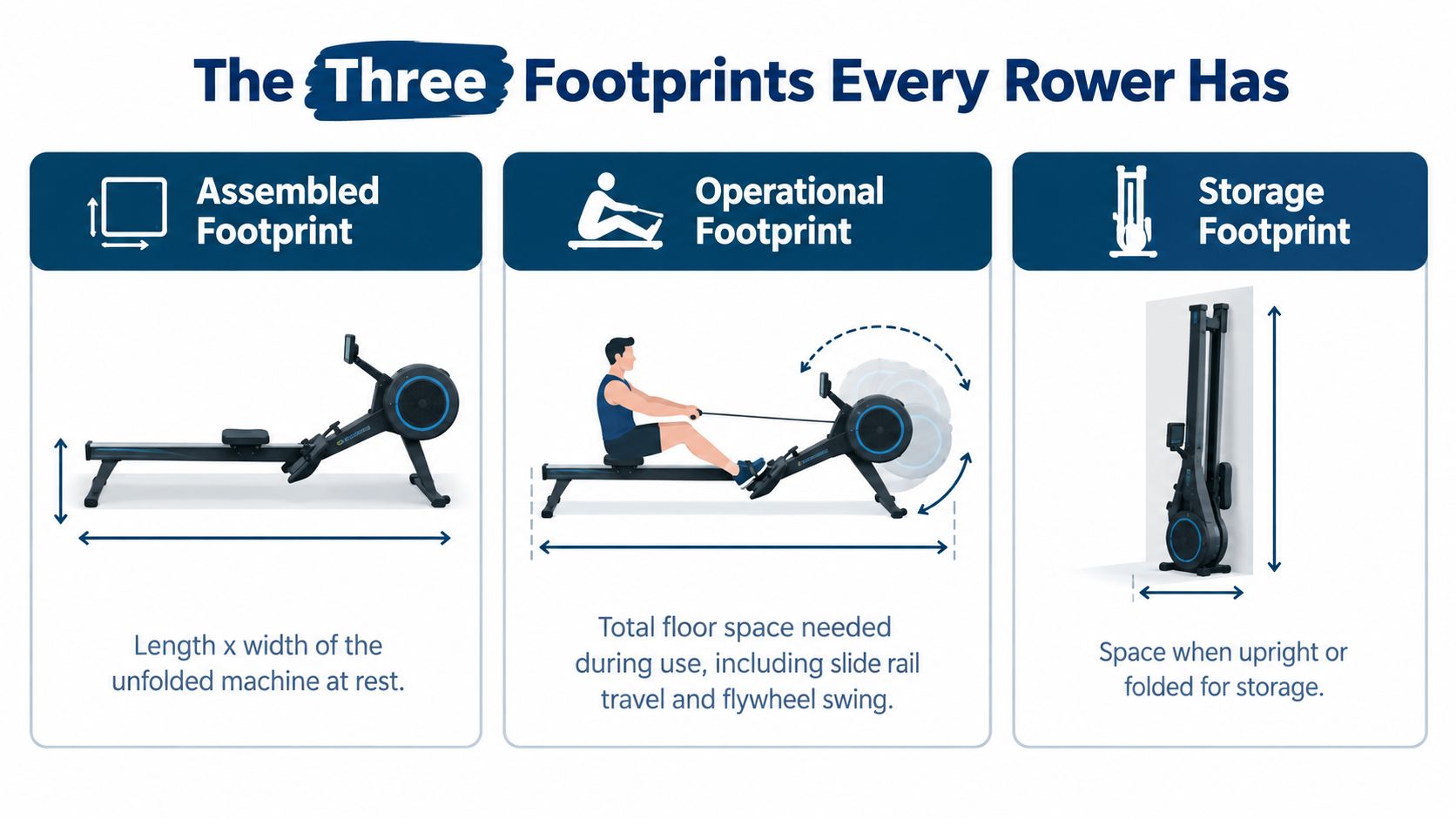
Record all three measurements before comparing products. MedEq Fitness rowing machines can help compare categories, but the room's stroke clearance and storage route should determine the final choice, not the unfolded frame alone.
How Footprint Changes by Rower Type
Resistance technology changes the machine's front housing, rail length, centre of gravity, and storage method. Those differences affect the space a rower needs in a home, clinic, or training room, even when two frames have similar widths.
Air rowers typically pair a substantial flywheel housing with a long rail. The Concept2 RowErg measures 96 by 24 inches in its standard in-use configuration, as noted earlier. Water and wood rowers often use a similarly long profile. Their tank or wood frame can also make the machine feel more prominent in a room, even when the measured width is close to an air model.
Magnetic rowers often have a narrower frame and smaller front housing. A sampled Matrix commercial model measures 87.6 by 21.5 inches. That can suit bedrooms, apartments, and treatment rooms, but a shorter frame is not automatically a better fit. Short hybrid and hydraulic designs may reduce floor length while limiting extension for taller users.
| Rower Type | Anchor Model | Assembled L x W (in) | Operational Length (in) | Storage Footprint | Typical Weight |
|---|---|---|---|---|---|
| Wood or water | Water-style full-length rower | Qualitatively full-size | Longer than the frame during use | Often upright or full-length | Heavier than compact magnetic designs |
| Air | Concept2 RowErg | 96 x 24 | About 108 operational length | 25 x 33 x 54 with standard legs | Commercial-grade, substantial frame |
| Magnetic | Matrix commercial rower | 87.6 x 21.5 | Longer than assembled length | Depends on folding design | Varies by construction |
| Hybrid or hydraulic | Compact designs | Often shorter than full-size | Limited by rail length | Often designed for compact storage | Usually lighter than full-size models |
The table avoids false precision because manufacturers publish different configurations and may omit stored dimensions. For planning, compare three practical questions: does the rail support the user's full stroke, does the operating zone fit beside nearby equipment, and can staff or household members reach the storage position?
For buyers comparing water resistance rowing for home gyms, measure the tank depth, frame weight, and route used to move the machine before and after sessions. A compact magnetic rower may fit a smaller storage zone. A full-length air or water rower may provide more rail for taller athletes, but it needs a longer clear route and more deliberate placement. The specification sheet starts the comparison. The user's stroke and the room's storage geometry finish it.
Clearance, Stroke Arc, and User Height
A rower can fit its listed footprint and still crowd the room during a workout. The seat travels along the rail, the handle enters the user's torso space, and the athlete needs a clear route to mount, dismount, and regain balance.
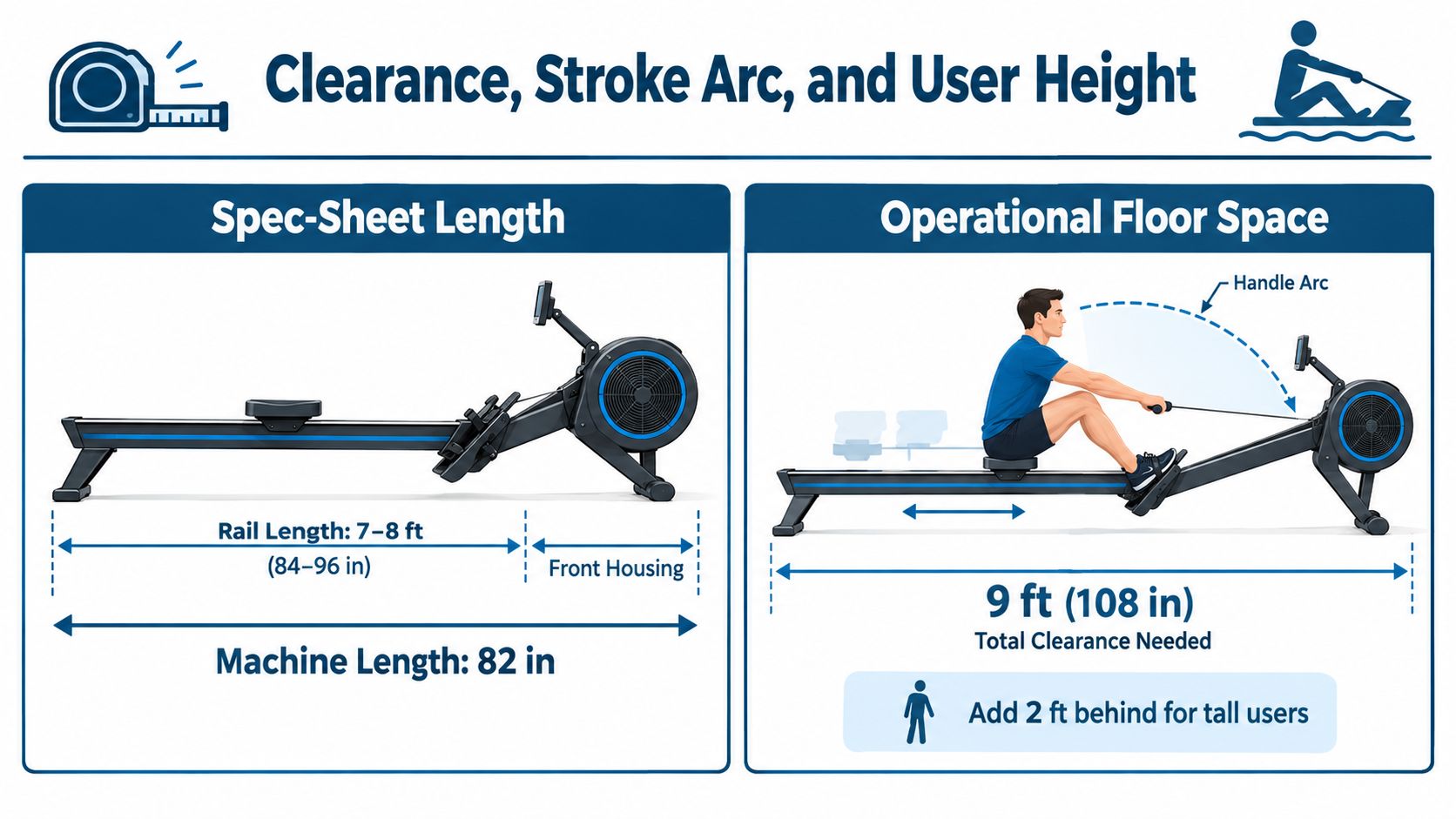
Full-size machines commonly occupy the 7 to 9 foot length range. In practice, the operating zone can reach approximately 108 by 48 inches, even though the frame itself may be only 24 inches wide. Use the Concept2 RowErg specifications as a product reference, then plan the surrounding lane separately. The specification measures the machine, not every movement around it.
Measure the catch, not just the finish
The catch usually governs the usable length. The knees are bent, the seat is forward, and the handle reaches toward the flywheel. A shorter user may complete the stroke on a shorter rail, while a taller user may need more travel to avoid a compressed catch or incomplete finish. Inseam length matters more than height alone, so a maximum-height label should not decide placement by itself.
Mark the machine's front and rear limits with masking tape. Sit on the rower and move slowly through the catch, drive, finish, and recovery. Mark the furthest points reached by the seat and handle, then add a safety buffer where the room permits. This test converts catalogue dimensions into the actual floor area your users need.
Check overhead and lateral clearance
Vertical clearance seldom limits the stroke, but it matters when the machine is tilted upright or placed near low shelves, basement joists, and ceiling fans. Check the highest point reached during handling, not only the rower's resting height.
Keep space beside the handle for a natural mount and emergency dismount. Users should not have to step over the rail, squeeze between the frame and a wall, or twist around another station. In a clinic or commercial room, that side lane also reduces the chance of contact with a moving handle or elbow.
The asensei home rowing guide distinguishes static product dimensions from the clear lane needed for movement. Test the catch with the longest intended user before fixing the machine in place.
Doorways, Hallways, and Storage Geometry
A rower can fit the training room and still fail at the front door. Doorways, stair turns, elevator cabs, and narrow hallways often impose tighter limits than the final floor plan.
Measure the clear opening inside the door frame, including the usable height. Record the narrowest hallway point and the diagonal distance across each turn. A long rail may pass through a straight doorway yet fail when rotated around a corner. Check thresholds and door closers too, since they reduce the opening available during delivery.
Compare the route with the storage plan
Magnetic and air rowers may separate or fold. Many wood and water rowers remain long, less flexible pieces. Folding helps only after the machine reaches the room. For vertical storage, measure the arc required to tilt the rower upright, not just its standing height. Low shelves, ceiling fans, joists, and wall-mounted equipment can block that movement.
A standard-leg rower's stored dimensions are listed by its manufacturer as approximately 25 by 33 by 54 inches. Use that figure for the settled storage position, then allow extra room for tilting, hand placement, wall protection, and the user moving around it.
| Rower Type | In-Use Length | Stored Folded | Vertical Storage Footprint | Folds? |
|---|---|---|---|---|
| Air | Full-length | Shorter when separated | Compact floor position | Often separates rather than folds |
| Magnetic | Typically shorter than full-size | Compact when folded | Narrow wall-side position | Commonly folds |
| Wood or water | Full-length | Often remains long | Upright storage may be possible | Often does not fold conventionally |
| Hybrid or hydraulic | Shorter rail | Compact | Usually easy to position | Design-dependent |
Check the surrounding room
Leave wall clearance where the rail tilts and settles. The storage position must also clear shelves, lights, fans, and nearby equipment. In changing rooms or shared facilities, compare the planned aisle with typical school and gym locker dimensions so locker doors and rower movement do not compete for the same space.
A solid-wood home gym rowing machine may suit a home or clinic, but its finish does not reduce the required doorway width or turning radius. Mark the machine's storage posture on the floor with tape, then test the tilt path before ordering. This simple check exposes conflicts that a product specification cannot show.
Transport, Assembly, and Delivery Day
Delivery problems usually start before assembly. The carton may be wider, taller, or harder to rotate than the assembled rower, so request the seller's package dimensions and compare them with every doorway, hallway turn, stairwell, and elevator opening. Measure the tightest point, not just the room entrance.
Unbox in the room where the machine will stay when possible. Keep the long rail supported while attaching the front stabilizer, seating the rail, and fitting the monitor. Simpler magnetic and air designs often require less assembly than water models, but the manual controls the sequence and hardware for that specific machine.
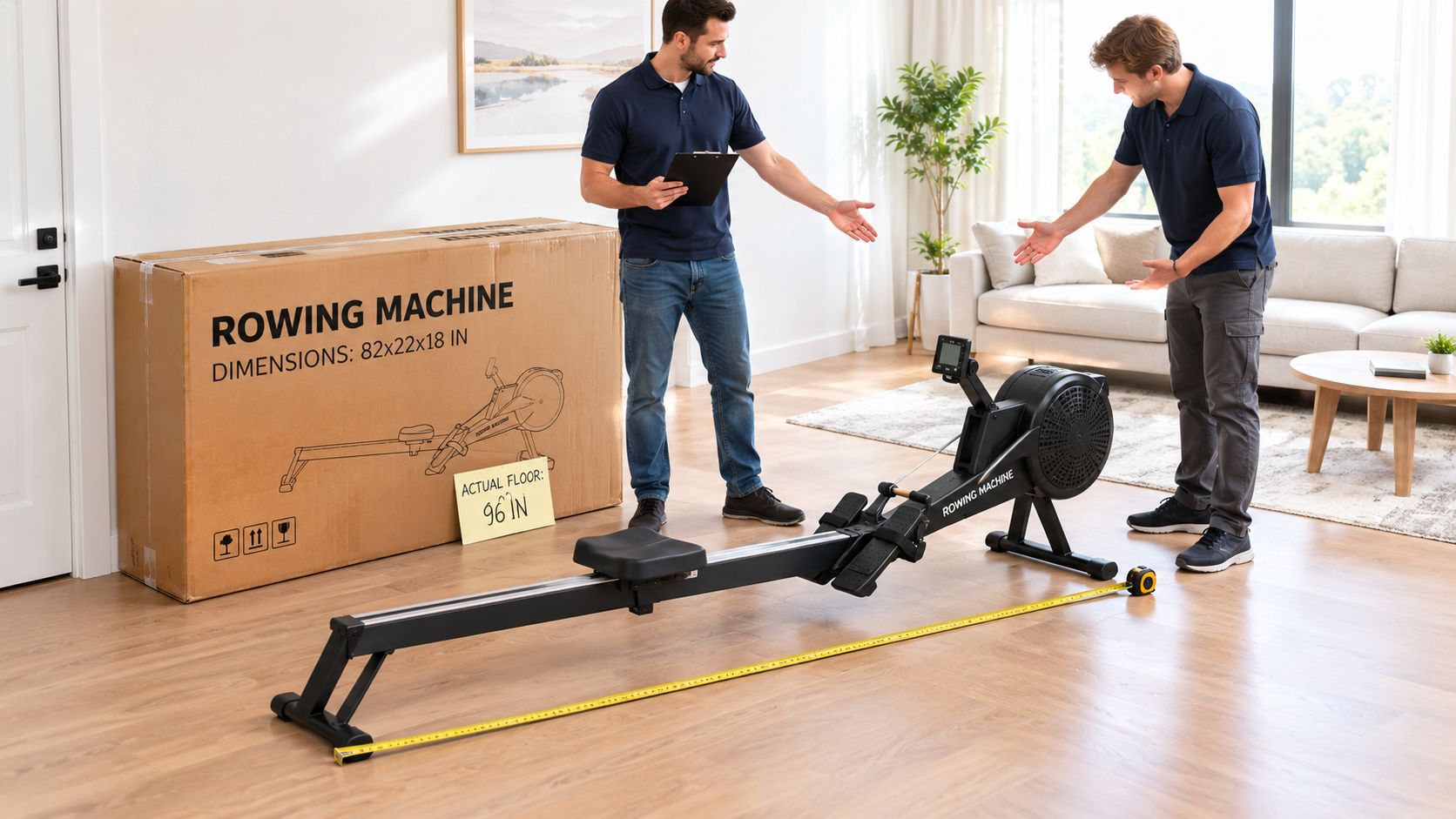
A heavy front housing affects both balance and floor protection. Front transport wheels can help you tilt and roll the rower across a smooth surface, while the rear rail may drag at carpet transitions or catch on thresholds. Test the tilt angle, wheel path, and hand positions before attempting a solo move through a narrow corridor.
For stairs, apartments, and upper-floor rooms, check the stairwell turn and elevator cab before delivery. Any box over 80 pounds calls for a two-person carry. Review practical guidance on how to move heavy machinery safely and protect door frames, walls, and flooring during the move.
Keep the packaging until the rower is assembled, tested, and positioned. The video below shows the handling sequence worth reviewing before delivery.
Sizing Your Rower for Recovery and Consistency
A rower earns its place in a recovery routine when the route to it is clear. You should be able to reach the machine, mount without twisting, complete the stroke without contacting nearby walls, and step off safely. Those details affect whether the rower supports warm-ups, steady work, cooldowns, and controlled conditioning, or becomes equipment that is used only when the room is rearranged.
For home gyms, clinics, and rehabilitation spaces, the usable footprint matters more than the catalog dimensions alone. Seated rowing offers low-impact cardiovascular work, while the full-body pattern can complement mobility, strength, and rehabilitation programming after a qualified professional has cleared the activity. Set the rail length and operating lane for the user's current movement quality. A shortened stroke caused by a wall or furniture can encourage compensations.
Make space for the recovery routine
Leave room around the machine for the actions that surround a session. Users need to adjust foot straps, stand, hydrate, and move to stretching or another recovery tool. In a clinic, side access also lets therapists observe technique and assist with mounting. A rower that fits only when the user remains seated is poorly sized for practical care.
Contrast therapy may appear in a broader wellness plan, but recovery claims require restraint. A systematic review of contrast therapy found inadequate evidence to support the claim that contrast therapy enhances recovery. Treat cold and heat exposure as context-dependent options, not guaranteed results. Training load, sleep, hydration, and professional guidance remain the foundation.
The full-body rowing machine benefits guide can help with exercise planning, while the room determines whether that plan is workable. Position the rower where it can stay ready for use. If every session begins by dragging it around furniture, consistency suffers.
Protect the floor and preserve access
Air and water rowers need stable flooring, especially when their heavier front housings shift during transport or setup. Keep the rail level, protect the surface from repeated movement, and avoid locations where moisture or condensation can affect the floor. Preserve side access so the user can exit without stepping over the frame.
The shortest rower is not automatically the right choice. Match the rail length, seat position, storage arrangement, and operating lane to the people using the machine, then judge whether the complete routine still works in the space.
Your Pre-Purchase Measurement Checklist
A rower can fit the room on paper and still block a doorway, shorten the user's stroke, or leave no safe path to step off. Take the following measurements in the actual room, then compare them with the manufacturer's assembled, operational, and stored specifications.
Survey the room
- Assembled footprint: Measure the complete unfolded length and width, including the front housing, rail, seat travel, and rear stabilizer.
- Seat height: Measure from the floor to the top of the seat. In a home or clinic, confirm that the intended user can sit down and stand up without excessive knee or hip strain.
- Operational clearance: Mark the furthest catch and finish positions. Include the handle path, leg movement, and enough side access to mount and dismount.
- Rear buffer: Keep space behind the rail for the seat path, dismounting, and taller users. A commercial planning benchmark expands the working area to 108 by 48 inches. Treat that as a planning reference, not a substitute for testing the exact model.
- Ceiling height: Check the highest point during vertical storage. Include fans, lights, shelves, beams, and joists in the measurement.
- Storage position: Measure the folded, separated, or upright arrangement. The storage zone needs its own usable dimensions, not just an open patch beside the machine.
Record the measurements before choosing between a full-length air rower, a shorter magnetic model, or a design intended for vertical storage.
Trace the delivery route
Measure the clear doorway opening, hallway width, stair turns, elevator interior, and the diagonal distance across tight corners. Ask the seller for carton dimensions and weights. Packaging may need a different route from the assembled machine, particularly where a long rail cannot turn inside a narrow hall.
If the room will hold several machines or protective flooring, use a guide to avoid flooring measurement mistakes. A small error can leave the mat edge, door swing, rower, and storage area competing for the same floor.
Match the machine to the user
- Check the catch: Confirm that the knees, hips, and handle reach a comfortable starting position.
- Check full extension: Ensure the user can finish the stroke without an awkward reach or restricted handle path.
- Compare rail length with inseam: Use the longest intended user as the deciding test, rather than a generic height estimate.
- Confirm side access: Leave room for one foot beside the rail so the user can step off without climbing over the frame.
Use the room's usable dimensions instead of its total area:
- Under 6 by 4 feet: A fold-flat magnetic design may work only if its operating clearance extends beyond the stored footprint. A full-length rower is unlikely to suit this space.
- 6 by 8 feet: A compact magnetic or shorter mid-frame air rower may fit with careful orientation and unobstructed access. Trace the stroke path before installation.
- 8 by 10 feet: This gives more flexibility for a mid-frame air machine or a full-length rower, provided the operating lane and side clearance remain open.
These ranges guide planning, not purchasing. Confirm the exact model dimensions, the longest user's inseam, storage height, and delivery route before ordering. MedEq Fitness offers rowing equipment alongside professional wellness and recovery products, allowing home and clinical buyers to compare the rower with the rest of the intended setup. Review MedEq Fitness, then order only after the assembled, operational, storage, and delivery measurements all work.