The Ultimate Guide to Fitness Rowing Machines
What if one piece of equipment could give you a powerful full-body workout and be gentle on your joints? That's the beauty of a fitness rowing machine. They hit that sweet spot between low-impact cardio and holistic strength training, making them a true cornerstone for anyone serious about their health and wellness.
Why Fitness Rowing Machines Are Your Ultimate Wellness Tool
A quality rower is so much more than just another machine at the gym. It's a complete system for building physical resilience and driving deep, systemic recovery.
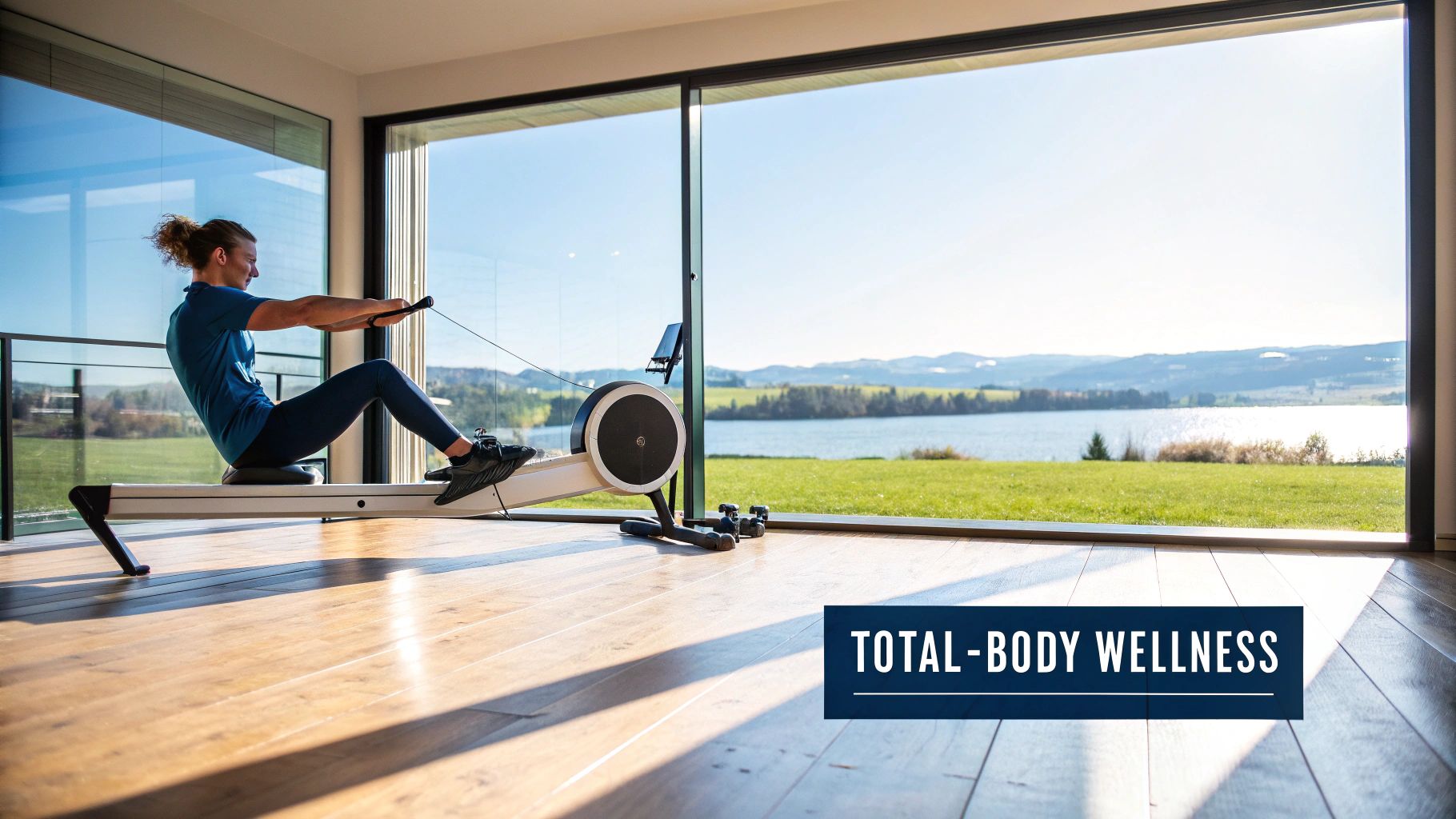
Every single stroke is a full-body event, firing up over 85% of your muscles—from your legs and core all the way to your back and arms. This coordinated effort builds functional strength and cardiovascular health in a way few other exercises can match, promoting overall wellness from the inside out.
A Fusion of Strength and Cardiovascular Health
Most cardio machines primarily target your lower body. Rowing is different. It provides a balanced, total-body challenge that builds you up without breaking you down.
- Total-Body Conditioning: You're engaging the large muscle groups in your legs, core, back, and arms, which translates to balanced, functional strength for everyday life.
- Low-Impact Efficiency: Since you're seated, there's no jarring impact on your joints. This makes it an amazing choice for long-term fitness, injury prevention, and gentle rehabilitation.
- Cardiovascular Enhancement: It efficiently elevates your heart rate, strengthening your heart muscle and boosting circulation without the high-impact stress of activities like running.
Of course, to get the most out of your training, it's smart to incorporate proven sports injury prevention strategies into your routine. This helps ensure you can train consistently and safely for the long haul.
The Rower as a Recovery and Wellness Tool
Top athletes and physical therapists don't just use rowers for grueling workouts. They use them for renewal.
The smooth, rhythmic motion is almost meditative. It promotes healthy blood flow, which is exactly what your muscles need to repair themselves on active recovery days. By gently working the muscles, rowing helps flush out metabolic waste and deliver oxygen-rich blood, accelerating the body's natural healing processes. This dual-purpose function is what truly sets it apart as a premier wellness tool.
Rowing bridges the gap between intense physical output and mindful recovery. It trains the body to be powerful yet resilient, building functional strength that translates directly into everyday life and athletic pursuits.
To give you an idea of the impact, a 2023 analysis found a 33.9% increase in back muscle strength after just six weeks of consistent rowing. It's clear why elite performers rely on them for both conditioning and recovery.
Here’s a quick breakdown of the core health benefits.
Rowing Machine Health Benefits At a Glance
| Benefit Category | Specific Advantage | Impact on Wellness |
|---|---|---|
| Physical Conditioning | Engages 85% of muscles | Builds balanced, functional strength and improves posture. |
| Joint Health | Low-impact, fluid motion | Reduces stress on knees, hips, and ankles, ideal for all fitness levels. |
| Cardiovascular Fitness | Efficiently elevates heart rate | Strengthens the heart, improves circulation, and supports long-term heart health. |
| Workout Recovery | Promotes healthy circulation | Aids muscle repair, reduces soreness, and provides a safe modality for active recovery. |
By combining strength and cardio into one seamless movement, rowing machines offer a path to better health that’s both efficient and genuinely enjoyable.
If you want to dive deeper into the unique advantages of one of our favorite types, check out our guide to water rowing machine benefits.
The Science Behind Rowing for Peak Health and Performance
There’s a beautiful simplicity to the rowing stroke, but don't let that smooth, flowing motion fool you. Beneath the surface is a powerhouse of physiological benefits, making the rower one of the most effective tools for bridging intense work with deep, systemic recovery.
The magic is in its full-body nature. Every single stroke is a masterclass in efficiency, firing up major muscle groups in your legs, core, back, and arms all at once. This isn't just about building muscle; it creates a massive cardiovascular demand.
To keep up, your heart has to work harder to pump oxygen-rich blood to all those muscles. Over time, this strengthens the heart itself, leading to a lower resting heart rate and better blood pressure—two of the biggest markers for long-term health and wellness.
Fine-Tuning Your Body's Engine
Think of your lungs and circulatory system as the engine that powers you. Rowing is one of the best ways to get it running at peak performance. The constant need for oxygen during a workout trains your lungs to become more efficient, steadily increasing their total capacity.
This boost in respiratory function means your body gets better at using the oxygen it takes in—a key performance metric known as VO2 max. A higher VO2 max is a direct sign of your aerobic fitness and is tightly linked to endurance and even longevity. It’s a change you can actually feel, both on the rower and in your daily life.
The rhythmic, repetitive nature of rowing does more than build physical stamina; it trains your nervous system. This results in real, measurable improvements in wellness markers like Heart Rate Variability (HRV), which shows how well your body handles stress and bounces back.
If you're someone who loves data, these metrics are pure gold. Consistent rowing often leads to higher HRV scores and better sleep, signs that your body is becoming more resilient. These aren’t just numbers on a screen; they represent a real shift toward a healthier, more robust you.
Rowing’s Metabolic Edge
When it comes to burning calories and managing body composition, the rower is a beast. Because you’re using so many muscles simultaneously, the metabolic cost—the rate you burn energy—is incredibly high.
A tough rowing session can torch hundreds of calories, making it a fantastic tool for anyone focused on weight management. But the health benefits don't stop when your workout does. By building lean muscle across your entire body, rowing actually boosts your resting metabolic rate. That means you burn more calories around the clock, even when you’re resting.
This is a huge reason why fitness rowing machines are exploding in popularity. The global market has surged from USD 1.2 billion in 2023 and is on track to hit a forecasted USD 1.9 billion by 2033. This growth isn't just a fad; it shows a real shift toward smart, science-backed fitness solutions. You can dig deeper into this market trend in recent industry analyses.
At the end of the day, the science speaks for itself. Rowing delivers a powerful mix of cardio conditioning, muscle development, and metabolic benefits. For more wellness strategies that deliver lasting results, check out our MedEq Wellness Journal.
How to Choose Your Ideal Rowing Machine
Stepping into the world of fitness rowing machines can feel like learning a new language. You hear terms like air, magnetic, water, and hydraulic resistance thrown around, and it's easy to get lost. Let's cut through the noise and give you a clear, simple framework for picking the perfect rower for your wellness journey.
Choosing the right machine isn’t about finding the single "best" one on the market. It’s about finding the one that’s best for you. Think of it like picking the right running trail. A flat track is perfect for speed work, while a rugged mountain path offers a completely different, dynamic challenge. Each type of rower provides a similarly unique feel and serves a different purpose.
Understanding the Four Main Resistance Types
The heart of any rowing machine is its resistance system—it’s what dictates the feel, the sound, and how the machine responds to your effort. Let's break down the big four.
This decision tree helps visualize how your main goal—whether it's cardio, strength, or recovery—can point you toward the right kind of rowing program.
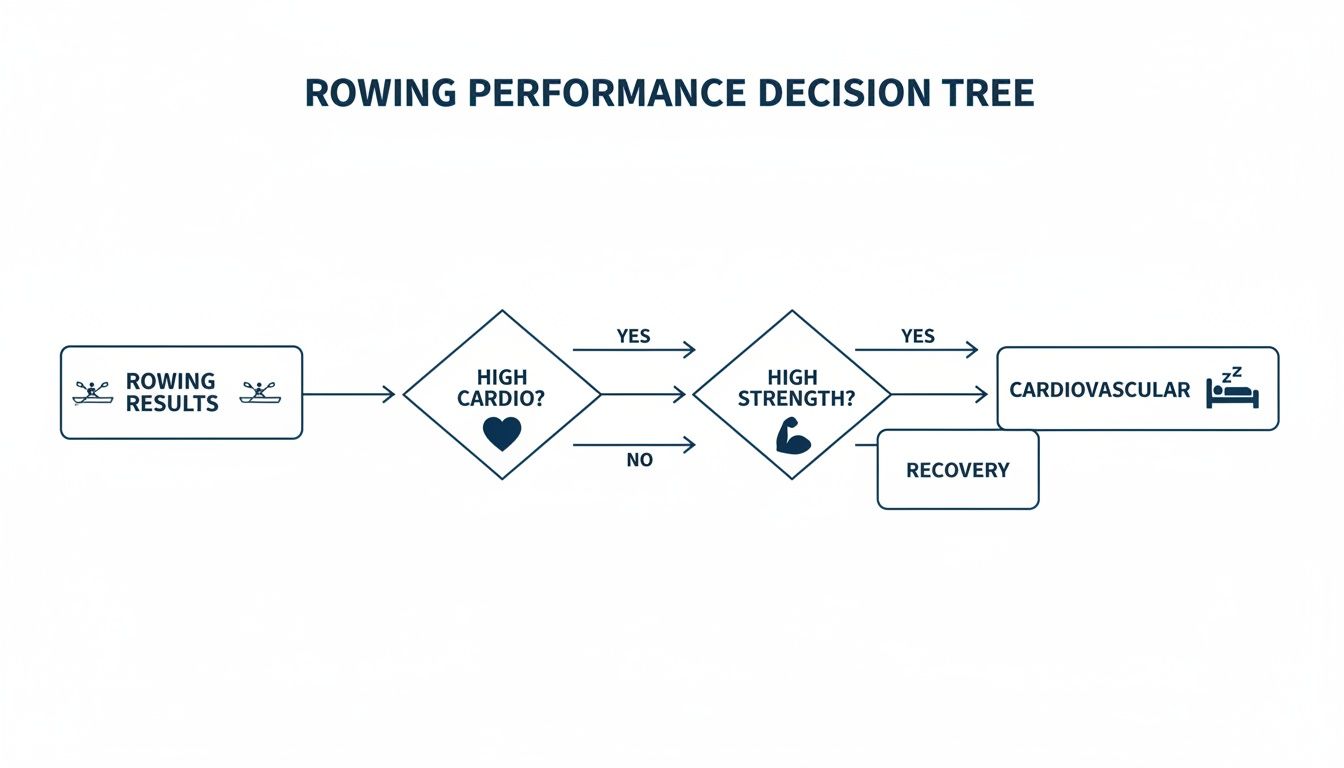
As you can see, no matter where you start, rowing offers a clear path toward better cardiovascular health, functional strength, and smarter recovery.
To help you decide, here’s a quick breakdown of what makes each resistance type tick.
Comparing Rowing Machine Resistance Types
| Resistance Type | Feel & Experience | Noise Level | Best For | Maintenance |
|---|---|---|---|---|
| Air | Smooth, responsive feel. Resistance increases the harder you pull. | Loud | HIIT, competitive training, and users who want unlimited resistance. | Regular cleaning of the fan cage to remove dust. |
| Magnetic | Consistent, quiet, and predictable. Resistance is set manually or electronically. | Nearly Silent | Apartments, shared spaces, and users needing precise, quiet workouts. | Very low; no friction parts to wear out. |
| Water | Mimics the natural feel of rowing on water. Smooth, consistent resistance with a meditative "swoosh" sound. | Quiet/Soothing | Home users seeking a realistic and aesthetic experience; holistic wellness. | Change water periodically and use purification tablets. |
| Hydraulic | Compact and affordable. The feel can be more mechanical and less fluid than other types. | Quiet | Budget-conscious buyers, small spaces, and casual fitness users. | Check pistons for leaks over time. |
Let's dig a little deeper into what these experiences are actually like.
-
Air Resistance: You'll find these in just about every commercial gym, and for good reason. They use a flywheel that spins against the air—the harder you pull, the more resistance you create. It’s a beautifully simple system that gives you unlimited, responsive resistance that perfectly matches your output. The only real trade-off? The fan can be quite loud.
-
Magnetic Resistance: If silence is golden, these rowers are the gold standard. They use magnets to create drag on a metal flywheel, and because nothing is actually touching, they're practically noiseless. This makes them a fantastic choice for apartments or early-morning workouts. The resistance is dialed in electronically, giving you super consistent difficulty levels, though some purists find the feel a bit less "organic" than air or water.
-
Water Resistance: Praised for delivering the most authentic on-the-water feel, these rowers use paddles churning inside a tank of water. You get a smooth, consistent pull from start to finish, accompanied by the gentle swoosh of water that many people find meditative. Just like with air rowers, the resistance is self-regulating: pull harder, and the water pushes back more. It's why our handcrafted wooden water rowers at MedEq Fitness are so popular for home use. For a closer look, check out our guide to the best water rowing machines.
-
Hydraulic Resistance: These are typically your smaller, more budget-friendly options. They use pistons filled with fluid to create resistance. While they're compact and quiet, the rowing motion can feel a bit mechanical and less fluid. They're a solid entry point for casual users but might fall short for anyone serious about performance training.
Key Factors Beyond Resistance
Once you’ve got a feel for the resistance type you want, a few other critical pieces of the puzzle come into play. These are the things that separate a good rower from a great one.
Ergonomics and Build Quality
A great rowing workout hinges on comfort and stability. Pay close attention to:
- A Padded, Contoured Seat: You'll be spending a lot of time here. It needs to be comfortable and, just as importantly, glide smoothly.
- An Ergonomic Handle: The handle should feel natural in your hands without forcing you to strain your wrists or grip too tightly.
- Adjustable Footplates: Your feet are your anchor. Secure, well-designed footplates are non-negotiable for proper form and power.
- Solid Frame Construction: The last thing you want is a machine that wobbles or flexes when you’re pulling hard. A high-quality build, like you’ll find in the MedEq collection, is all about longevity and safety.
The Performance Monitor
The monitor is your command center. It’s your coach, your pacer, and your progress log all rolled into one.
Your performance monitor is your coach, your competitor, and your progress journal all in one. Without reliable data, you're just guessing.
At a minimum, look for a console that clearly tracks your time, distance, strokes per minute (SPM), and power output (measured in watts or calories). More advanced monitors will offer pre-set workouts, heart rate tracking, and even the ability to race yourself. For both home athletes and clinical settings, accurate metrics are essential for seeing real improvement. For more informative wellness content, visit our blog at https://medeqfitness.com/blogs/medeq-wellness-journal.
Integrating Rowing Into Your Workout and Recovery Plan
A great rowing machine is so much more than a cardio tool—it’s a powerful instrument for managing your energy and supercharging your workout recovery. When you learn to weave it into your weekly schedule, you can build serious performance, boost your endurance, and speed up muscle repair, all with one beautiful piece of equipment.
The real magic of the rower is its versatility. It’s just as ready for an all-out sprint as it is for a gentle, restorative session. The machine simply adapts to whatever you need that day, which is a huge reason why its popularity has exploded.
It’s no surprise that the residential rowing machine market is set for massive growth, projected at a 12% CAGR. That’s outpacing commercial sales as more and more people get serious about their health at home. In the US alone, home-use sales hit a staggering $149 million in 2023, which is up 62.2% since 2019. Families and biohackers alike are investing in science-backed tools for daily optimization.
Crafting Your Weekly Rowing Schedule
A smart weekly plan uses the rower for both high-intensity work and low-intensity recovery. This balance is the key to avoiding overtraining while still making consistent progress.
Here’s what that might look like depending on your wellness goals:
-
For Peak Performance: Your go-to is high-intensity interval training (HIIT). These short, explosive bursts are incredible for building raw power and cardiovascular capacity. A classic session is a 3-minute warm-up, then 8 rounds of 1 minute at 90% effort followed by 1 minute of easy recovery, and a 3-minute cool-down.
-
For Building Endurance: Steady-state rows are your best friend. These are longer, moderately paced workouts that train your body to work more efficiently over time. Aim for 30 minutes, keeping your heart rate in Zone 2-3 and your strokes per minute (SPM) between 22-26.
-
For Active Recovery: On days after a tough workout, a gentle "flow" session is perfect. It gets blood moving to sore muscles without adding any real stress. Just do 15-20 minutes of light rowing with a focus on perfect form and deep, rhythmic breathing. This promotes healing and helps reduce muscle soreness.
Rowing is unique in its ability to serve both ends of the fitness spectrum. It can push you to your absolute limit or guide you through a mindful, restorative session, making it an indispensable tool for holistic wellness.
Advanced Recovery With Contrast Therapy
Ready to take your recovery to the next level? Try pairing your rowing workouts with advanced therapeutic techniques. One of the most effective is contrast therapy, which involves switching between hot and cold temperatures to kickstart circulation and reduce inflammation.
A really powerful way to do this is to follow an intense HIIT rowing session with a cold plunge. The row heats your body and muscles, and the immediate cold immersion forces your blood vessels to constrict and then dilate upon rewarming. This "pumping" action helps flush out metabolic waste products like lactic acid and can dramatically reduce muscle soreness. It’s a favorite technique among elite athletes for a reason—it helps them bounce back faster to train harder. For more ideas, check out our guide on how to reduce muscle soreness.
Beyond the workout itself, knowing how to recover faster from workouts is critical for sustainable health and making real, long-term progress.
Complementing Other Training Modalities
A fitness rowing machine doesn’t have to replace your other workouts. In fact, it makes them better. Because it’s a full-body, low-impact activity, it’s the perfect partner for almost any other training you do.
-
For Weightlifters: Use the rower for a dynamic warm-up to fire up your posterior chain before a heavy deadlift or squat session. It also works as a fantastic low-impact cardio finisher that won’t beat up your joints.
-
For Runners: Rowing builds serious leg power and core strength without the pounding impact of running. This can improve your running economy and significantly lower your risk of common overuse injuries.
-
For Yogis and Pilates Practitioners: The smooth, rhythmic motion of rowing can become a form of moving meditation. It deepens the mind-body connection that’s so central to these practices.
By weaving rowing into your existing routine, you build a body that’s more balanced, resilient, and capable. You can find more wellness and recovery tips on our blog: https://medeqfitness.com/blogs/medeq-wellness-journal.
Your Rowing Machine Setup and Long-Term Care
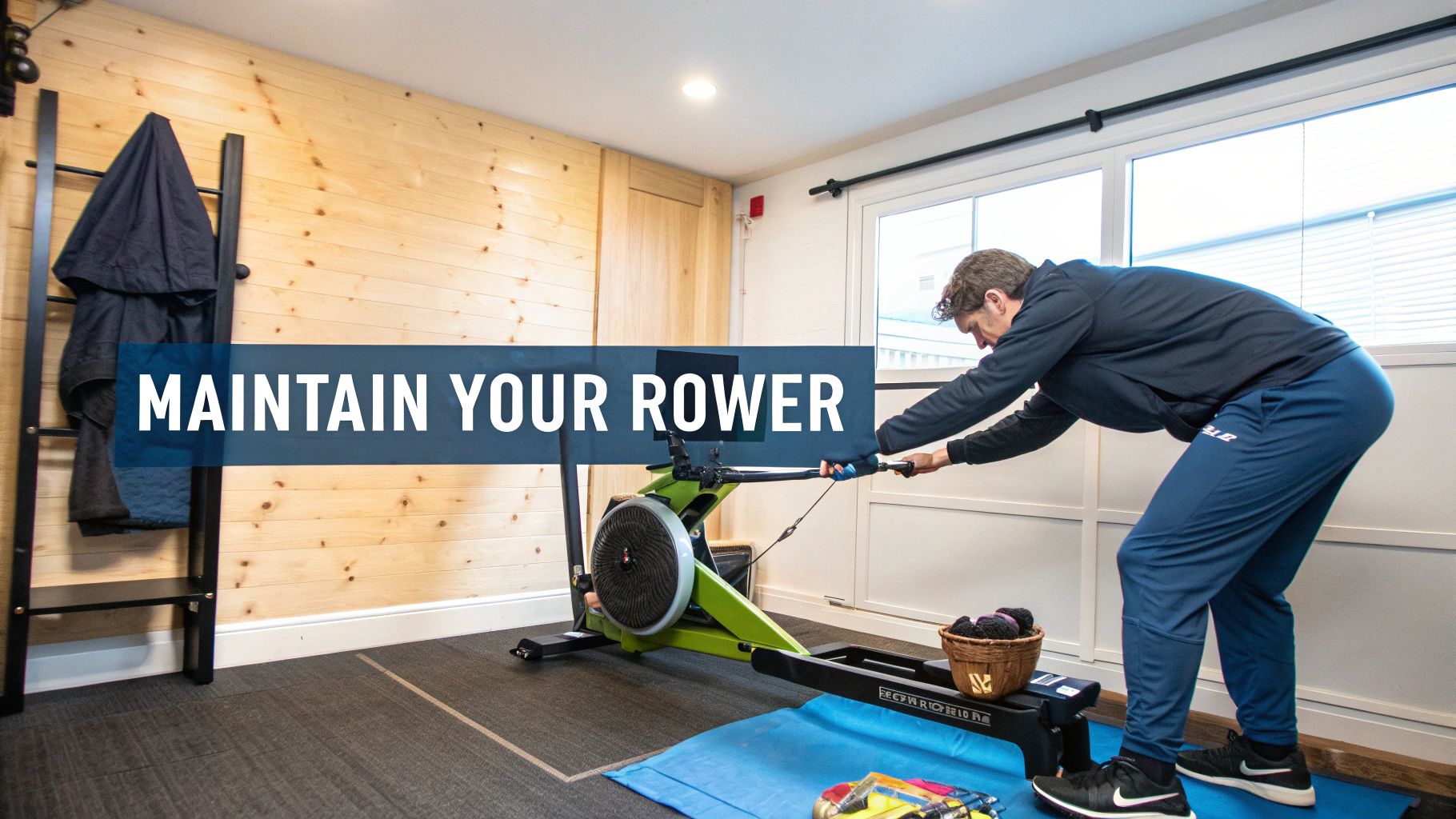
Bringing home a top-tier fitness rowing machine is more than just a purchase; it's an investment in your long-term health. To make sure that investment pays dividends for years to come, a little bit of proactive care makes all the difference. Proper setup and a few simple maintenance habits will keep your rower feeling smooth, quiet, and ready for every workout.
First things first: set yourself up for success. Always place your rower on a level surface to prevent any wobbling or instability while you’re pulling hard. When you get on, adjust the foot straps to sit snugly across the widest part of your feet. This creates a solid anchor for a powerful leg drive, ensuring you transfer energy efficiently and keep your lower back safe.
Essential Long-Term Care Checklist
Once you're set up, a simple maintenance routine is all it takes. Think of it as a quick cooldown ritual that takes just a minute or two but adds years to your machine’s life.
- Wipe Down After Each Use: Sweat can be corrosive over time. Give the seat, handle, and especially the monorail a quick wipe with a dry cloth after your workout. This stops grime from building up and keeps the seat gliding effortlessly.
- Check the Chain or Strap: Every so often, give the chain or strap a quick visual inspection for wear. If you have a chain-driven rower, a light drop of chain oil every few months will keep the pull feeling perfectly fluid.
- Inspect Bolts and Screws: About once a month, take a moment to check that all the bolts and screws are tight. Rowing involves a lot of repetitive motion, which can sometimes loosen things up. A quick tighten prevents squeaks and ensures total stability.
"Preventative maintenance isn't a chore; it's the simplest way to guarantee your equipment is always ready for you. A well-cared-for machine provides a superior workout experience, reinforcing the connection between your effort and your results."
Special Care for Water Rowers
If you’ve opted for a water rower, like the beautiful handcrafted wooden models from MedEq Fitness, there’s just one extra thing to keep in mind. The water in the tank needs a little attention to stay crystal clear.
Just pop a purification tablet in the water every few months to prevent any algae from growing. If you ever notice the water getting a bit cloudy, it's a simple fix—just use a siphon to empty and refill it. It’s a tiny bit of effort that preserves that signature soothing sound and clean aesthetic that water rowers are famous for.
Following these simple steps ensures your machine remains a reliable partner on your wellness journey. For more expert advice on equipment care and wellness, visit our MedEq Wellness Journal.
Your Rowing Questions, Answered
It's natural to have a few questions before bringing a new piece of equipment into your life. We get it. Let’s clear up some of the most common things people ask, so you can feel confident you're making the right move for your health.
Is A Rowing Machine A Good Investment For A Home Gym?
Without a doubt. A high-quality rower is one of the smartest, most efficient investments you can make for your health and wellness at home. You're getting a full-body workout that targets over 85% of your muscles in a single, fluid motion—building both heart health and real-world strength at the same time.
And because it's so low-impact, it's safe for just about everyone, protecting your joints from the pounding that comes with other forms of cardio. Plus, our MedEq Fitness handcrafted wooden rowers are designed to be quiet and actually look good in your home, all while delivering the performance you'd expect in a professional clinic.
How Often Should I Use A Rowing Machine For Best Results?
When you're starting out, consistency beats intensity every time. For overall health and wellness, shooting for 3 to 5 sessions a week is a fantastic goal.
How you spend that time is up to you:
- For Endurance: Aim for a steady 20-30 minute row.
- For Performance: Mix in shorter, high-intensity interval (HIIT) sessions.
- For Recovery: A gentle 10-15 minute session on off-days is perfect for boosting blood flow and aiding muscle repair.
The golden rule is to listen to your body. Make rowing part of a balanced routine that includes proper rest and other recovery methods, like contrast therapy, to see the best results.
Will Rowing Make Me Bulky?
This is a classic myth. Rowing builds long, lean, functional muscle—not the bulky mass you might be imagining. It’s all about creating muscular endurance and toning your entire body, from your legs and glutes all the way up through your core and back.
The powerful physiques you see on competitive rowers come from elite-level training volumes and extremely specific diets. For most of us, rowing consistently leads to a strong, toned, and more capable body.
Think of it less as adding size and more as sculpting functional strength that serves you in your everyday life. You're building a more resilient, well-put-together machine.
What Is The Difference Between An Air Rower And A Water Rower?
The real difference comes down to the feel of the pull and the sound it makes. Both are phenomenal tools, but they create a different experience.
An air rower uses a flywheel fan for resistance. The harder you pull, the more air it moves, and the tougher it gets. This creates a responsive, energetic feel, often with a distinct "whoosh" sound.
A water rower, on the other hand, uses paddles in a tank of water. This gives you an incredibly smooth, consistent resistance that feels a lot like rowing on a calm lake. The sound of the water sloshing is often described as meditative, which makes it a favorite for home gyms where a quieter, more organic vibe is important.
For more wellness insights and expert advice, be sure to explore our MedEq Wellness Journal. You can find a wealth of information to guide your health journey at https://medeqfitness.com/blogs/medeq-wellness-journal.
Ready to bridge the gap between exertion and renewal? At MedEq Fitness, we offer a curated selection of handcrafted wooden rowing machines and pro-grade wellness equipment to elevate your daily capacity. Explore our collection and find the perfect tool for your home or clinic at https://www.medeqfitness.com.