Is Red Light Therapy Safe: A Guide to Its Health and Wellness Benefits
So, let's get right to it: is red light therapy safe?
The short answer, supported by a substantial body of clinical research, is that it has a strong safety profile. When used as directed, it is well tolerated by most people. Unlike the UVA and UVB radiation in sunlight, red light therapy uses a different part of the spectrum entirely — a targeted, non-thermal form of light energy that supports cellular activity as part of a broader wellness and workout recovery routine.
Your Guide to Red Light Therapy Safety and Wellness Benefits
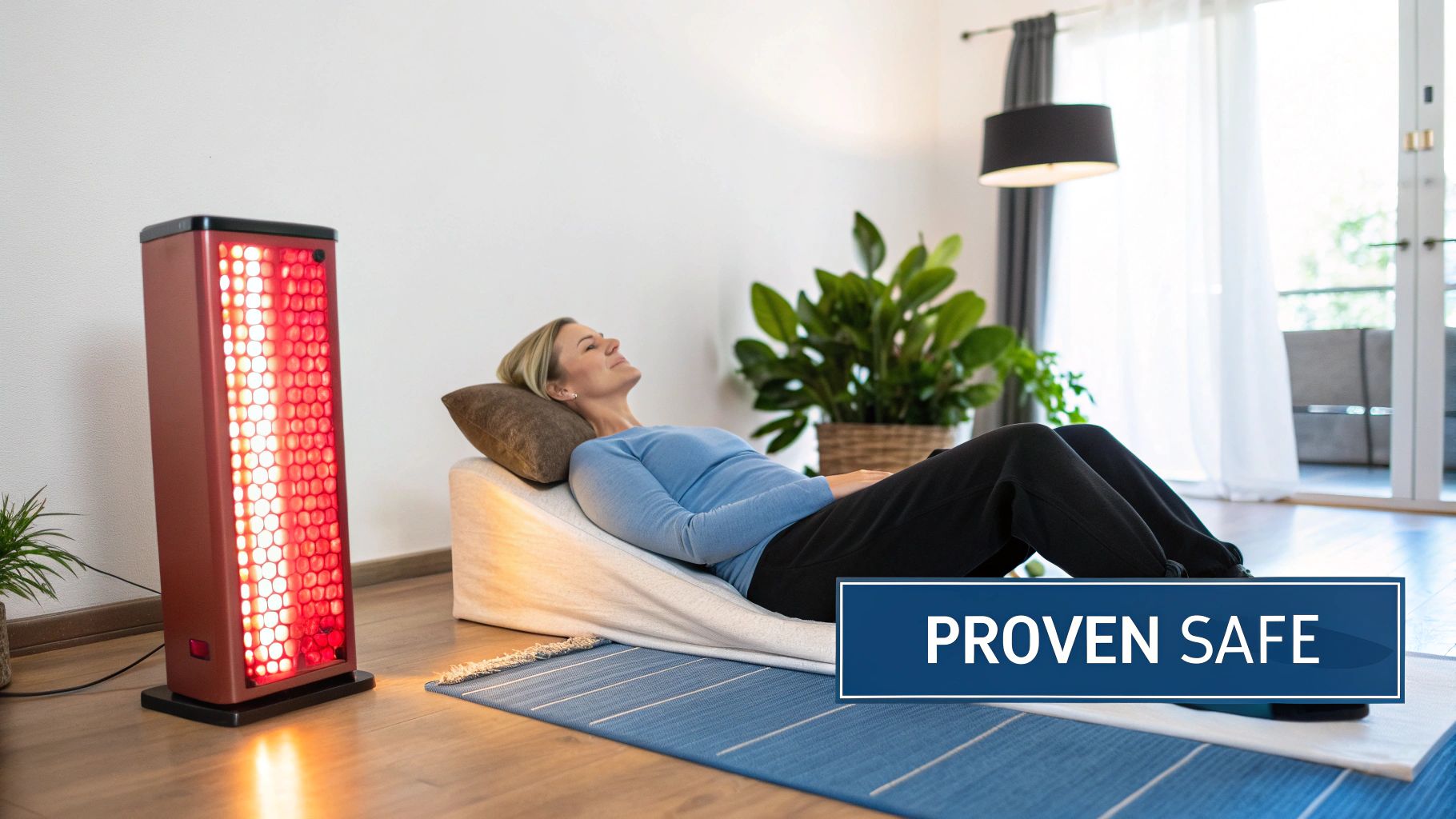
Red light therapy, also called photobiomodulation, is a non-invasive modality that uses specific wavelengths of red and near-infrared light to support healthy cellular activity. It is not a high-intensity laser, and it does not generate the heat levels associated with tissue damage. This is a non-thermal process focused on wellness rather than medical treatment.
That gentle mechanism is the foundation of red light therapy safety, and it is why the modality has become a common addition to workout recovery routines. By supporting cellular energy production, it may help the body's own recovery processes work more efficiently. If you want the underlying physiology first, the MedEq Cellular Energy Framework™ explains how light, oxygen, mitochondria, and ATP interact.
What the Clinical Research Shows
Red light therapy has a well-documented safety record, and the clinical data shows adverse effects are uncommon.
A randomized controlled trial by Wunsch and Matuschka, published in Photomedicine and Laser Surgery, assigned 113 subjects to four treatment groups receiving full-body or partial-body red and near-infrared light twice weekly for 30 sessions, alongside 23 untreated controls. No severe adverse events were registered during the study or its follow-up, and no participant withdrew because of an adverse event. The two issues recorded were minor and temporary: one volunteer noticed increased visibility of facial telangiectasia, and one experienced reddening of scar tissue from a 40-year-old knee injury that healed completely within a week without pausing treatment (Wunsch & Matuschka, 2014).
Worth noting for context: that trial was funded by a light-device manufacturer, and the principal investigator was remunerated by the sponsor. It remains the largest controlled trial of its kind, but the funding relationship is part of an honest reading of it.
That consistency is why the modality is used across a range of settings, from athletic recovery to at-home wellness routines. It is also why red light therapy is often paired with other recovery modalities rather than used in isolation.
Red light therapy supports the body's existing recovery processes. It is not a quick fix but a consistent wellness tool that works alongside your biology, which is exactly why its safety profile holds up under repeated use.
Red Light Therapy Safety at a Glance
How Red Light Therapy Compares on Key Safety Factors
| Safety Aspect | Summary | Key Takeaway |
|---|---|---|
| UV Radiation | Contains no UVA or UVB wavelengths. | Does not carry the UV-related risks associated with sun or tanning exposure. |
| Heat Production | Non-thermal; does not burn the skin at recommended settings. | Comfortable for direct skin exposure when device guidelines are followed. |
| Invasiveness | Fully non-invasive, with no needles or tissue disruption. | Suitable for repeated home or professional use. |
| Side Effects | Reported side effects are rare, minor, and typically temporary. | Most users report no adverse effects when the device is used as directed. |
Safety depends on using a well-specified device at the intended distance and session length. See the dosing guidance below.
For more on how these systems are specified and compared, see our guide to choosing the best red light therapy device, or browse the VitalGlow red light therapy collection.
How Red Light Therapy Works to Support Your Body
To understand why red light therapy is well tolerated, it helps to look at the cellular level. The process is a supportive interaction with systems your body already runs, and it is free of the UV wavelengths that cause photodamage.
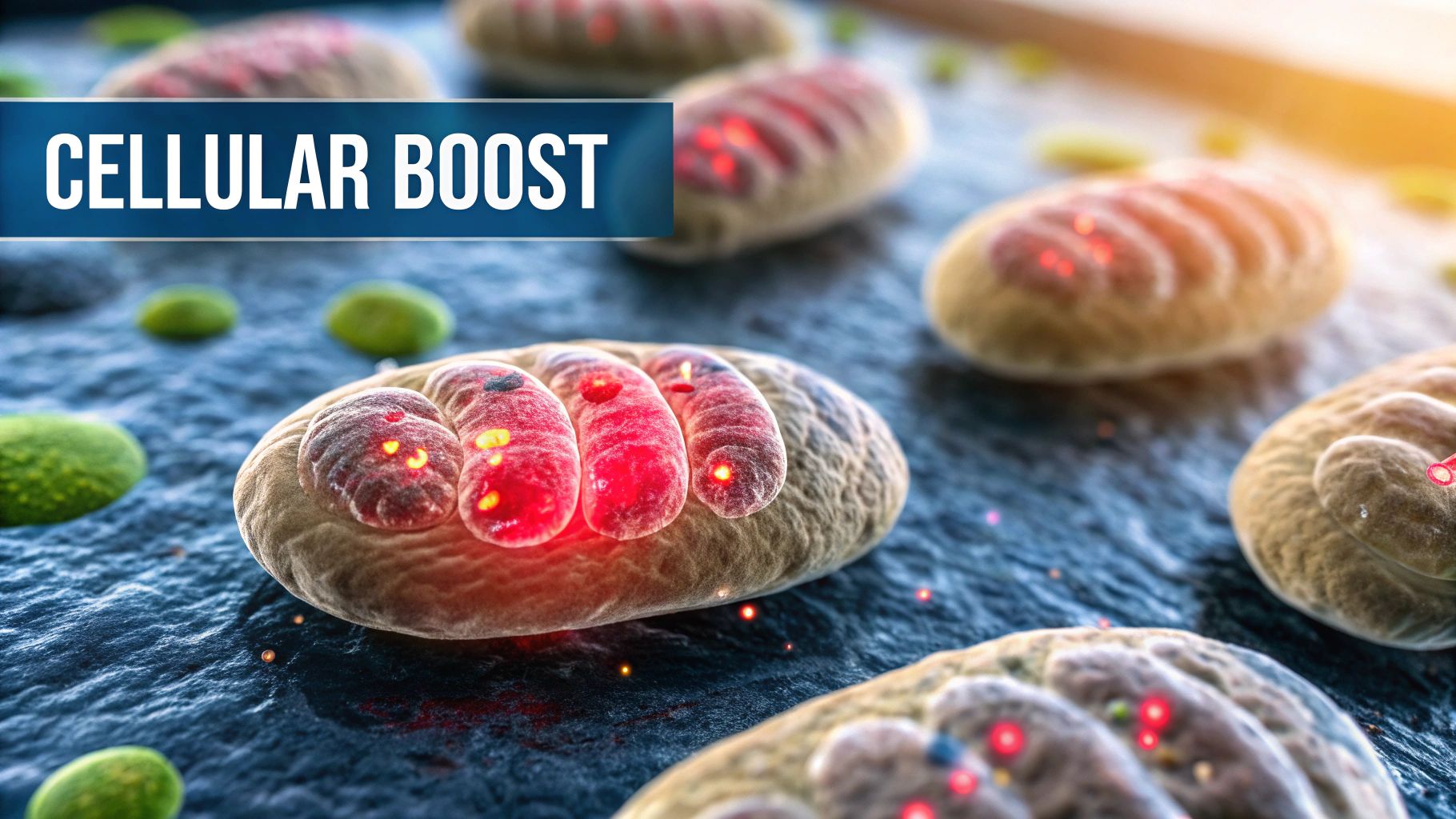
Your body is made of trillions of cells, and inside each one are structures called mitochondria. These produce the energy that fuels everything from movement to tissue repair and recovery after training. Red light therapy safety and effect both come down to how light interacts with these structures.
Supporting Cellular Energy Production
The therapy works through photobiomodulation. When specific wavelengths of red and near-infrared light — generally between 630 and 850 nanometers — reach cells, mitochondria absorb that light energy.
That absorption supports production of adenosine triphosphate (ATP), the cell's energy currency. More available ATP means cells have more resources for their normal work, whether that is repairing muscle tissue after training or supporting collagen production in skin.
The interaction is non-invasive and does not depend on heat. Unlike modalities that work by creating controlled thermal injury, red light therapy supports existing cellular function, which is a significant part of why it is considered appropriate for regular use. For the mechanism in detail, see our explainer on how red light therapy works.
Supporting cellular energy sets off a broader chain: better circulation, lower inflammatory load, and more efficient recovery — the same levers described in the MedEq Cellular Energy Framework™.
From Cellular Energy to Real-World Recovery
That cellular support translates into the outcomes most users are after, which is why red light therapy has become common in athletic recovery routines.
- Workout recovery support: by supporting circulation and moderating inflammatory response, red light therapy may help reduce post-training soreness and stiffness.
- Comfort and mobility: the same mechanisms are studied in the context of joint discomfort and general mobility support.
- Skin wellness: ATP availability supports collagen and elastin production, which is associated with firmer skin tone and texture.
These are areas of active research rather than settled clinical fact — our evidence review of red light therapy benefits separates what is well supported from what is still preliminary.
This supportive mechanism is also what makes red light a natural pairing with contrast therapy. Moving between the cold stress of a cold plunge and a red light session creates a recovery cycle that works on circulation and cellular energy from two different directions. Heat completes the picture — sauna sessions are frequently stacked into the same weekly rotation.
Decoding the Clinical Evidence on Red Light Therapy Safety
Claims about safety need evidence behind them. When someone asks whether red light therapy is safe, they are asking to see the research rather than a marketing assurance.
Photobiomodulation has been studied for years, and the consensus across controlled trials points to a strong tolerability record. What follows is drawn from that literature rather than from anecdote.
Testing the Upper Limits
One of the clearest ways to establish safety is a dose-escalation trial, where researchers deliberately increase light energy to find the point at which adverse effects appear.
In one such study, exposure was pushed to 320 J/cm² for participants with skin of color and 480 J/cm² for non-Hispanic Caucasian participants, delivered three times weekly for three weeks, without dose-limiting adverse events below those thresholds. Those levels sit far above what a typical at-home session delivers. The methodology and results are available in the published safety research.
Tolerability Across Different Users
A modality is only genuinely safe if it holds up across a range of people. Studies consistently report that red light therapy is well tolerated across skin types, age groups, and wellness goals.
The Wunsch and Matuschka trial described above recruited 136 volunteers ranging from 27 to 79 years of age, with group means around 46. Volunteers who did not complete the study left for scheduling conflicts, relocation, or a medication exclusion — not because of adverse effects. Tolerability was assessed after every one of the 30 sessions.
Where the Evidence Is Stronger and Weaker
The safety picture is consistent across applications. The efficacy picture is more uneven, and it is worth being direct about that: support is strongest for a defined set of skin and tissue applications, while many popular wellness claims still rest on smaller or lower-certainty studies. Our device selection guide walks through which outcomes have the firmest backing.
Red Light Therapy Side Effects and Who Should Use Caution
A responsible view of any modality means covering the full picture. While the clinical evidence supports a strong safety profile, there are specific situations that warrant care.
Reported red light therapy side effects are uncommon and almost always minor and temporary. Most users notice nothing beyond mild warmth. When effects do occur, they typically present as brief skin redness in the treated area that fades within an hour or two.
This is where red light differs meaningfully from UV exposure: it does not burn or photodamage skin at recommended settings. Mild transient redness generally reflects increased local circulation.
The most commonly reported effect is temporary redness or a sensation of warmth — a normal response to increased blood flow rather than a sign of tissue stress.
Following the manufacturer's guidelines is the most reliable way to keep sessions safe and effective. The light is not UV, but full-body panels are very bright, which is why quality systems ship with protective eyewear.
Who Should Consult a Physician First
Red light therapy is appropriate for most people, but certain conditions warrant a conversation with your doctor beforehand. This is not because the modality is known to be dangerous for these groups — it is because the research base is thinner, and individual medical guidance is the right standard.
When to Speak With Your Physician First
| Condition or Group | Reason for Caution | Recommended Action |
|---|---|---|
| Pregnancy | Limited research exists on red light therapy during pregnancy. The caution is precautionary and reflects a lack of data rather than a known risk. | Speak with your obstetrician or primary care physician before starting. |
| Active Cancer | Effects on malignant cells are not fully characterized, though some research examines photobiomodulation for treatment-related side effects. | Consult your oncologist. Do not use over or near a known tumor without explicit approval. |
| Photosensitizing Medications | Some medications, including certain antibiotics, acne treatments, and supplements, increase skin sensitivity to light. | Review your medications with your doctor or pharmacist before beginning sessions. |
| Epilepsy or Seizure Disorders | Bright or pulsing light output may pose a risk for individuals with photosensitive seizure disorders. | Discuss with your neurologist. If cleared, use a device without a pulse mode and wear blackout goggles. |
This list is not exhaustive. When in doubt, consult a qualified healthcare professional before starting any new therapy.
Safe and Effective At-Home Red Light Therapy Sessions
Bringing red light therapy into your home routine is straightforward. Results depend far more on consistency than on complexity, and the same variables that drive effectiveness — session duration, frequency, and distance — are what keep sessions within a safe range.
Setting Your Protocol
Three parameters shape every session:
At-Home Red Light Therapy Protocol by Goal
| Goal | Duration | Distance | Frequency |
|---|---|---|---|
| Skin wellness | 10 minutes | 12–18 inches | 4–5 times per week |
| Workout recovery | 15 minutes per area | 6–12 inches | Post-training, 3–5x per week |
| Joint comfort | 15 minutes | 6–10 inches | 5 times per week |
| General wellness | 10–20 minutes | 6–12 inches | 3–5 times per week |
These durations assume a session dose in the range of 8–10 J/cm², consistent with the controlled trial cited above. Always defer to your device's published irradiance and documentation — distance changes delivered dose significantly. See red light therapy distance from skin.
Consistency matters more than intensity. For a step-by-step routine, see how to use red light therapy for recovery.
Choosing a Well-Specified Device
Device quality is the one variable worth not compromising on. A reputable system publishes its wavelength configuration and its irradiance at a stated distance, not just total wattage — those two numbers, combined with session length, determine the dose actually reaching tissue.
One correction worth making, because it circulates widely: there is no clinically established irradiance minimum for red light therapy. Published parameter reviews generally describe power densities below 100 mW/cm² paired with energy densities of 4 to 10 J/cm² at the target tissue, and report that ineffective results in mitochondria-rich tissue arose more often from over-dosing than from under-dosing. The controlled trial cited earlier in this article delivered between 5.9 and 13.3 mW/cm² in the red band and still produced significant measured improvements, because the dose accumulated across a consistent schedule.
The practical implication for safety: a device advertising unusually high output is not inherently safer or more effective. It shortens the window in which you are dosing correctly, which makes following the session guidance more important, not less.
Look for published specifications, clear session guidance, and transparency about what the device is and is not intended for. Systems sold for general wellness use are not medical devices and should not be marketed as treatments. For a full breakdown of what to compare, see our red light therapy buyer's guide, or the full-body red light therapy beds comparison if you are weighing table formats.
Matching a VitalGlow System to Your Routine
| System | Coverage | Best Suited To |
|---|---|---|
| VitalGlow Core | Targeted | Focused joint, scalp, or skin sessions |
| VitalGlow Elevate | Expanded, 9-wavelength | Larger treatment areas at home |
| VitalGlow Pulse | Full-body, 576 LED | Regular post-training recovery |
| VitalGlow Apex | High-output full body, 720 LED | Dedicated recovery rooms |
| VitalGlow Elite Table | 360° multi-spectrum | Medspa, clinic, executive wellness |
Full specifications for each system are published in the VitalGlow collection.
Your First Session Checklist
Six Steps for a Safe First Session
- Read the manual: confirm your device's specific session times and distances.
- Start clean: skin should be clean, dry, and free of lotions or creams that block light.
- Protect your eyes: the light is not UV, but it is bright. Wear the supplied eyewear.
- Start short: begin with a 5–10 minute session and build gradually.
- Monitor your response: sessions should feel comfortable. Mild warmth is normal; discomfort is not.
- Stay consistent: a repeatable schedule matters more than any single long session.
Where Red Light Therapy Fits in a Complete Recovery Stack
Red light rarely stands alone in a serious recovery routine, and there is a physiological reason. Red light supports the mitochondrial side of energy production. Hyperbaric oxygen therapy works on the delivery side, increasing dissolved oxygen available to tissue under pressure. Heat and cold shift circulation and autonomic tone. Each pulls a different lever on the same system.
How Recovery Modalities Work Together
| Modality | Primary Lever | Where to Start |
|---|---|---|
| Red Light Therapy | Mitochondrial energy production | VitalGlow systems |
| Hyperbaric Oxygen | Oxygen delivery under pressure | What is HBOT? |
| Sauna / Heat | Circulation and heat adaptation | Infrared sauna for athletes |
| Cold Plunge | Vasoconstriction and autonomic tone | Cold plunge systems |
The MedEq Cellular Energy Framework™ explains how these levers interact.
If red light is your entry point and you are considering hyperbarics next, HBOT for athletes covers how chamber sessions fit around training, and the home hyperbaric chamber buyer's guide for 2026 walks through pressure ratings and chamber design. The full chamber collection compares soft and hard models directly.
Common Questions About Red Light Therapy Safety
Can red light therapy damage your eyes?
Red light therapy does not emit UV radiation, so it does not carry the UV-related ocular risks associated with sun exposure. That said, full-body panels are extremely bright, and looking directly into the LEDs can cause temporary eye strain or headache, as any intense light source would. Reputable devices ship with protective eyewear for this reason.
How do I know if I am using it too much?
Follow the guidelines that came with your device, which generally land around 10 to 20 minutes per treatment area, three to five times weekly. Signs of overuse are rare but can include lingering redness or mild skin irritation. If that happens, shorten sessions or add a rest day. More is not better — the goal is a consistent, repeatable dose.
Is at-home red light therapy as safe as professional sessions?
When you use a well-specified device according to its documentation, the wavelengths and dose delivered at home can match what professional settings use. The differences are typically coverage area, output, and session convenience rather than safety. Larger full body red light therapy panels narrow that gap by covering more of the body per session.
Can I combine red light therapy with other recovery modalities?
Yes, and most users do. Red light pairs naturally with cold plunge and sauna in a contrast therapy rotation, and with hyperbaric oxygen therapy for a fuller recovery stack.
At MedEq Fitness, we curate physician-guided wellness and recovery equipment for home, athletic, and professional environments. Browse the VitalGlow red light therapy collection, or talk to a MedEq specialist for help matching coverage, output, and room requirements to your goals.