Red Light Therapy Device Reviews An In-Depth Buyer's Guide
Trying to make sense of red light therapy device reviews can feel like you're learning a new language. But at its core, the principle is straightforward: these devices use specific light wavelengths to supercharge your cells, promoting wellness and helping them heal and rejuvenate.
The real trick is looking past the marketing noise and focusing on the numbers that matter—wavelength, irradiance, and energy dosage. This guide will walk you through the science so you can choose a device that actually delivers on its promises for your health and wellness goals, especially for things like workout recovery.
How Red Light Therapy Devices Get the Job Done
Red light therapy, which you might see called photobiomodulation (PBM), works on a pretty incredible concept. When specific wavelengths of red and near-infrared light hit your skin, they go deep enough to be absorbed by your mitochondria—the tiny power plants inside every cell.
This interaction kicks off the production of adenosine triphosphate (ATP), which is basically the fuel your body runs on.
Think of it as giving a drained battery a direct jolt of energy. When your cells have more ATP, they can repair damage faster, produce vital proteins like collagen, and calm inflammation. This cellular-level boost is what drives all the health benefits, from faster workout recovery to smoother, healthier skin. For a closer look at the science, you can learn more about how red light therapy works and what it does inside the body.
The Metrics That Truly Matter
If you want to evaluate a device properly, you have to ignore the brand hype and get down to the technical specs. These numbers are what separate a powerful, effective wellness tool from an expensive lamp.
Here’s what to look for:
- Wavelength (nm): This tells you the specific color of light, which dictates how deep it can penetrate your body. The most studied and effective wavelengths are 660nm for skin health and 850nm for reaching deeper into muscles and joints.
- Irradiance (mW/cm²): This is all about power density—how much energy the device delivers to a target area. Higher irradiance means you can get an effective treatment in less time.
- Energy Dose (Joules/cm²): This is the total energy your body absorbs. It’s calculated by multiplying the irradiance by the treatment time. Getting the right dose is absolutely critical for seeing health benefits.
At-Home Wellness Is Booming
The explosion of interest in red light therapy isn't just a trend you're seeing on social media; the numbers back it up. The global market was valued at USD 421.38 million in 2024 and is expected to climb to USD 658.10 million by 2032.
This growth is fueled by a massive jump in consumer awareness. Today, more than 70% of Americans know about red light therapy, thanks in large part to wellness experts and a flood of positive user reviews. It's clear that people are actively seeking out proven, science-backed tools to take control of their health at home. For more information, you can visit my blog: https://medeqfitness.com/blogs/medeq-wellness-journal
Decoding the Specs That Actually Matter
When you start digging into red light therapy device reviews, the tech jargon can feel a bit much. But a few key numbers separate a high-performance wellness tool from a glorified red light bulb. These are the specs that dictate the health benefits you'll get.
First up is wavelength, measured in nanometers (nm). Think of this as the light's ability to penetrate your tissue. Not all red light is the same, and specific wavelengths are proven to be the most bioactive for promoting wellness.
For surface-level goals like better skin texture and fewer fine lines, 660nm red light is your go-to. Skin cells soak it up, which helps kickstart collagen production. For deeper work—think muscle recovery, joint pain, and inflammation—you need 850nm near-infrared (NIR) light. This one reaches deep into muscles, joints, and even bone, making it essential for effective workout recovery.
Irradiance: Why It Shortens Your Sessions
Next, we have irradiance. This is the power density, or how much light energy is hitting your skin from a certain distance. It’s usually measured in milliwatts per square centimeter (mW/cm²). Simply put, it’s the light's intensity.
A device with high irradiance delivers a therapeutic dose of light much faster. This is a game-changer for anyone with a packed schedule. A weak device might need 30 minutes to achieve the health benefits a high-irradiance panel can deliver in just 10, especially when it comes to workout recovery.
Calculating the Perfect Energy Dose
This brings us to the most critical factor for results: the energy dose, measured in Joules per square centimeter (J/cm²). The dose is the total energy your body absorbs in a session. You get this number by multiplying the irradiance by the treatment time (in seconds).
Getting the dose right is everything. Too little, and you won’t see much of a health benefit. Too much, and you can actually reduce the benefits. A lower dose might be perfect for skin health, but post-workout recovery demands a higher dose to get that energy deep into the muscle tissue where it’s needed.
Key Takeaway: The goal isn't just to find a device with the right light; it's to find one that delivers an effective energy dose efficiently. A powerful device gets you optimal results and supports your wellness goals without wasting your time.
The push for at-home wellness solutions has caused the red light therapy market to explode. It's not just a niche trend anymore—consumer awareness and investment are climbing fast.
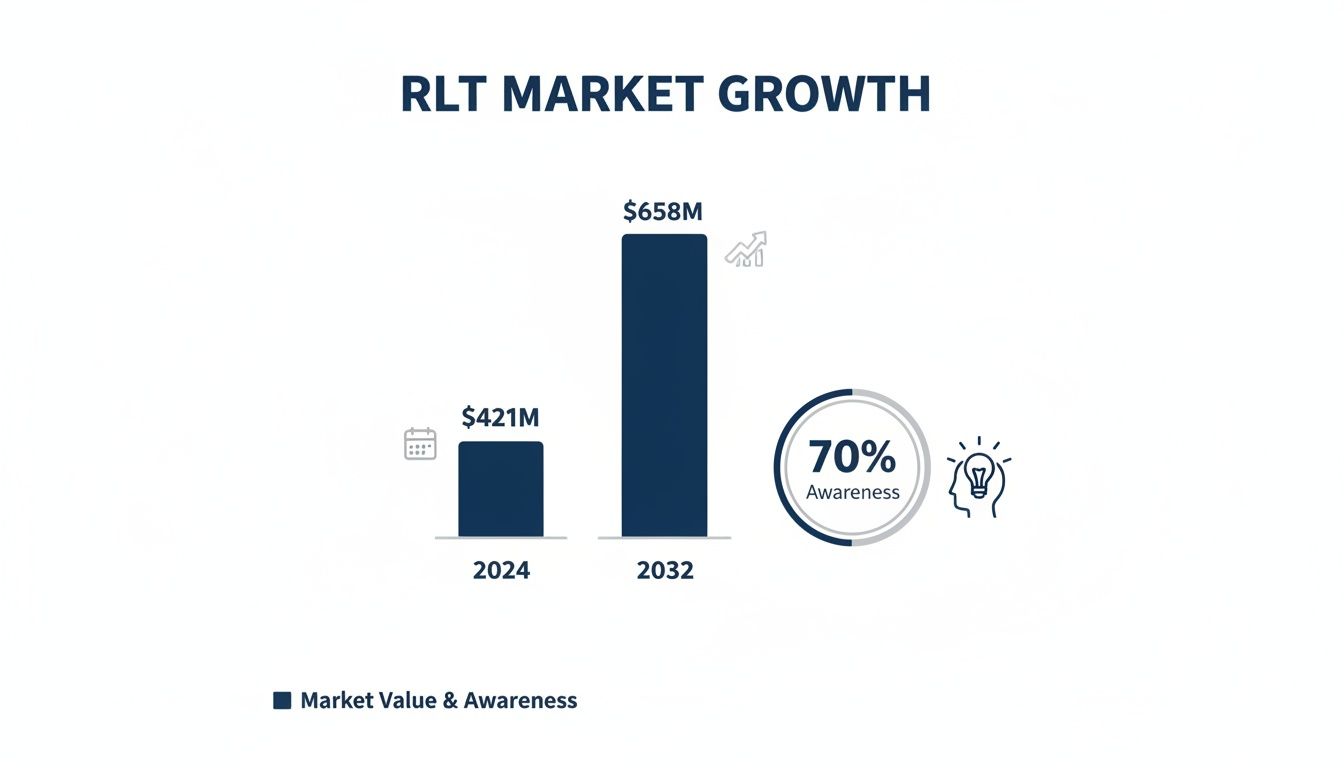
This data shows a clear shift toward people investing in their own wellness tech. The market is projected to hit USD 620 million by 2032, with the home-use segment leading the charge—a solid 65% of reviewers prefer the convenience of at-home panels. Top-rated devices are also setting a high bar, with 70% of best-sellers holding a 4.6-star rating or higher across thousands of reviews. You can dive deeper into this data by checking out the full market report.
Comparing Device Specifications by Type
The type of device you choose comes with trade-offs between coverage, power, and convenience. A small wand is great for targeted spots, but a full-body panel is way more efficient for systemic health benefits like full-body workout recovery.
This table breaks down the typical specs you'll find across different formats, helping you see the performance differences at a glance and match a device to your actual wellness needs.
| Device Type | Common Wavelengths (nm) | Typical Irradiance (mW/cm²) | Coverage Area | Best For |
|---|---|---|---|---|
| Handheld Wand | 660nm or 850nm (often single) | 50 - 100 | Small, Targeted | Facial treatments, specific joints, small muscle groups |
| Targeted Panel | 660nm + 850nm (dual) | 100 - 150 | Medium (e.g., back, legs) | Post-workout muscle soreness, larger joint areas |
| Full-Body Panel | 660nm + 850nm (dual) | 100 - 200+ | Large, Systemic | Full-body workout recovery, skin health, overall wellness |
| Wearable Device | 660nm or 850nm | 30 - 80 | Specific Body Part | Joint wraps for knees/elbows, localized pain relief |
Once you understand these core specs, you can read through red light therapy device reviews with confidence and pick a product that truly aligns with your wellness goals. For more insights into wellness technologies, be sure to check out the MedEq Wellness Journal.
Panels vs Handhelds: Which Device Is Right for You?
The first major fork in the road when buying a red light therapy device is choosing between a large panel and a smaller, handheld unit. Forget generic pro/con lists. The real answer comes down to your specific health goals, your lifestyle, and how much time you're willing to dedicate to your routine.
What’s right for an elite athlete focused on workout recovery is almost certainly different from what someone needs for targeting fine lines on their face. Let’s break this down with a few real-world scenarios to see why one person might consider a panel essential, while another gets everything they need from a portable device.
For the Athlete Focused on Workout Recovery
Picture a serious athlete. Their main goal is to bounce back faster from tough workouts and keep systemic inflammation in check. They need to hit large muscle groups—the back, quads, glutes, and hamstrings—all at once to make workout recovery as efficient as possible.
For this person, a large panel is the only practical choice. Here’s the logic:
- Broad Coverage: A full or half-body panel can flood the entire front or back of their body with therapeutic light in a single 10-15 minute session. Trying to do that with a handheld device would take forever and be wildly inefficient for workout recovery.
- Higher Power Output: Panels are built to deliver higher irradiance (power density). This means more light energy penetrates deeper into muscle tissue, faster. That’s exactly what’s needed to kickstart mitochondrial function and accelerate cellular repair after you’ve pushed your body to its limit.
- Systemic Health Benefits: When you treat a huge surface area of your body, you’re not just targeting muscles. You’re also promoting systemic health benefits like reduced overall inflammation and better circulation, both of which are critical for peak athletic performance and overall wellness.
The athlete’s goal is maximum impact in minimum time. Spending an hour spot-treating individual muscles with a small wand just isn't a winning strategy compared to one powerful, all-encompassing session with a panel.
For the Individual Targeting Skin Health and Anti-Aging
Now, let's shift gears to someone whose primary focus is skin rejuvenation. They’re looking to boost collagen, smooth out fine lines around the eyes and mouth, and even out the skin tone on their face and neck.
In this case, a handheld device is often the smarter play.
- Targeted Application: A small wand lets you be precise. You can easily concentrate the light exactly where you need it without over-treating surrounding skin.
- Cost-Effectiveness: Let's be practical. Handhelds are far more affordable than large panels. If your wellness goals are localized to your face, investing in a full-body setup is simply overkill.
- Portability and Convenience: They're small, easy to store, and perfect for travel. This is a bigger deal than it sounds because with skin health, consistency is everything. A portable device ensures your routine doesn't get derailed.
For targeted wellness goals like anti-aging or treating a specific joint, a handheld device provides a practical and budget-friendly solution without sacrificing the necessary therapeutic wavelengths.
The Hybrid Approach: Combining RLT and Contrast Therapy
Many wellness enthusiasts are now stacking different modalities to get the best health benefits. For example, someone using a cold plunge for contrast therapy might find a panel to be the perfect follow-up. After the cold constricts blood vessels, a red light therapy session promotes vasodilation, which cranks up blood flow and rushes nutrients to your tissues.
This creates a powerful one-two punch for workout recovery. The cold plunge tackles the acute inflammation, and the red light session comes in right after to speed up cellular repair and energy production. A large panel is perfect here, giving you that full-body warmth and circulatory boost to complete the contrast therapy experience.
Ultimately, the best device is the one that fits your primary wellness goals and slides seamlessly into your life. Reading red light therapy device reviews is far more useful once you’ve clearly defined your "why." Are you after broad, systemic health benefits for recovery, or precise, targeted treatments for your skin? Answering that question will point you straight to the right device for you.
To continue learning about advanced wellness strategies, explore our articles on the MedEq Wellness Journal.
Evaluating the Health and Wellness Benefits
The buzz around red light therapy isn't just hype; it's grounded in a solid and growing body of evidence showing real, tangible health benefits. It’s not just about a temporary feeling of wellness—we're talking about measurable improvements in how the body repairs, recovers, and fundamentally rejuvenates itself. On a cellular level, this targeted light energy kicks off a powerful cascade of positive biological processes.
This stimulation enhances everything from the elasticity of your skin to how quickly your muscles repair after a tough workout. It's a non-invasive way to empower the body's own healing mechanisms, which is why people are turning to these devices for a broad boost in overall wellness and physical resilience, not just a single quick fix.
Accelerating Workout Recovery and Easing Pain
One of the most celebrated health benefits of red light therapy is in the world of athletic performance and workout recovery. When you push yourself physically, you create microscopic tears in your muscle fibers. This leads to inflammation and that all-too-familiar ache we know as Delayed Onset Muscle Soreness (DOMS).
Red light, especially near-infrared wavelengths around 850nm, has the unique ability to penetrate deep into muscle tissue. This helps cut down on oxidative stress and inflammation right at the source, allowing your muscles to repair themselves much more efficiently.
Many users are looking for an edge, exploring red light therapy specifically for strategies for faster workout recovery and to boost their athletic performance. The therapy helps flush out metabolic waste and cranks up blood flow, delivering a fresh supply of oxygen and nutrients to tired muscles. The end result? Less soreness, less downtime, and a faster return to peak condition.
Revitalizing Skin Health from Within
The skin benefits of red light therapy are probably the most visually documented and talked-about health benefits. Wavelengths in the 660nm range are perfectly absorbed by skin cells—specifically the fibroblasts responsible for producing collagen and elastin.
By stimulating these cells, you're essentially helping rebuild your skin's foundational structure from the inside out, leading to a noticeable reduction in fine lines and wrinkles. Plus, the boost in circulation improves overall skin tone and texture, leaving you with a healthier, more vibrant look.
User reviews consistently back this up. In North America, where the market is booming, home-use devices average 4.7 stars. People are sharing their own before-and-after photos, measuring a 25-35% boost in collagen. Wearable devices are also taking off, with a forecasted growth of over 9% CAGR, as users love the hands-free convenience for daily 20-minute sessions that have led to 40% less joint pain.
Key Insight: Red light therapy works from the inside out. Instead of just treating the surface, it energizes the very cells responsible for skin repair and regeneration, leading to more sustainable and natural-looking results.
The Synergy of Contrast Therapy
If you're really serious about maximizing workout recovery and wellness, red light therapy pairs incredibly well with other methods like contrast therapy. This is the practice of alternating between cold exposure (like a cold plunge) and heat—or in this case, red light.
This combination creates a powerful physiological response and significant health benefits. Here’s a quick breakdown:
- Cold Exposure: A cold plunge causes vasoconstriction, which is just a fancy way of saying your blood vessels narrow. This is great for dramatically reducing inflammation and flushing metabolic waste from your tissues.
- Red Light Therapy: Following that up with a red light session promotes vasodilation, where the blood vessels widen. This floods the same tissues with oxygen-rich blood and nutrients, all while stimulating cellular energy production for repair.
This "pumping" action amplifies the health benefits of both therapies, creating a far more robust recovery environment than either could achieve on its own. It's a perfect example of how stacking wellness practices can lead to compounded, powerful outcomes.
To dive deeper into the science and user experiences, check out our comprehensive guide on the benefits of red light therapy.
A Practical Framework for Choosing Your Device
Jumping into the world of red light therapy can feel like a lot. With so many devices on the market, how do you even begin to choose? It really boils down to one simple question: what health and wellness benefits do you want to achieve? Are you an athlete chasing faster workout recovery, someone looking to soothe aching joints, or are you after that healthy skin glow? Your answer is the key to everything.
This guide is designed to cut through the noise and give you a clear, actionable path forward. We'll connect your personal wellness goals to the technical specs that actually matter, making sure you can pick a device with total confidence. Let's cover the must-do checks before you buy, how to use it safely, and what you should realistically expect in the first few weeks.

Aligning Personal Goals with Device Specifications
First things first, let's match your wellness goals to the right kind of tech. Not all red light devices are built the same. A panel that’s perfect for skin health might not have the punch needed for deep tissue repair. The single most important factor is what you plan to use it for.
Here’s a quick breakdown of how to connect your needs to the numbers:
- For Workout Recovery and Joint Pain: Look for power. You need a device with high irradiance (over 100 mW/cm²) and near-infrared light (850nm). This is the combination that drives light deep into muscle and connective tissues to kickstart repair and calm inflammation. Larger panels are a huge plus here for covering big muscle groups like your back or legs.
- For Skin Health and Anti-Aging: The magic number here is 660nm red light. High power is still nice, but it’s not as critical as it is for deep tissue work. Targeted devices like handheld wands or face masks are often perfect for stimulating collagen and evening out skin tone.
- For General Wellness: Your best bet is a combination device that offers both 660nm and 850nm wavelengths. This gives you the ultimate flexibility to tackle anything from surface-level skin concerns to mild muscle aches, making it a fantastic all-around tool for your daily wellness routine.
Your Pre-Purchase Checklist
Before you click "buy," it's smart to run through a quick mental checklist. This simple step can save you from misleading marketing claims and ensure the device you get is both safe and effective. It helps to see how experts evaluate similar products, which you can see in these other wellness device reviews.
A solid checklist includes these key questions:
- Is the Device FDA-Cleared? While it's not a deal-breaker for all wellness gear, an FDA Class II clearance means the product has passed specific safety and quality hurdles. It’s a good sign.
- Does the Company Provide Third-Party Testing Data? This one is huge. Trustworthy brands will have no problem sharing independent lab reports that verify their device's power (irradiance) and wavelength accuracy. If they hide this information, walk away.
- What Are the Wavelengths and Irradiance? Double-check that the device uses the clinically proven wavelengths (660nm and 850nm) and has an irradiance level that lines up with your goals.
- What Is the Warranty and Return Policy? A company that offers a strong warranty and a fair return policy believes in its product. It’s a great indicator of quality and customer support.
Crucial Insight: Third-party testing for irradiance is non-negotiable. A manufacturer’s claims mean little without independent verification, as this single metric determines the power and efficiency of your treatments.
Safety Protocols and Setting Realistic Expectations
Once your new device is in your hands, using it safely and consistently is key. Always start with shorter sessions to see how your body reacts. And please, never stare directly into the LEDs—especially with high-powered panels. Protective eyewear is a must.
It’s also important to have the right mindset. Red light therapy isn’t a magic bullet; it works by supporting your body’s natural healing processes over time.
- First Few Weeks: You’ll likely notice subtle shifts first, like feeling less sore after a workout or seeing a slight improvement in your skin’s texture. Consistency is everything at this stage.
- 1-2 Months: This is when the more obvious health benefits often start to show up. You might see a visible reduction in fine lines or feel more meaningful relief from that nagging joint pain.
- 3+ Months: The long-term, cumulative health benefits really become clear. Continued use helps lock in your results and supports your overall cellular health for the long haul.
Making a smart purchase isn't just about reading a few red light therapy device reviews. It's about truly understanding your own wellness needs and making sure a device has the proven specs to meet them. For more tips on making this technology a part of your daily life, check out our deep dive on red light therapy at home.
Common Questions on Red Light Therapy
As you dig through red light therapy device reviews, a few practical questions always come up. Getting clear on daily use, what to expect, and realistic timelines helps you move forward with confidence. We get these questions all the time, so let's get you some straight answers.
Starting any new wellness practice takes a little getting used to, but red light therapy is refreshingly simple. The real magic is in consistency and following the guidelines for your specific device to get the health benefits you're after.
How Often Should I Use My Device?
For general wellness goals like better skin tone or faster workout recovery, the sweet spot is a 10 to 20-minute session, 3 to 5 times per week. This schedule gives your cells a steady stream of energy without overdoing it.
Think of this as a starting point, though. You should always default to the manufacturer's instructions that came with your specific panel. Things like the device's irradiance and its intended purpose can change the ideal session time, and following their recommendations is the surest way to get safe, effective results.
Expert Tip: Treat red light therapy like you treat exercise. Consistent, regular sessions deliver far more value than sporadic, intense ones. The easiest way to stick with it is to fold it into a routine you already have, like right after a workout or during your evening wind-down.
Are There Any Side Effects?
Red light therapy is known for being incredibly safe. When side effects do occur, they're almost always minor and temporary. The most common thing people report is a bit of redness right after a session—like a mild flush—that usually fades quickly.
The one non-negotiable safety rule is to protect your eyes.
- Always Wear the Goggles: High-power panels are intensely bright. Those little goggles that come in the box aren't just a suggestion; they are essential for preventing eye strain.
- Don't Stare into the Light: Even with your eyes shut, the intensity can be too much. It's just good practice to wear your eye protection for the entire session.
When you use it as directed, red light therapy is a safe, non-invasive way to elevate your overall wellness. For more information, you can visit my blog: https://medeqfitness.com/blogs/medeq-wellness-journal
How Long Until I See Results?
This is where patience and consistency really pay off. The timeline for seeing a change depends entirely on what health benefits you're trying to achieve, the severity of the issue, and your own unique biology.
For instance, skin-related benefits tend to show up fastest. You might notice a better skin tone, smoother texture, or fewer fine lines in just a few weeks as your body ramps up collagen production.
Deeper tissue work, on the other hand, takes more time. If you're using it to recover from tough workouts or soothe achy joints, it could take 1 to 2 months of consistent use before you feel a significant, lasting difference. Stick with it—the cellular changes are cumulative and build on each other over time. For a deeper dive, check out our articles on the MedEq Wellness Journal.
At MedEq Fitness, we're committed to providing physician-led, science-backed wellness equipment to help you hit your recovery and performance goals. Our curated red light therapy devices are built to the highest standards for both home and clinical use. Explore our clinic-quality solutions and elevate your daily capacity by visiting MedEq Fitness.