How to Improve Heart Rate Variability: A Practical Guide to Wellness and Recovery
If you’re looking to improve your heart rate variability, the answer lies in consistent, thoughtful lifestyle changes. Things like regular exercise, a clean diet, prioritizing great sleep, and managing stress with tools like breathwork can make a huge difference. These aren't just wellness buzzwords; they directly influence your autonomic nervous system, which is the master controller behind the tiny variations between your heartbeats. A higher HRV is the hallmark of a resilient, well-recovered body, offering profound health benefits from improved workout recovery to better stress management.
What Is Heart Rate Variability and Why Does It Matter for Your Health?
Contrary to what you might think, your heart doesn’t beat like a perfect metronome. There are subtle, millisecond-level fluctuations in the time between each beat, even when you're just sitting still. That tiny variation is your heart rate variability (HRV), and it's one of the most powerful windows we have into your body's readiness, resilience, and overall wellness.
Think of HRV as a direct line to your autonomic nervous system (ANS)—the body's behind-the-scenes command center. The ANS manages all the crucial functions you don't consciously control, like breathing, digestion, and of course, your heart rate. It's a system built on a delicate, dynamic balance between two key branches, and a higher HRV indicates a healthier, more adaptable system.

The Two Sides of Your Nervous System
First, you have the sympathetic nervous system (SNS), better known as your "fight-or-flight" response. When you encounter any kind of stressor—a tough workout, a looming deadline, or even just a sudden loud noise—the SNS jumps into action. It cranks up your heart rate and shunts energy to your muscles, getting you ready to perform.
On the other side is the parasympathetic nervous system (PSNS), or the "rest-and-digest" system. Once the perceived threat is gone, the PSNS takes the wheel. It slows your heart rate back down and shifts the body’s focus toward recovery, digestion, and relaxation.
A healthy, adaptable body is one that can switch between these two states seamlessly. When your SNS and PSNS are in sync, your HRV is typically higher. This high variability is a sign that your body is responsive and can handle stress while also being incredibly efficient at calming down to recover. A high HRV is a key indicator of overall wellness and cardiovascular health.
A high HRV doesn't mean your heart is erratic; it means your nervous system is agile and well-regulated. It's a sign of a system that is ready to perform but also proficient at down-regulating to recover.
What a Low HRV Might Signal
When your HRV is consistently low, it's often a sign that your body is stuck in that sympathetic "fight-or-flight" mode. Your system is dominated by stress, leaving little room for recovery. This can be triggered by a whole host of factors, including:
- Overtraining: Pushing your body past its limits without giving it time to rebuild, hindering workout recovery.
- Poor Sleep: A lack of quality rest robs your PSNS of the time it needs to do its job.
- Chronic Stress: Constant mental or emotional pressure keeps your SNS perpetually activated.
- Illness: Your body is funneling all its resources into fighting off an infection.
- Poor Nutrition or Dehydration: Not giving your body the fuel and hydration it needs to function.
A low HRV is basically a warning light. It tells you that your body's resources are running low, leaving you less resilient to any new stressors that come your way. This is precisely why tracking HRV is so invaluable for athletes and anyone serious about their wellness. It tells you when to push hard and, more importantly, when it's time to pull back and focus on recovery.
Establishing Your HRV Baseline
Before you can start improving your HRV, you need to know where you're starting from. A single measurement is just a snapshot; what you really need is a baseline, which you can establish by tracking your HRV consistently over time.
Most of today's wearables, like the Oura Ring or Whoop strap, measure HRV automatically while you sleep. For the most precise, on-demand readings, a chest strap monitor paired with a dedicated app is still considered the gold standard by many clinicians and coaches.
To get clean, reliable data, the key is consistency:
- Measure at the same time every day. First thing after waking up is ideal.
- Stay in the same position for every reading, whether that's lying down or sitting.
- Avoid distractions. Don't eat, drink, or start scrolling through your phone before taking your morning measurement.
By tracking your HRV, you stop guessing how you feel and start knowing how your body is actually responding to your training and lifestyle. It’s the essential first step in learning how to improve heart rate variability for better health, peak performance, and long-term vitality. For more deep dives into wellness metrics, explore the MedEq Wellness Journal.
Building Your Foundation with Sleep, Nutrition, and Hydration
Before you start diving into advanced recovery tools like contrast therapy or specific breathwork patterns, you need to know a simple truth: the biggest wins for your heart rate variability come from mastering the absolute fundamentals.
Think of sleep, nutrition, and hydration as the non-negotiable pillars holding up your entire nervous system. If you neglect them, you’re trying to build a house on a shaky foundation. It doesn't matter how fancy the architecture is; it's destined to crumble under stress.
Improving your HRV isn't about chasing a high score with complicated hacks. It's about creating a lifestyle that naturally coaxes your autonomic nervous system back into balance. The most sustainable path to a higher HRV begins the moment your head hits the pillow, directly impacting your overall wellness and health benefits.
Prioritize Restorative Sleep for Nightly Recovery
Sleep is when your parasympathetic "rest-and-digest" system really gets to work, actively repairing your body and brain. It’s no surprise that this is also when your HRV typically hits its peak. When you consistently short-change yourself on sleep, you keep your body in a low-grade state of stress, which suppresses that crucial parasympathetic activity and sends your HRV score plummeting.
But not all sleep is created equal. The quality and structure of your sleep cycles matter—a lot. Deep sleep, in particular, is where the magic happens for physical repair and workout recovery, and it has a massive impact on your HRV. To get a better handle on this critical phase of rest, check out our detailed guide on how to increase deep sleep.
Here are a few ways to lock in your sleep quality and boost your HRV:
- Stick to a Schedule: I can't overstate this one. Go to bed and wake up at the same time every single day. Yes, even on weekends. This consistency is what trains your body's internal clock, your circadian rhythm.
- Dial in Your Environment: Your bedroom should be your sanctuary. Keep it dark, cool (around 65°F or 18°C works for most people), and quiet. A good set of blackout curtains and a white noise machine can be game-changers.
- Create a Wind-Down Ritual: An hour before bed, kill the screens. The blue light from your phone and TV messes with melatonin production. Pick up a book, take a warm bath, or do some light stretching instead.
If you’ve nailed your habits and are still struggling, exploring supplements for better sleep might offer that extra bit of support you need.
Fuel Your System with Mindful Nutrition
Every bite of food you eat is information for your body. It directly influences everything from inflammation and hormone balance to your nervous system function. A diet loaded with processed foods, sugar, and unhealthy fats is a chronic stressor, plain and simple. It keeps your sympathetic system on high alert and pushes your HRV down.
On the flip side, an anti-inflammatory, nutrient-dense diet gives your body the raw materials it needs to thrive. Focus on whole foods that support your autonomic health. For instance, foods rich in omega-3 fatty acids, like salmon and walnuts, have been shown time and again to positively influence vagal tone and increase HRV, contributing to significant health benefits.
Your dietary choices send constant signals to your nervous system. By choosing anti-inflammatory foods, you are actively telling your body to shift from a state of stress to one of recovery and balance.
Here are a few nutritional strategies to get you started:
- Time Your Meals Wisely: Avoid big, heavy meals within three hours of bedtime. Digestion is an active process that can jack up your heart rate and disrupt those restorative sleep stages, sabotaging your nightly HRV.
- Balance Your Macros: Make sure every meal has a solid source of quality protein, healthy fats, and complex carbs. This helps keep your blood sugar stable, avoiding the energy spikes and crashes that tax your system.
- Limit the HRV Killers: Be smart about alcohol and caffeine. A morning coffee is probably fine, but caffeine late in the day can wreck your sleep. And alcohol, even just one drink, can significantly suppress HRV as your body works overtime to metabolize it.
Don't Forget Hydration and Electrolytes
Being properly hydrated is fundamental to almost every process in your body, especially the electrical signaling that governs your heart's rhythm. Even mild dehydration can tank your HRV because your body reads it as a stressor, kicking your sympathetic nervous system into gear.
And it’s not just about water—it’s about electrolytes. Minerals like magnesium, potassium, and sodium are absolutely critical for nerve function and cardiovascular health. Magnesium, in particular, is often called the "relaxation mineral" for its calming role in the nervous system. An imbalance here can throw off the delicate communication within your ANS.
Get in the habit of sipping water throughout the day, not just chugging it when you feel thirsty. If you're an athlete or just sweat a lot, think about adding an electrolyte supplement to replace what you're losing. Once you master these foundational habits, you create an internal environment where a high HRV becomes your body's natural default. For more expert wellness insights, visit the MedEq Wellness Journal.
Using HRV Data to Train Smarter and Recover Faster
Your morning HRV score is more than just a number—it's a direct line of communication from your nervous system. It tells you exactly how ready your body is to handle stress, whether that's from a workout, a busy day at work, or anything in between.
Learning to read this data is a game-changer for optimizing workout recovery and overall wellness. It transforms your fitness plan from a rigid, pre-set schedule into a dynamic system that responds to your body's real-time needs. This is the heart of HRV-guided training. Instead of just pushing through, you learn to work with your biology, not against it.
Matching Your Training to Your Readiness Score
Most wearables make interpreting your daily HRV pretty simple, often using a color-coded system—green, yellow, or red—or a score compared to your personal baseline. Each color gives you a clear, actionable plan for the day.
- High HRV (Green Zone): A green light means your body is well-recovered and your parasympathetic "rest and digest" system is in control. These are the days to push it. Plan your toughest workouts—heavy lifting, high-intensity intervals, or that long, grueling run—to maximize your gains.
- Moderate HRV (Yellow Zone): Think of this as a "proceed with caution" sign. Your body is carrying some fatigue, so it's not the day to go for a personal best. This is a perfect opportunity for moderate-intensity work, dialing in your technique, or simply reducing the volume of a planned tough workout.
- Low HRV (Red Zone): A red flag means your body is under significant stress and your sympathetic "fight or flight" system is dominant. Pushing hard today will likely dig you into a deeper recovery hole. Prioritize active recovery like a walk, gentle mobility work, or even a full rest day.
This simple decision tree is a great visual guide for translating your morning HRV score and how you feel into a smart training choice.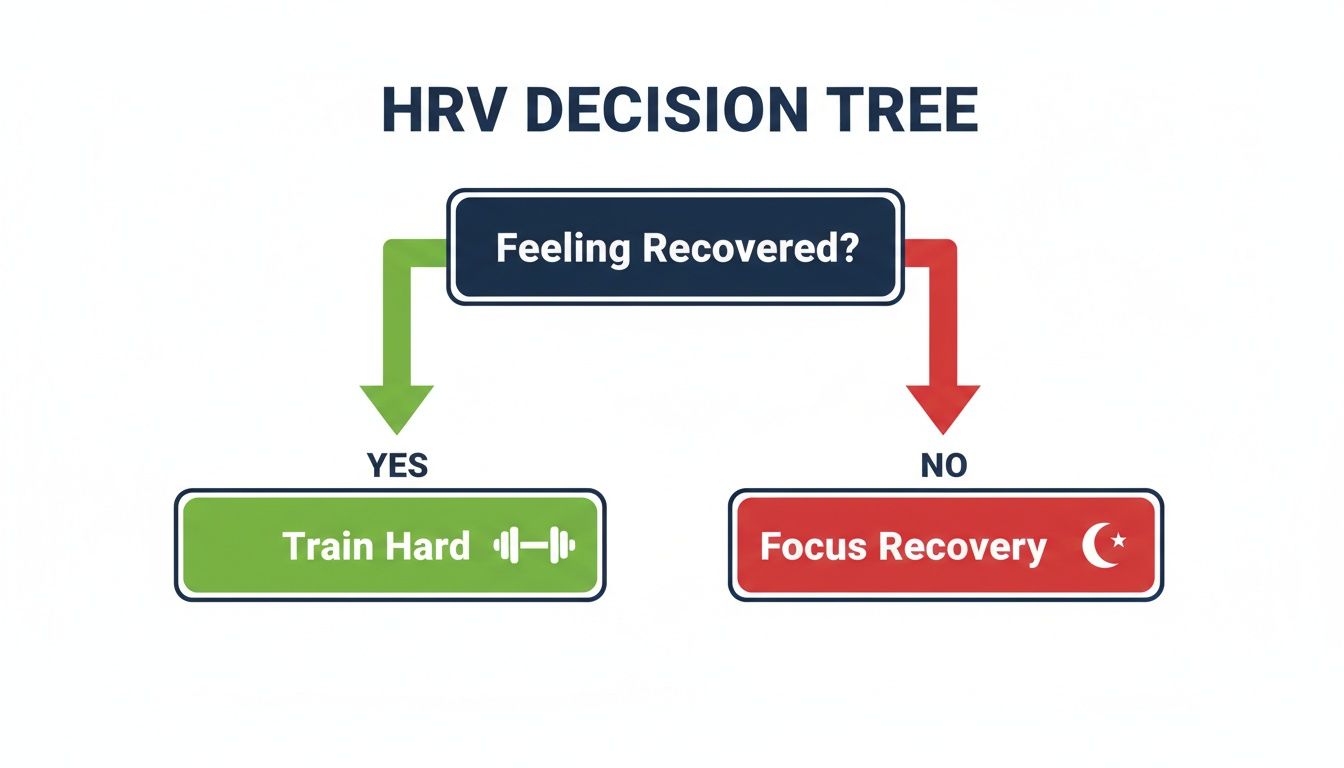
The idea is to sync your physical effort with your body's actual recovery status. This is how you prevent overtraining and unlock consistent performance improvements.
Practical Examples for Athletes
Let's look at how this works in the real world. Imagine a marathon runner who wakes up to a low HRV score the morning of a scheduled 10-mile tempo run. Instead of forcing it, they could swap it for an easy 30-minute jog or a non-impact cross-training session. This respects the body’s need to recover while still promoting blood flow and staying active.
Or consider a weightlifter planning a heavy squat day who sees a yellow-zone HRV reading. Rather than chasing a new PR, they could reduce the weight by 10-15% and focus on perfect form. Another option is to keep the weight the same but cut back on the total number of sets. It's about staying on track without overloading an already stressed system.
If you want to dive deeper into this methodology, understanding what HRV training is can help you personalize these adjustments even further.
By listening to your HRV, your workout becomes a tool for building a more adaptable and resilient nervous system, not just stronger muscles. You’re actively training your body to handle stress and bounce back faster.
Mastering Stress With Breathwork and Mindfulness
While your training builds the engine, some of the most potent tools for tuning your nervous system are completely free and always available. I'm talking about breathwork and mindfulness—direct lines of communication to your autonomic nervous system.
Think of it this way: by consciously controlling your breath, you can manually shift your body out of a sympathetic "fight-or-flight" state and into a parasympathetic "rest-and-digest" mode. This isn't just about relaxing; it's an active process of building real stress resilience from the inside out, providing immense health benefits for your mind and body.
Finding Your Rhythm With Resonant Frequency Breathing
One of the most effective techniques I've seen is resonant frequency breathing, sometimes called coherent breathing. The principle is simple yet profound. When you slow your breathing to a very specific, steady rhythm, you amplify your heart rate's natural oscillations, which immediately boosts your HRV.
For most people, that sweet spot is somewhere between 5 to 6 breaths per minute. Hitting this cadence creates what's known as cardiorespiratory coherence, a powerful feedback loop between your heart and brain. It’s like tuning a radio to the perfect frequency, allowing your nervous system to operate with maximum efficiency.
Here’s a simple protocol to get started:
- Inhale through your nose for a steady count of five.
- Exhale slowly and completely for a count of five.
- Continue this seamless 10-second cycle for 5-10 minutes.
The more you practice this, the more flexible your nervous system becomes. It learns to snap back to a calm, high-HRV state much faster after you encounter a stressor.
Practical Breathing Techniques for Daily Use
To help you get started, here's a quick guide to some of the most effective breathing protocols I recommend to clients for boosting parasympathetic tone and improving their HRV.
Breathing Techniques for HRV Improvement
| Technique | Breathing Pattern (In-Hold-Out) | Primary HRV Benefit | Recommended Practice |
|---|---|---|---|
| Coherent Breathing | 5-0-5 | Maximizes cardiorespiratory coherence by syncing heart and breath rhythms. | 5-10 minutes, 1-2 times daily, especially before bed or after a workout. |
| Box Breathing | 4-4-4-4 | Calms the nervous system by creating a predictable, balanced rhythm. | 3-5 minutes whenever you feel overwhelmed or need to refocus. |
| Physiological Sigh | 2 short inhales, 1 long exhale | Quickly offloads carbon dioxide and reduces anxiety in real-time. | 1-3 cycles as needed to immediately shift out of a stressed state. |
| 4-7-8 Breathing | 4-7-8 | The long exhale strongly stimulates the vagus nerve to promote relaxation. | 4-6 cycles before bed to help prime the body for deep sleep. |
Each of these techniques offers a slightly different way to tap into your nervous system. Experiment with them and see which one feels most effective for you.
The Compounding Power of Daily Mindfulness
Beyond dedicated breathwork sessions, other mindfulness practices are incredibly effective at taming sympathetic overdrive. They teach you to observe your thoughts and feelings without getting carried away by them—a critical skill for managing modern stress.
Don't just take my word for it. A landmark study in Nature that analyzed 1.8 million biofeedback sessions confirmed that training coherent breathing reliably boosts HRV and slashes stress. Even short programs lasting just a few weeks demonstrated huge benefits, from improving brain health to increasing the volume of brain regions tied to emotional regulation.
Here's how to make it a reality:
- Daily Meditation: Just 10 minutes can create measurable changes. Guided apps like Calm or Headspace are great for getting started.
- Time in Nature: A short walk in a park has a powerful grounding effect that helps down-regulate your stress response.
- Mindful Moments: You don’t always need a long session. Take one minute between meetings to close your eyes and just focus on your breath. These small doses of calm really add up.
Often, unmanaged stress spills over into other areas, like our eating habits. Learning how to stop stress eating is another practical skill that directly supports your physiological and mental well-being.
Integrating short, 5-10 minute breathwork or mindfulness sessions into your daily routine is one of the highest-impact strategies for improving your heart rate variability and building long-term stress resilience.
These practices aren't about eliminating stress—that's impossible. They're about upgrading your response to it. By consistently showing up, you're conditioning your body to recover faster and maintain a state of powerful balance. For more wellness protocols and insights, be sure to visit the MedEq Wellness Journal.
Advanced Recovery with Cold Plunges and Saunas
Once you've dialed in the fundamentals—sleep, nutrition, stress management—you might start looking for that next level. This is where advanced recovery tools like cold plunges and saunas come in. They're a powerful way to train your nervous system, build resilience, and drive serious improvements in your heart rate variability.
These modalities work on a principle called hormesis. Simply put, it's the idea that small, controlled doses of stress can make your body stronger and more adaptable over time. Think of it as lifting weights for your nervous system. The deliberate shock of intense heat or cold forces your autonomic nervous system to adapt and recover, ultimately making it better at handling real-world stress.

The Power of Contrast Therapy
Alternating between hot and cold, known as contrast therapy, is a potent strategy for boosting workout recovery and HRV. The quick temperature swings trigger a powerful physiological response.
The sauna causes vasodilation—your blood vessels expand to bring blood to the skin's surface to cool you down. Then, the cold plunge triggers vasoconstriction, narrowing those same vessels to conserve core body heat. This alternating expansion and contraction creates a "pumping" effect in your circulatory system, helping to flush out metabolic waste and ease inflammation after a tough session.
This intense cycle also trains your vagus nerve, which is the command center for your parasympathetic "rest-and-digest" system. By repeatedly pushing your body to adapt to these extremes, you improve your overall vagal tone, leading to a higher resting HRV. For a deeper dive, check out our article on sauna and cold plunge benefits.
A Safe and Effective Protocol for Beginners
Jumping into extreme temperatures requires a smart, gradual approach. Going too hard, too fast can overtax your system and actually tank your HRV. The goal here is stimulation, not annihilation.
Here’s a practical protocol to get you started safely:
- Sauna Session: Start with 15-20 minutes in a sauna set between 175-195°F (80-90°C). Focus on your breathing and make sure you're well-hydrated.
- Cool Down: Give yourself a minute or two to cool down naturally after stepping out of the heat.
- Cold Plunge: Submerge yourself in cold water, ideally between 45-55°F (7-13°C), for 1-3 minutes. Your first few sessions might be on the shorter end of that, and that's perfectly okay.
- Repeat: You can cycle through this 2-3 times. Always try to end with cold exposure to help bring down inflammation.
Remember, consistency trumps intensity every time. A shorter, more frequent practice will deliver better long-term HRV improvements than an occasional, grueling session. Listen to your body and adjust accordingly.
Percussive Massage for Targeted Recovery
While heat and cold offer systemic benefits, tools like percussive massage guns give you a more targeted approach. These devices use rapid, concentrated pulses to work deep into muscle tissue.
This powerful vibration helps release tension, break up knots, and increase blood flow to specific areas. From an HRV standpoint, percussive massage can help shift your body into a parasympathetic state by stimulating nerve receptors in the muscles, signaling to your brain that it's time to relax and repair.
Using a massage gun on sore spots for just a few minutes after a workout can dramatically speed up recovery and prime your nervous system for rest. It’s a direct way to tell your body to switch off the "fight-or-flight" mode and kickstart the healing process.
Red Light Therapy for Cellular Energy
Another powerful tool gaining serious traction is red light therapy (RLT). This technology uses specific wavelengths of red and near-infrared light to penetrate the skin and stimulate the mitochondria—the powerhouses inside your cells.
By enhancing mitochondrial function, RLT helps your cells produce more energy (ATP), which can accelerate tissue repair and reduce inflammation. This support at the cellular level reduces the overall stress load on your body, allowing for a stronger parasympathetic response and, you guessed it, a better HRV. Sessions are usually short, around 10-15 minutes, making RLT easy to stack with other recovery practices.
Interestingly, while we're talking about recovery, structured exercise itself remains a primary driver of HRV improvement. A recent study in Frontiers in Sports and Active Living found that sedentary adults following HRV-guided exercise programs saw significant gains in strength, endurance, and power. The data showed a direct link between their improved fitness and higher HRV, proving just how connected smart training and nervous system health really are. You can read the full research about these fitness improvements to see the data for yourself.
By layering these advanced tools into your routine, you move beyond passive recovery. You're actively building a more resilient and adaptable nervous system. For more expert-led strategies, visit the MedEq Wellness Journal.
Your HRV Questions, Answered
As you start tracking your heart rate variability, you’re bound to have questions. What do the numbers mean? Are you on the right track? It’s completely normal to wonder about the details as you get familiar with this powerful metric.
Think of this as your go-to guide for making sense of it all. Getting these key concepts down will help you turn your HRV data from just numbers on a screen into real-world action for better recovery and performance.
What’s a Good HRV Score?
This is probably the number one question we get, and the answer is surprisingly simple: it's entirely personal. There's no single "good" number to aim for. Your HRV is unique to you, shaped by your age, genetics, fitness, and lifestyle.
For perspective, a healthy 20-something might see a baseline between 55-100 ms. Meanwhile, someone in their 60s could be in great shape with a range of 25-45 ms. The key isn't to compare yourself to others, but to establish your own baseline over a few weeks. A "good" score is one that's stable or trending up for you. It's all about tracking your own resilience over time.
How Fast Can I Actually Improve My HRV?
You might be surprised how quickly you can see a change. Even one night of bad sleep or a single alcoholic drink can tank your score the very next day. On the other hand, something as simple as a 10-minute resonant breathing session can sometimes give you a little boost within hours.
But for real, lasting change, you need to think in weeks and months, not days. It's the consistent habits that make a real difference. After about 4-8 weeks of dialing in your sleep, managing stress, eating well, and training smart, you'll likely see a much more stable and higher baseline.
Lasting HRV improvement isn’t about one perfect day. It’s the result of stacking small, consistent habits over time—a true reflection of a more resilient nervous system.
Morning vs. Night: When Should I Measure HRV?
For the most accurate and useful data, measure your HRV first thing in the morning. Take your reading right after you wake up, before you even get out of bed. This gives you a clean snapshot of how your body has recovered overnight. It’s your readiness score for the day ahead.
Many wearables track HRV all night, but that average can be skewed by late-night meals or even vivid dreams. Your morning reading is the gold standard because it's a standardized measurement of your nervous system in a rested state. It's the most reliable number for tracking trends and making smart decisions about your day.
For more deep dives and wellness protocols, be sure to explore the MedEq Wellness Journal.
At MedEq Fitness, we know that true performance is built on a foundation of optimal recovery. Our curated selection of physician-vetted wellness equipment—from cold plunges and saunas to hyperbaric chambers—is designed to help you master your nervous system and unlock your full potential. Shop our complete collection of recovery tools today.