What Is HRV Training and How Can It Boost Your Wellness?
HRV training is a way of using your body's own data to make smarter decisions about your health, fitness, and overall well-being. Think of it as a built-in stress gauge that offers powerful insights into your workout recovery and daily wellness. When your Heart Rate Variability (HRV) is high, it's a green light—you're recovered and ready to take on a challenge. If it's low, it's your body's way of asking for a break, signaling a need for rest and rejuvenation.
Decoding Your Body's Readiness Signal

At its heart, understanding what is HRV training comes down to listening to your body's internal feedback. Your heart doesn't beat perfectly in time like a metronome. Those tiny, millisecond differences between each beat are what we call Heart Rate Variability (HRV). This isn't just random noise; it's a direct window into how your Autonomic Nervous System (ANS) is managing stress and promoting recovery.
The ANS is essentially the automatic control center for all the things you don't consciously think about—like breathing, digestion, and, of course, your heart rate. It has two main branches that are in a constant tug-of-war to keep your body in balance, directly impacting your health and wellness.
The Two Sides of Your Nervous System
First, you have the sympathetic nervous system, which is your "fight or flight" response. It's the gas pedal. It kicks into high gear when you're stressed, exercising, or excited, speeding up your heart rate to prepare you for action. When this system is in charge, the beats of your heart become more regular and metronome-like, which actually lowers your HRV score.
The other side is the parasympathetic nervous system, your "rest and digest" system. This is the brake pedal. It promotes relaxation, enhances workout recovery, and conserves energy. When you're well-rested and calm, this system is more active, allowing for more natural variation between heartbeats and resulting in a higher HRV.
A higher HRV generally indicates that your body is adaptable, resilient, and in a state of wellness. It shows that your parasympathetic system is active, signaling good recovery, balanced fitness, and a strong ability to handle stress.
So, how does this all tie back to training and health? HRV training simply means using this data to guide your daily decisions. By tracking your HRV, you can decide if today is the day to push for a new personal record, go for a light recovery jog, or focus on stress-reducing activities to boost your overall well-being.
This data-driven approach helps you move past one-size-fits-all workout plans. It's about fine-tuning your efforts to optimize performance, speed up your workout recovery, and build a more robust, resilient body over time. For more ideas on building out your wellness toolkit, you can find great resources in the MedEq Wellness Journal.
To break it down even further, here's a quick look at the core ideas.
HRV Training Core Concepts at a Glance
This table simplifies the main principles behind HRV, giving you a clear snapshot of what each concept means for your personal health and wellness.
| Concept | Simple Explanation | What It Means for You |
|---|---|---|
| Heart Rate Variability (HRV) | The tiny, natural variations in time (milliseconds) between your heartbeats. | It's not about how fast your heart beats, but how variable the rhythm is. More variability is a key sign of good health. |
| Autonomic Nervous System (ANS) | Your body's "automatic" control system, balancing your "fight or flight" (stress) and "rest and digest" (recovery) responses. | HRV is a direct measurement of how well your ANS is balancing stress and promoting wellness and recovery. |
| High HRV | A signal that your "rest and digest" system is active. Your heart rate is more variable. | Your body is recovered, resilient, and ready to handle stress or intense training. It's a strong indicator of overall health. |
| Low HRV | A signal that your "fight or flight" system is dominant. Your heart rate is more regular. | Your body is under stress—from poor sleep, illness, or overtraining—and needs to prioritize recovery to restore wellness. |
| The Goal of HRV Training | To use your daily HRV score to guide your training and lifestyle choices, pushing hard on "green" days and recovering on "red" days. | It helps you train smarter, avoid burnout, improve workout recovery, and enhance your overall resilience and wellness. |
By keeping these fundamentals in mind, you can start to see how this one simple metric provides a powerful, personalized roadmap for your health and performance.
The Science Behind Your Body's Internal Rhythm
To really get a handle on HRV, let’s use an analogy. Think of your nervous system as the engine and transmission of a high-performance car. A high, healthy HRV is like having a vehicle that can instantly accelerate, brake, and hug the curves with incredible precision. It’s responsive and ready for whatever the road throws at it, a clear sign of optimal wellness.
A low HRV, on the other hand, is like being stuck in first gear. The car is sluggish, burns a lot of fuel to go nowhere fast, and can't adapt to changing conditions. This signals that your body is under some kind of stress—be it a brutal workout, a bad night's sleep, or just mental exhaustion—and needs to focus on recovery.
The master mechanic behind this whole operation is your Autonomic Nervous System (ANS). It's the sophisticated, behind-the-scenes system that runs the show, constantly fine-tuning your heart rate, breathing, and other vital functions without you ever having to consciously think about it.
The Push and Pull of Your Nervous System
Your ANS has two main branches that are constantly in a state of dynamic tension, a sort of push and pull. You have the sympathetic system—your body’s gas pedal. This is your "fight or flight" response, revving up your heart rate and sharpening your focus for action.
Then you have the parasympathetic system, which acts as the brake pedal. It's the "rest and digest" side of things, helping you calm down, recover, and conserve energy.
A higher HRV is a clear sign that your parasympathetic system—the brake—has more influence. This allows for that healthy, natural variation between each heartbeat. It’s a direct indicator that you're well-rested, recovered, and adaptable. This isn't just about physical readiness; it's a huge component of mental wellness and overall health.
A flexible and adaptive nervous system, reflected by a higher HRV, is the foundation of both physical performance and emotional resilience. It's a direct measure of your body’s ability to handle and recover from stress, which is central to long-term health.
This link between HRV and mental health isn't just theory; it's backed by solid research. For instance, a fascinating study showed that HRV coherence training—which is essentially learning to breathe at a specific rhythm to stabilize your heart rate—led to major improvements in emotional stability and cognitive function. After just five weeks of daily training, participants had increased cortical volume in brain regions tied to emotional regulation and higher low-frequency HRV power. You can dive into the specifics of these HRV training findings on Nature.com.
Ultimately, simple things like how well you sleep, how hard you train, and your day-to-day stress levels are what move the needle on this sensitive balance. Understanding this science is the first step toward using HRV as a powerful tool for your health. For more deep dives like this, keep exploring the MedEq Wellness Journal.
How to Measure and Understand Your HRV Data
So, how do we turn all this science into something you can actually use? It all starts with measuring your HRV, and you've got a couple of good options. Each one strikes a different balance between pinpoint accuracy and everyday convenience. Getting a handle on how to collect and read this data is the first real step in making HRV training work for you.
For the most precise, clinical-grade data, nothing beats an electrocardiogram (ECG), which you’ll typically find in a chest strap monitor. These devices read the heart's electrical signals directly, capturing the exact milliseconds between each heartbeat. If you're a serious athlete or a researcher, this is your gold standard.
But for the rest of us tracking daily fitness and wellness, modern wearables are more than up to the task. Devices like smartwatches and rings have made HRV tracking accessible to everyone. They use optical sensors (photoplethysmography, or PPG) to see the pulse of blood flow in your finger or wrist and calculate HRV from that. While they might not be as surgically precise as a chest strap, their consistency makes them fantastic for tracking your daily trends, which is what really matters for wellness and workout recovery.
Decoding the Numbers
Once you start tracking, you’ll see a few different metrics pop up. The one you'll encounter most often on consumer devices is rMSSD, which stands for the Root Mean Square of Successive Differences. It sounds complicated, but the concept is simple.
Think of rMSSD as a direct snapshot of your 'rest and digest' system's activity. A higher rMSSD number generally means your parasympathetic nervous system is running the show. In other words, your body is in a good state for recovery and ready to take on stress.
This ease of access has sparked a huge wave of interest in personal biofeedback. The market for HRV biofeedback apps recently hit USD 1.12 billion and is expected to grow at a compound annual rate of 18.7%, projected to reach USD 5.36 billion by 2033. You can dig deeper into this rapid market expansion at DataIntelo.com.
The Golden Rule of HRV Analysis
If you remember only one thing from this section, let it be this: your numbers are your own. Comparing your HRV score to your friend's or some pro athlete's is a complete waste of time. Your age, gender, fitness level, and even your genetics create a "normal" range that is totally unique to you.
The real magic happens when you establish your own personal baseline and watch the trends.
Here's how to think about it:
- Find Your Baseline: Just live your normal life and track your HRV for a week or two. This will give you a clear picture of your typical range.
- Look for Trends: Is your average HRV slowly climbing over several days or weeks? That’s a fantastic sign that your body is adapting and becoming more resilient.
- Watch for Dips: A sharp, unexpected drop below your baseline is your body waving a red flag. It’s a signal to back off, prioritize sleep, and maybe swap that intense workout for a recovery day.
By focusing on your personal trends instead of the raw number, HRV stops being a confusing metric and becomes a clear, personalized guide for your health. To explore more ways to fine-tune your well-being, check out the MedEq Wellness Journal.
Using HRV for Smarter Workouts and Faster Recovery
So, you’ve got the tools to measure and understand your HRV. What’s next? This is where the real magic happens. Instead of blindly following a pre-written workout plan, you can start listening to what your body is actually ready for on any given day. This approach enhances not only your performance but also your overall wellness and workout recovery.
This approach lets you train smarter, not just harder. It’s all about knowing when to push the throttle and when to ease off, ensuring every single workout contributes positively to your health.
A brilliantly simple way to put this into practice is the traffic light system. Think of it as a daily decoder for your body's readiness signals, turning your HRV data into a clear, actionable plan for the day.
The HRV Traffic Light System
Your morning HRV score essentially gives you your marching orders for the day. It tells you whether it's time to hit the gas, cruise, or pull over for a pit stop to prioritize wellness.
-
Green Light (HRV is at or above your baseline): All systems go. This is a clear sign that you've recovered well and your body has adapted to recent stress. Today is the day to tackle that high-intensity interval session, go for a heavy lift, or aim for a new personal record. You're primed for peak performance.
-
Amber Light (HRV is slightly below baseline): Time to be cautious. Your body might be carrying some lingering fatigue or stress. A moderate-intensity workout is a good call here—think a steady-state run, a controlled strength session, or focusing on technique. Pushing to your absolute limit today probably isn't the best idea for long-term health.
-
Red Light (HRV is significantly below baseline): Full stop. A major dip in HRV is your body waving a big red flag. It’s overloaded from training, poor sleep, illness, or other stressors. Hitting a hard workout now would do more harm than good, seriously elevating your risk of injury and burnout. Instead, make it an active recovery day with a light walk, some gentle stretching, or even a complete day off to focus on wellness.
This simple chart breaks down the decision-making process.
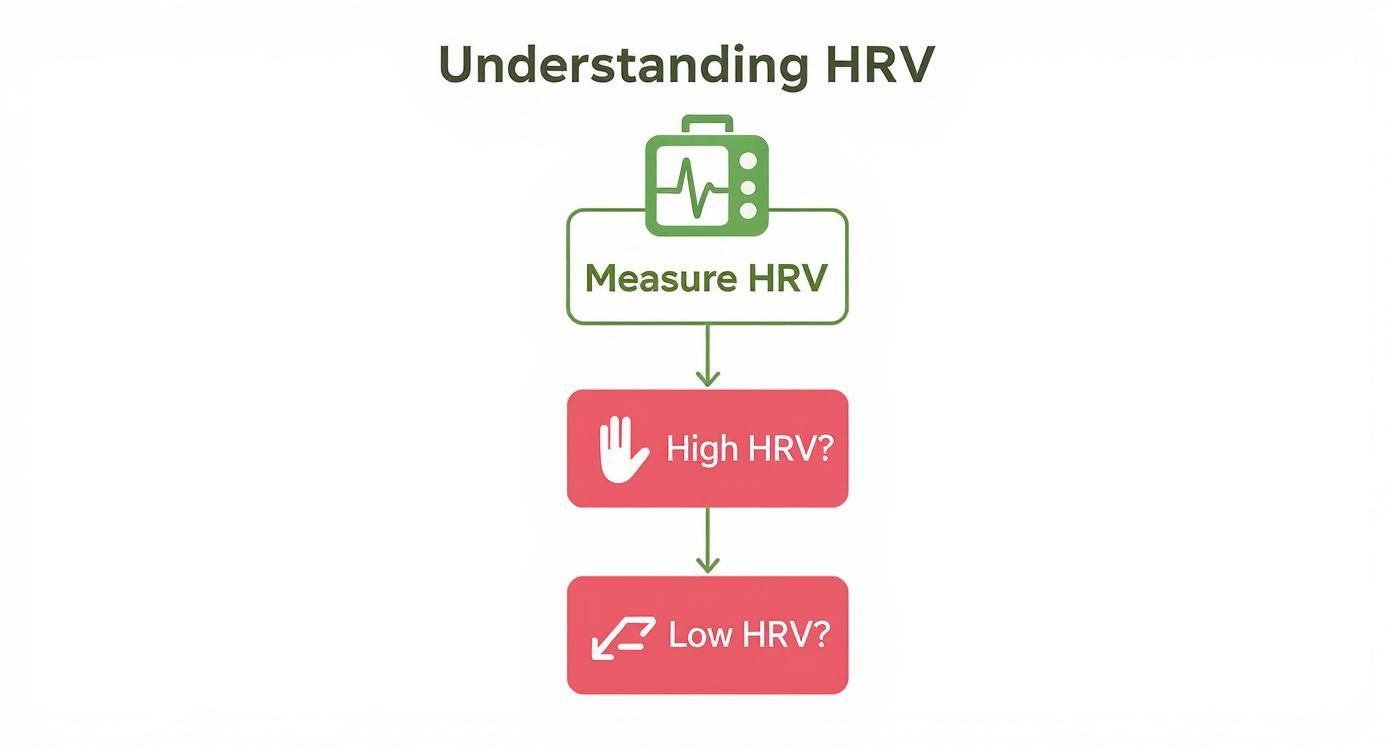
The takeaway is straightforward: a high HRV gives you the green light to go hard, while a low HRV is your body’s cue to prioritize rest and recovery.
To give you a clearer picture, here’s a practical protocol you can follow.
HRV-Guided Daily Workout Protocol
This table shows how to translate your daily HRV reading into a specific training action that supports both fitness and wellness.
| Daily HRV Reading | Interpretation | Recommended Action |
|---|---|---|
| Well above baseline | Peak readiness; fully recovered and adapted. | Go for it. Ideal for a max-effort workout, HIIT, or a long, challenging session. |
| Within baseline range | Good recovery; ready for a solid effort. | Train as planned. Perform your scheduled moderate-to-high intensity workout. |
| Slightly below baseline | Some lingering fatigue; not fully recovered. | Dial it back. Reduce intensity or volume. Focus on technique or endurance, not power, to aid recovery. |
| Significantly below baseline | High stress/fatigue; system is overloaded. | Active recovery or rest. Opt for a walk, mobility work, stretching, or take the day off entirely to boost wellness. |
This isn't about skipping workouts—it's about making sure the work you do is productive, not destructive.
Backed by Science for Better Results
This isn’t just a trendy bio-hacking concept; it’s a strategy firmly rooted in scientific evidence. A recent randomized controlled trial confirmed that HRV-guided training leads to significant fitness improvements.
In the study, athletes who performed high-intensity sessions only when their HRV was high saw substantial gains, with effect sizes ranging from small to large (0.21–1.63). You can dive into the specifics by reading the full research on HRV-guided training from Frontiers.
By adopting this personalized method, you're officially moving beyond guesswork. Keeping an eye on your HRV after a workout also gives you incredible feedback on how your body is handling the training load, which helps you fine-tune your recovery. For a closer look at what works, check out our articles at the MedEq Wellness Journal.
Boosting Your HRV with Advanced Recovery Therapies
HRV training is a powerful tool for wellness, but you can elevate its benefits by pairing it with advanced recovery therapies. Think of these techniques as amplifiers for your nervous system. They help your body flip the switch into that parasympathetic "rest and digest" mode much more efficiently, enhancing workout recovery and overall health.
When you combine HRV training with these modalities, you create a powerful feedback loop. You're no longer just passively recovering; you're actively teaching your body how to manage stress better. These practices introduce a controlled, short-term stressor, which sounds counterintuitive, but it’s this challenge that strengthens your body's long-term stress response system and improves wellness.
Cold and Heat Contrast Therapy for Nervous System Resilience
One of the most effective methods for enhancing wellness is contrast therapy. This involves alternating between hot and cold environments, like moving from a sauna into a cold plunge. This practice is a fantastic way to directly stimulate your vagus nerve—a major player in your parasympathetic nervous system—which can give your HRV and workout recovery an immediate boost.
The quick shift in temperature makes your blood vessels constrict and then dilate. This creates a natural "pumping" action that helps flush out metabolic waste and ease muscle soreness. But the real health benefit is what it does over time. This controlled stress makes your nervous system far more adaptable, which translates to a higher baseline HRV and quicker recovery from your workouts.
Here’s a closer look at how each component works its magic on your HRV:
-
Cold Plunge: That initial shock from the icy water? It triggers a strong vagal response. This kicks your parasympathetic system into gear, helping to slow your heart rate and increase the variability between beats as your body acclimates. Done regularly, it can lead to a real, sustained increase in your baseline HRV.
-
Sauna Sessions: The heat from a sauna is a perfect example of hormetic stress—basically, a "good" stress that forces your body to adapt and get stronger. It’s great for cardiovascular health, helps lower inflammatory markers, and triggers an endorphin release. All of this helps create a more balanced nervous system and, you guessed it, a better HRV.
Stacking Therapies for Maximum Benefit
You can build some incredibly effective workout recovery protocols by combining these methods. A great post-workout routine, for instance, could be a solid sauna session followed immediately by a cold plunge. This doesn't just supercharge the physical health benefits of reducing inflammation; it gives your nervous system a serious workout, making it more skilled at switching between "go" and "slow" modes.
By intentionally exposing your body to controlled thermal stressors, you are actively conditioning your nervous system to become more flexible and resilient. The result is a higher, more stable HRV and a body that recovers faster and performs better under pressure, leading to greater overall wellness.
Integrating these practices is a core part of what HRV training is all about—using data and smart tools to guide your body toward peak function. Other advanced tools can also fit into this recovery ecosystem. To learn about another powerful modality, you can explore the hyperbaric chamber benefits for athletes right here on our blog.
Expanding the Wellness Benefits of HRV Training
https://www.youtube.com/embed/982In66Kic8
While HRV-guided training is a total game-changer for athletes, its real power extends far beyond the gym. The health benefits are for everyone. Thinking about what is HRV training really just opens the door to taking charge of your own wellness, helping you build resilience against the non-stop pressures of modern life.
A higher, more adaptable HRV is a direct sign of better overall well-being. We're talking about key health benefits like sharper mental clarity, a stronger immune system, and a much better handle on stress. When you learn to influence your HRV, you're essentially conditioning your nervous system to deal with life's curveballs more effectively, both physically and emotionally.
Mastering Your Breath to Master Your Stress
One of the simplest yet most profound ways to improve your wellness is through resonance frequency breathing. This just means intentionally slowing your breathing down to a steady, consistent rhythm—usually somewhere around five to seven breaths per minute. It might sound simple, but this specific pace has a massive and immediate positive impact on your nervous system.
By practicing slow, paced breathing, you directly stimulate your vagus nerve, which is the main highway to your parasympathetic "rest and digest" system. This simple action can instantly boost your HRV, quiet feelings of anxiety, and flip the switch on your body's recovery mode—a powerful health benefit you can access anytime.
This isn't just about relaxing in the moment; it's active training for your nervous system. By making resonance breathing a consistent practice, you can actually raise your baseline HRV over time. That makes your entire system more resilient to whatever stress comes your way, leading to enhanced long-term wellness.
Ultimately, getting a handle on your HRV is a cornerstone of proactive health. Better sleep is another huge win that comes from a well-regulated nervous system. If you're looking to really dial in your nightly rest, you can find some fantastic strategies in our guide on how to increase deep sleep.
For more expert advice on optimizing your health and recovery, explore the MedEq Wellness Journal.
Common Questions About HRV Training
Jumping into a new health metric always brings up a few questions. Getting a handle on the practical side of HRV training is what builds confidence and helps you actually use this powerful tool for your wellness journey. Let's tackle some of the most common things people ask.
One of the first questions I usually hear is, "How long until I see results?" It's a great question. While you can see your daily HRV score jump after just one great night's sleep or a relaxing afternoon, building up your baseline resilience is more of a long game. Most people start to see a stable, upward trend in their average HRV after about four to six weeks of consistent effort—that means smart training combined with solid sleep and stress management.
Do I Need an Expensive Device to Start?
This is a big one. People worry they need to spend a fortune on gear to reap the health benefits. The short answer? Absolutely not.
Sure, a dedicated chest strap is considered the gold standard for accuracy. But the real magic of HRV training comes from consistency, not from chasing clinical-grade precision every single morning. Many of today's smartwatches and fitness rings give you reliable trend data that's more than enough to guide your decisions on whether to push hard or take it easy for better workout recovery.
The most important thing is to pick one device and stick with it. That's how you establish a personal baseline you can trust.
The goal isn't to chase a perfect number but to understand your body's unique patterns. A simple, consistently used device is far more valuable for your wellness journey than an expensive one that gathers dust.
Finally, people often ask if a single low reading is a red flag for overtraining or getting sick. Not necessarily. A one-off dip can be caused by almost anything—a tough meeting at work, a late-night meal, or just a single restless night. The real power of HRV is in the trends over time. I always tell people to look for a pattern of low readings over several days before making any big changes to their training plan.
For more in-depth articles and guidance on your wellness journey, be sure to explore the MedEq Wellness Journal.
At MedEq Fitness, we provide science-backed wellness and recovery equipment to help you bridge the gap between exertion and renewal. Explore our collection of professional-grade tools designed to restore energy, accelerate recovery, and elevate your daily capacity.