Manual Running Treadmill Your Guide to Better Wellness and Workouts
Picture running outdoors, where every step you take sets the pace. That’s the feeling a manual running treadmill brings inside. Forget motors and moving belts pulling you along; on these machines, you are the engine. It’s a completely self-propelled experience that makes indoor running feel far more natural and intuitive, aligning perfectly with a wellness-focused lifestyle.
How a Manual Running Treadmill Works
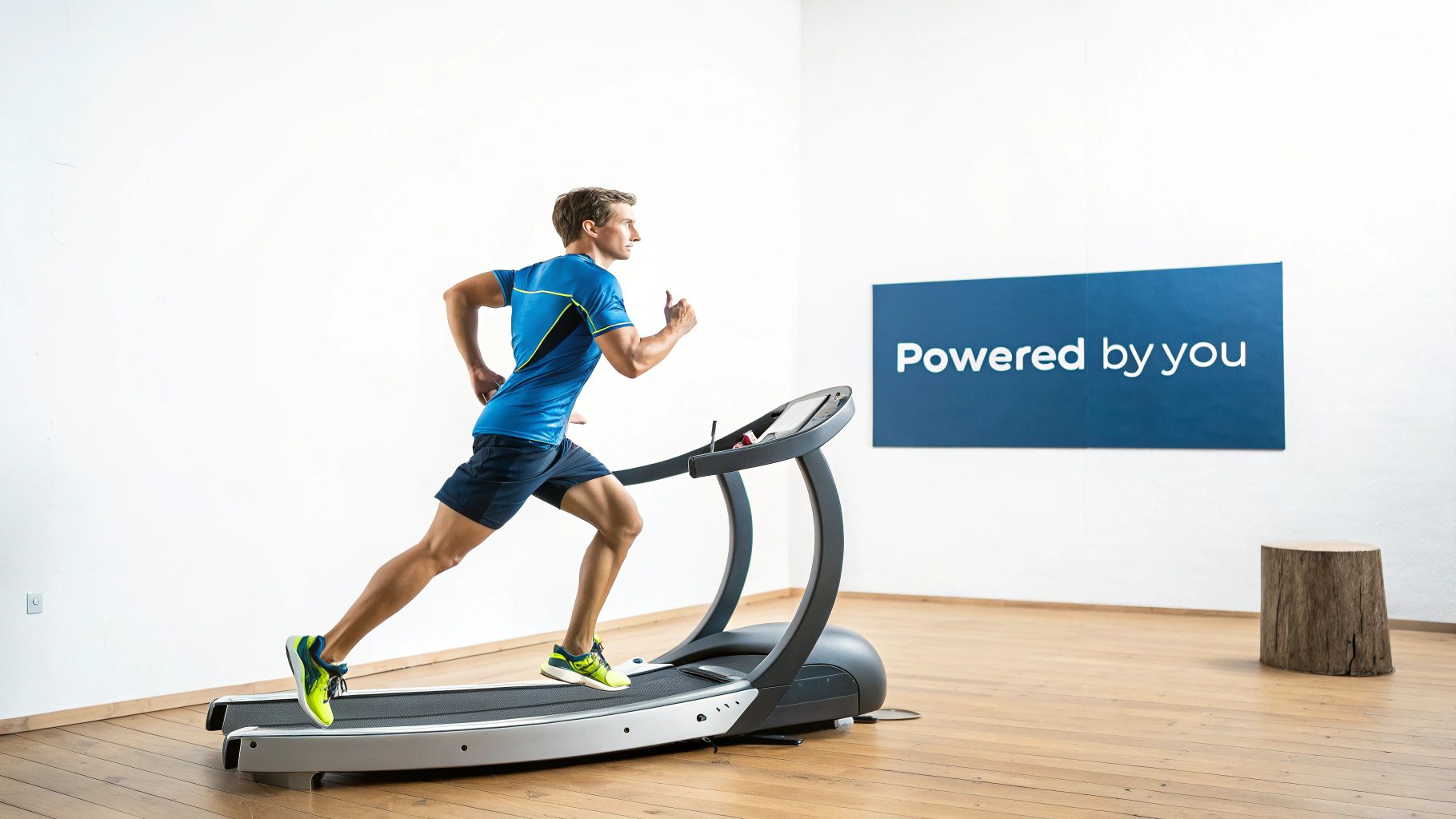
The magic behind a manual treadmill is brilliantly simple: it’s all about physics, specifically your motion and the force of gravity. Instead of a motor, these treadmills use a curved running deck fitted with a series of low-friction slats. This unique, concave design is the secret to its responsive, user-driven feel and its significant health benefits.
Think of it as a human-powered flywheel. The curve isn't just for looks—as your foot lands, your body weight pulls the belt down and back, starting the motion. To keep it going, you have to keep stepping forward, propelling the belt with every single stride. This creates an immediate, one-to-one relationship between your effort and the treadmill's speed.
You Are the Engine
The biggest difference you'll feel is that you have 100% control over your speed. Want to break into a full-out sprint? Just lengthen your stride and drive forward; the belt accelerates right with you. Need to slow down for a recovery walk? Shorten your steps and drift toward the back of the curve, where gravity naturally helps you decelerate. There are no buttons to fumble with or speeds to program.
This self-powered mechanism is a game-changer for your health and wellness for a few key reasons:
- Instant Pace Changes: The belt responds in real-time to your output. This makes it perfect for high-intensity interval training (HIIT) where you need to switch from a sprint to a jog, maximizing cardiovascular benefits without waiting for a motor to catch up.
- Natural Running Form: The curve encourages a healthier running posture, promoting an efficient midfoot or forefoot strike instead of a harsh heel strike. For many runners, this can significantly reduce the impact on their joints and support long-term wellness.
- More Muscle Engagement: Because you’re actively pulling the belt back with each stride, you fire up your posterior chain—your glutes and hamstrings—way more than on a motorized treadmill. You’re doing all the work, not the machine, leading to a more effective workout.
Promoting Better Biomechanics and Wellness
A manual treadmill doesn't just make you work harder; it actually helps you move better. By forcing you to generate and maintain your own momentum, it subtly corrects common running flaws. You have to engage your core to stay balanced and centered, which naturally improves your posture and strengthens those all-important stabilizing muscles, contributing to your overall wellness.
A manual treadmill mimics the physics of running on solid ground far more accurately than a motorized one. Your body has to overcome inertia on its own, leading to a more authentic and demanding workout that taps into your natural movement patterns.
Understanding these mechanics is key to seeing why these treadmills are so beneficial for everything from elite athletic training to general wellness and workout recovery. It’s a fundamentally different and more engaging way to run.
To see how our tools can support your wellness goals, check out the MedEq Wellness Journal.
The Science Behind the Health and Fitness Gains
The unique design of a manual running treadmill does more than just change the feel of your run—it fundamentally rewires the physiological demands on your body, unlocking significant health benefits. Because you’re the engine, the machine forces a level of muscle engagement that a motorized treadmill simply can't match. This self-propelled motion is the key to a healthier, more effective workout.
Every stride requires you to actively pull the belt back, which instantly fires up your posterior chain—the powerful muscles in your glutes and hamstrings. Unlike a motorized belt that does the work for you, a manual treadmill demands that you generate the force for every single step. This constant, active engagement delivers a far more comprehensive lower-body workout and enhances overall muscular wellness.
A Higher Calorie Burn by Design
One of the biggest health benefits is the increased metabolic cost. Since your body is doing all the work to overcome inertia and keep the belt moving, you naturally burn more calories. And this isn't a small difference.
For high-performance training, these treadmills perfectly mimic outdoor sprinting. Users propel the belt with their own power, engaging more muscle groups and boosting calorie burn by 20-30% over motorized treadmills. At the same time, this makes them perfect for workout recovery, as the manual operation actually reduces joint impact. Studies have shown 15-20% less stress on the knees, making them a go-to for physical therapists and wellness biohackers focused on optimizing recovery.
Improving Your Running Form, Naturally
A manual running treadmill is like having a running coach built into the machine, subtly correcting your form with every step. The curved deck encourages a more natural gait, guiding you toward a midfoot or forefoot strike instead of the jarring heel strike that causes so many running injuries. This is a fundamental health benefit for long-term joint integrity.
This mechanical shift isn't just about your feet. To stay balanced and maintain a consistent pace on the curve, you have to engage your core stabilizers the entire time. This constant core activation builds better posture, improves stability, and develops a stronger, more resilient torso—the foundation of all efficient movement and a pillar of physical wellness.
The self-propelled nature of the machine requires continuous core engagement to maintain balance and control speed. This creates a feedback loop where better form leads to a better run, reinforcing healthier movement patterns without you even thinking about it.
Low-Impact Movement for Longevity and Workout Recovery
While the workout is definitely more intense, it's also kinder to your body, a key aspect of wellness. The curved design and the forefoot strike mechanics help absorb and distribute impact forces much more effectively than running on a flat, motorized surface. This dramatically reduces the stress on your ankles, knees, and hips.
This low-impact quality makes the manual running treadmill an incredible tool for several wellness applications:
- Injury Prevention: By promoting a healthier gait and reducing joint loading, it helps minimize the risk of common overuse injuries.
- Active Rehabilitation: It provides a safe way to reintroduce movement and build strength post-injury without subjecting vulnerable joints to harsh impacts.
- Active Recovery: On rest days, a gentle walk or slow jog can stimulate blood flow, ease muscle soreness, and speed up the body's natural healing processes, making it a cornerstone of effective workout recovery.
As you consider the cardiovascular advantages, it's worth thinking about the broader context of promoting heart health through initiatives like American Heart Month. By integrating a tool like this, you're not just getting a better workout; you're investing in a more sustainable, health-focused fitness practice. You can learn more in our article about running on a manual treadmill.
Manual Treadmills Versus Motorized Treadmills
So, you're weighing your options: a manual running treadmill or a classic motorized one. The right choice really boils down to understanding how they work and, more importantly, what you want to achieve. This isn't just about features; it’s about matching the machine's fundamental design to your specific training, workout recovery, or wellness goals.
The biggest difference is simple: what makes the belt move? A motorized treadmill uses an electric motor to set the pace, essentially pulling your feet along for the ride. But on a manual running treadmill, you are the engine. The belt only moves when your feet push it backward.
Workout Intensity and Muscle Activation
This one mechanical distinction creates a world of difference in workout intensity and health benefits. When you're on a motorized treadmill, your main job is to lift your feet and keep up. It's a fantastic cardio workout, but the motor is doing a lot of the heavy lifting.
Switch to a manual treadmill, and suddenly you have to generate all the force yourself. With every stride, you're overcoming inertia, which demands way more from your posterior chain—your glutes and hamstrings have to fire to pull that belt. The result? A much tougher workout that recruits more muscle and burns more calories, maximizing the health benefits of your time.
The User Experience and Control
Control is another huge factor. Motorized treadmills make you hit buttons to change speed or incline, and there’s always a slight lag. That can feel a bit clunky, especially during high-intensity interval training (HIIT) where you need to switch from a full-out sprint to a recovery jog in a split second.
A manual treadmill gives you instant, intuitive control. Your speed is a direct result of your effort. Want to sprint? Drive your legs harder and lengthen your stride. Time to slow down? Just ease up. This immediate feedback makes HIIT sessions feel more athletic and natural, much closer to how you’d run outside.
The core contrast lies in the source of momentum. A motorized treadmill provides it for you, asking you to react. A manual treadmill demands you create it, forcing you to be proactive in every step of your workout.
Joint Impact and Running Form
While a manual treadmill workout is more intense, it’s often kinder to your joints—a major wellness advantage. The curved deck naturally promotes a midfoot or forefoot strike, which is much better at absorbing impact than the heel-pounding that can happen on flat surfaces. This makes it a great tool for anyone focused on preventing injuries or working through active rehab and workout recovery.
The flat, unforgiving deck of a motorized treadmill can sometimes encourage a less-than-ideal running form, especially if the user isn't paying attention. Over time, that repetitive impact can add stress to the ankles, knees, and hips. To go deeper, check out our full breakdown of a manual treadmill vs a motorized treadmill.
The infographic below really drives home the unique health and wellness benefits.
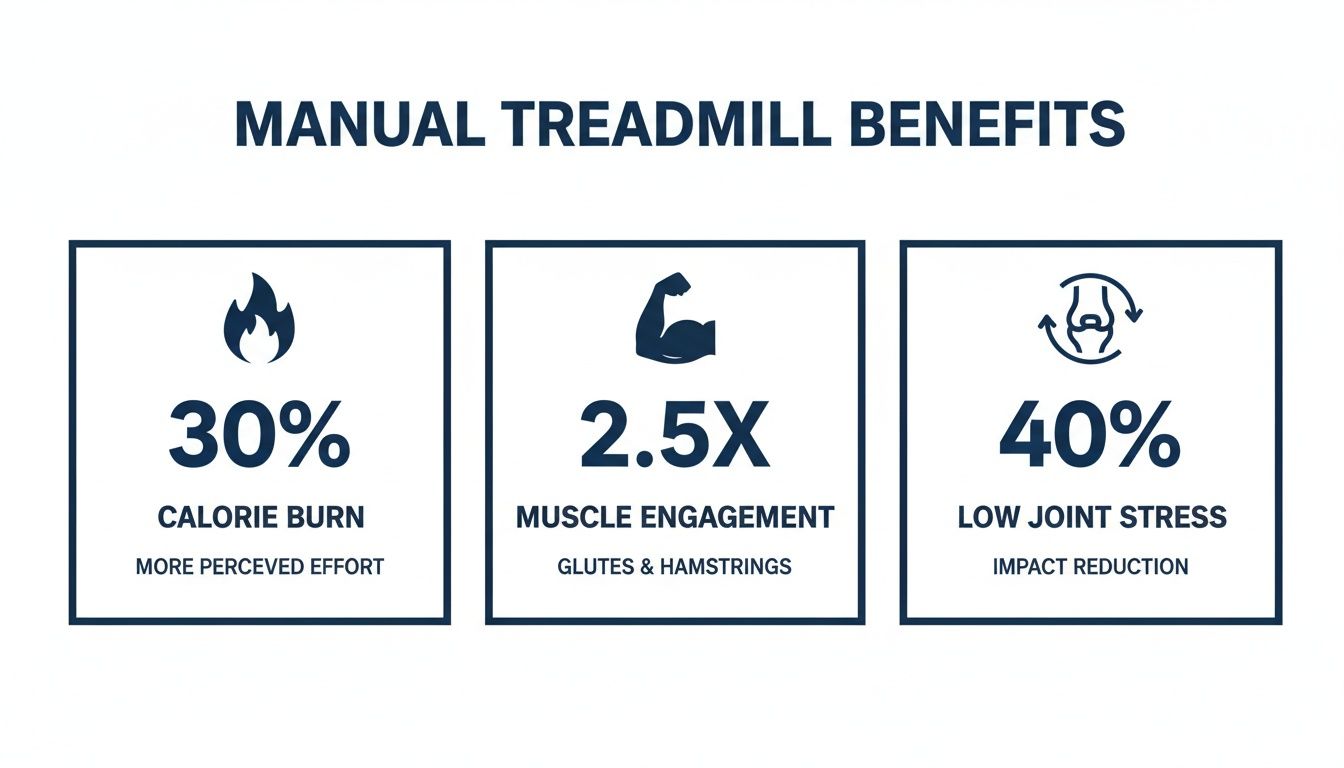
As you can see, the self-powered design isn't just a novelty—it directly translates into better calorie burn, more muscle activation, and less stress on your body, all key components of a holistic wellness plan.
Manual Running Treadmill vs. Motorized Treadmill
| Feature | Manual Running Treadmill | Motorized Treadmill |
|---|---|---|
| Power Source | Entirely self-propelled by the user. | Electric motor powers the belt. |
| Speed Control | Instantaneous; controlled by user's stride. | Button-based with a slight delay. |
| Workout Intensity | Higher metabolic demand; greater muscle engagement. | Lower intensity; motor assists with propulsion. |
| Health Benefit | Curved deck encourages a low-impact midfoot strike. | Flat deck can lead to a high-impact heel strike. |
| Energy Use | Zero electricity required. | Requires a standard electrical outlet. |
| Noise Level | Significantly quieter operation. | Motor and belt create noticeable noise. |
| Ideal Use Case | HIIT, athletic training, gait analysis, workout recovery. | Steady-state cardio, endurance training. |
This table shows how each treadmill type excels in different areas, making it easier to see which one aligns best with your needs, whether for a high-performance clinic or a home wellness routine.
Integrating Manual Treadmills into Your Wellness Routine
Think of a manual running treadmill as more than just a workout machine. It's a highly versatile tool for building a smarter, more balanced wellness and workout recovery practice.
Because you are the motor, you can seamlessly shift from an all-out sprint to a gentle, restorative walk in an instant. This makes it a perfect fit for a whole spectrum of health goals, but it all comes down to learning how to use your own body to get the results you want.
The most important skill to dial in is pace control. It’s all in your stride. Unlike a standard treadmill where you hit a button, here, you’re the one conducting the orchestra. To speed up, you just lengthen your stride and drive forward from the balls of your feet, pushing yourself up the curve. To slow down, you shorten your steps and let yourself drift back, allowing gravity to do the work. This intuitive feel makes it an incredible tool for dynamic workouts.
Sample Workout Protocols for Every Goal
The real magic of a manual treadmill is its raw adaptability. Whether you’re an athlete chasing a new personal best or just someone focused on active workout recovery, the machine responds directly to your intent.
Here are a few sample protocols to get you started:
-
For High-Intensity Interval Training (HIIT): This is where these treadmills truly come alive.
- Warm-up: 5 minutes of easy walking.
- Work Interval: 30 seconds of an all-out sprint, driving hard with your legs.
- Rest Interval: 60-90 seconds of slow, controlled walking to recover.
- Repeat: 8-10 rounds.
- Cool-down: 5 minutes of gentle walking.
-
For Active Workout Recovery: Use this on your off days to help your body heal without piling on more stress.
- Pace: A slow, deliberate walk for 15-20 minutes.
- Focus: Keep a steady heart rate and just concentrate on your breathing.
- Goal: The aim is to increase circulation to sore muscles and help flush out metabolic byproducts, a key health benefit for muscle wellness.
The Role in Advanced Workout Recovery
Going beyond simple recovery walks, a manual treadmill plays a key part in modern wellness strategies. The low-impact movement is fantastic for boosting blood flow, which is exactly what your body needs to shuttle oxygen and nutrients to repairing muscles. This is a critical health benefit for anyone serious about their fitness.
This gentle stimulation can significantly reduce delayed onset muscle soreness (DOMS) and cut down the time you need between intense training sessions. This improved circulation also has a positive effect on Heart Rate Variability (HRV), a core metric for tracking your body's recovery status. Consistent, low-intensity movement helps calm your nervous system, shifting it from "fight-or-flight" into "rest-and-digest" mode, which shows up as a healthier HRV score.
Integrating gentle, self-propelled movement on non-training days can be one of the most effective ways to support your body's natural recovery cycles. It's a low-stress activity that delivers high-value physiological benefits, from improved blood flow to better nervous system balance.
Complementing Contrast Therapy
For those using more advanced workout recovery methods, the manual running treadmill is the perfect partner for contrast therapy. The practice of alternating between hot and cold environments—like a sauna and a cold plunge—puts a unique and beneficial stress on the body that promotes recovery and wellness.
A manual treadmill acts as the ideal low-intensity bridge between these sessions. A simple 5-10 minute gentle walk after a cold plunge or before a sauna can help keep blood flowing and ease your body's transition between the temperature extremes. This active recovery element keeps the circulatory system working without causing extra fatigue, maximizing the restorative health benefits of the therapy. To enhance your overall physical conditioning and ensure a well-rounded fitness regimen, consider how you can explore various exercise videos to complement your treadmill workouts.
By weaving these strategies into your routine, you can turn your manual treadmill from a simple piece of cardio equipment into a central pillar of your health, wellness, and performance.
Is a Manual Running Treadmill Right for You?
So, is a manual running treadmill the right call? The answer isn't in the machine itself, but in what you want to achieve with it. Its unique, self-powered design offers serious health and wellness advantages, but they shine brightest when matched with the right goals.
Let's break down a few real-world scenarios to see where this kind of treadmill really clicks. The beauty of a manual running treadmill is the complete control it gives you. That direct connection makes it an incredibly versatile tool for elite athletes, everyday homeowners focused on wellness, and clinical patients undergoing rehabilitation. It’s all about matching your "why" to the machine's "how."
For High-Performance Athletes and Fitness Enthusiasts
If you're an athlete chasing a competitive edge, this is where a manual treadmill becomes a precision instrument. Think of it as a tool for honing sprint mechanics and building raw, explosive power. Since the belt only moves when you drive it, you’re forced to engage your entire posterior chain—glutes, hamstrings, the works—in a way a motorized deck just can't touch.
This creates a powerful feedback loop that's perfect for:
- Sharpening Sprint Mechanics: It naturally guides you into a forefoot strike and a powerful forward lean, which is exactly how you sprint on solid ground.
- Building Anaerobic Capacity: The instant response is a game-changer for High-Intensity Interval Training (HIIT). You can go from an all-out sprint to a dead stop without mashing buttons or waiting for a motor to slow down.
- Developing Raw Power: Every single step requires you to overcome inertia. That builds the kind of functional strength that pays dividends on the track, field, or court.
For the Home Gym Owner Focused on Wellness
For anyone building out a personal fitness space with wellness in mind, a manual treadmill just makes sense. Home gym owners are usually looking for equipment that's quiet, doesn't hog space, and won't give them headaches with maintenance. A manual model nails all three.
With no motor, it's nearly silent. You can get a workout in at 5 AM without waking up the rest of the house. It also uses zero electricity, so you can place it anywhere without hunting for an outlet, and you'll save a bit on your energy bill. The simpler design, free of complex electronics, also means there's less that can break, making it a solid, long-term investment in your health and wellness.
For Wellness Clinics and Rehabilitation Centers
In a clinical setting, control and safety are everything. A manual running treadmill offers an incredibly safe environment for patient rehab and wellness programs. The second a user stops walking, the belt stops moving. There’s virtually no risk of the machine getting away from a patient who might be unsteady on their feet.
Physical therapists love these machines because the user-driven pace is ideal for workout recovery and:
- Gait Retraining: A patient recovering from an injury can move at their own natural pace. This lets the therapist observe their movement patterns in real-time and provide immediate feedback.
- Low-Impact Strengthening: The curved deck helps reduce stress on the joints, making it a great tool for reintroducing movement without flaring up sensitive knees or hips.
- Progressive Recovery: As a patient gets stronger and more confident, they can naturally pick up the pace without having to fuss with a complicated digital console.
These machines have evolved from niche rehab tools to mainstream wellness and recovery staples. While early curved designs caught on with the rise of CrossFit, demand truly took off after the 2020 lockdowns, when the home fitness market spiked by 55%. You can read more about how global treadmill market data shows this trend and its ongoing impact.
Whether you're an athlete dialing in your performance, a homeowner looking for a practical wellness solution, or a clinician guiding a patient's recovery, the manual running treadmill delivers. Find more insights on our MedEq Wellness Journal.
How to Choose the Right Manual Treadmill
Picking the right manual running treadmill isn't just a purchase; it's a commitment to a specific kind of training and wellness journey. You need to know it will stand up to your demands, whether that’s all-out sprints in a performance center, steady-state cardio at home, or guided rehabilitation in a clinical setting.
Let’s walk through a simple, practical checklist to make sure you get the perfect machine for your needs.
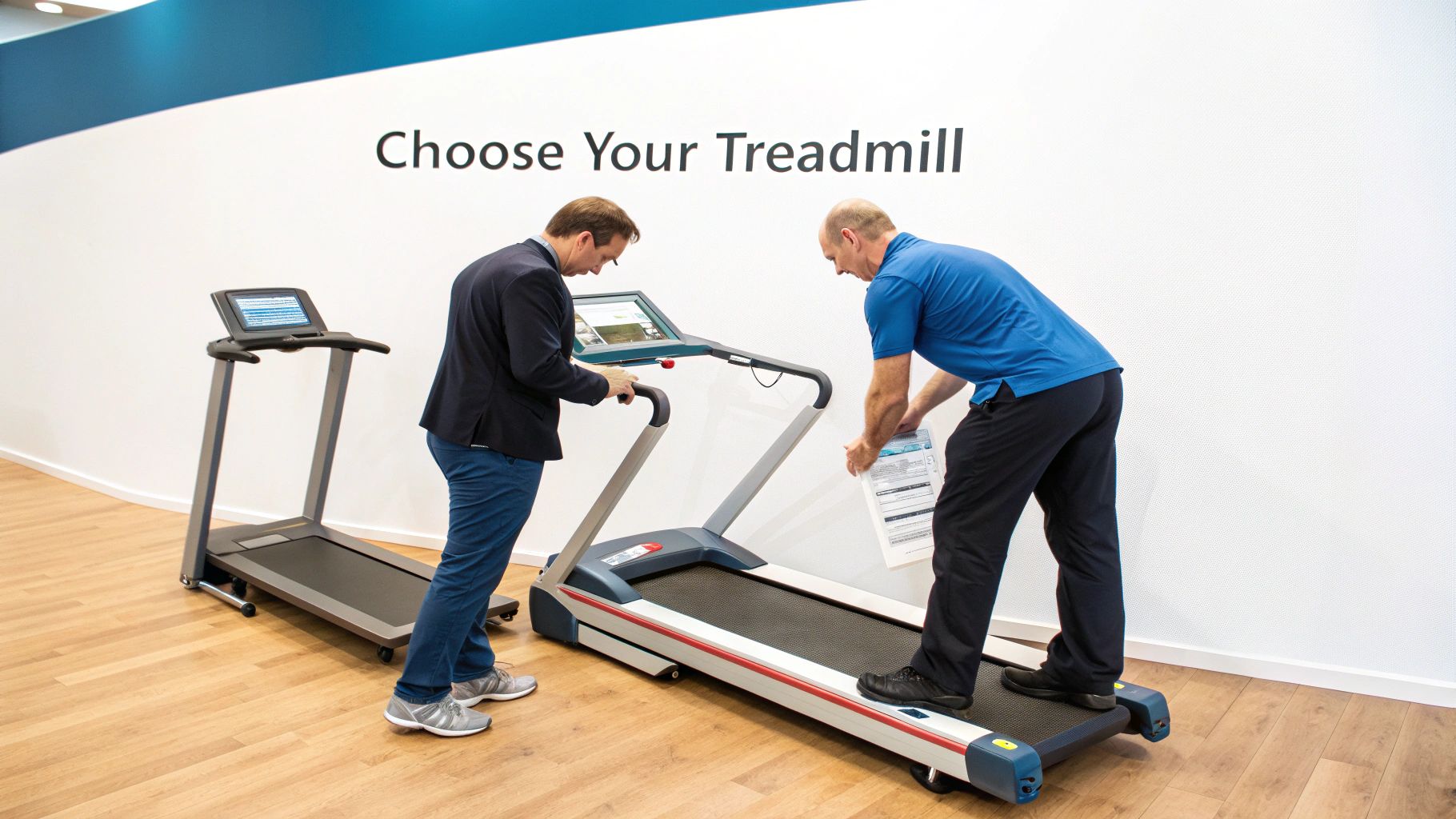
Before you get lost in features and specs, start with the basics. The right choice is always grounded in purpose and practicality.
Assess Your Space and Needs
First thing's first: grab a tape measure. A manual running treadmill, especially a professional-grade model, has a serious footprint. Make sure you have enough room not just for the machine itself, but for safely getting on and off.
Next, think about who’s using it and how often. A treadmill destined for a busy commercial gym needs a far more rugged build than one meant for a couple of workouts a week in a home wellness space.
The most important initial step is matching the machine's specifications to its intended environment and users. A treadmill that fits your space and supports your primary activities will deliver the best long-term value and safety.
Getting this right from the start will instantly narrow your options, saving you from considering models that are either too big for your space or not tough enough for the job.
Key Factors for Your Checklist
Once you've got the foundational requirements down, it's time to dig into the details that separate a good machine from a great one.
-
Build Quality and Durability: Look for a heavy-duty steel frame. More weight usually means more stability, which is critical when you’re sprinting. A long manufacturer's warranty is also a great sign—it shows the company stands behind its construction.
-
User Weight Capacity: This is a non-negotiable safety check. Always pick a model with a max user weight well above that of the heaviest person who will use it. Commercial-grade treadmills typically handle 350-400 lbs or more.
-
Belt Smoothness and Design: The running deck is where you'll really feel the quality. A slatted belt gliding on low-friction ball bearings is the gold standard. It gives you that smooth, instant response to your stride with zero lag or sticking.
-
Footprint and Portability: If this is for a home or a smaller studio, look for models with built-in transport wheels and a handle. Even though these treadmills are heavy, those simple features make moving it for cleaning or repositioning so much easier.
Want to see how these factors play out with real-world examples? Be sure to check out our guide on the best curved treadmills for in-depth comparisons. A little homework now ensures your new treadmill becomes a core part of your training for years to come.
Still Have Questions?
Deciding on new equipment always brings up a few questions. Let's clear up some of the most common ones about manual running treadmills so you can feel confident you're making the right choice for your health and wellness goals.
Is a Manual Treadmill Too Hard for a Beginner?
Not at all, though it does take a minute to get the hang of it. Most beginners find their groove after just a few sessions. You're in complete control—you dictate the pace with your stride and where you stand on the deck.
The best part for newcomers is its intuitive safety. The belt stops the second you do. Unlike a motorized treadmill, it can't "get away from you," which is a huge confidence booster. Just start slow and use the handrails until you feel steady.
Can You Just Walk On It?
Absolutely. A manual running treadmill is a fantastic tool for walking, especially if you're focused on active workout recovery or need some quality low-impact cardio. Because you're the engine, you engage more of your posterior chain—glutes, hamstrings, calves—than you would on a motorized belt.
This means you get a more effective workout even at a slower pace. It’s perfect for gentle walks that improve circulation and ease muscle soreness without putting unnecessary strain on your body, a key health benefit.
How Do You Stop Safely?
Stopping is probably the most natural and safe feature of a manual treadmill. Since your feet are what make the belt move, stopping is as simple as... well, stopping.
Your momentum is the belt's momentum. To stop, just slow your stride to a halt. If you need to stop quickly, simply grab the handrails and plant your feet.
This immediate, user-controlled stop is a major safety plus, especially in clinical environments or for anyone working on their balance.
Are Curved Treadmills Actually Better for Joints?
For most people, the answer is a firm yes. The curved deck is designed to promote a more natural running form, encouraging you to land on your midfoot or forefoot. This is a big deal because it helps spread out the impact forces much more evenly than the heavy heel-striking you often see on flat surfaces. This is a crucial health benefit.
By reducing that jarring impact, you put significantly less stress on your ankles, knees, and hips. This makes it a smarter choice for long-term joint health, injury prevention, and physical therapy programs.
For more deep dives into wellness and equipment, check out the MedEq Wellness Journal.
At MedEq Fitness, we build science-backed equipment that closes the loop between exertion and renewal. Explore our collection of manual treadmills and other recovery tools today.