Your Ultimate Guide to the Best Curved Treadmill
Finding the best curved treadmill isn't about picking the flashiest model; it's about matching its unique, self-powered design to your specific health and wellness goals. Unlike a motorized treadmill that pulls the belt for you, a curved treadmill demands you to be the engine. You power every single step, which engages more muscle and promotes a much more natural, low-impact running form, contributing to your long-term wellness.
Understanding the Power of Curved Treadmills
Think of a curved treadmill as more than just a piece of cardio equipment. It’s a sophisticated tool designed to refine your biomechanics and improve your overall health. Its real power is in its simplicity—a motorless, concave deck that responds directly to your effort. That one difference is the secret to its effectiveness and a cornerstone of its health benefits.
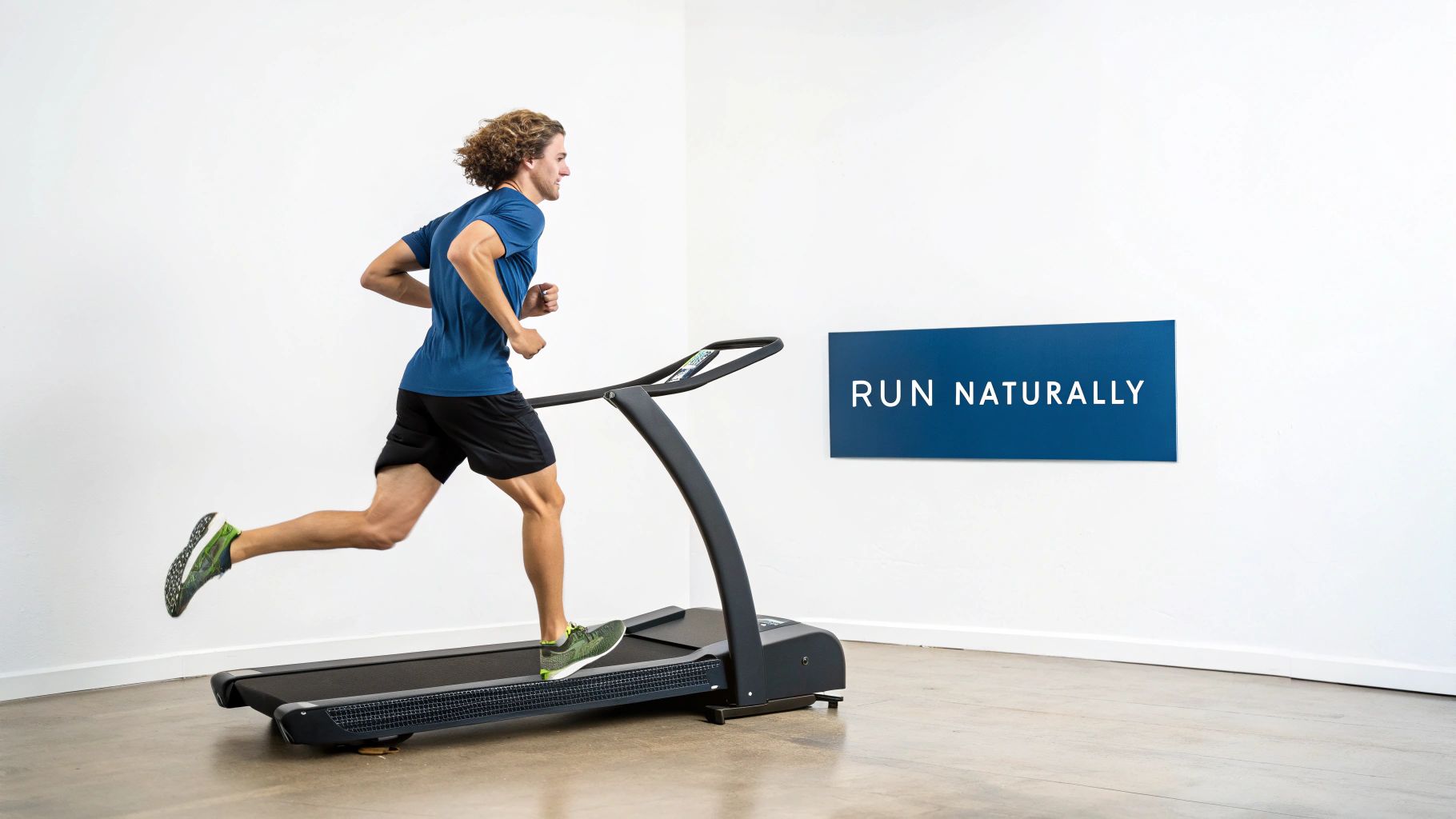
Because it’s self-powered, you have to actively drive the belt with your posterior chain—your glutes, hamstrings, and calves. This muscle activation is significantly higher than on a traditional treadmill, which is why users often burn up to 30% more calories running at the same speed, making it a highly efficient tool for weight management and cardiovascular health.
Promoting Natural Running Mechanics and Wellness
The concave shape of the deck is intentionally engineered to guide you into a healthier, more efficient stride. It encourages a midfoot or forefoot strike, which helps you avoid the jarring impact that comes with heel striking. The wellness benefits here are profound:
- Reduced Joint Stress: Your muscles absorb more of the impact, so less force travels up into your ankles, knees, and hips. This is crucial for sustainable, long-term fitness.
- Improved Posture: To keep the belt moving, you naturally adopt a more upright posture, which engages your core and prevents the slouching you often see on motorized treadmills.
- Enhanced Muscle Engagement: Your body has to work harder to maintain momentum, building functional strength that translates directly to running outdoors and supports overall metabolic health.
The core advantage of a curved, manual treadmill is that it teaches you the skill of running. It forces you to maintain proper form, from a slight forward lean to a higher cadence, mirroring the mechanics of elite runners for better performance and injury prevention.
A Versatile Tool for Diverse Health Goals
The market for curved treadmills has exploded for a reason. Research confirms that the curved design not only reduces joint stress but also increases calorie expenditure compared to flat, motorized treadmills, making them a superior choice for wellness.
This unique combination of low impact and high intensity makes it an ideal tool for a huge range of people. Elite athletes use them to dial in their form and build explosive power. Home gym owners get efficient, high-intensity workouts without the risk. And in clinical settings, physical therapists rely on them for gait training and functional rehab, helping patients recover with natural movement patterns that support holistic healing.
Ultimately, the best curved treadmill is one that aligns with a science-backed approach to long-term wellness. It acts as a bridge between high performance and sustainable health. For those interested in motorless designs with added difficulty, you can also learn more about the benefits of a resistance treadmill in our detailed guide.
How To Choose The Best Curved Treadmill For Your Goals
Shopping for a curved treadmill isn't about ticking off features on a spec sheet. It's about understanding how the engineering translates to your performance, your clients' recovery, or your own wellness journey. This guide will walk you through the specifications that actually matter, so you can make a smart investment in your health.
We’re going to break down the key components, from the steel frame right down to the belt under your feet. Whether you’re equipping a high-performance training facility, a physical therapy clinic, or a dedicated home gym, you'll know exactly what to look for.
H3: Build Quality And Durability
The soul of a great curved treadmill is its frame. You want to see heavy-gauge steel in the specs. A solid steel frame is what keeps the machine from wobbling or shifting when you’re in an all-out sprint, providing the kind of stability that inspires confidence for years of hard use and supports your wellness journey.
Pay close attention to the user weight capacity. A machine rated for 350 lbs or more isn’t just for heavier users; it's a clear signal of superior engineering. It tells you the manufacturer used stronger bearings, beefier rollers, and a more robust structure all around.
H3: The Running Surface: Slat Belts vs. Fabric Belts
The running surface is where the rubber meets the road—literally. The two main options, slat belts and fabric belts, offer completely different experiences.
- Slat Belts: This is the gold standard, and for good reason. Slat belts are made of individual, interlocking rubberized slats that deliver phenomenal grip and just the right amount of cushion. The design creates incredibly low friction, which results in a smooth, quiet, and responsive run that feels much closer to hitting the pavement outdoors.
- Fabric Belts: You'll typically find these single-piece belts on budget models. They get the job done, but they generate more friction and just don't have the same durable, premium feel as a proper slat belt system.
The market for slat belt curved treadmills is surging for exactly these reasons. It's projected to jump from USD 450 million in 2024 to an incredible USD 900 billion by the end of the forecast period, with new models hitting both home and commercial markets.
H3: Curvature And Resistance Systems
The steepness of the curve directly dictates the intensity of your workout. A more aggressive curve demands greater muscular activation—especially from the glutes and hamstrings—just to get it moving and keep it going. On the other hand, a gentler curve is more forgiving, making it a better fit for beginners or for controlled rehabilitation work.
Resistance is the other game-changer. The best curved treadmills feature magnetic resistance, which lets you dial in smooth, consistent tension. This is perfect for simulating tough hill climbs, doing sled-push workouts, or just adding a controlled challenge to a walk. Cheaper friction-based systems can feel jerky and tend to wear out over time.
When you combine a well-engineered curve with adjustable magnetic resistance, the treadmill becomes so much more than a cardio machine. It’s a versatile tool for building strength and conditioning, letting you flow seamlessly between speed drills, endurance runs, and powerful sled pushes.
As you weigh your options, it’s also worth seeing how these machines fit into the bigger picture of the best cardio machines for weight loss.
H3: Console Metrics And Practical Considerations
It's easy to get wowed by a big, flashy console, but you need to focus on the data that drives progress. Make sure the basics are there and easy to read at a glance:
- Time
- Distance
- Speed (or Pace)
- Calories Burned
- Watts (for power output)
More advanced displays might add heart rate monitoring or pre-set programs, which are nice bonuses. But don't get sidetracked by vanity metrics that don't actually help you reach your wellness goals. For a deeper look at how manual treadmills compare to their electric cousins, our guide on manual treadmills vs electric models is a great resource.
Finally, think about the practical stuff. Get out the tape measure and check the machine's footprint against your available space. If it’s for a home gym or a smaller clinic, look for models with transport wheels. But for a busy commercial gym, a heavier, non-folding unit is usually the better call for maximum stability.
Curved Treadmill Feature Comparison Framework
To make this even easier, we've put together a framework to help you evaluate treadmills based on your budget and needs. This isn't just a list of features; it's a guide to understanding what you're really getting at each price point.
| Feature | What to Look For (Budget) | What to Look For (Mid-Range) | What to Look For (Premium/Clinical) |
|---|---|---|---|
| Frame | Steel construction, but may be lighter gauge. Check user weight limits closely (often < 300 lbs). | Heavy-gauge steel frame, powder-coated finish. Weight capacity of 350+ lbs. | Commercial-grade, heavy-duty steel. Often robotically welded. Weight capacity of 400-500+ lbs. |
| Belt System | Typically a fabric belt. Functional, but may have higher friction and wear faster. | Rubberized slat belt. Offers a smoother, more durable run with better grip. | High-durometer rubber slat belt with premium bearings. Designed for extreme durability and near-silent operation. |
| Resistance | May have no resistance or a basic friction-based system. | Multi-level magnetic resistance. Smooth, consistent, and reliable for varied training. | Precision magnetic resistance (often 6+ levels). Calibrated for performance and rehab protocols. |
| Curvature | A fixed, often gentler curve. Good for walking and jogging. | Optimized curve designed to promote proper running form. Balances intensity and accessibility. | Scientifically engineered curve for maximum posterior chain engagement. May be steeper for elite athletes. |
| Console | Basic LCD display: time, speed, distance, calories. | Backlit LCD or LED display with more metrics like pace, watts. May include basic programs. | High-contrast console with advanced metrics, heart rate connectivity (ANT+/Bluetooth), and programmable workouts. |
| Warranty | Limited warranty, often 1-3 years on the frame and 90 days on parts. | Solid warranty: 5-10 years on frame, 1-3 years on parts, 1 year labor. | Lifetime frame warranty, 5+ years on parts, 2+ years on labor. Reflects confidence in build quality. |
| Noise & Maint. | Louder operation due to friction. May require belt adjustments. | Quieter due to slat belt design. Bearings may require occasional checks. | Near-silent operation. Sealed commercial-grade bearings requiring zero maintenance. |
This table should help you cut through the marketing noise and focus on the components that deliver real value. Whether you’re investing in a home setup or a clinical facility, matching these features to your specific use case is the key to finding the perfect fit. For more insights on wellness and fitness, visit our blog at the MedEq Wellness Journal.
Comparing the Top Curved Treadmill Models
Now that we have a solid grasp on the core features, let's see how they stack up in the real world. Picking the right curved treadmill is all about comparing how different brands strike a balance between performance, raw durability, and price. We'll walk through some representative machines from budget, mid-range, and premium tiers to give you a clear picture of what you get for your money.
This breakdown is structured around the key metrics we've already covered—build quality, belt system, resistance, and warranty. The goal here is an honest, objective look at the market. This way, you can confidently match a model to your specific training or wellness goals.
Entry-Level Models: The Accessible Starting Point
Entry-level curved treadmills are all about making this technology more accessible, mostly for home use. They’re typically built with a lighter steel frame and a simple fabric belt. While they get the job done for walking and light jogging, these materials just don't offer the same kind of longevity or whisper-quiet run you'll find in higher-end models.
These machines often feature a gentler curve, which can feel a little less intimidating if you're just starting out. The big trade-off? They usually skip magnetic resistance, which means they're not built for strength work like sled pushes. Expect a shorter warranty, too—often one year on the frame and maybe just 90 days on parts.
Mid-Range Models: The All-Around Performer
This category is the sweet spot for a lot of people, from serious home gym enthusiasts to smaller physical therapy clinics. Mid-range models usually upgrade to a heavy-gauge steel frame that can handle a user weight of 350 lbs or more. That's a huge jump in durability and stability.
But the most important upgrade is the running surface. Here you’ll find high-quality rubberized slat belts that give you way better grip, a smoother feel underfoot, and much quieter operation. They also introduce multi-level magnetic resistance, turning the treadmill into a versatile tool for both HIIT and controlled strength training.
The leap from a fabric belt to a slat belt is a game-changer. It’s the difference between a machine that just lets you run and one that actively improves the quality of every stride through better responsiveness and less friction.
These models are built for the grind of daily use and perfectly bridge the gap between casual fitness and dedicated training.
Premium and Clinical-Grade Models: The Gold Standard
At the very top, you'll find the premium, clinical-grade machines. These are engineered for the toughest environments, from elite athletic training centers to busy PT clinics. Honestly, they’re built like tanks. We're talking commercial-grade, robotically-welded steel frames that can support users well over 400 lbs.
Everything is dialed up to the max in this tier. The slat belts use high-durometer rubber and are paired with sealed commercial-grade bearings that need zero maintenance and are nearly silent. This whisper-quiet operation is a massive deal, especially in clinical settings or shared spaces where noise is a real factor.
The chart below shows how features tend to scale as you move up in price.
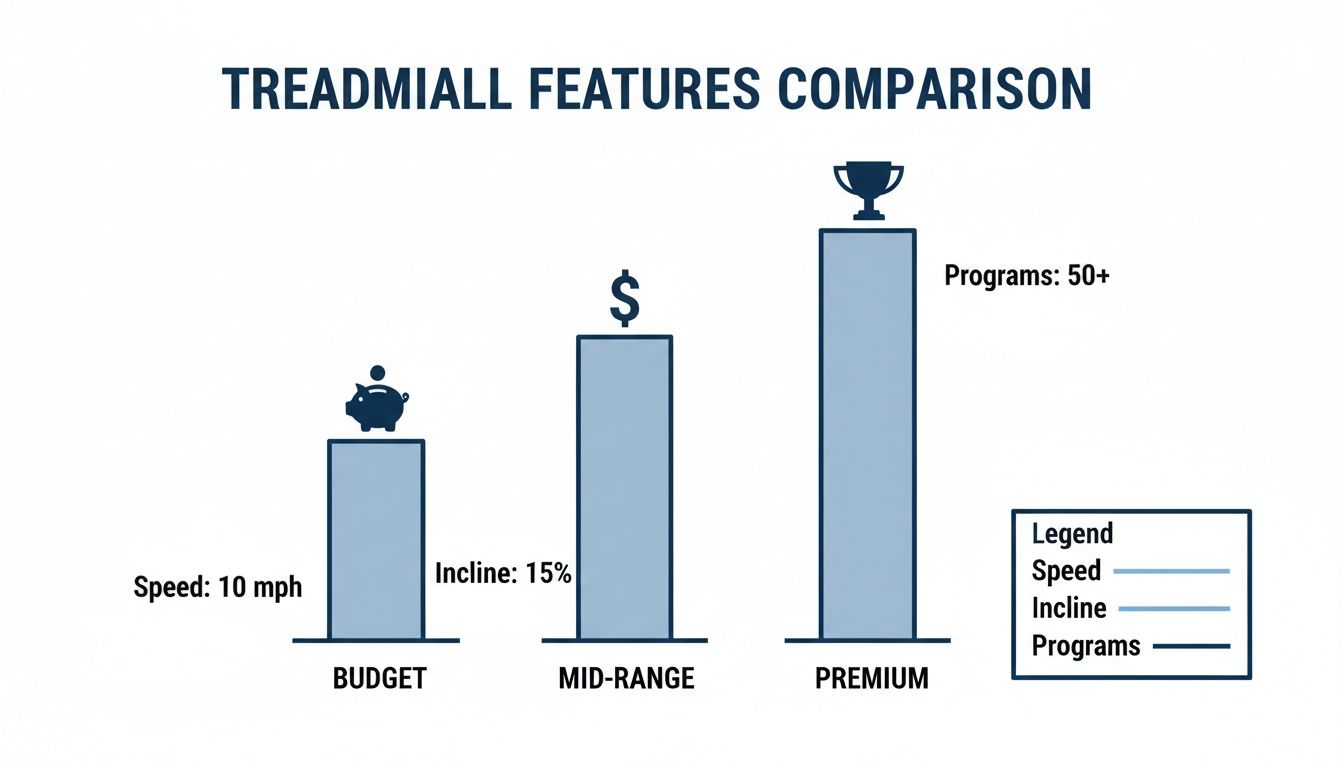
It’s pretty clear you’re not just paying for a brand name. As you move from budget to premium, you're investing in tougher materials, smarter features, and a machine that's built to last.
Where MedEq Fitness Fits In
So, where does the MedEq Fitness manual curved treadmill land? Firmly in the premium, clinical-grade category. It was specifically designed to meet the rigorous demands of both high-performance athletes and rehabilitation professionals, with an uncompromising focus on durability, health benefits, and user experience.
Here’s what sets it apart:
- Clinical-Grade Durability: A heavy-duty frame and commercial-grade components guarantee stability and a long operational life, even under constant, heavy use.
- Near-Silent Slat Belt System: The precision-engineered slat belt and sealed bearings offer an exceptionally smooth and quiet workout. This makes it ideal for home gyms where noise is a concern or professional settings that need a calm atmosphere.
- Responsive Magnetic Resistance: The calibrated magnetic resistance provides a consistent and challenging workout, perfect for everything from rehab walks to powerful sled pushes for athletic conditioning.
This combination of features creates a machine that supports a complete approach to health—from building peak performance to facilitating gentle recovery. The focus on quiet operation and zero-maintenance parts also delivers an excellent return on investment by minimizing downtime and making every session better.
For a deeper dive into wellness strategies and equipment, feel free to explore our MedEq Wellness Journal.
Who Benefits Most from Using a Curved Treadmill?
Beyond the specs and engineering, what truly matters is how a piece of equipment performs in the real world. A curved treadmill isn't just one-size-fits-all; its unique design offers specific, tangible advantages to a surprisingly broad range of people—from athletes chasing peak performance to individuals focusing on their long-term wellness.
Let’s break down who gets the most out of this machine and why it might be the right investment for your health.
Elite Athletes and High-Performance Training
For elite athletes, every single tool has to deliver a competitive edge. The curved treadmill does exactly that by demanding an honest, powerful running form. There's no motor doing the work for you, which means every stride is earned by firing up the posterior chain—your glutes and hamstrings have to work far harder than they would on a flat, motorized treadmill.
This self-powered design is a game-changer for perfecting running mechanics. The belt responds instantly, letting you shift from a steady jog to a full-blown sprint without fumbling for a button. That makes it an incredible tool for High-Intensity Interval Training (HIIT), building the kind of raw power and anaerobic endurance that directly translates to the field or track.
The Modern Home Gym Owner
The home gym isn't just a backup plan anymore; it's the center of many people's wellness routines. For anyone looking to get the most out of every minute, the curved treadmill is a standout. It’s been shown to deliver a higher calorie burn in less time—perfect for squeezing an effective workout into a packed schedule.
A huge plus is the motorless design, making it significantly quieter than a traditional treadmill. That’s a non-negotiable benefit if you live in an apartment or have family members trying to work or sleep nearby. This shift to high-quality home fitness is a major reason the residential sector now leads the treadmill market. It's all about finding effective solutions for long-term health.
Plus, the gentle curve is easier on your joints, offering a more sustainable way to stay fit for years to come.
For the home user, a curved treadmill combines the intensity of an outdoor hill sprint with the joint-sparing benefits of a low-impact workout. It’s an investment in both immediate results and long-term physical wellness.
Physical Therapists and Rehabilitation Clinics
In a clinical setting, recovery is all about controlled, natural movement. That's why more physical therapists are bringing curved treadmills into their clinics for gait training and functional rehab. The machine’s self-paced design lets patients move at a speed that feels safe and comfortable, which is key for rebuilding confidence after an injury.
The curved deck also naturally promotes a proper midfoot strike, helping patients correct the exact biomechanical issues that may have caused their injury in the first place. Because the user is the engine, it helps re-engage neuromuscular pathways and build functional strength from the ground up, accelerating the recovery process.
It’s an exceptional tool for a variety of recovery scenarios:
- Post-Surgical Rehabilitation: Helping patients regain a natural walking pattern after hip or knee surgery.
- Neurological Recovery: Assisting stroke survivors with improving their balance and coordination in a secure environment.
- Gait Analysis: Giving therapists a clear, real-time view of a patient's stride to make immediate corrections.
General Wellness and Active Aging
Finally, a curved treadmill is a fantastic tool for anyone focused on general wellness, especially as we age. The ability to walk or jog at your own pace makes it incredibly accessible, whether you're just starting out or you've been active for decades.
The reduced impact is a huge win for joint health, allowing for consistent cardio without the pounding of running on pavement. Its operation is dead simple—you just get on and go. There are no intimidating consoles or complex programs to figure out. This straightforward design encourages consistency, which, as we know, is the foundation of any successful wellness routine.
For more insights on building a complete fitness and recovery plan, explore the resources on the MedEq Wellness Journal.
Maximizing Recovery After Your Curved Treadmill Workout
A killer session on a curved treadmill is only half the battle. The real health benefits—muscle repair, increased endurance, and overall resilience—are forged during workout recovery. Skipping this step is like building a high-performance engine and never bothering to change the oil. Sooner or later, you're going to break down.
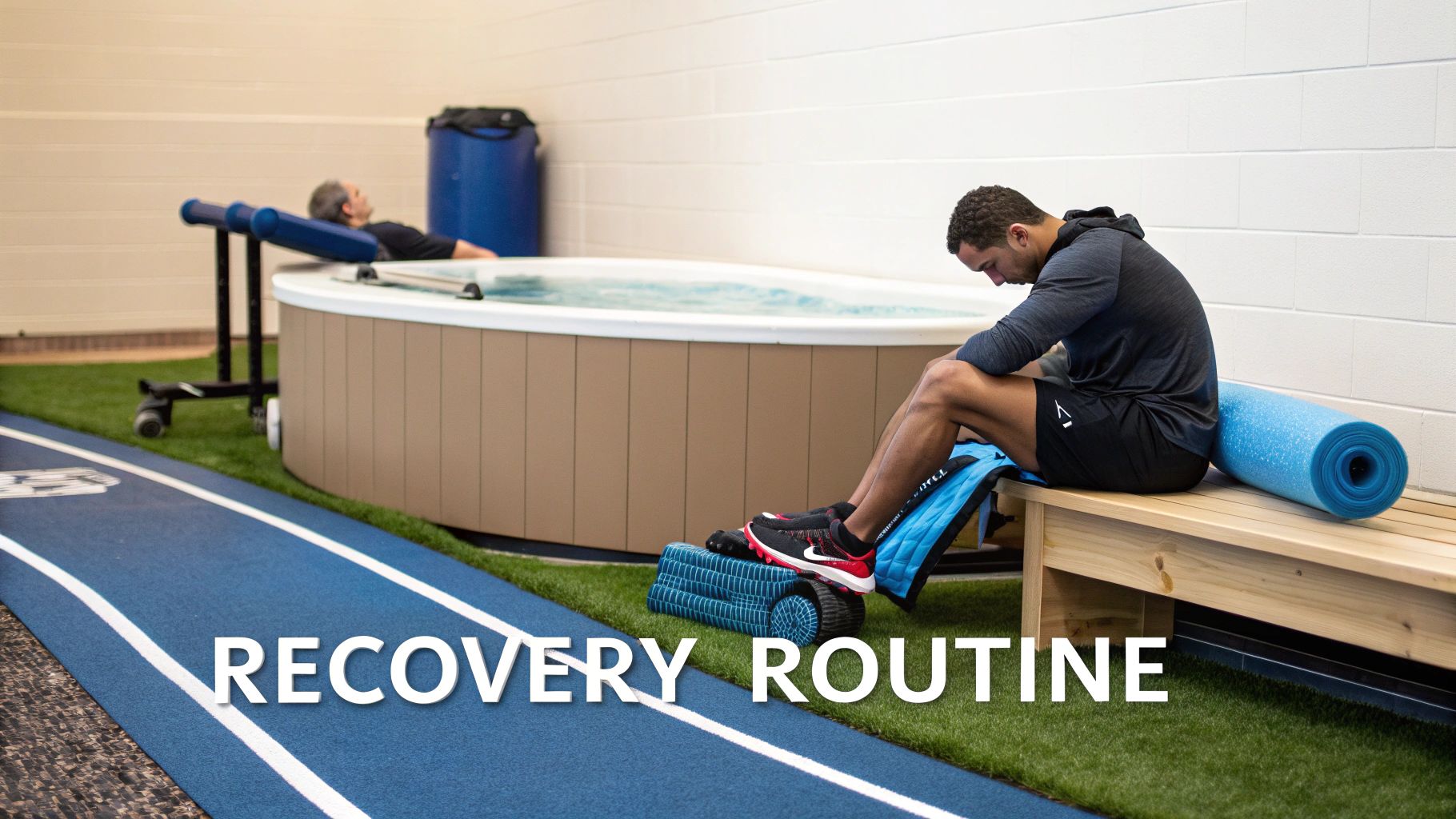
Smart recovery is what translates all that hard work into real-world results. It helps you bounce back stronger, sidestep injuries, and turn a simple fitness routine into a comprehensive wellness strategy.
Building Your Post-Workout Wellness Protocol
After you’ve pushed your body to its limits, it’s crying out for resources to repair and rebuild. This isn’t just about crashing on the couch. It’s a strategic process designed to tackle muscle soreness, calm inflammation, and kickstart cellular repair. Your post-workout routine should feel just as important as the workout itself.
Here are the non-negotiable pillars of a solid recovery plan:
- Active Cool-Down: Never just stop cold. A 5-10 minute walk on the curved treadmill lets your heart rate come down gradually, which helps flush metabolic byproducts out of your muscles.
- Targeted Mobility: Immediately after your cool-down, grab a foam roller or do some gentle stretching. This helps release muscle tightness, boosts flexibility, and can seriously reduce that next-day soreness.
- Proper Nutrition and Hydration: Get some protein and carbs in you within an hour of finishing. This provides the essential building blocks for muscle repair, while water is critical for literally every function in your body.
For a more detailed breakdown, our guide on how to cool down after a workout lays out some great, actionable steps.
Advanced Recovery Modalities for Peak Performance
If you really want to level up your recovery, many athletes and wellness enthusiasts are turning to more advanced techniques. These methods go straight after inflammation and circulation, helping your body handle the stress of intense training far more effectively.
One of the most powerful strategies is contrast therapy—alternating between hot and cold environments, like a sauna and a cold plunge. This forces your blood vessels to constrict (cold) and then dilate (hot), creating a "pumping" action. This pump flushes out inflammatory waste and pulls in fresh, oxygen-rich blood to your exhausted muscles. The health benefits extend beyond muscle recovery to include reduced inflammation, improved circulation, and a stronger immune response.
Contrast therapy is a game-changer for recovery. It crushes muscle soreness, ramps up circulation, and can even strengthen your immune system. It’s a cornerstone of any serious wellness plan.
Another key tool is active recovery. This just means light physical activity on your rest days, like a slow walk on your curved treadmill. For runners, understanding what a recovery run is is essential for integrating this practice correctly without adding unnecessary strain.
When you start to see your workout and recovery as two sides of the same coin, you build a truly sustainable path to peak performance and health.
Your Curved Treadmill Questions, Answered
Thinking about adding a curved treadmill to your gym or clinic? It’s natural to have questions. We’ve put together answers to some of the most common things people ask, from how they actually work to what it takes to keep one running smoothly.
How Does a Curved Treadmill Burn More Calories?
It’s all about who’s doing the work. On a curved treadmill, you are the motor. There’s no electricity powering the belt forward; it only moves when you do. This forces your body to fire up more muscle groups to get going and stay going, especially your glutes and hamstrings.
This extra muscle recruitment requires a lot more energy. The result? Users can see up to a 30% higher calorie burn compared to running at the same speed on a standard motorized treadmill. It makes every workout that much more effective and supports your overall health and weight management goals.
Are Curved Treadmills Hard for Beginners to Use?
There's a small learning curve, but most people get the hang of it in a few minutes. The treadmill’s speed is completely controlled by your effort—speed up, it speeds up; slow down, it slows down. The best way to start is with a slow, deliberate walk to get a feel for how the belt responds to your stride.
The design actually guides you into better running form, making it a great tool for anyone looking to run more safely and efficiently. Our advice is to start slow, use the handrails for a bit of balance if you need to, and then build up your pace as you get more comfortable.
What Maintenance Does a Manual Curved Treadmill Require?
This is one of the best parts. Because there’s no motor, no motherboard, and no complex wiring, the usual points of failure on a treadmill are gone. A manual curved treadmill is built for simplicity and durability.
Routine care is incredibly simple. Just keep the running surface and frame clean and give the visible bolts a quick check now and then to make sure they’re snug. That’s it. This minimal upkeep means a lower cost of ownership over time and a solid return on your investment.
You get to spend your time focusing on your workouts and recovery, not worrying about equipment repairs.
Can You Walk on a Curved Treadmill for Low-Intensity Exercise?
Absolutely. It’s an excellent tool for walking and a cornerstone of workout recovery. You have total control over the pace, so you can easily maintain a slow, steady walk for warm-ups, active recovery, or just getting your daily steps in.
The low-impact surface is also forgiving on your joints, making it a comfortable and safe option for any fitness level. Whether you're coming back from a tough session or just trying to move more, a curved treadmill supports your wellness goals. For more on fitness and recovery strategies, check out the MedEq Wellness Journal.
At MedEq Fitness, we build equipment that supports both peak athletic performance and long-term health. Our Manual Curved Treadmill is engineered with clinical-grade durability and runs almost silently, delivering a premium workout whether you’re in a professional clinic or your own home.