Discover manual treadmill vs motorized treadmill: Which Option Is Best?
When you’re weighing a manual treadmill vs motorized treadmill, the biggest difference comes down to who’s doing the work. Manual treadmills are powered entirely by you, forcing more muscle engagement for superior health benefits, while motorized treadmills use electricity to give you a consistent, predictable pace. The right one for your wellness journey depends on whether you're after high-intensity, self-driven workouts or more controlled, therapeutic exercise.
Choosing The Right Treadmill For Your Fitness Goals
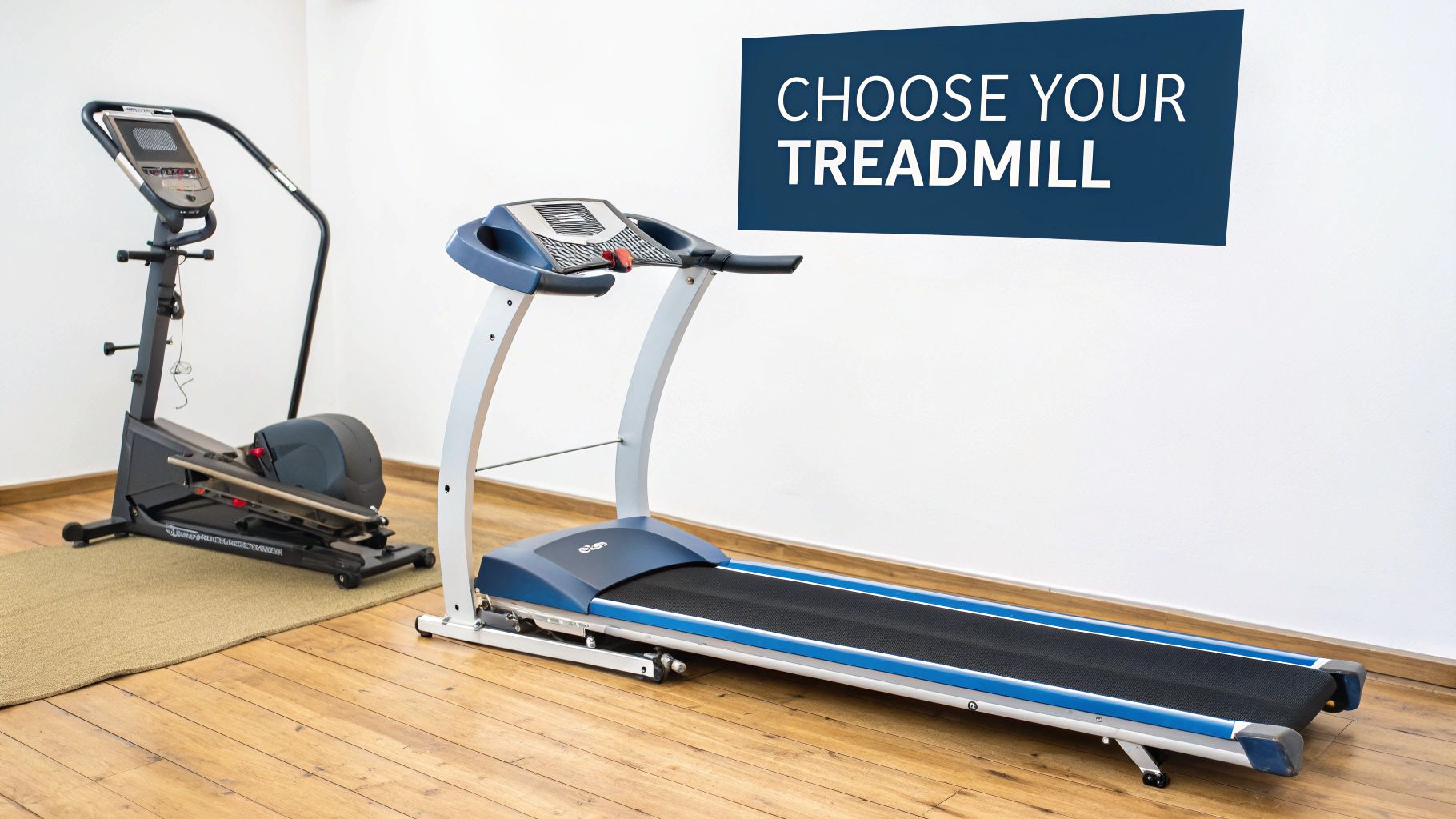
Picking the right treadmill is a foundational step in building your wellness and workout routine. It’s not just about cool features—it’s about matching the machine’s fundamental design to what you want to achieve, whether that's elite athletic training, steady cardio improvement, or gentle, safe workout recovery.
A manual treadmill, especially a curved one, runs on a self-propelled system. That means the belt only moves when you move. This makes it an incredibly responsive machine for high-intensity interval training (HIIT) and all-out sprints. The effort needed to keep that belt moving fires up more muscle groups, particularly your glutes and hamstrings, which translates to a higher calorie burn and greater health benefits compared to running at the same speed on a motorized machine.
On the flip side, a motorized treadmill is all about consistency and control. You can set a precise speed and incline with the push of a button, making it perfect for steady-state cardio, specific rehab protocols, or any workout where holding a target heart rate is key. This predictability is a huge wellness benefit for anyone needing a structured, low-impact environment to build endurance or recover from an injury safely.
At a Glance Manual vs Motorized Treadmill Comparison
To cut through the noise, here’s a quick table breaking down the key differences. Think about how each feature aligns with your personal approach to fitness, wellness, and workout recovery.
| Feature | Manual Treadmill | Motorized Treadmill |
|---|---|---|
| Power Source | User-powered; no electricity needed. | Requires an electrical outlet. |
| Workout Type | Ideal for HIIT, sprints, and functional strength. | Best for steady-state cardio and programmed workouts. |
| Calorie Burn | Generally higher due to increased user effort. | Consistent but typically lower at the same perceived speed. |
| Muscle Activation | Engages more of the posterior chain (glutes, hamstrings). | Less muscle recruitment as the belt assists movement. |
| Health & Wellness | Promotes natural running form and improves proprioception. | Provides a controlled environment for specific rehab protocols. |
| Workout Recovery | Excellent for low-impact, self-paced recovery walks. | Can be programmed for gentle, consistent recovery sessions. |
| Noise Level | Very quiet, often near-silent operation. | Produces a noticeable hum from the motor. |
At the end of the day, the best treadmill is the one you'll actually use consistently and safely. By understanding these core differences, you can make a smart choice that will get you closer to your health and performance goals.
For a deeper dive into wellness strategies, be sure to explore the MedEq Wellness Journal.
How Each Treadmill Impacts Your Body and Biomechanics
The machine you run on fundamentally changes how your body moves. We're not just talking about a power source—the difference between a manual and a motorized treadmill creates a deep biomechanical split that directly impacts muscle activation, joint health, and your overall performance. Getting this choice right means aligning the machine's mechanics with your body's wellness needs.
Manual treadmills, especially curved models, are powered by you. You are the engine. To get the belt moving, you have to physically pull it backward with every single stride, which forces a movement pattern that's much closer to running on solid ground. This simple fact completely changes the game for your posterior chain—your glutes and hamstrings have to work significantly harder, delivering superior health benefits.
This self-powered motion actively corrects your form. It encourages a forefoot or midfoot strike, steering you away from the harsh heel striking that the passive, moving belt of a motorized treadmill can promote. For many people, this shift leads to better posture, improved running mechanics, and less impact on the joints. That’s a massive win for long-term wellness.
The Biomechanics of Self-Powered Motion
On a curved manual treadmill, you have to maintain a slight forward lean, keeping your center of mass just ahead of your feet to keep the belt rolling. This posture naturally engages your core for stability and forces a much more powerful push-off from the ground. The result? Your workout becomes a blend of intense cardio and functional strength training that enhances your overall health.
This dynamic also sharpens your proprioception, which is your body’s innate sense of its position in space. Because you control the speed with every step, your brain and muscles are in constant communication, making micro-adjustments that build better balance, coordination, and athletic responsiveness—key components of physical wellness.
A manual treadmill doesn't just let you run; it teaches you how to run better. By forcing you to generate the power, it provides instant, honest feedback on your form and efficiency. It’s a true partner in your wellness journey.
There's a reason the global unpowered treadmill market hit USD 571.63 million in 2023 and is still growing. High-performance users value how it rewires their movement patterns for better health outcomes. In fact, some research shows that running on a curved deck can boost glute activation by up to 25%—a critical factor for building explosive power and speeding up workout recovery.
Controlled Motion and Its Wellness Applications
A motorized treadmill, on the other hand, delivers a perfectly consistent and predictable surface. The belt moves at a set speed, pulling your foot backward and reducing the amount of work your posterior chain has to do. While this means less raw muscle activation per stride, it offers powerful wellness advantages in specific health and rehab scenarios.
For anyone in physical therapy or cardiac rehab, that precise control is non-negotiable. A therapist can set an exact speed and incline, creating a safe, repeatable environment for a patient to rebuild strength without any risk of overdoing it. This makes it the perfect tool for steady-state cardio, where maintaining a specific heart rate is the only goal for cardiovascular health.
The automated incline on motorized models also allows for highly structured cardiovascular programming, mimicking hill climbs to challenge your heart and lungs without guesswork. This makes them an excellent tool for building endurance at a safe, manageable pace. Understanding how different treadmills function can help you find the perfect fit for your unique biomechanics and wellness goals.
For more information, visit our MedEq Wellness Journal.
Comparing Workout Intensity, Calorie Burn, and Recovery
This is where the true wellness impact becomes clear. The difference between a manual and a motorized treadmill isn't just about the plug—it's about the physical demand, the health benefits of calorie burn, and how effectively you can approach workout recovery.
Let's break down the performance gap so you can match the machine to your wellness mission.
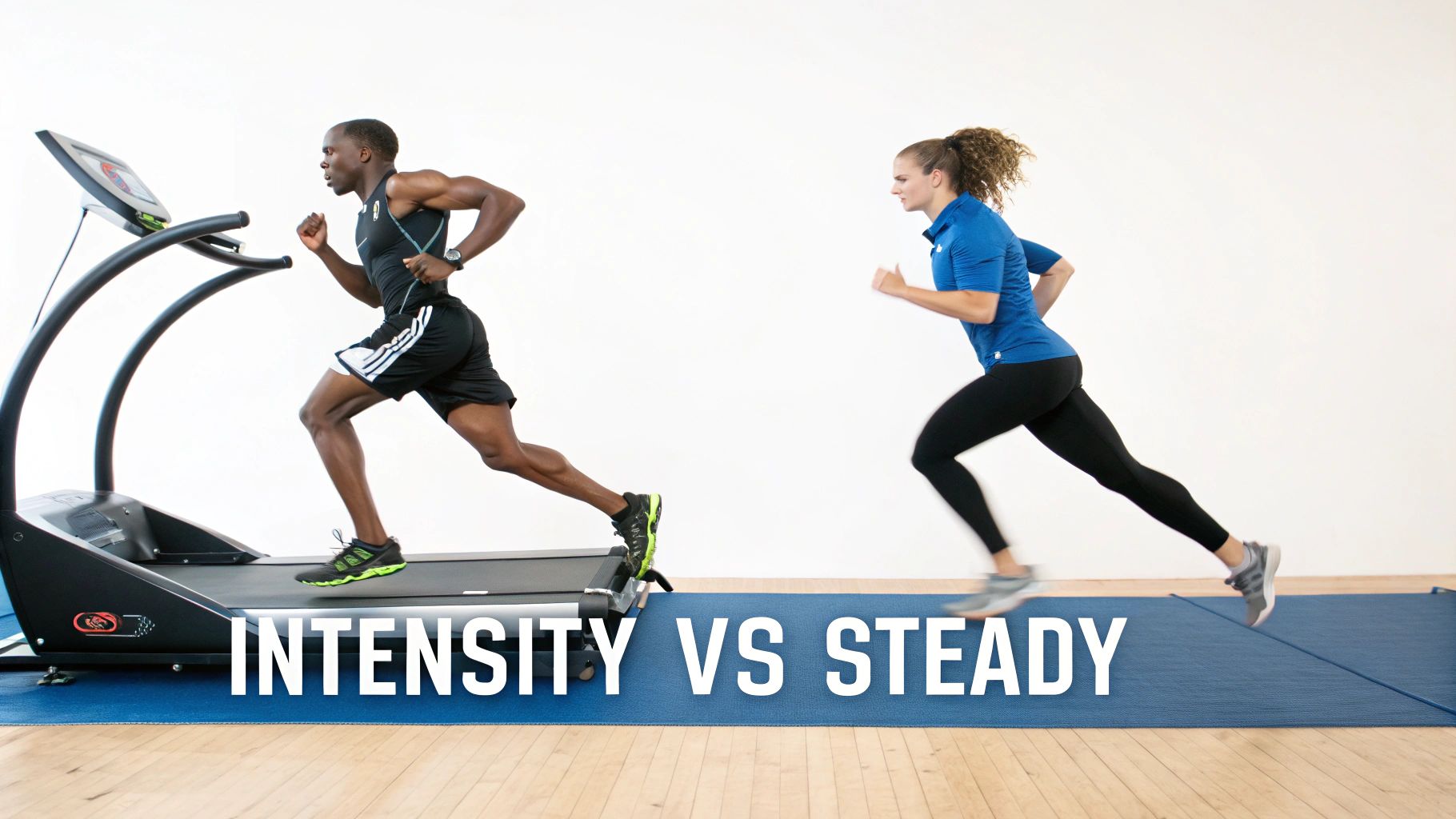
Manual treadmills, especially the curved ones, make you the engine. You provide 100% of the power, forcing your body to work dramatically harder to get that belt moving and keep it there. This self-propelled design spikes the workout intensity, leading to a significantly higher calorie burn—a key health benefit—than you'd see on a motorized deck at the same perceived speed.
The secret is in the muscle recruitment. To pull the belt with each stride, you have to engage your entire posterior chain—glutes, hamstrings, calves—far more aggressively. It turns a simple run into a potent, full-body conditioning session that boosts your overall health.
Calorie Burn and HIIT: The Manual Advantage
If your goal is to maximize health benefits by burning calories efficiently, the manual treadmill is in a league of its own. Studies consistently show users burn 20-30% more calories on these self-powered machines. Your metabolic rate has no choice but to ramp up to meet the intense physical demand.
This makes manual treadmills the perfect machine for High-Intensity Interval Training (HIIT). There is zero lag time. You can go from an all-out sprint to a dead stop or a slow walk in a split second, just by changing your own speed. No waiting for a motor to catch up or slow down.
This raw responsiveness is what enables true explosive training. You can hammer out Tabata sprints, simulate sled pushes, or crush other high-effort intervals and get immediate, honest feedback from the machine. It’s about maximizing your output in minimum time for maximum wellness gains.
Steady-State Cardio and Controlled Recovery
While manual treadmills win on intensity, motorized treadmills are the undisputed champs of consistency, which is vital for workout recovery and specific health goals. For steady-state cardio, where the objective is to hold a specific pace or heart rate for a long duration, they are the superior tool. That level of control is essential for building aerobic endurance and is a non-negotiable for goals like marathon training.
When it comes to workout recovery, both machines have a place. The controlled, predictable environment of a motorized treadmill makes it a staple in physical therapy. A therapist can dial in a precise, slow speed and a slight incline to help a patient safely rebuild strength and mobility.
On the other hand, a curved manual treadmill is a fantastic tool for active recovery. The self-paced, low-impact nature of walking on its deck encourages a natural gait and boosts blood flow to sore muscles, which can speed up the repair process. A gentle walk feels more intuitive, letting your body find its own perfect recovery rhythm. This process is a key part of holistic wellness.
To get the most out of your sessions, whether you're going all-out or dialing it back, understanding the machine's mechanics is key. Our complete guide on running on a manual treadmill dives deeper into optimizing its unique benefits.
The choice really boils down to your primary wellness goal:
- For maximum health benefits and HIIT: The manual treadmill is unmatched.
- For steady-state endurance and controlled workout recovery: The motorized treadmill provides the necessary precision.
By matching the machine to your objective, you can create a far more effective and sustainable wellness routine.
The Practical Side: Noise, Space, Maintenance, and Cost
Beyond performance metrics and health benefits, the day-to-day reality of owning a treadmill is what truly shapes your experience. This is where the practical differences between manual and motorized treadmills become crystal clear. We're talking about the noise, the footprint, the upkeep, and the total cost—the factors that determine how well a machine actually fits into your wellness lifestyle.
A motorized treadmill’s biggest asset—its motor—is also its biggest liability when it comes to noise. Even the quietest models produce a constant hum that can easily disrupt a quiet home or a peaceful clinic. That noise is always there, competing with your music, your TV, or the simple desire for a quiet workout.
Manual treadmills, on the other hand, are practically silent. The only sounds you’ll hear are the soft rhythm of your own feet on the belt and the gentle whir of the bearings. This makes them perfect for early morning sessions or late-night runs when you don’t want to wake the whole house, contributing to a more peaceful wellness environment.
Space, Portability, and Power
Your available space is a huge factor, especially if you're setting up a home gym. Motorized treadmills are notoriously big and heavy, and they chain you to the nearest electrical outlet. Once you build one, it’s not moving without a serious effort.
This is where manual treadmills really shine for a wellness-focused home.
- No Electrical Cords: Forget hunting for an outlet. You can put a manual treadmill anywhere—the garage, a spare room, even a covered patio.
- Compact Designs: Many flat-belt models are surprisingly lightweight and designed to fold up, making them a breeze to tuck away after your workout.
- Enhanced Portability: Even the beefier curved models usually include transport wheels and a handle, so one person can easily roll the machine out of the way.
That freedom from cords and a generally smaller footprint make manual treadmills incredibly adaptable for just about any living situation.
Maintenance and Long-Term Reliability
Let's be honest: any machine with a motor and complex electronics is going to need attention eventually. Motorized treadmills have a lot more that can go wrong—the motor, control board, wiring, and the digital console. Keeping them running requires regular maintenance, and repairs can get expensive fast.
The beautiful simplicity of a manual treadmill is its biggest wellness advantage here. With no motor or electronics to burn out, there are far fewer potential points of failure. Maintenance is usually as simple as checking the belt tension and lubricating the bearings. If you need a hand, our guide on how to properly adjust a treadmill belt is a great resource. This straightforward mechanical design means better durability and much lower ownership costs over time.
The true cost of a treadmill isn't just the sticker price; it's the total cost of ownership over its lifespan. A manual treadmill's lack of electrical consumption and minimal repair needs offers a compelling financial advantage.
The global treadmill market hit USD 5.03 billion in 2023, with more and more budget-conscious buyers choosing manual models. They don't add a dime to your electricity bill and you avoid the risk of $100+ annual repair bills. With an operating noise level under 60 dB, they are ideal for shared living spaces or clinical settings, and their self-powered nature can even help reduce injury risk—a massive plus for rehab and overall health. You can dig deeper into the growth of the treadmill market to see these trends for yourself.
For more wellness insights and in-depth product guides, be sure to visit our MedEq Wellness Journal.
Picking the Right Treadmill for Your Goals
Choosing the right treadmill isn't about finding the single "best" machine—it's about finding the best fit for your specific space, training style, and wellness goals. Are you an athlete chasing peak performance, a home gym owner balancing practicality and motivation, or a clinician guiding patient workout recovery?
The answer to that question will point you directly to the right machine. Let's break down which treadmill makes the most sense for each scenario.
For the High-Performance Athlete
For serious athletes, a curved manual treadmill is a game-changer. It's a pure, self-powered training tool that demands maximum effort, making it unbeatable for developing raw power and anaerobic capacity. The near-instant response allows you to go from an all-out sprint to a recovery jog in a heartbeat, which is exactly what you need for effective High-Intensity Interval Training (HIIT).
Beyond intensity, the curved deck naturally promotes better running mechanics. It encourages a forefoot strike and forces you to engage your posterior chain—glutes and hamstrings—far more than a motorized deck. This builds functional strength and can help fine-tune your form, reducing injury risk and enhancing long-term health.
For the Home Gym Owner
For a home gym, the decision gets a bit more personal and really boils down to your wellness priorities. A manual treadmill has some huge practical wins: it’s almost silent, doesn't need to be plugged in, and usually takes up less space. If you're working out early in the morning or have your gym set up near a living area, this is a massive advantage for your lifestyle.
On the other hand, a motorized treadmill brings the structure. It offers guided workouts, entertainment screens, and push-button incline changes. If you need that external push from a pre-set program to stay engaged, the features of a motorized model are probably a better fit. It’s a classic trade-off: the quiet simplicity of manual versus the guided experience of motorized.
This flowchart breaks down how your priorities can lead you to a clear choice.
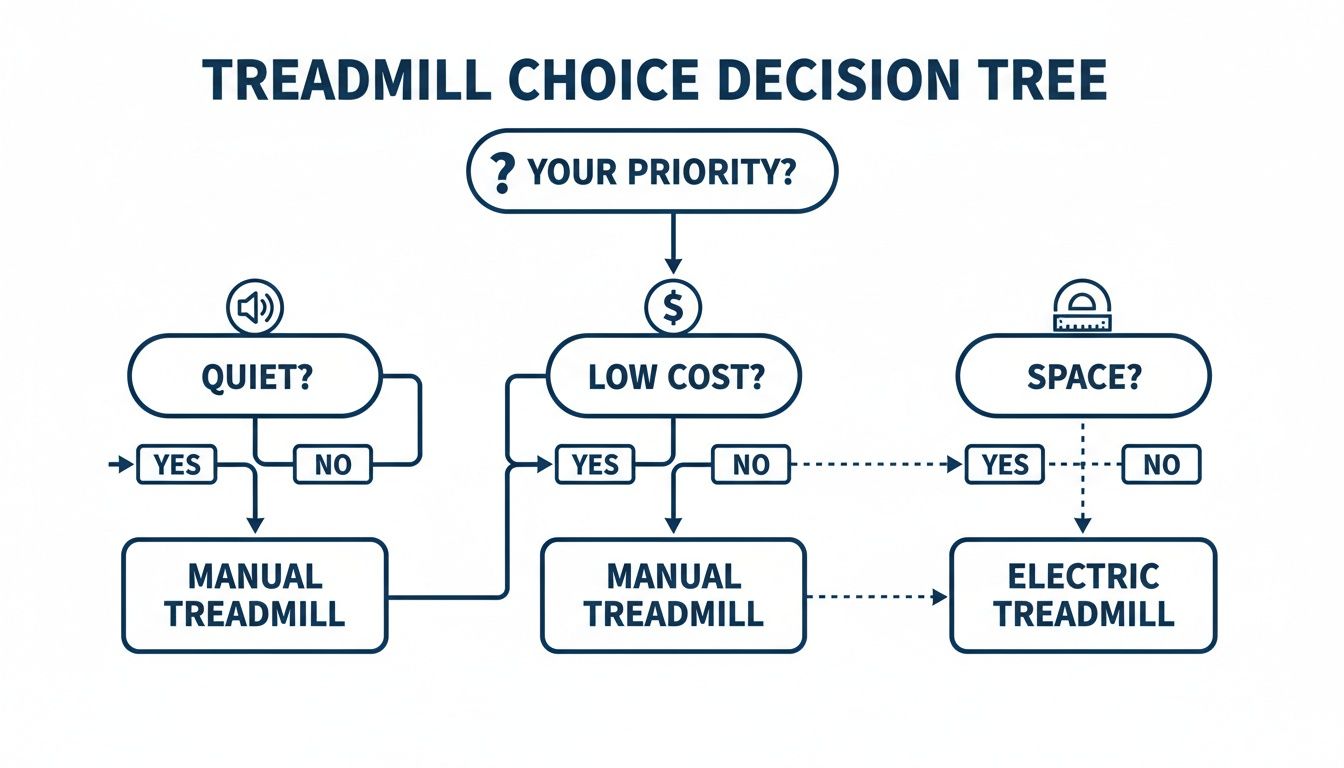
As you can see, if keeping things quiet, affordable, or compact is at the top of your wellness list, the manual treadmill is the obvious winner.
For Wellness Clinics and Physical Therapists
In a clinical setting, the manual treadmill vs motorized treadmill choice is all about control versus natural movement. A motorized treadmill gives therapists the precision they need for early-stage rehab. You can set an exact speed and incline, creating a safe and perfectly repeatable environment for a patient recovering from an injury or surgery. That level of control is non-negotiable for tracking progress and ensuring patient health.
A manual treadmill, however, shines for functional gait training and later-stage active workout recovery. Because it’s self-propelled, it allows patients to move at their own instinctive pace, helping them retrain proper movement patterns. It’s also a fantastic tool for contrast therapy protocols; a gentle walk on a manual treadmill after a cold plunge can gently boost circulation and support muscle repair, accelerating the body's natural healing processes. The choice depends entirely on the therapeutic goal and the patient's stage of recovery.
Ultimately, the right treadmill is a direct extension of your health and performance philosophy. For more expert insights to guide your journey, explore the MedEq Wellness Journal.
So, Which Treadmill Is Right for You?
The debate over manual vs. motorized treadmills isn't about which is "best"—it's about which one aligns with your specific philosophy on training, health, and workout recovery. Your final decision should come down to what you want to get out of every single step.
A manual treadmill, especially a curved one, is all about raw, self-propelled effort. It’s the clear winner if your training is built around maximum calorie burn, explosive high-intensity intervals, and refining your natural running mechanics for better long-term health. Its beautiful simplicity also means it’s a quiet, ultra-reliable machine for any home gym or wellness clinic.
On the other hand, a motorized treadmill delivers a perfectly controlled and predictable workout. It's the superior tool for steady-state cardio, targeted rehabilitation programs, and any training that demands precise speed and incline. For anyone who thrives on structure, its features provide the guided framework you need for consistent health progress.
From Effort to Recovery
Your treadmill should be more than just a machine; it's a bridge between intense effort and intelligent workout recovery. The right equipment becomes a seamless part of your commitment to long-term health, helping you build real-world strength and resilience.
The best treadmill is the one you’ll actually use. Whether it's the quiet simplicity of a manual model or the structured workouts of a motorized one, pick the machine that makes you want to show up for your wellness.
At MedEq Fitness, we focus on science-backed equipment built to optimize that cycle of performance and recovery. We invite you to explore our curated selection of manual curved treadmills, all backed by our free shipping and dedicated support.
To learn more about optimizing your training and recovery, continue your journey on the MedEq Wellness Journal.
Common Questions, Answered
We get a lot of questions about the differences between manual and motorized treadmills. Let's clear up a few of the most common ones so you can feel good about your decision and focus on your health benefits.
Are Manual Treadmills Harder to Use?
There's a short learning curve, for sure. But what feels like "difficulty" is actually the secret sauce to a better workout and greater health benefits. You're the engine. The belt only moves when you do, forcing more muscle engagement and torching more calories than a machine that just pulls you along.
It's a completely honest workout. The treadmill's speed is a direct reflection of your output, which is what makes it such a powerful tool for building real, functional fitness and enhancing your overall wellness.
Can You Use a Manual Treadmill for Walking and Recovery?
Absolutely. They're fantastic for active workout recovery days. Since you control the pace, you can walk at a slow, natural rhythm that helps improve blood flow and repair muscle without the jerky, artificial feel of a motor.
This makes it perfect for a cooldown or for light movement between intense training sessions. It’s also a great fit for contrast therapy protocols—a gentle walk after a cold plunge can really get your circulation going and support the body’s healing response, which is a cornerstone of effective workout recovery.
With a manual treadmill, your body leads the recovery, not a machine. That intuitive movement is exactly what you need to listen to your body and avoid pushing too hard on your wellness journey.
Is a Curved Manual Treadmill Better Than a Flat One?
For just about any performance or wellness goal, the curved design has a clear edge. The arc isn't just for looks; it's engineered to improve your running form and deliver significant health benefits.
It naturally encourages you to land on your forefoot or midfoot instead of slamming down on your heel, which is a huge win for your knees and hips. That curve also demands a stronger push-off, firing up your glutes and hamstrings more effectively. It’s a one-two punch of lower joint stress and better muscle activation, making it the smarter pick for athletes and anyone serious about long-term joint health and wellness.
To continue learning about science-backed wellness strategies and equipment, explore more articles on the MedEq Wellness Journal.
At MedEq Fitness, we are dedicated to providing physician-led, science-backed equipment to help you bridge the gap between exertion and renewal. Explore our curated selection of manual curved treadmills and other recovery tools designed to elevate your health and performance. Shop now at MedEq Fitness.