A Guide to Recovery Tools for Athletes
Peak performance isn't just built in the gym; it's forged in the downtime. How you recover is just as critical as how you train, and the right recovery tools for athletes can turn that downtime into a massive strategic advantage. The real gains in strength, endurance, and resilience don't happen when you're pushing your limits—they happen afterward, during a process that is essential for your overall wellness.
Why Smart Recovery Is Your New Competitive Edge
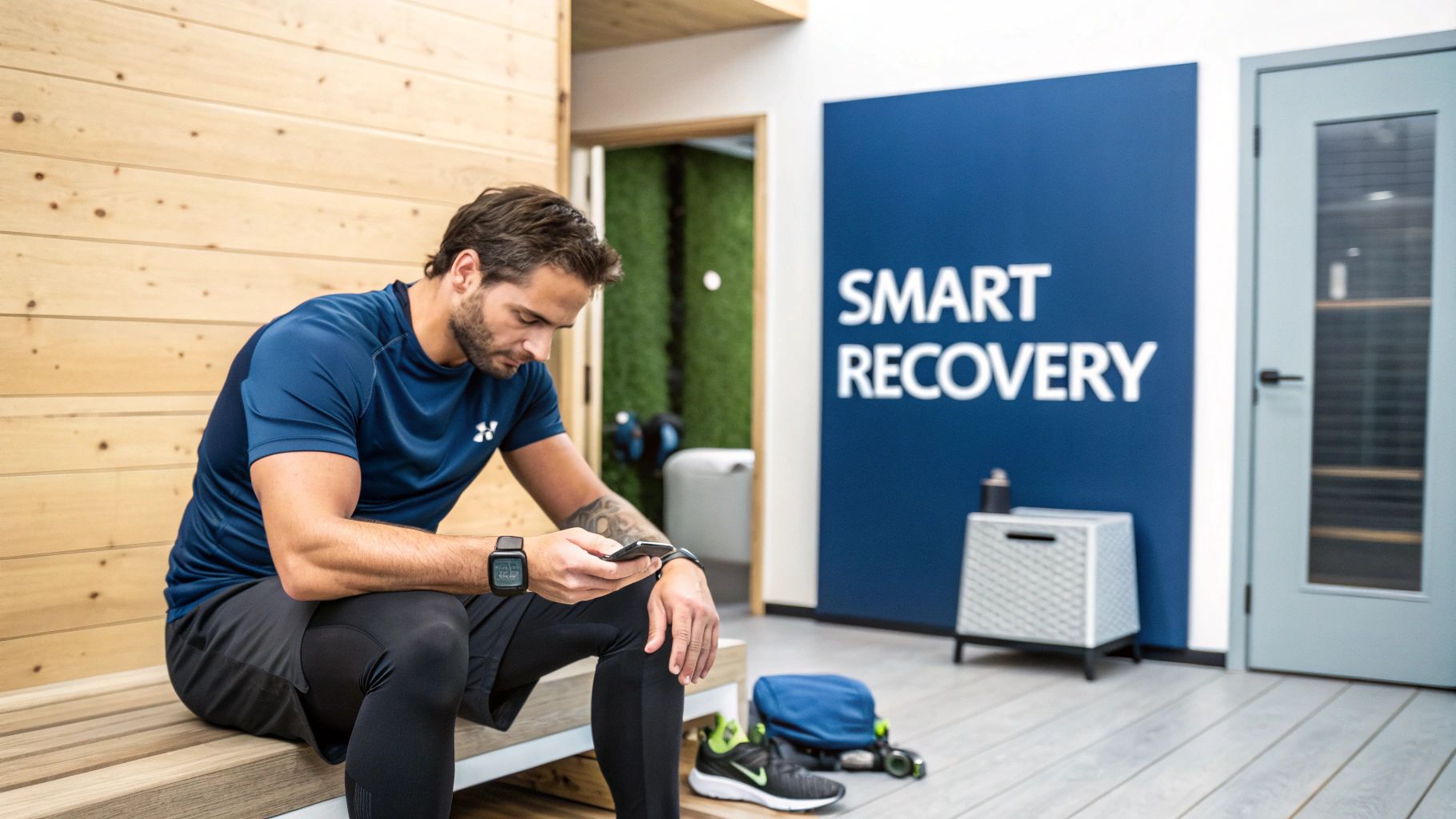
For years, the athlete’s mantra was simple: go harder, train longer. Recovery was something you just let happen. That mindset is completely outdated. Today’s top performers know that workout recovery is an active, science-backed discipline that directly fuels their next big effort. It's not about stopping; it's about strategically repairing and reloading to enhance both performance and long-term health.
Think of your body as a high-performance engine. A grueling workout is like running a race—it burns through fuel, causes microscopic damage to the engine parts (your muscles), and floods the system with metabolic waste. Just parking the car overnight isn't enough. Smart recovery is your professional pit crew, systematically refueling, repairing, and fine-tuning the engine so it comes back stronger for the next race.
The Shift from Passive Rest to Active Repair
This shift is all thanks to a much deeper understanding of how our bodies adapt. The magic—muscle growth, improved endurance, all of it—happens between training sessions. Targeted recovery tools simply speed up that vital process, contributing to a holistic sense of wellness. You can see this in action with the proven benefits of cold water therapy, where a simple cold plunge can dramatically reduce inflammation and kickstart repair.
You don't have to look far to see this proactive approach catching on. The global market for recovery tools is expected to jump from USD 1.5 billion in 2025 to a massive USD 3.5 billion by 2035, growing at a steady 8.7% CAGR. This boom isn't just hype; it shows a real change in how athletes and fitness lovers are thinking about performance and long-term health.
Measuring What Matters Most
So, how do you know if your recovery plan is actually working? We've moved way beyond just "feeling sore." Today, it's all about objective data. With a simple wearable, you can get a clear window into your body’s readiness using key metrics that reflect your health status:
- Heart Rate Variability (HRV): This measures the tiny variations in time between your heartbeats. It's a powerful look into your nervous system's state and your ability to handle stress. A higher HRV generally means you're well-recovered and your body is in a state of balance.
- Sleep Quality: Deep sleep is prime time for tissue repair and hormone regulation. Tracking your sleep cycles helps you see if you're truly getting the restorative rest your body needs to rebuild and maintain optimal health.
By keeping an eye on these numbers, you take the guesswork out of recovery. You can directly see how a sauna session or 20 minutes in a massage chair impacts your body's ability to bounce back and perform.
At the end of the day, investing in the right recovery tools is an investment in your own performance and longevity. By being strategic about it, you gain a powerful competitive edge that keeps you in the game and at your best. For more on this, visit the MedEq Wellness Journal.
Understanding the Core Recovery Modalities
To pick the right recovery tools, you first have to understand how they actually work. Each method targets a different physiological process—things like tamping down inflammation, boosting blood flow, or flushing out the metabolic junk left over from a hard workout. These processes are key to effective workout recovery and overall wellness.
Think of it as having a specialized toolkit. You wouldn't use a hammer to turn a screw, right? Same idea here. We can break these methods down into four main categories, and getting a handle on the "why" behind each one is your first step to building a smarter recovery routine.
Temperature Therapy: Hitting the Reset Button
Using temperature to supercharge recovery is one of the oldest tricks in the book. By strategically using heat and cold, you can trigger powerful physiological responses that get your body healing faster, providing significant health benefits.
- Cold Therapy (Cold Plunges): Ever jumped into a cold lake? That immediate tightening you feel is your blood vessels constricting. This process, vasoconstriction, is key right after a tough session. It limits blood flow to beat-up muscle tissue, which helps put the brakes on swelling and inflammation. Once you get out, your vessels open back up, flooding those same muscles with fresh, nutrient-rich blood to kickstart the repair job.
- Heat Therapy (Saunas): Heat does the exact opposite. A good sauna session causes vasodilation, widening your blood vessels. This cranks up circulation, delivering more oxygen to your muscles while helping escort metabolic byproducts out. Plus, the heat is fantastic for easing tense muscles and calming your nervous system—a huge benefit for mental wellness.
When you put them together in what’s called contrast therapy—alternating hot and cold—you create a powerful "pumping" action in your circulatory system. This is a highly effective workout recovery technique that can significantly reduce muscle soreness and accelerate healing by enhancing blood flow.
Compression Therapy: Squeezing Out the Junk
Picture your circulatory and lymphatic systems as a busy highway. After a hard workout, that highway gets clogged with traffic—metabolic waste like lactic acid that makes you sore. Compression therapy is like bringing in a team of expert traffic controllers to clear the jam.
Systems like dynamic air compression boots or sleeves apply waves of pressure up and down your limbs. This rhythmic squeezing mimics your body's own muscle pump, pushing old blood and lymphatic fluid back toward your core. It’s an incredibly efficient way to flush out all that waste, leaving your legs feeling lighter and fresher for your next session.
Percussive and Vibration Therapy: Releasing Deep Tension
Sometimes soreness isn't just about metabolic waste. It's about actual physical knots and adhesions locked deep in your muscle tissue. That's where percussive therapy tools, like massage guns, come in.
These gadgets deliver rapid, focused pulses deep into your muscles. This does a few things:
- It drives blood flow right to the spot you're working on.
- It helps break up those stubborn knots and release tight muscle fascia.
- It reduces stiffness and can immediately improve your range of motion.
It’s like having a deep-tissue massage on demand, letting you pinpoint problem areas with serious precision. This kind of hands-on work is wildly popular for a reason. In fact, massage therapy and assisted stretching are on track to grab 34.2% of the global fitness recovery services market in 2025. That whole sector is projected to balloon by an incredible 198% by 2035.
Athletes constantly report that these methods speed up their muscle recovery by 20-50%. For those training at home, a physician-approved massage chair from a brand like MedEq can deliver clinic-level results. We see many users track a 25% improvement in their sleep scores alone.
Light and Oxygen Therapy: Fueling Repair at the Cellular Level
This last category gets right down to the microscopic level—your cells. These therapies are all about giving your cells the raw materials they need to repair tissue and generate energy more effectively, offering profound health benefits.
Red Light Therapy (RLT): This is all about bathing your skin in specific wavelengths of red and near-infrared light. The light actually penetrates your skin and gets absorbed by the mitochondria—the little powerhouses inside your cells. This stimulates them to produce more ATP, which is the body's main energy currency. More ATP means faster tissue repair and less inflammation, straight from the source.
Hyperbaric Oxygen Therapy (HBOT): This involves breathing pure oxygen inside a pressurized chamber. The increased pressure allows your blood to absorb and carry way more oxygen than it normally could. This super-oxygenated blood then circulates through your entire body, flooding your muscles, tendons, and ligaments with the fuel they need to regenerate and heal.
Just remember, while these tools are incredibly effective, they’re amplifiers, not replacements. You can't out-train a bad diet. Nutrition is the absolute foundation of recovery, and knowing the best foods for muscle recovery is a non-negotiable part of the process. Be sure to explore all aspects of your wellness by visiting our MedEq Wellness Journal.
Picking the Right Recovery Tools for Your Goals
The "best" recovery tool is the one that actually helps you. A marathoner's needs are worlds apart from a powerlifter's, and your recovery stack should reflect that reality. It's not about owning every gadget; it's about building a personalized toolkit that directly addresses the demands of your sport and supports your health and wellness goals.
Think of it like a mechanic's toolbox. You don't use a sledgehammer to fix a watch. Your recovery should be just as precise. You need the right tool for the right job, matched to your specific athletic goals.
This decision tree helps cut through the noise. Are you fighting inflammation, trying to release crippling tension, or focused on rebuilding muscle tissue? Your answer points you directly to the most effective tools for the job.
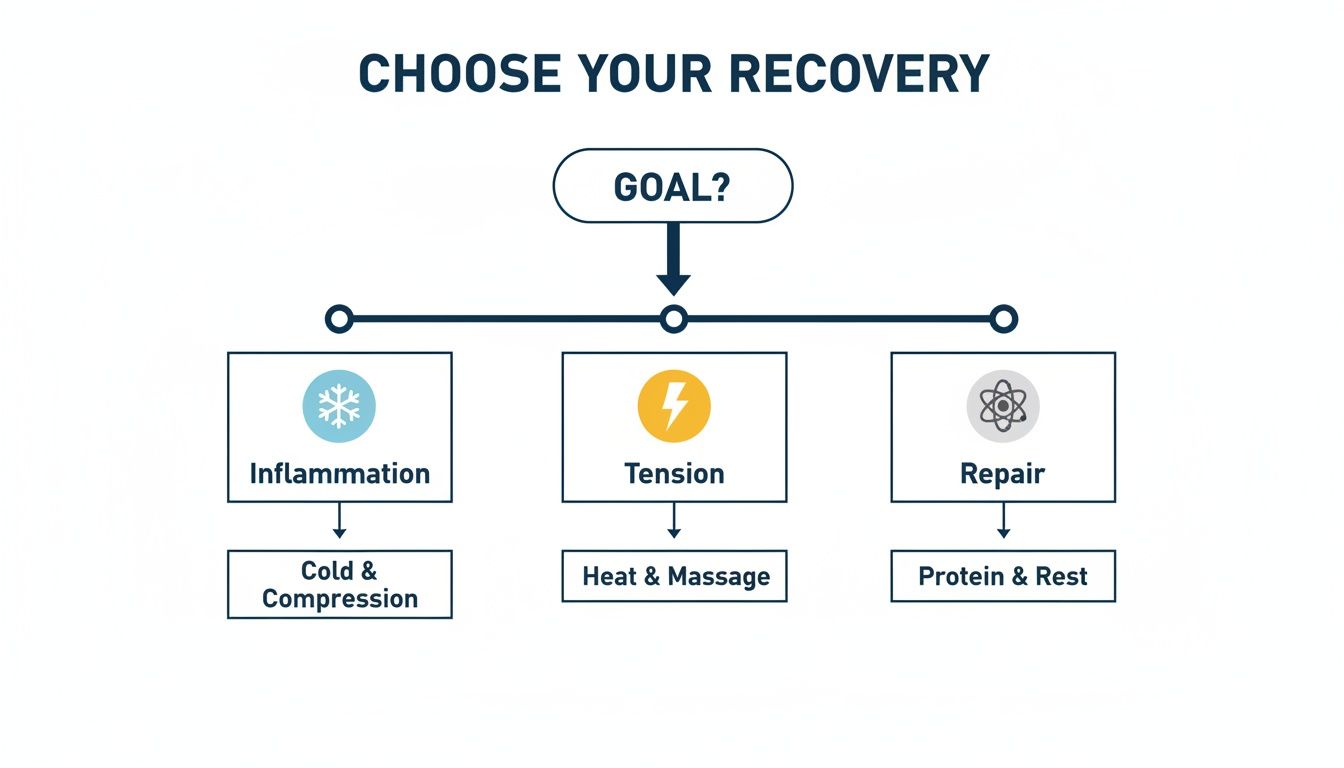
As you can see, your "why" determines your "what." This simple framework helps you stop guessing and start building a smart, effective recovery plan.
Endurance Athletes: The Inflammation Battle
Long-distance runners, cyclists, and triathletes know the feeling all too well: systemic inflammation and that heavy, dead-leg sensation. Your body is under prolonged, repetitive stress. The main goal of your workout recovery is to get that inflammation under control and flush out all the metabolic junk that’s slowing you down.
- Cold Plunges: This is your number one weapon. A quick plunge after a long session uses vasoconstriction to immediately put a damper on inflammation. It's a powerful reset button.
- Compression Boots: After hours on your feet or in the saddle, your circulation is begging for help. Compression boots automate the process, pushing old fluid and waste out of your legs to cut down on swelling and soreness.
- Contrast Therapy: Nothing gets your blood moving quite like jumping from a hot sauna to a cold plunge. This creates a powerful "pump" effect, flushing your tissues with fresh blood and nutrients to kickstart the healing process and boost overall wellness.
Strength Athletes: The Repair and Rebuild Mission
Weightlifters, sprinters, and functional fitness athletes create intense, focused muscle damage. Recovery here is all about repairing that tissue, calming a fried central nervous system after big lifts, and staying mobile enough to avoid injury. It’s about building back bigger and stronger.
- Saunas: The deep, penetrating heat from a sauna is fantastic for boosting blood flow, which is how your muscles get the oxygen and nutrients they need to repair. It also does wonders for down-regulating a jacked-up nervous system, a key health benefit.
- Massage Chairs & Percussion Guns: Got a nagging knot or a muscle group that’s locked up? These tools are perfect for spot treatments. They break up adhesions, release trigger points, and can give you an immediate boost in range of motion.
- Red Light Therapy: This works on a deeper level. RLT gives your mitochondria—the power plants of your cells—a serious boost, helping them produce more ATP. More cellular energy means faster, more efficient muscle repair. It’s a game-changer for strength development.
Your sport dictates your stress, and your stress dictates your recovery needs. An endurance athlete manages systemic fatigue, while a strength athlete repairs acute muscle trauma. Choose your tools accordingly.
To make this even clearer, let's break down which tools work best for different types of athletes and their most common recovery challenges.
Which Recovery Tool Is Right for You?
| Athlete Type | Primary Recovery Need | Recommended Tools | Secondary Tools |
|---|---|---|---|
| Endurance Athlete | Reduce Systemic Inflammation | Cold Plunge, Compression Boots | Contrast Therapy, Red Light Therapy |
| Strength/Power Athlete | Accelerate Muscle Repair | Sauna, Percussion Guns | Red Light Therapy, Massage Chairs |
| Team Sport Athlete | Manage Impact & Soreness | Compression Boots, Massage | Cold Plunge, Contrast Therapy |
| CrossFit/Hybrid Athlete | Both Inflammation & Repair | Contrast Therapy, Sauna | Percussion Guns, Cold Plunge |
| Desk Worker/Weekend Warrior | Relieve Tension & Stiffness | Massage Chair, Sauna | Percussion Guns, Red Light Therapy |
Ultimately, the best recovery tools for athletes are the ones that fit your life and address your specific weak points. When you match the tool to your goal—whether it's cooling inflammation, releasing tension, or rebuilding tissue—you stop recovering by accident and start doing it on purpose.
For more deep dives into optimizing your health and performance, check out the MedEq Wellness Journal.
How to Time Your Recovery for Maximum Benefit
Owning the best recovery tools is one thing. Knowing exactly when to use them is what turns a good workout recovery routine into a great one.
Think of it like cooking. You wouldn't just toss every ingredient into a pot at the same time and hope for the best. You add things in a specific order. Recovery is the same—timing isn't just a small detail; it's what separates a real training advantage from wasted effort.
Each tool has its own sweet spot, a window where it delivers the biggest physiological bang for your buck. Let's break down how to sync your tools with your training cycle for maximum health benefits.
Post-Workout: The Acute Recovery Window
Those first few hours right after a tough workout are go-time. Your body is in a state of controlled chaos, with inflammation kicking in to start cleaning up the mess. Your job is to manage this process, not stop it, and start flushing out all the metabolic junk left behind.
- Cold Plunge (Immediately Post-Workout): This is the moment for cold therapy. Intense training creates micro-tears in your muscles, and the inflammation that follows is what makes you sore. A 2–5 minute plunge in cold water (around 50-59°F or 10-15°C) constricts blood vessels, putting a cap on that initial inflammatory flood and helping to seriously cut down on delayed onset muscle soreness (DOMS).
- Compression Therapy (30-60 Minutes Post-Workout): After you've taken the edge off with the cold, it’s time for compression. Think of compression boots as a dynamic flush for your limbs. They systematically squeeze metabolic waste products like lactic acid out of your muscles while helping fresh, oxygenated blood flow back in. A solid 20–30 minute session will leave your legs feeling remarkably lighter.
Rest Days: Maximizing Systemic Repair
Rest days are for more than just binging Netflix. They’re a golden opportunity to focus on deep, system-wide recovery. The goal shifts from managing acute inflammation to promoting blood flow, calming your nervous system, and supporting tissue regeneration on a grand scale—all pillars of wellness.
This is where heat modalities really come into their own.
Using something like an infrared sauna on a rest day is a game-changer. The heat sinks deep into your muscle tissue, opening up blood vessels and cranking up circulation. This floods your muscles with the oxygen and nutrients they need to repair and rebuild, all without the stress hormones that are flying around right after a workout.
In fact, using heat immediately after training can sometimes make inflammation worse. That’s why saving it for an off-day is so effective for your long-term progress. A 20-minute sauna session also helps lower cortisol and kicks your body into that "rest and digest" parasympathetic state—the perfect zone for healing.
Pre-Workout: Activating and Preparing
Who said recovery tools are only for after? They can also be fantastic for getting your body fired up and ready to perform. Here, the focus isn't on repair but on activation, improving mobility, and driving blood to the muscles you’re about to put to work.
- Percussion Massage Gun (5-10 Minutes Before): A quick once-over with a massage gun on the muscle groups you’re about to train can literally wake them up. It boosts local blood flow and can unlock a bit more range of motion, helping you move better and potentially sidestepping injuries.
- Red Light Therapy (10-15 Minutes Before): Used as a prep tool, RLT can prime your cellular engines for the work ahead by giving your mitochondria a little boost. We actually wrote a whole guide on this, which you can check out here: red light therapy before or after a workout.
The real secret is intelligently stacking these methods throughout your week. By timing your tools correctly, you make sure every session is giving you the biggest possible benefit, helping you come back stronger and more resilient every time.
Measuring the Impact of Your Recovery Routine
So, you've invested in a few new recovery tools. How do you actually know if they're working? Sure, feeling less sore is a good sign, but the real proof is in the numbers. Modern wearables have taken the guesswork out of workout recovery, turning it into a science you can track on your phone.
This isn't about chasing random stats. It's about connecting the dots. You can literally see how that new sauna habit or consistent massage gun use is changing your body's readiness to perform. It empowers you to stop guessing and start building a routine based on what your own data tells you.
Key Biomarkers You Can Actually Track
Your body is constantly sending signals about its state of recovery. Wearables like a WHOOP strap or an Oura Ring are essentially translators, turning those subtle signals into concrete metrics you can use to monitor your health. The big three you want to watch are Heart Rate Variability (HRV), Resting Heart Rate (RHR), and sleep quality.
-
Heart Rate Variability (HRV): This is the gold standard for measuring recovery. It tracks the tiny, millisecond-level variations between your heartbeats. A higher HRV is a fantastic sign—it means your nervous system is balanced, recovered, and ready to take on stress. If you see your HRV trending up after a week of red light therapy, you've got clear evidence that it's working for you.
-
Resting Heart Rate (RHR): Simple, but powerful. Your RHR is a direct reflection of your cardiovascular fitness and how recovered you are. A lower RHR means your heart is working more efficiently. If you see it trending down over a few weeks, that's a huge win, showing that your body is adapting well to your training and recovery.
-
Sleep Quality: We're talking about more than just the number of hours you're in bed. Wearables break down your sleep into stages—light, deep, and REM. Deep sleep is where the magic happens for physical repair, and REM sleep is vital for mental restoration. Improving the time spent in these stages is a direct sign of better recovery and improved wellness.
This screenshot from a WHOOP device shows exactly how sleep performance, HRV, and daily strain come together to generate a recovery score.
The data gives you a clear, visual snapshot of how your body is responding, so you can make smarter decisions about how hard to push each day.
The Rise of AI in Recovery Optimization
This ability to track metrics is now getting a major boost from artificial intelligence. The market for AI-powered athlete recovery is exploding, projected to jump from USD 895.3 million in 2025 to a staggering USD 9,619.7 million by 2035.
Breakthroughs now allow wearables to crunch your strain, sleep, and stress data to give you predictive insights. This tech can forecast fatigue with up to 90% accuracy and has been shown to reduce injury risk by 22-30%. When you pair these AI insights with cutting-edge hardware—like red light therapy or hyperbaric chambers from innovators like MedEq—the results are even more impressive. Home users are seeing a 20% boost in HRV and a 25% improvement in sleep quality, results once reserved for pro athletes. You can dig into more of these market trends over at Market.us.
By focusing on these numbers, you can build a truly personalized and effective routine. If your HRV is consistently low, you might need more relaxing modalities. If you want a deeper dive into this key metric, check out our guide on what HRV training is. Ultimately, using data transforms your recovery into a strategic part of your training plan, ensuring every tool you use pushes you closer to your peak potential.
For more wellness insights, be sure to visit the MedEq Wellness Journal.
Building Your At-Home Recovery Sanctuary
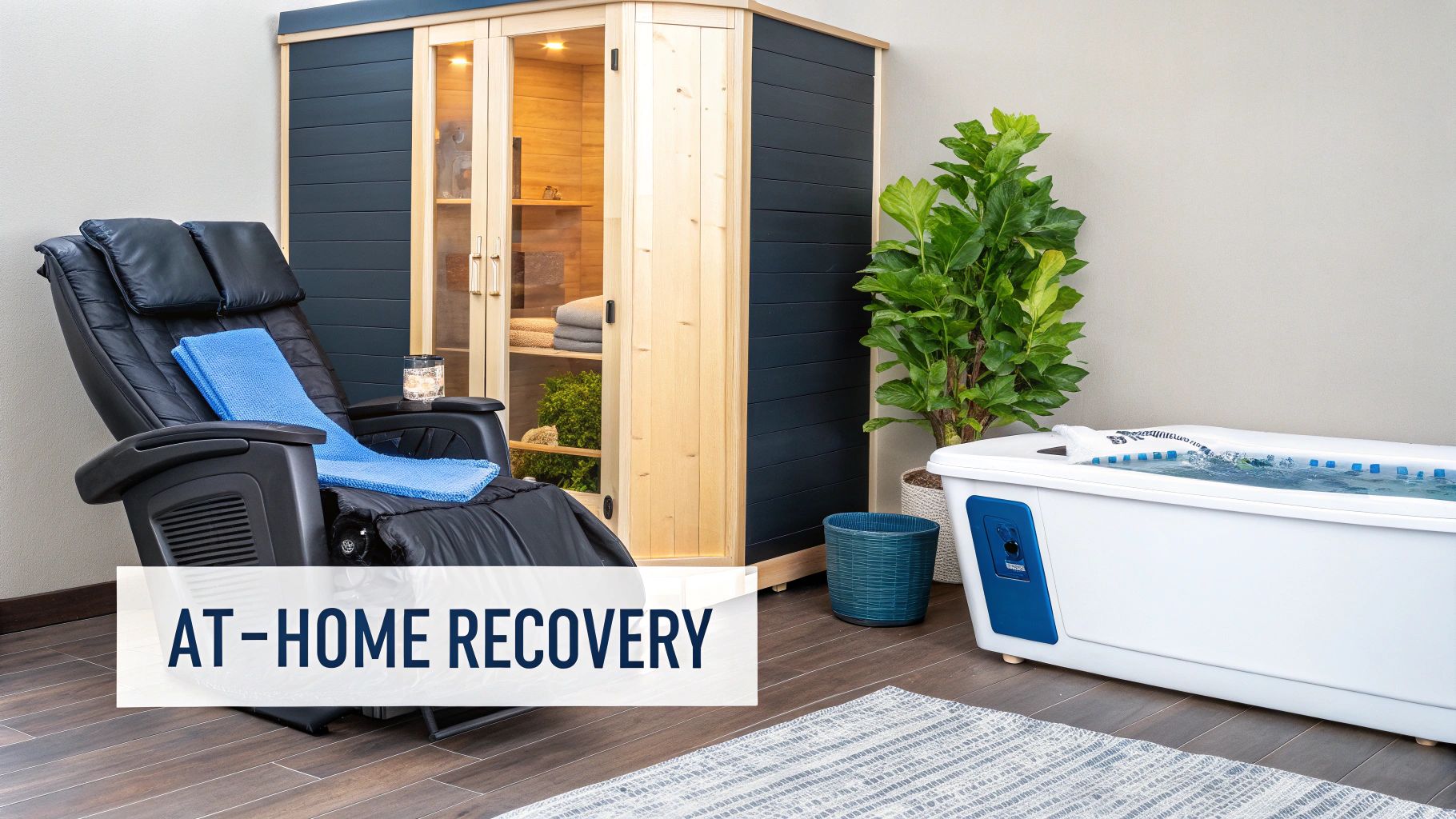
So, you're ready to bring professional-grade recovery into your own home? Fantastic. Creating a dedicated sanctuary shifts recovery from a once-in-a-while luxury to a consistent, powerful habit that boosts your wellness. But let's be honest, investing in this kind of equipment is a big deal, and you want to make sure you’re getting real value and lasting health benefits.
When you're picking out recovery tools for athletes to use at home, the little details are everything. Durability, quiet operation, and ease of use are what separate premium, effective gear from gadgets that just end up collecting dust. A noisy massage chair or a high-maintenance cold plunge can easily become another source of stress, which is the exact opposite of what you want.
What to Look for in Key Equipment
Making the right choice really boils down to knowing what features actually matter for each tool. When you’re ready to pull the trigger, here are the non-negotiables to look for in three of the most popular pieces of home recovery equipment:
- Cold Plunges: Look past the tub and zero in on the sanitation system. A powerful filtration system combined with ozone or UV sanitation is the secret to crystal-clear water without constant hassle. It stops bacteria from building up and drastically cuts down on how often you need to do a full water change.
- Saunas: The heater type is probably the biggest decision you'll make. Carbon heaters offer a deep, penetrating, and more gentle heat, while traditional rock heaters give you that classic, intense, high-temperature sweat session. Think about what you're trying to achieve—is it deep tissue relaxation or a powerful, purifying sweat?
- Massage Chairs: A quality chair needs to have S-Track or L-Track technology. This allows the rollers to follow the natural curve of your spine instead of just going straight up and down. Also, look for a zero-gravity recline to deepen relaxation and make sure it has adjustable intensity settings so you can tailor every session to exactly what your body needs that day.
Protecting Your Investment with Smart Maintenance
Once you've got your gear, a little upkeep goes a long way. Regular maintenance isn't just about protecting your investment; it's about making sure your tools perform safely and effectively for years to come. Think of it as just another part of your wellness routine.
Simple, consistent maintenance preserves the functionality and hygiene of your recovery tools. A clean filter in a cold plunge or a well-kept sauna heater ensures you get the maximum health benefits from every single session.
For example, make it a habit to check and clean the filters on your cold plunge. For your sauna, a quick wipe-down of the interior surfaces prevents moisture buildup, and it's smart to inspect the heating elements for wear and tear. The same logic applies to more advanced tools like hyperbaric chambers, where understanding the best practices is critical. You can learn more about that in our guide on using a hyperbaric chamber for home use. Taking these simple steps will keep your home sanctuary in peak condition, so you can focus on what really matters: your recovery.
For more expert advice on building your ideal wellness space, explore the MedEq Wellness Journal.
Common Questions on Recovery Tools
Stepping into the world of advanced recovery can feel a bit like learning a new sport—there's a lot to take in. As you start to bring these tools into your daily life, questions are bound to pop up. Here are the answers to some of the most common ones we hear from athletes.
Can I Use Multiple Recovery Tools on the Same Day?
Absolutely, but the key is to be smart about it. We call this "stacking," and when done right, it can seriously amplify your results. For instance, you could use a percussion massager to loosen up a tight hamstring before you train, then hop in a cold plunge afterward to keep inflammation in check.
One of the most powerful stacks is contrast therapy—alternating between a cold plunge and a sauna. This method is fantastic for workout recovery as it creates a vascular pump that flushes out metabolic waste and reduces soreness. The main thing is to pay attention to how your body feels and not push it too hard. A good starting point is to leave a few hours between something stimulating (like a cold plunge) and something deeply relaxing (like a massage chair).
How Soon Will I See Results?
You'll notice benefits on two different timelines: immediate and long-term. Tools like massage chairs and percussion guns offer instant gratification by easing muscle tightness right away. A cold plunge can make your legs feel refreshed and less sore almost immediately.
But the real magic happens with consistency.
You'll likely see tangible shifts in metrics like your Heart Rate Variability (HRV) and deep sleep within 1-2 weeks. The deeper performance gains—like being able to handle more training volume without breaking down—usually show up after 4-6 weeks as you raise your body's entire recovery baseline.
Are Professional-Grade Recovery Tools Safe for Home Use?
For the most part, yes—as long as you stick to the manufacturer's guidelines. Reputable brands engineer their equipment with plenty of safety features and give you clear instructions for using it correctly at home. That said, it’s vital to know your own body and health history.
If you have any underlying health conditions like heart problems, epilepsy, or if you're pregnant, it's non-negotiable to talk to your doctor before using tools like saunas, cold plunges, or hyperbaric oxygen chambers. Always begin with shorter sessions and lower intensities to let your body adapt. Smart, safe progression is the name of the game.
To keep learning and get the latest on wellness technology, check out our complete MedEq Wellness Journal.
At MedEq Fitness, we offer physician-approved, science-backed wellness equipment designed to bridge the gap between exertion and renewal. Discover our collection of professional-grade recovery tools and start building your at-home sanctuary today.