
Hyperbaric Chamber Cost Explained: Your Investment in Health & Wellness
So, how much does a hyperbaric chamber actually cost? The short answer is: it depends entirely on what you need it for.
You can find soft-shell models designed for home wellness and athletic recovery starting around $5,000, with more advanced units going up to $25,000. On the other end of the spectrum, clinical-grade hard-shell chambers are a much bigger investment, typically running from $60,000 to over $150,000. Think of this as the ticket price to one of the most powerful tools for boosting your body's natural healing, health, and accelerated recovery available today.
Your Quick Guide To Hyperbaric Chamber Costs
Choosing a hyperbaric chamber is a lot like buying a car. A soft-shell chamber is your reliable daily driver—perfect for consistent wellness routines and helping athletes bounce back faster. A hard-shell chamber, however, is a high-performance machine, built to handle the intense demands of a busy clinic. This guide will give you a clear, no-nonsense look at what to expect financially as an investment in your well-being.
It helps to know you're not alone in looking into this. The global market for hyperbaric therapy is booming, growing from USD 3.3 billion in 2022 to a projected USD 4.9 billion by 2030. What's driving this? A big part of it is the 15-20% annual jump in sports injuries and post-surgical recovery needs. People are actively seeking better, faster ways to heal and enhance their health. You can dig deeper into these market trends and their drivers to see the full picture.
Before we get into the nitty-gritty of pricing, here's a quick overview to help you frame the different options.
Hyperbaric Chamber Cost at a Glance
| Chamber Type | Average Price Range | Typical Pressure (ATA) | Best For |
|---|---|---|---|
| Soft-Shell (mHBOT) | $5,000 – $25,000 | 1.3 – 1.5 ATA | Home users, athletes, wellness centers |
| Hard-Shell (Monoplace) | $60,000 – $95,000 | Up to 2.0 ATA | Small clinics, med-spas, serious athletes |
| Hard-Shell (Multiplace) | $100,000 – $150,000+ | Up to 3.0+ ATA | Hospitals, large clinics, research facilities |
This table gives you a solid starting point. Now, let's connect these numbers to your actual wellness goals.
Aligning Cost With Wellness Goals
The real key is matching the chamber's specs—and its price tag—to what you want to achieve. Are you a competitive athlete trying to slash muscle recovery time after brutal workouts? Or are you more focused on general wellness, like sharpening your focus, improving skin health, and getting better sleep? Knowing your "why" makes the "which" so much easier.
- For Athletic Recovery: A session in a soft-shell chamber, often called mild hyperbaric oxygen therapy (mHBOT), is fantastic for calming inflammation and speeding up tissue repair. It’s an absolute game-changer for any serious athlete looking to minimize downtime and maximize performance. For an even greater recovery boost, some athletes pair hyperbaric sessions with contrast therapy—alternating between hot and cold environments like saunas and ice baths—to amplify circulation and reduce soreness.
- For General Wellness: Regular sessions help drench your body's tissues in oxygen. The result? More energy, better mental clarity, improved immune function, and an overall sense of well-being that you can really feel. This enhanced oxygenation is the foundation for profound health benefits.
- For Advanced Therapies: This is where the hard-shell models come in. Clinics need chambers that can reach higher pressures to treat specific FDA-approved medical conditions, which is why they come with a significantly higher price tag.
An investment in a hyperbaric chamber is a direct investment in your body's capacity to heal and perform. It moves beyond passive recovery, offering an active method to enhance your biological processes and unlock significant health benefits.
Once you understand these basic distinctions, you're in a much better position to navigate the options and pick a chamber that truly supports your long-term health and performance. For more on the technologies we stand behind, check out the MedEq Wellness Journal.
Decoding The Total Cost Of Ownership
The sticker price on a hyperbaric chamber is just the starting line. It’s a bit like buying a performance car—the initial cost is one thing, but you also have to think about getting it home, the fuel to run it, and the tune-ups to keep it in peak condition. Understanding the total cost of ownership is what lets you make a smart, sustainable investment in your health without any surprises.
When you're looking at a chamber, you're not just buying a piece of equipment. You're investing in a whole system that needs to be set up correctly and supported over time. Getting a clear picture of the full financial commitment from day one means you can focus on what really matters: reaping the benefits, from faster recovery to better overall vitality and long-term wellness.
To give you an idea, the financial landscape looks very different for a personal wellness chamber versus a heavy-duty clinical model.
This chart gives you a quick visual on the upfront cost gap between home-use chambers and their clinical-grade counterparts, helping you see where your wellness investment might fall.
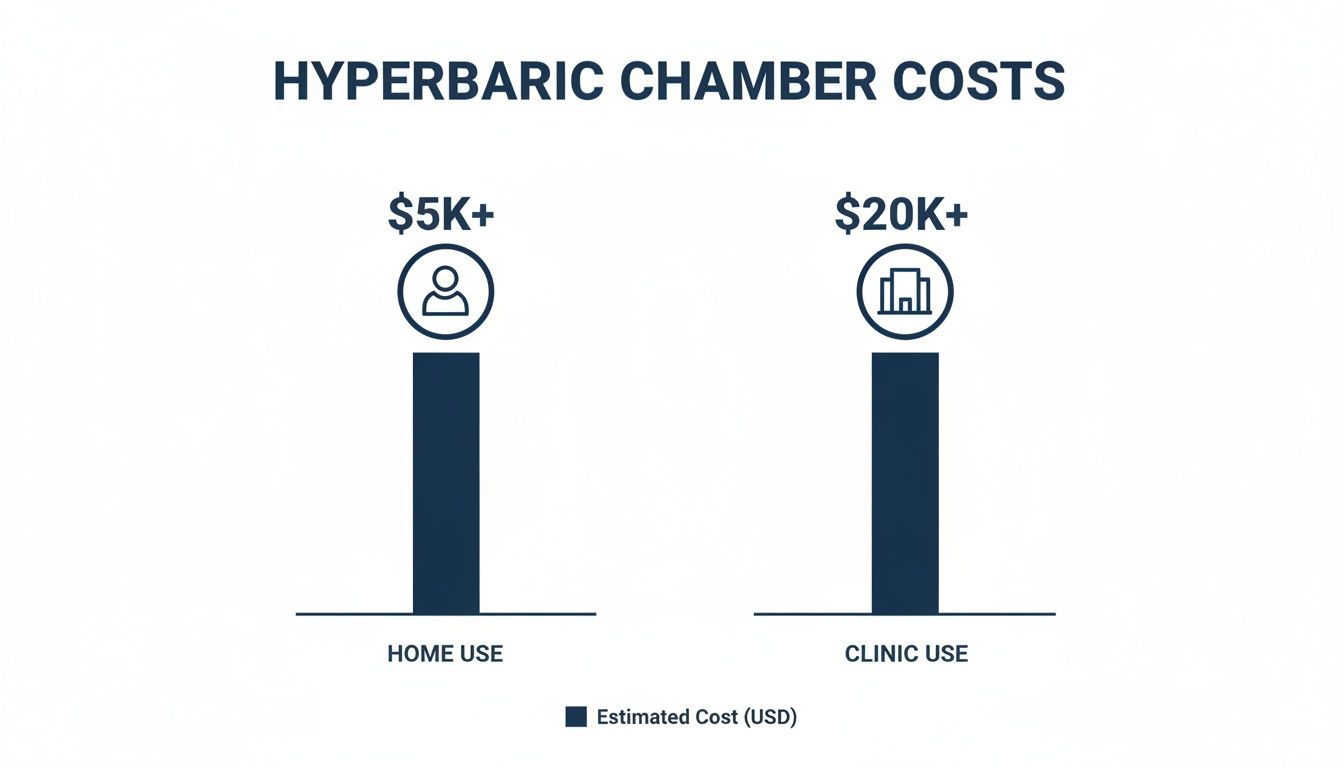
As you can see, the entry point for at-home wellness is much more accessible than the investment needed for a professional clinic, which makes sense given the differences in pressure capabilities and sheer construction.
Breaking Down The Upfront Costs
Beyond the chamber itself, a few other one-time costs are part of the initial investment. These are all about getting your system up and running safely and correctly from the get-go.
-
Shipping and Freight: Let's face it, hyperbaric chambers are big and heavy. Shipping can run anywhere from a few hundred to several thousand dollars, depending on how far it's going and its size. Many people opt for white-glove delivery to get it safely inside their home or clinic without the hassle.
-
Installation and Setup: A lot of soft-shell chambers are pretty straightforward to assemble yourself. But if you'd rather not deal with it, professional installation is an option. For the big hard-shell units, professional setup is pretty much a must. This can add $500 to $2,500+ to your initial cost.
-
Essential Accessories: Your chamber needs a few key buddies to work. That means an air compressor to pressurize it and an oxygen concentrator to supply the purified oxygen. These are usually sold as a package, but it's always smart to double-check that they're included.
Planning For Ongoing Operating Expenses
Once your chamber is all set up, the day-to-day costs are actually quite minimal. But they're still important to factor into your budget. Think of these as the recurring expenses that keep your wellness tool ready for every session.
The two main things you'll be paying for are electricity and your oxygen source.
You really start to see the value of a home chamber over time. When a single session at a clinic can cost $100 to $350, a home unit can pay for itself surprisingly fast with regular use. It stops being an expense and becomes a long-term wellness asset that generates health benefits on your schedule.
The electricity draw is similar to running a standard home appliance—nothing crazy. And since most home setups use an oxygen concentrator that just purifies the air around you, you buy it once and you're done. No more dealing with renting and refilling oxygen tanks. If you want to see what else you might need down the line, you can explore various hyperbaric chamber accessories and upgrades that can enhance your experience.
Total Cost of Ownership Breakdown
To make it even clearer, let's break down the lifetime costs side-by-side. This table gives you a realistic look at what to expect financially from both a soft-shell home unit and a hard-shell clinical model, from the day it arrives to years of use.
| Cost Component | Soft-Shell Chamber (Home Use) | Hard-Shell Chamber (Clinic Use) | Key Considerations |
|---|---|---|---|
| Initial Purchase | $5,000 – $25,000 | $20,000 – $100,000+ | Reflects pressure (ATA), size, and materials. |
| Shipping & Delivery | $300 – $1,500 | $1,000 – $5,000+ | Varies by weight, size, and destination. |
| Installation | $0 (DIY) – $1,000 | $1,500 – $5,000+ | Hard-shells almost always require professional setup. |
| Accessories | Included or $500 – $2,000 | Included or $2,000 – $7,000 | Compressor & concentrator are essential. |
| Operating Costs | Minimal (electricity) | Moderate (electricity, O2 tanks) | Concentrators avoid recurring oxygen tank fees. |
| Maintenance | $50 – $200 / year | $500 – $2,500+ / year | Filter changes, seal checks, annual service contracts. |
| Total 5-Year Est. | $6,000 – $29,000 | $26,000 – $120,000+ | Illustrates the complete financial commitment. |
This breakdown shows that while the upfront cost is the biggest piece of the puzzle, the ongoing expenses are also part of the full picture you need to consider.
Long-Term Maintenance And Care
Just like any high-quality equipment, your hyperbaric chamber needs a little TLC to ensure it runs safely and lasts for years. The good news? For most home models, the maintenance is simple and doesn't demand much of your time.
Routine care usually just involves:
- Filter Replacements: The air compressor and oxygen concentrator have filters that you'll need to clean or swap out every so often to keep the air pure.
- Seal and Gasket Inspections: A quick check of the zippers, seals, and gaskets for any wear and tear ensures the chamber holds pressure perfectly.
- General Cleaning: Wiping down the inside and outside of the chamber is just good practice for hygiene.
By keeping all these pieces in mind—the initial purchase, setup, operating costs, and long-term care—you can build a budget that makes sense. Having this complete view of the hyperbaric chamber cost helps you invest with confidence, so your focus can stay right where it belongs: on hitting your health, wellness, and recovery goals. For more insights, visit our blog, the MedEq Wellness Journal.
Soft-Shell vs. Hard-Shell Chambers: What Drives The Price Difference?
So, why does one hyperbaric chamber have a price tag that’s miles apart from another? It’s not random. The cost difference is baked right into the design, materials, and what each chamber is built to do. Figuring out what drives the hyperbaric chamber cost is key to picking the right tool for your health, wellness, or athletic goals.
Here’s a simple way to think about it. A soft-shell chamber is like a high-performance expedition tent. It's portable, efficient, and perfectly suited for its environment—delivering fantastic recovery and wellness benefits. A hard-shell chamber, on the other hand, is more like a reinforced steel bunker. It’s built for extreme conditions, incredibly durable, and can handle much, much higher pressures for medical applications.
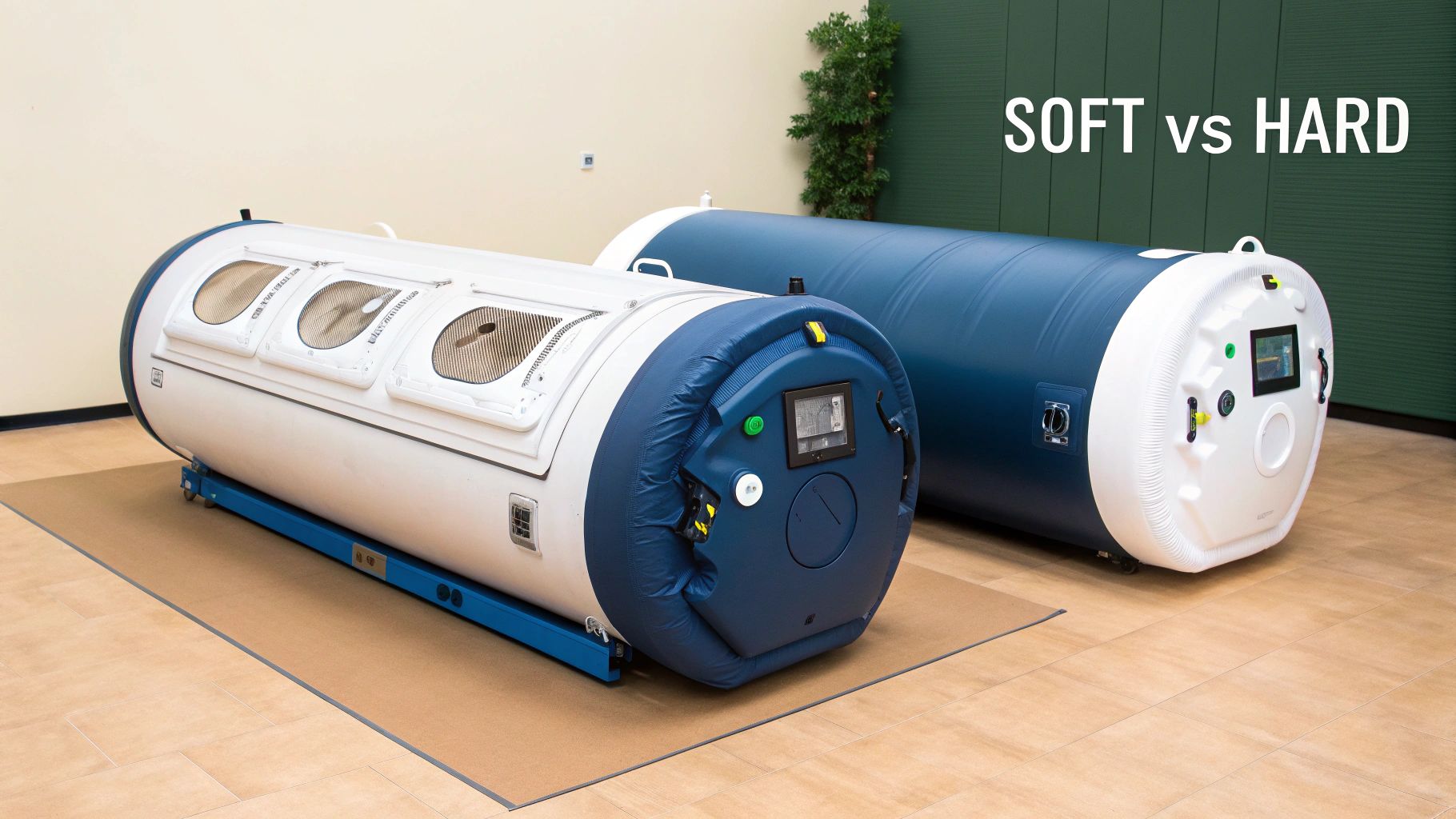
Both are incredible pieces of equipment, but they’re engineered for completely different jobs. That core distinction is what creates the significant gap in price.
The Impact of Materials and Construction
The most obvious difference is what they’re made of. Soft-shell chambers use advanced, medical-grade fabrics like double-sided thermoplastic polyurethane (TPU). This material is tough yet flexible, which is what allows the chamber to be inflatable, portable, and way more affordable to manufacture.
Hard-shell chambers are a different beast entirely. They’re constructed from solid steel and acrylic—materials designed to handle immense and repeated pressurization, day in and day out. This heavy-duty build is essential for busy clinics where chambers run for hours on end and have to meet strict medical safety codes. Naturally, the cost of these raw materials and the complex manufacturing process is significantly higher.
This split in the market is a big reason why the global HBOT industry, which was valued at USD 4.44 billion, is expected to skyrocket to USD 9.11 billion by 2032. As demand grows for treatments targeting conditions like chronic wound infections, there's a need for both accessible home units and powerful clinical systems. You can learn more about the growth of the global HBOT market and what's driving it.
Pressure Capabilities: ATA and Its Role in Cost
The pressure a chamber can safely hit, measured in atmospheres absolute (ATA), is the single biggest factor influencing its price and its purpose.
-
Soft-Shell Chambers (mHBOT): These operate at milder pressures, usually between 1.3 and 1.5 ATA. This range is the sweet spot for general wellness, boosting cognitive function, and seriously speeding up workout recovery. Because the pressure is lower, the engineering and materials don't need to be as extreme, which helps keep costs down. This level is ideal for unlocking significant health benefits without the need for clinical-grade intensity.
-
Hard-Shell Chambers (HBOT): These are built to reach much higher pressures, often 2.0 ATA to 3.0 ATA or even more. This is the level required to treat the 13 FDA-approved medical conditions, like decompression sickness ("the bends") and non-healing wounds. Hitting these pressures safely demands a much more robust—and expensive—construction.
The distinction is simple: 1.5 ATA is a powerful setting for wellness and recovery, while 2.0+ ATA is a clinical dosage for specific medical interventions. Your health goals will tell you which pressure level you actually need.
This functional difference is directly tied to the price. A chamber built for 1.5 ATA serves the wellness and athletic market perfectly, while one engineered for 2.0 ATA is a medical device with a price tag to match. If you're trying to find the perfect fit for your space, check out our guide on the best hyperbaric chamber for home use.
Durability, Longevity, and Intended Use
Finally, how the chamber is meant to be used shapes its entire design and cost. Soft-shell chambers are built for personal use—think a session or two a day for one person in a home or a small wellness studio. They are plenty durable for this and can last for many years with good care.
Hard-shell chambers are designed to be commercial workhorses. A busy clinic might run its chamber for 8-12 hours a day, cycling through patient after patient. That kind of workload requires a level of durability and engineering that goes far beyond what’s needed for a home unit, and their higher initial investment reflects that.
Ultimately, choosing between a soft-shell and a hard-shell chamber is all about matching your needs to the equipment's design. For enhancing recovery, boosting energy, and promoting overall wellness, a soft-shell chamber delivers incredible value and profound health benefits. For a clinical practice, the investment in a hard-shell unit is a necessary cost of doing business to provide medical-grade therapy.
Calculating Your Return on Wellness And Performance
When you invest in a hyperbaric chamber, you're buying something that pays dividends far beyond your bank account. It's a direct investment in your body's potential—your energy, your recovery, and ultimately, your quality of life. The conversation around hyperbaric chamber cost shouldn't just be about the price tag; it's about calculating your "return on wellness."
For athletes, that return is measured in real, tangible performance gains. Faster muscle repair translates to less downtime and more time spent training effectively. Reduced inflammation acts as a shield against overtraining injuries, keeping you in the game longer and helping you hit your peak when it matters most. It’s a powerful tool for sharpening your competitive edge and accelerating workout recovery.
The True Value For Home Wellness
For those focused on home wellness, the return on investment (ROI) shows up in the rhythm of daily life. It's that deeper, more restorative sleep that leaves you feeling genuinely recharged in the morning. It’s the mental clarity that helps you cut through the fog during a demanding workday. It's having the consistent energy to be present and active with your family. These are tangible health benefits that improve your entire well-being.
These aren't just vague concepts; they are concrete improvements that build on each other over time. With regular use, a hyperbaric chamber becomes a cornerstone of your health regimen, delivering value you can actually feel, every single day.
When you look at the health industry, you can see this shift happening. A growing number of medical wellness clinics are adopting this technology because they see the powerful, non-invasive results their clients are getting.
Investing in a home chamber shifts your mindset from paying for individual treatments to owning the means of production for your own well-being. The true long-term value is having unlimited access to recovery and vitality.
The market data backs this up. The monoplace hyperbaric chamber market was recently valued at USD 262.30 million as clinics and individuals sought more accessible alternatives to massive hospital-grade units. The entire global HBOT market has now swelled to USD 3.25 billion, driven by a more proactive approach to wellness. North America is leading the charge, holding over 31% of the market share as awareness and accessibility continue to grow.
Quantifying The Return For Athletes And Clinics
For serious athletes and fitness professionals, the math is incredibly compelling. Think about a dedicated athlete who already spends a small fortune on recovery tools—massages, physical therapy, supplements, you name it. A hyperbaric chamber doesn't just add to that list; it can consolidate and even reduce those ongoing expenses while delivering far more profound benefits.
- Reduced Downtime: Recovering faster from brutal workouts or minor injuries means more consistency and fewer missed opportunities to improve.
- Enhanced Performance: Super-oxygenating your tissues can lead to greater endurance and more power output. It’s a simple equation for better health and athleticism.
- Long-Term Savings: Owning a chamber erases the recurring cost of clinic sessions, which can run anywhere from $100 to $350 a pop. With consistent use, a home unit can pay for itself surprisingly quickly. You can dive deeper into the specific benefits of hyperbaric therapy for athletes in our detailed guide.
For a wellness clinic, the ROI is even more straightforward. A hyperbaric chamber isn't just a piece of equipment; it's a premium service that attracts a new, high-value client base and creates a reliable revenue stream. It instantly positions a facility as a leader in advanced recovery, setting it apart from the competition.
Making Wellness Accessible Through Financing
We get it—the upfront hyperbaric chamber cost can feel like a big hurdle. But financing options are making this powerful technology more attainable than ever. We partner with financing companies to offer flexible payment plans, letting you spread the investment over time.
This approach means you can start experiencing the health benefits of elite-level recovery right away while managing the cost in a way that fits your budget. It removes the biggest barrier to entry, putting world-class wellness technology within reach for home users and small clinics alike.
Ultimately, deciding to invest in a hyperbaric chamber is a decision to prioritize your health. When you look at the cost through the lens of long-term returns—better performance, more vitality, and a higher quality of life—the value becomes crystal clear.
Your Smart Buyer Checklist Before You Invest
Ready to pull the trigger? A smart hyperbaric chamber investment isn’t just about the sticker price—it’s about finding the right fit for your goals, your space, and your budget. This checklist will walk you through the essentials so you can buy with confidence.
Define Your Primary Wellness Goals
First things first: get clear on your "why." Are you an athlete looking to crush recovery times and bounce back from brutal workouts? Or are you focused on general wellness—better sleep, sharper focus, and more energy? Your health goals are the most important factor.
Your answer here is everything, as it points directly to the right type of chamber.
- Athletic Recovery & Performance: You'll want easy, consistent access to mild hyperbaric therapy (mHBOT). A soft-shell chamber is perfect for this, letting you jump in after training to gain that competitive edge in your workout recovery.
- General Health & Vitality: For boosting your body's natural healing, enhancing cognitive function, and achieving long-term well-being, regular sessions in a soft-shell chamber are fantastic for supporting systemic oxygenation and unlocking powerful health benefits.
Confirm Your Required Pressure Level
Your goals dictate the pressure you need, measured in atmospheres absolute (ATA). For home wellness and athletic recovery, a soft-shell chamber running between 1.3 ATA and 1.5 ATA is the gold standard. It's incredibly effective.
Clinical treatments for serious medical conditions often demand hard-shell chambers that can hit 2.0 ATA or more. Don't pay for pressure you don't need. For wellness and recovery, that 1.3–1.5 ATA range is your sweet spot for health optimization.
Measure Your Space and Plan for Logistics
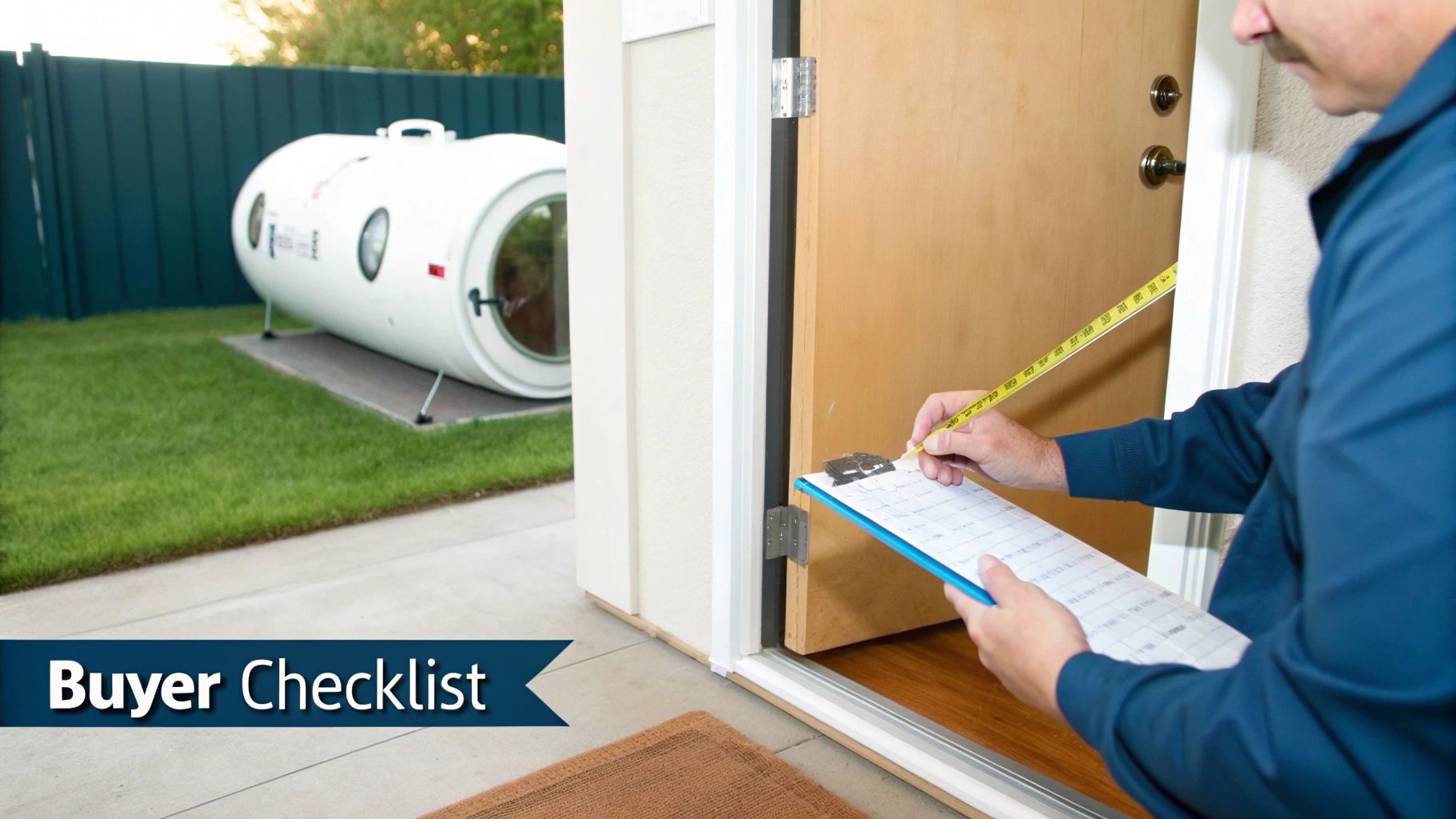
Before you get attached to a specific model, break out the tape measure. Home chambers are designed to fit into a normal room, but you have to account for the whole setup.
You're not just placing the chamber. You need space for the air compressor and oxygen concentrator, too. Make sure there’s enough room for all three, plus clearance to get in and out comfortably and good ventilation for the equipment.
Think about the delivery path. Can it fit through your doorways? What about hallways or tight corners on the stairs? Measure it all to avoid a headache on delivery day.
Understand the Warranty and Support
Your relationship with the company doesn't end when they take your money. A solid warranty and real customer support are a huge part of your investment.
Look for these things:
- A Clear Warranty: Know exactly what’s covered (parts, labor) and for how long. A multi-year warranty is a great sign that the manufacturer stands behind their product.
- Reliable Customer Support: Can you actually call a U.S.-based team if you have questions about setup or operation? Good support is peace of mind.
Working through this list will help you confidently pick a chamber that’s a perfect match for your goals. For more deep dives into wellness tech, check out the articles on our MedEq Wellness Journal.
Your Top Questions About Hyperbaric Chamber Costs, Answered
Deciding to invest in your health always brings up a few questions. We get it. Here are some straight-to-the-point answers to the most common things people ask about hyperbaric chamber costs and what to expect. We want you to feel totally informed and ready to take the next step.
Are Soft-Shell Chambers Really Strong Enough For Workout Recovery?
Absolutely. It’s easy to think more pressure is always better, but that’s not the case for recovery. While hard-shell chambers in hospitals hit high pressures for specific medical treatments, the gentle pressure in soft-shell chambers—usually 1.3 to 1.5 ATA—is the sweet spot for athletes and wellness seekers.
This pressure range is perfect for dialing down inflammation, getting more circulation to your muscles, and speeding up your body's own repair crews. It's an ideal setup for anyone serious about their fitness and workout recovery. This enhanced oxygen delivery provides significant health benefits without the intensity of a clinical session.
Can My Health Insurance Help Pay For A Chamber?
This is a big one, and for home use, the answer is almost always no. Insurance companies generally only cover hyperbaric therapy for a very specific list of FDA-approved medical conditions, and those treatments have to happen in a clinical setting.
When you buy a chamber for general wellness, improved workout recovery, or to boost athletic performance, it’s considered an out-of-pocket investment in your health. If you do get clinical treatments, it's a good idea to understand your Explanation of Benefits (EOB) to see exactly what you'll be responsible for.
How Much Room Do I Actually Need For A Home Chamber?
Good news—most soft-shell chambers are designed to fit right into your home. A chamber for one person (a monoplace) takes up about the same amount of floor space as a large couch or a twin bed. But definitely measure your space first.
Don’t just measure for the chamber itself. You need to account for the support gear, too. Make sure there’s enough room for the air compressor and oxygen concentrator, with plenty of space around them for airflow. And, of course, you'll want enough room to get in and out comfortably.
What's The Difference Between An Oxygen Concentrator and An Oxygen Tank?
Think of an oxygen concentrator as a machine that creates its own oxygen on demand. It pulls in regular room air, filters out the nitrogen, and gives you a steady stream of concentrated oxygen. It’s a one-time purchase that’s safer and way more convenient for home use.
An oxygen tank, on the other hand, holds a limited amount of compressed oxygen. Once it’s empty, you have to get it refilled or replaced, which is why it's mostly used in clinical settings. For more practical wellness tips, check out our MedEq Wellness Journal.
At MedEq Fitness, we believe in giving you the best science-backed tools to power your recovery and enhance your overall wellness. Take a look at our handpicked collection of hyperbaric chambers to find the right one for your health goals and start your journey to peak performance today.