Manual Treadmills for Running: A Guide to Self-Powered Wellness and Recovery
There’s a clear shift happening in the fitness world. We're moving away from machines that set the pace for us and turning towards equipment that puts us back in control. At the forefront of this movement are manual treadmills for running—self-propelled machines that are quickly becoming a staple for everyone from elite athletes to those focused on holistic wellness.
The Shift to Self-Powered Fitness and Health
Imagine the difference between a motorboat and a kayak. An electric treadmill is the motorboat, pulling you along at a fixed speed, regardless of how you feel. A manual treadmill is the kayak; it only moves when you put in the work. You are the engine. This single distinction changes everything about how we approach indoor running, training, and workout recovery, turning every session into an opportunity to improve our overall health.
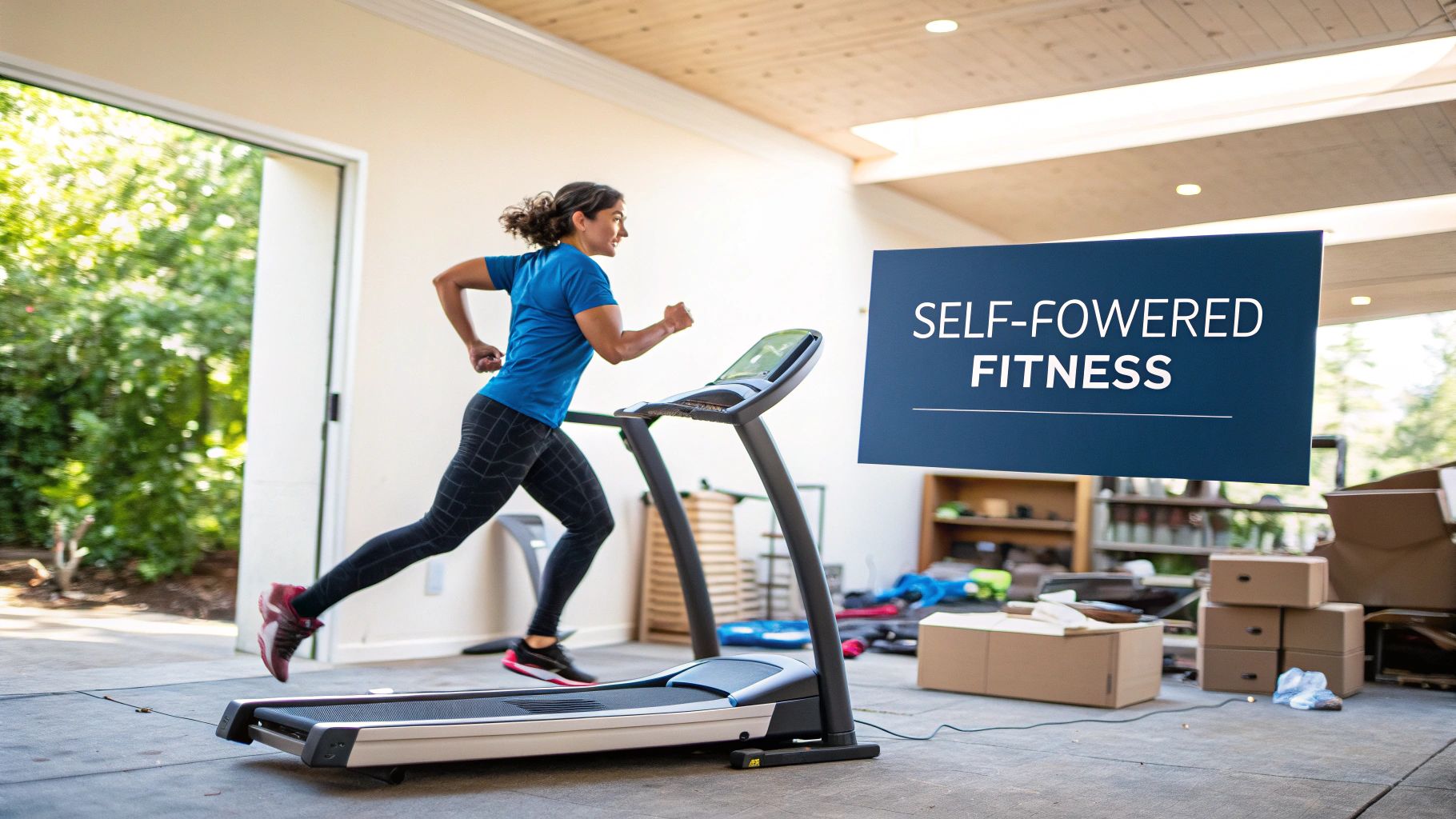
This guide is a deep dive into these innovative machines. We'll explore how making the switch from motorized to manual can have a profound impact on your body, from correcting your running form and building functional strength to enhancing your overall wellness and accelerating recovery.
Why Self-Propelled Motion Matters for Your Health
The beauty of manual treadmills for running is in their raw simplicity and the physiological demands they place on the body. Since you provide 100% of the power, your body is forced to recruit more muscles and burn more calories to get the belt moving. This user-driven approach unlocks some serious health and wellness benefits:
- Better Biomechanics: The design of a manual treadmill naturally encourages a more efficient running gait. Many runners find they shift to a healthier mid-foot strike, which helps reduce the harsh joint impact associated with heel striking, protecting your knees and hips.
- Greater Muscle Activation: To propel the belt, you have to fire up your entire posterior chain—your glutes, hamstrings, and calves. This active engagement builds functional strength in the muscles that power you forward in everyday life.
- Higher Caloric Burn: The data doesn't lie. Research and user reports consistently show that you burn significantly more calories on a manual treadmill compared to a motorized one, supporting weight management and cardiovascular health.
- Mindful Movement: You control the pace with every single step. This creates an immediate mind-body connection that’s perfect for active recovery sessions where listening to your body's signals is the whole point of the workout.
A Focus on Holistic Wellness and Workout Recovery
Beyond just grueling workouts, manual treadmills are incredible tools for recovery and holistic health. They are nearly silent, creating a peaceful environment that’s more conducive to mindful fitness and mental wellness. This makes them ideal for recovery protocols, where the goal is to gently increase blood flow and ease muscle soreness without putting the body under more stress.
The ability to go from an all-out sprint to a slow, deliberate walk in an instant makes the manual treadmill uniquely versatile. It’s built for high-intensity intervals, but it’s just as effective for advanced workout recovery methods like contrast therapy, where you can pair a light walk with a cold plunge to maximize circulation and speed up tissue repair.
This guide will break down the science, health benefits, and real-world applications of using manual treadmills for running, walking, and rehabilitation. For more expert insights on optimizing your health, check out the MedEq Wellness Journal.
How Manual Treadmills Redefine Your Run
Running on a manual treadmill is a totally different ballgame. Forget everything you know about motorized treadmills that pull the belt for you. On a self-powered machine, you are the motor.
Every single stride requires you to physically drive the belt backward. This simple, yet profound, change forces your entire posterior chain—glutes, hamstrings, and calves—to wake up and get to work. You're not just keeping pace; you are the engine generating every bit of momentum. The result is a more powerful, engaged running gait that feels a lot more like running on the road, providing significant health benefits.
Unpacking the Biomechanical Advantages for Long-Term Health
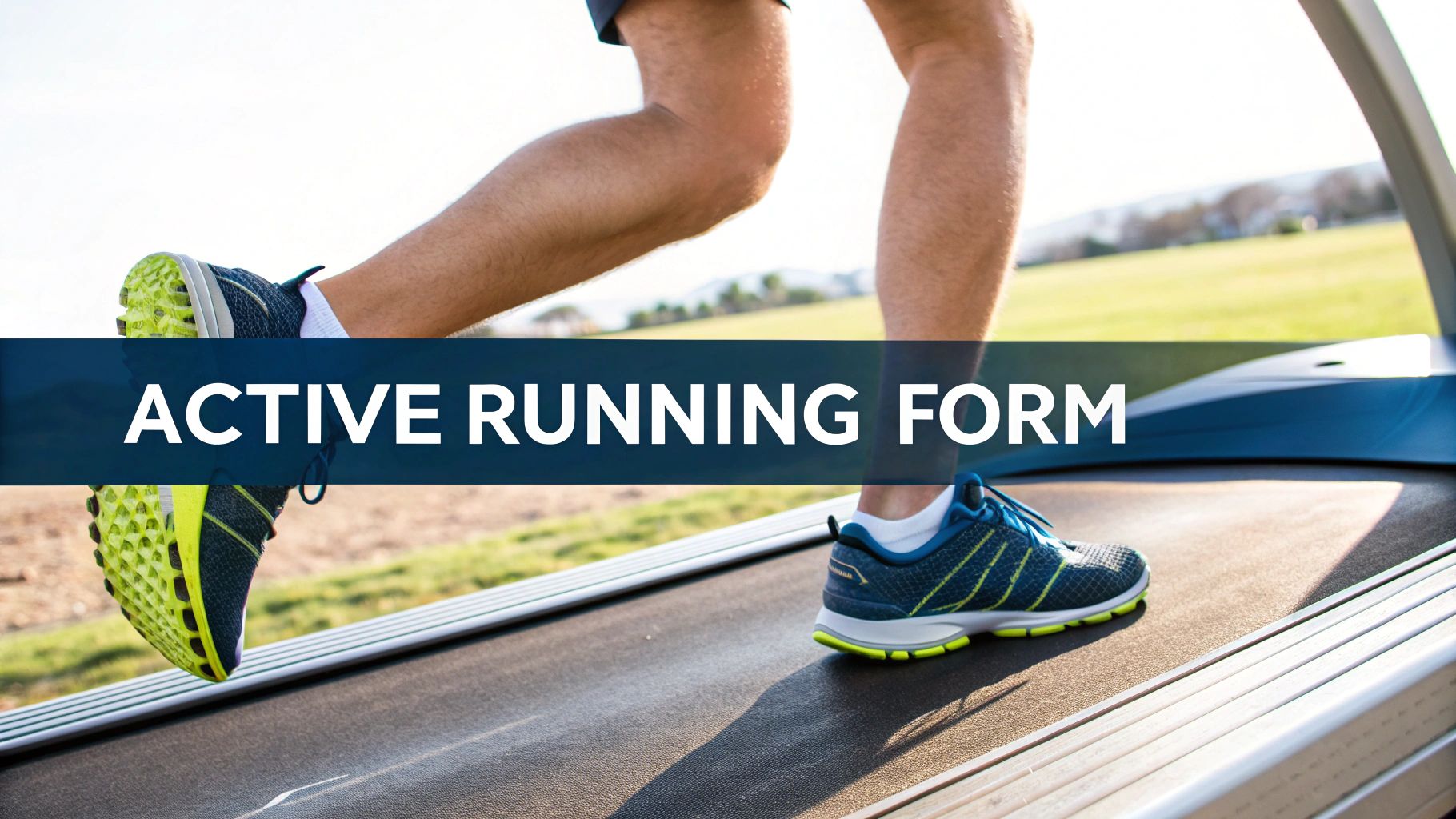
Curved manual treadmills have a unique design that encourages a better, more efficient foot strike. The arc of the deck naturally guides your foot to land on the midfoot or forefoot, which is a huge departure from the harsh heel-striking many people do on flat surfaces.
This small adjustment can make a massive difference, significantly reducing the impact forces that travel up through your ankles, knees, and hips. But it's about more than just protecting your joints. This improved form enhances your running economy—meaning you use less energy to hold your pace—and sharpens your proprioception, which is your body’s sense of its position in space. This leads to fewer injuries and a more sustainable running practice for life-long wellness.
The secret sauce of a manual treadmill is neuromuscular activation. By forcing you to pull the belt with every step, it reinforces the correct firing pattern for your glutes and hamstrings. Over time, this corrects common gait problems and builds a more resilient, injury-proof athlete from the ground up.
This isn't just a niche trend; it's a significant shift in how we approach indoor training. The global market for these machines hit USD 571.63 million in 2023, largely driven by a post-pandemic focus on low-impact, high-efficiency cardio. Biomechanics studies have shown you can burn up to 30% more calories compared to walking on a motorized treadmill, a game-changer for anyone looking to maximize health results at home or in the clinic.
Building a Stronger Foundation for Total Wellness
Think of every step on a manual treadmill as a mini core exercise. Because the belt reacts instantly to your effort, your abs and lower back have to fire constantly to keep you stable and upright. It turns your run into a dynamic core workout without you even thinking about it.
This constant core engagement pays off in a few key ways for your overall health:
- Better Posture: Strengthening your core helps fix postural imbalances that often lead to nagging aches and pains.
- Rock-Solid Stability: A stronger midsection means better balance, which is vital for preventing falls and boosting athletic performance.
- More Efficient Power: A stable core is the linchpin for transferring power from your legs through the rest of your body.
Of course, to truly get the most out of your runs, fueling your body is just as important as your form. For ideas on how to optimize your energy levels, check out these best snacks for runners.
Ultimately, a manual treadmill does more than just give you a workout—it teaches your body how to move better. By removing the motor, it puts the focus back on you, helping you become a stronger, more efficient, and more mindful runner. You can dive deeper into how adding resistance takes this to the next level in our guide on the resistance treadmill.
Integrating Manual Treadmills into Workout Recovery Protocols
Sure, we talk a lot about grueling sprints and high-intensity work on manual treadmills, but some of their most profound health benefits show up when you slow things down. They are exceptional tools for wellness and workout recovery.
Their power is in their simplicity. Since you’re the engine, the belt only moves when you decide to move, giving you complete and instantaneous control over your pace.
This makes them absolutely perfect for low-impact active recovery. Instead of being locked into a motor's speed, you can listen to your body’s signals and move at a pace that feels genuinely restorative, not demanding. It's the difference between a forced march and a mindful walk—one adds stress, the other helps you heal.
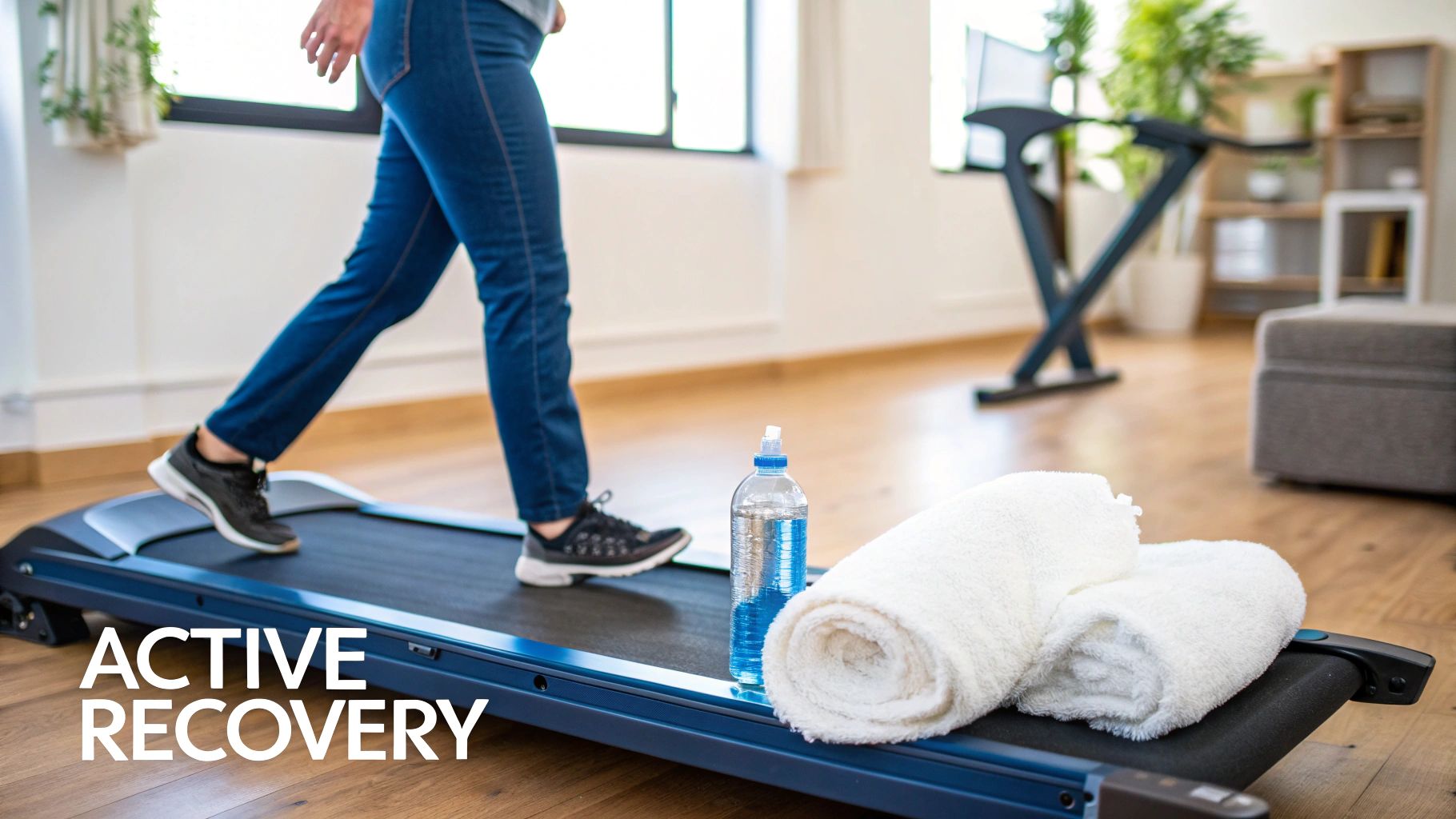
This user-powered design is ideal for gently encouraging blood flow to sore, tired muscles. A slow, deliberate walk helps flush out metabolic byproducts like lactic acid, which can dial down delayed onset muscle soreness (DOMS) and get your body ready for its next challenge without piling on more strain.
Elevating Workout Recovery with Contrast Therapy
If you really want to take your workout recovery to the next level, try incorporating a manual treadmill into a contrast therapy routine. This wellness technique alternates between hot and cold stimuli to create a powerful circulatory effect that can dramatically accelerate muscle repair and reduce inflammation. The manual treadmill fits perfectly as the active component in this cycle.
Here’s what a typical contrast therapy protocol might look like:
- Gentle Warm-Up: Start with 5-10 minutes of slow, easy walking on the manual treadmill. The goal is just to get your blood moving.
- Heat Exposure: Follow that with a 10-15 minute session in a sauna to increase blood flow and help your muscles relax.
- Cold Exposure: Immediately jump into a 2-3 minute cold plunge. This constricts your blood vessels, which helps reduce inflammation.
- Active Recovery: Finish with another 5-10 minute gentle walk on the manual treadmill. This final step helps your circulatory system ease back to normal while continuing the waste-flushing process.
The magic here is the "pump" effect. Switching rapidly from vasodilation (widening blood vessels from heat) to vasoconstriction (narrowing them from cold) creates a powerful circulatory flush that supercharges your body's natural recovery systems.
Improving Your Resilience to Stress for Better Wellness
Beyond just muscle repair, this mindful kind of movement has a huge impact on your nervous system and overall wellness. A key metric we use to track this is Heart Rate Variability (HRV), which is a snapshot of your body's ability to adapt to stress. A higher HRV is a clear sign of a well-recovered and resilient system.
Gentle, self-paced movement on a manual treadmill helps shift your nervous system out of a "fight-or-flight" state and into a "rest-and-digest" mode—which is exactly where you need to be for effective workout recovery and HRV improvement.
This isn't just a theory; elite training circles have fully embraced it. Pioneers like Woodway and TrueForm launched models post-2020 that put non-motorized tech at the center of prep for the NFL combine and Olympic training.
For MedEq Fitness enthusiasts, pairing these machines with tools like red light therapy or saunas can kick recovery into high gear, with some users reporting 20-30% improvements in HRV. This is globally significant, especially when the WHO notes that 1 in 8 deaths are linked to inactivity; these treadmills make effective fitness far more accessible.
When you integrate these machines into your wellness routine, you're not just recovering faster—you're building a more robust and adaptable body. For a deeper look at other powerful methods, check out our guide on the best recovery tools for athletes.
Choosing Your Ideal Manual Treadmill
Picking the right manual treadmill isn't about finding the absolute "best" machine—it's about finding the best machine for you. Your wellness goals, your running style, and even your available space play a huge role in the decision. Let's walk through the key features to look at so you can invest in a treadmill that will serve your health for years to come.
The first, and most important, choice you'll make is the belt design: curved or flat. This single decision shapes your entire running experience more than anything else.
Curved vs. Flat-Belt: What's the Difference?
Think of it this way: a curved treadmill is like a dynamic, rolling trail that begs you to open up your stride and build power. A flat-belt model is more like a steady, predictable path—perfect for walking, workout recovery, and building endurance at a controlled pace.
- Curved Manual Treadmills: The defining feature is the U-shaped deck. This arc naturally guides you to run on the balls of your feet, promoting a healthier mid-foot strike that can lessen joint impact. To speed up, you just move further up the curve. To slow down, you drift back. It's an intuitive design that's perfect for HIIT, sprint intervals, and for athletes fine-tuning their running mechanics.
- Flat-Belt Manual Treadmills: These are simpler and often much more compact. They operate on a slight, fixed incline, using gravity to get the belt moving. They excel at steady-state walking, active recovery sessions, and are a fantastic tool for anyone in rehabilitation who needs a stable, predictable surface to rebuild strength and mobility.
To make the choice clearer, let's put them side-by-side.
Manual Treadmill Feature Comparison: Curved vs. Flat-Belt
This table breaks down how each design serves different health and wellness needs, helping you align your goals with the right machine.
| Feature | Curved Manual Treadmill | Flat-Belt Manual Treadmill |
|---|---|---|
| Primary Use | High-intensity interval training (HIIT), sprint work, and performance-focused running. | Walking, light jogging, active recovery, and rehabilitation. |
| Running Experience | Dynamic and responsive. Encourages a faster pace and a forefoot/mid-foot strike. | Steady and controlled. Best for maintaining a consistent, low-to-moderate pace. |
| Muscle Engagement | Maximizes activation of the posterior chain (glutes, hamstrings) for explosive power. | Provides consistent, lower-intensity engagement for building endurance. |
| Footprint & Storage | Generally larger and heavier, often requiring a dedicated space. | Typically more compact and lighter, with many models offering folding capabilities. |
| Ideal User | Athletes, experienced runners, and those looking to maximize calorie burn in short bursts. | Beginners, walkers, seniors, and individuals focused on recovery or physical therapy. |
| Price Point | Tends to be a higher investment due to the complex design and robust build. | More budget-friendly, making it an accessible entry point into self-powered fitness. |
Once you've decided on a belt style, the next feature to consider is how the machine adds challenge.
Evaluating Resistance Systems
Beyond just moving faster, a good resistance system is what lets you dial up the intensity for strength and conditioning. The two main types you'll encounter are magnetic and friction.
Magnetic resistance is the gold standard. It uses powerful magnets to create a smooth, silent drag on the flywheel without any parts ever touching. This gives you incredibly consistent tension across multiple levels and is virtually maintenance-free. For a prime example of this system in action, check out the R1000 Curved Resistance Treadmill.
Friction resistance is simpler, using a pad that physically presses against the flywheel to create drag. It's an effective and common feature on more budget-friendly models, but it can be less precise and the friction pad may need replacing over time.
Build Quality, Durability, and Noise
Finally, zoom in on the construction. A high-quality manual treadmill feels solid underfoot. There should be zero wobble or shakiness when you're using it, whether you're walking or sprinting.
A key indicator of durability is the user weight capacity. A higher capacity—think 350-400 lbs—is a sign of a tougher frame and better components. It’s a promise of longevity, whether it’s for a home gym or a high-traffic clinic.
Another detail to look for is the bearing system. High-quality sealed bearings are what allow the belt to glide smoothly and quietly. In fact, a well-built manual treadmill is remarkably quiet; the only sounds you should hear are your footsteps and the gentle hum of the belt.
This quiet operation makes them perfect for home use where you don't want to disturb anyone else, contributing to a more peaceful wellness environment. Investing in a model with a solid frame and premium bearings ensures your treadmill will be a reliable training partner for the long haul.
The Growing Demand for Mindful Fitness and Wellness
The rise of manual treadmills for running isn't just a fleeting trend. It's a direct reflection of a much larger shift in how we think about fitness—a move toward workouts that are more intuitive, sustainable, and biomechanically sound.
People are actively looking for equipment that does more than just make them sweat. They want a better mind-body connection, a quieter home environment, and a smaller carbon footprint. That’s where self-powered fitness comes in. You’re not just keeping up with a motor; you are the motor.
A Market That's Picking Up Speed
The numbers don't lie. This isn't a niche market anymore. The global manual treadmill sector was valued at roughly USD 1.3 billion in 2023 and is on track to hit USD 2.5 billion by 2032.
That growth is driven by a steady compound annual growth rate (CAGR) of 7.2%. While North America is the current leader, the most significant expansion is happening in the Asia Pacific region, which is projected to grow at an even faster CAGR of 8.1%. You can explore more data on this growing market trend to see the full picture.
This flowchart can help you start thinking about which type of manual treadmill might align with your own health and wellness goals.
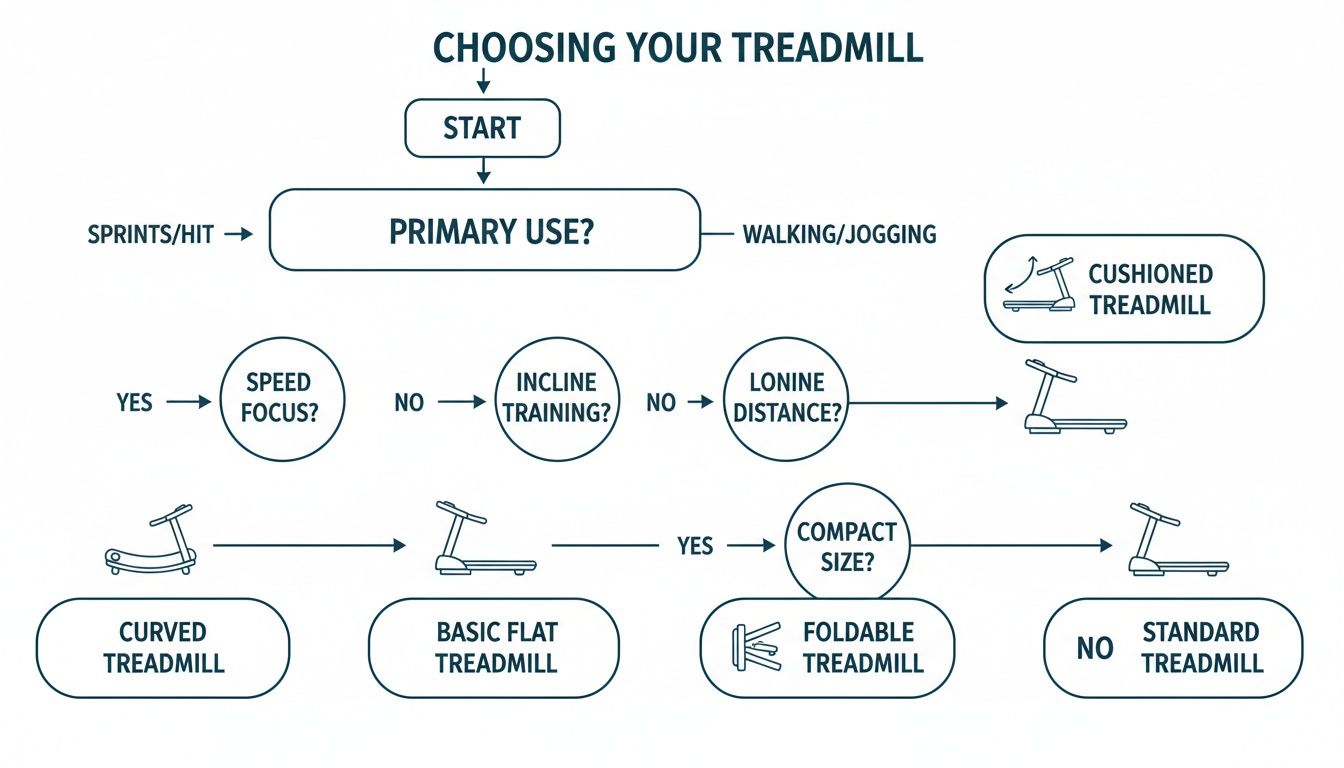
As you can see, the decision really starts with your primary goal—whether that's all-out sprints or a simple recovery walk. This choice is what points you toward either a curved or flat-belt model, each with unique health benefits.
Investing in a Modern Health Philosophy
Choosing a manual treadmill is about more than just buying a piece of equipment. It's a conscious decision to adopt a more holistic, modern approach to your health and wellness. It’s an investment that aligns with a future where user engagement, functional movement, and eco-friendly design are priorities.
By opting for a self-powered machine, you're not just improving your own fitness; you're participating in a broader movement that prioritizes personal effort, mindful movement, and long-term health over automated convenience. This philosophy is at the core of why manual treadmills are resonating so deeply with both home users and professional clinics alike.
This shift shows a clear desire for fitness tools that are as mentally engaging as they are physically effective—a sweet spot manual treadmills hit perfectly. To continue exploring modern approaches to wellness, check out our MedEq Wellness Journal.
Getting the Most Out of Your Treadmill for Years to Come
You’ve invested in a fantastic piece of equipment, and with just a little care, your manual treadmill will be a reliable partner in your health journey for a long, long time. One of its biggest health benefits is how safe it is. Since there’s no motor forcing a pace on you, the common risk of being "thrown off" by a sudden belt change is completely gone. You're the engine, so you're always in charge.
Getting started is as simple as it sounds. Just grab the handrails, start walking, and let your own movement get the belt rolling. When you’re ready to stop, you just slow down. That’s it. This self-powered design is a game-changer, especially if you're using it for careful rehabilitation where every step needs to be controlled.
Your Simple Maintenance Checklist
One of the best things about manual treadmills for running is how tough they are. No motor, no complex wiring, no electronics—that means fewer parts that can break down. A little upkeep is all it takes to keep it in prime condition.
- Wipe it Down: Give the handrails and deck a quick wipe with a clean cloth after you’re done to handle sweat and dust.
- Check the Belt: Every so often, take a look at the belt to make sure it’s centered and moving smoothly.
- Lubricate as Needed: Some models need a bit of lubrication under the belt from time to time to keep things gliding perfectly. Your owner’s manual will tell you exactly what to do.
Sample Workouts to Build Your Health and Wellness Routine
Your manual treadmill is ready for whatever you throw at it. Here are a few ideas to get you started, no matter your goal:
- HIIT Session: After a 5-minute warm-up, go all out in a sprint for 30 seconds, then recover with a 60-second walk. Repeat that cycle 8-10 times.
- Endurance Run: Settle into a rhythm you can hold comfortably for a solid 20-40 minutes.
- Workout Recovery Walk: After a heavy lifting day or intense workout, a slow 15-20 minute walk does wonders for blood flow and easing muscle soreness.
Think of your treadmill as the core of a powerful health ecosystem. A gentle recovery walk, for example, can become the active part of a contrast therapy circuit, where you move between the treadmill and a cold plunge to supercharge muscle repair. Of course, to get these long-term benefits, you need to fuel your body right. Check out the 10 Best Foods for Sustained Energy to keep your performance high.
When you bring these practices together, your treadmill becomes more than just equipment—it becomes the hub of your health. For more ideas on building out your wellness routine, head over to the MedEq Wellness Journal.
Common Questions About Manual Treadmills
Thinking about adding a self-powered treadmill to your routine? It’s a smart move for your health, but you probably have a few questions. Let's clear up some of the most common ones so you can feel confident in your decision.
Are Manual Treadmills Better for Running Than Electric Ones?
They offer a different, and in many ways, more beneficial experience for building real-world running strength and form. Because you are the engine, you're forced to fire up your glutes and hamstrings to get the belt moving. This provides significant health benefits by building functional muscle.
This self-propelled motion naturally encourages a better mid-foot strike, which can seriously reduce the joint impact that often comes with heel-striking on a motorized deck. So while an electric treadmill is great for locking in a specific pace, a manual one is where you go to refine your gait and build true, functional power for long-term joint health.
Can You Just Walk on a Manual Treadmill?
Of course. In fact, they’re fantastic for it. Manual treadmills are perfect for warm-ups, active workout recovery, or just a gentle walk. The belt only moves when you do, giving you instant, total control over your pace.
This makes them ideal for recovery days or rehabilitation. You can promote blood flow and ease muscle soreness without any pressure to keep up with a motor. It’s a great way to truly listen to what your body needs, which is a cornerstone of any effective wellness plan.
How Hard Is It to Get Used to a Curved Treadmill?
The learning curve is surprisingly short. Most people feel comfortable within the first 5-10 minutes. It's an intuitive experience—you start by walking on the lowest part of the curve to get the belt moving.
Want to speed up? Just lengthen your stride and move a little higher up the arc. To slow down, you simply drift back. The best way to get the hang of it is to start with a walk and ease into a light jog when you feel ready.
Are Manual Treadmills Noisy?
They are remarkably quiet compared to their motorized cousins. Without the constant drone of an engine, the only sounds you'll hear are the soft whir of the belt on its bearings and the sound of your own feet.
High-quality models with premium, sealed bearing systems are exceptionally quiet. This makes them a great option for home gyms or any shared space, promoting a calm environment for your wellness routine.
For more ideas on creating a complete wellness environment, check out the MedEq Wellness Journal.
At MedEq Fitness, our goal is to empower your health journey with equipment that puts you back in the driver's seat. Our hand-picked selection of manual treadmills is designed to boost your performance, speed up your workout recovery, and fit right into your wellness-focused life. See what self-powered fitness can do for you by exploring our collection at MedEq Fitness.