

Your Guide to a Hyperbaric Chamber for Home Wellness
Bringing clinic-level recovery tech into your own home was once a pipe dream. Now, a hyperbaric chamber for home use lets you take control of your healing and push your performance, all on your own time. This isn't just for elite medical centers anymore; it's a powerful tool for athletes, biohackers, and anyone serious about enhancing their health and wellness.
The New Frontier of At-Home Recovery
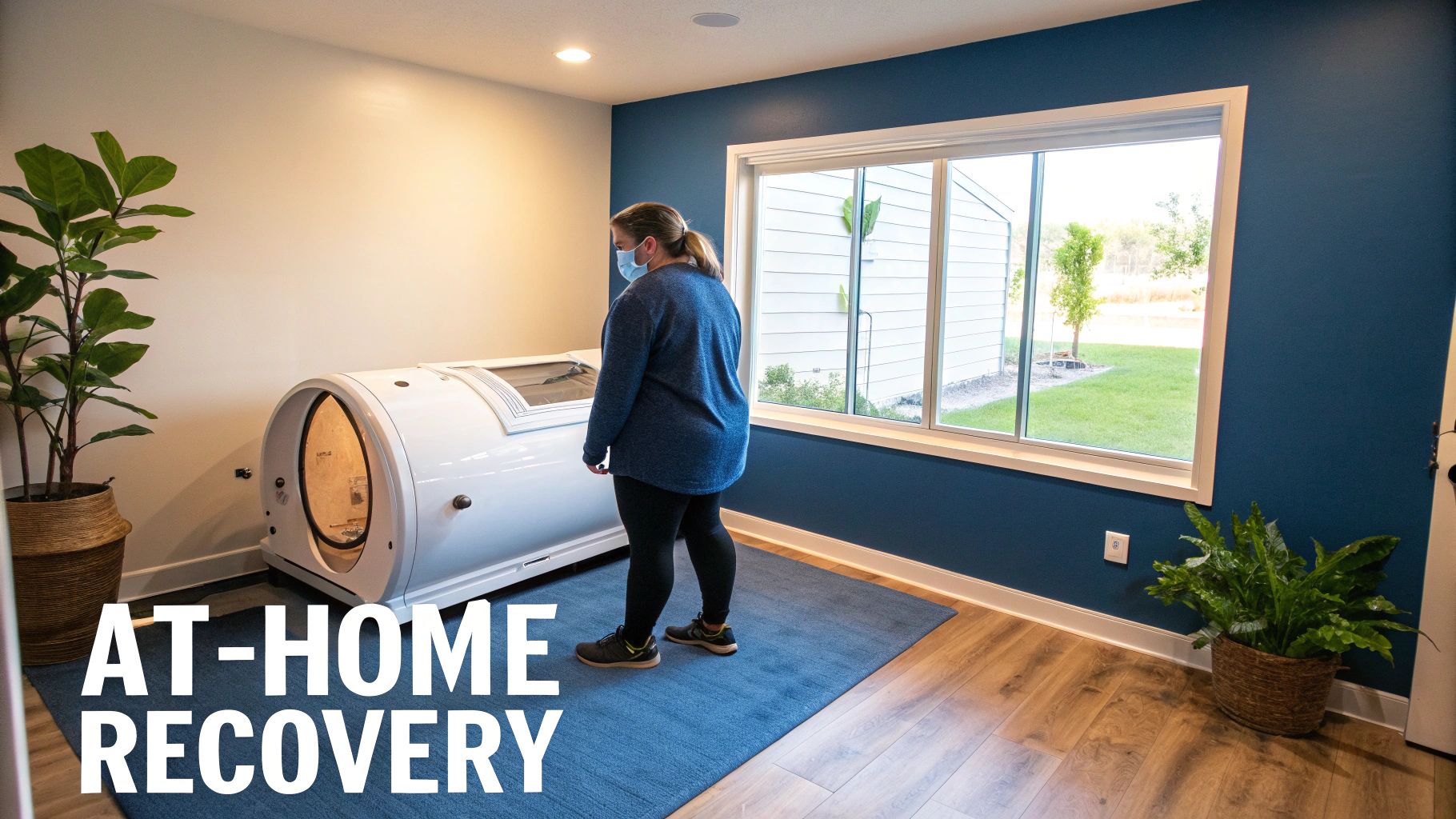
Imagine having the key to unlock your body's deepest healing potential, right in your own home. What used to require a trip to a specialized clinic is now becoming a go-to for daily wellness. A hyperbaric chamber for home use is a massive shift in how we think about recovery—moving from just fixing problems to proactively optimizing our bodies every single day.
It's more than just a piece of equipment; it's a whole new mindset. The idea behind it is incredibly simple but profoundly effective: supercharge your body's oxygen delivery. By slightly increasing the air pressure around you, these chambers help your lungs absorb way more oxygen. This extra oxygen dissolves directly into your blood plasma, creating an oxygen-rich fluid that can get to every nook and cranny of your body, fueling a wide range of health benefits, from mending sore muscles after a tough workout to sharpening your focus.
The Growing Demand for Personal Wellness
It's no secret that people are taking their health into their own hands, and the demand for at-home wellness tools is exploding. The market for home hyperbaric chambers has seen huge growth as more people see the value in having recovery tools right at their fingertips. The global market for soft-shell chambers—the kind most people use at home—was valued at USD 229 million and is expected to hit USD 331 million within the next decade. That’s some serious, consistent growth.
This is all part of a much bigger trend. People want to feel empowered about their health. It's not just about hyperbarics; other game-changing treatments like at-home IV therapy are also becoming staples for personal health management. These tools put you firmly in the driver's seat of your own well-being.
By integrating science-backed wellness tools into our daily routines, we transform our homes into sanctuaries for peak performance and longevity. The goal is to make consistent, high-level recovery an achievable part of everyday life.
Throughout this guide, we'll break down exactly how to choose, set up, and safely use a hyperbaric chamber for home to crush your specific goals. For more deep dives and guides on building out your ultimate wellness space, make sure to check out the MedEq Wellness Journal. Our whole mission is to bring clinic-quality, science-backed solutions right to your door.
How Hyperbaric Therapy Supercharges Your Body
Let’s get into the nuts and bolts of what’s happening inside a hyperbaric chamber. The easiest way to think about it is as a serious upgrade to your body's built-in repair system. When you're inside, the ambient air pressure is gently increased, which allows your lungs to take in far more oxygen than they ever could at normal sea-level pressure.
And this isn't just a tiny bump. The real magic is that this extra oxygen doesn't just ride along with your red blood cells—it actually dissolves directly into your blood plasma, lymph, and other bodily fluids. The result is what you could call "super-oxygenated" plasma.
This super-rich fluid can now journey to every corner of your body, reaching deep into tissues, joints, and even areas where blood flow might be choked off by injury or swelling. It's like dispatching a high-speed delivery service to every single cell, armed with the one element they need most for energy and repair, promoting significant health and wellness benefits.
Crushing Workout Soreness and Inflammation
If you push your body hard, you know the deal with Delayed Onset Muscle Soreness (DOMS). It's that deep, nagging ache that shows up a day or two after a killer workout, caused by tiny micro-tears in your muscle fibers and the inflammation that follows. This is where a hyperbaric chamber for home use really starts to shine for workout recovery.
That flood of oxygen you get during a session goes to work on inflammation at a cellular level. It helps your body clear out metabolic junk like lactic acid that builds up during intense exercise. By boosting circulation and saturating damaged muscle tissue with oxygen, HBOT helps your body patch up those micro-tears much faster. The bottom line? Less soreness and a quicker return to your training.
- Reduces Swelling: Increased oxygen helps constrict blood vessels, which can calm acute swelling and inflammation around an injury or overworked muscle.
- Accelerates Repair: Oxygen is a key ingredient in synthesizing collagen—the protein building block for repairing muscles, tendons, and ligaments.
- Boosts Cellular Energy: More oxygen directly feeds the mitochondria, your cellular power plants, ramping up the production of ATP, which is the pure energy currency of your cells.
This isn't just about masking pain; it’s about getting to the root of the problem by giving your body the raw materials it needs to heal itself more effectively. For anyone serious about performance, this means a massive reduction in the downtime between workouts.
The Power of Contrast Therapy
Want to take your recovery to an even higher level? Try pairing hyperbaric therapy with other wellness protocols. One of the most potent combinations is contrast therapy, which involves alternating between hot and cold treatments. This typically means spending time in an infrared sauna or hot bath, followed by a session in a cold plunge.
Adding HBOT to this routine creates an incredibly powerful wellness sequence. The cold plunge triggers vasoconstriction (your blood vessels tighten up), which helps reduce inflammation. Following that up with a hyperbaric session creates vasodilation (your blood vessels open up) and floods those same tissues with oxygenated blood, kicking the repair process into high gear.
When you combine these therapies, you create a powerful "pump" effect—pushing out metabolic waste while pulling in oxygen and nutrients. This synergy can amplify your recovery far beyond what any single therapy could do on its own.
Boosting Wellness from the Inside Out
The health benefits of having a hyperbaric chamber for home go way beyond just bouncing back from the gym. Since oxygen is essential for nearly every process in your body, improving its delivery has a ripple effect on your overall vitality and wellness.
This super-saturation of oxygen actually encourages the growth of new blood vessels (a process called angiogenesis), which improves your circulation for the long haul. Better circulation means more efficient nutrient delivery and waste removal for all your organs, supporting everything from your brain function to the health of your skin. You can dive deeper into how hyperbaric oxygen therapy works and its many benefits in the MedEq Wellness Journal.
Ultimately, consistent sessions help fortify your body's resilience, leaving you with more energy and a stronger foundation for lasting health.
Choosing Your Home Chamber: Soft vs. Hard Shell
Deciding on the right hyperbaric chamber for your home is a big step, and the first fork in the road is choosing between a soft-shell and a hard-shell model. This isn't just about looks; it fundamentally shapes your experience and determines how well the chamber aligns with your performance and wellness goals.
Think of soft-shell chambers as the go-to for athletes, biohackers, and anyone serious about daily wellness and crushing workout recovery. Made from tough, flexible materials like medical-grade TPU, they're lighter, more affordable, and can even be portable.
Hard-shell chambers, on the other hand, are the heavyweights. Built from steel and acrylic, these are the units you’d typically see in a clinic. But more and more, they’re becoming a staple in high-end home gyms for people who want the most intense experience possible.
Understanding Pressure and Performance
The real game-changer between these two types is pressure. We measure this in atmospheres absolute, or ATA. For context, the air you're breathing right now is at 1.0 ATA.
-
Soft-Shell Chambers (mHBOT): These typically run at milder pressures, usually between 1.3 ATA and 1.5 ATA. This gentle boost is fantastic for flooding your body with oxygen to fight inflammation, slash post-workout soreness, and just feel better overall. It's a significant wellness bump without the intensity of a clinical session.
-
Hard-Shell Chambers (HBOT): These are built to handle serious pressure, often hitting 2.0 ATA or even higher. This clinical-grade pressure super-saturates your blood plasma with oxygen, making it ideal for more targeted therapeutic goals and for users chasing maximum performance gains.
The market for single-person (monoplace) chambers is exploding for both home and clinical use. Why? They offer a far more comfortable and personal experience than the big, multi-person units of the past.
Portability, Space, and Long-Term Use
Your living situation and lifestyle are huge factors here. Soft-shell chambers are designed for convenience. You can set them up, take them down, and store them without a major hassle, making them perfect for smaller spaces or for anyone who might move.
A hard-shell chamber is more of a commitment—a permanent installation. They’re heavy, need more room, and aren’t going anywhere once they're assembled. This makes them a great fit for a dedicated wellness room or a serious home gym where they'll become a permanent fixture.
This decision tree helps visualize how your goals for pressure, oxygen, and recovery point you toward the right type of chamber.
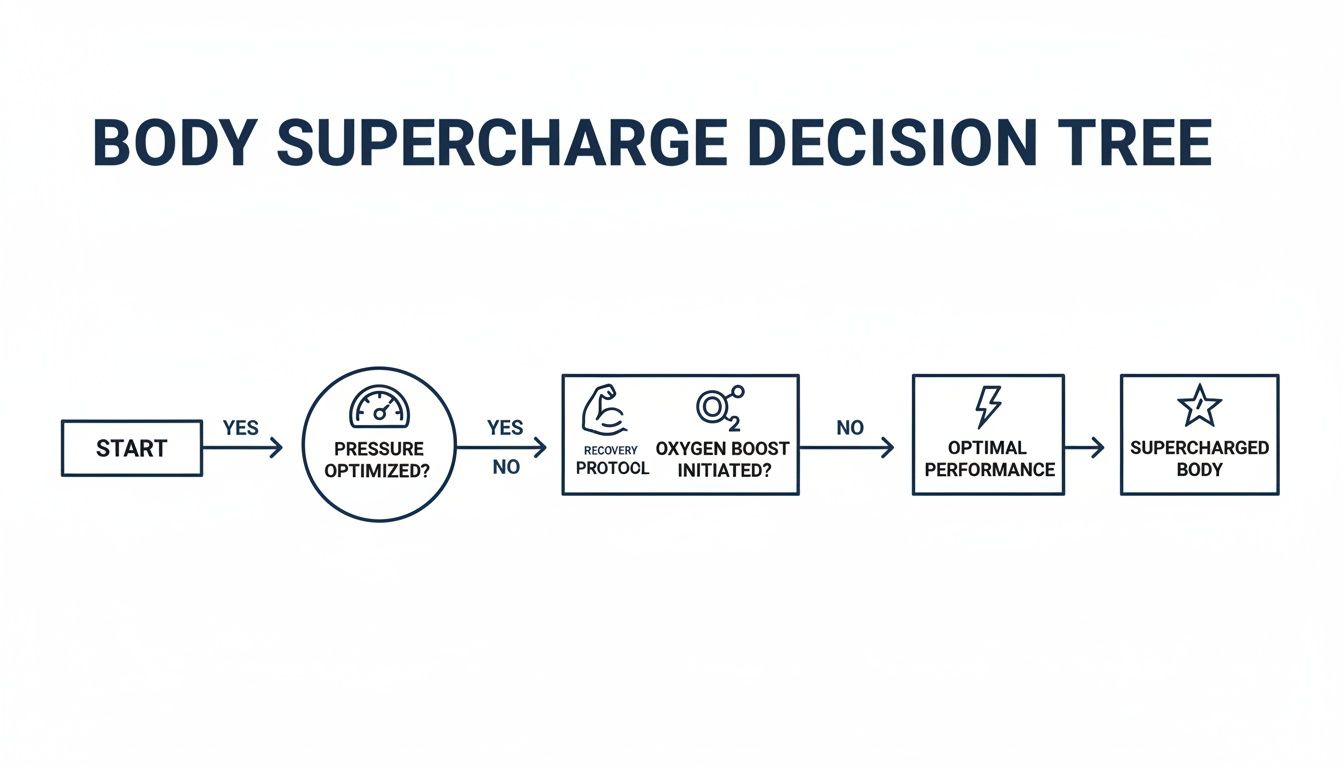
As you can see, the choice really boils down to whether you prioritize versatile, everyday recovery or high-intensity, clinical-level performance.
A New Generation of Hybrid Chambers
It used to be simple: if you wanted higher pressure, you had to get a bulky, rigid hard-shell chamber. But technology is catching up, and innovative designs are starting to blur the lines.
The next wave of home hyperbaric technology is focused on delivering higher pressures in more accessible formats. This means users no longer have to choose between convenience and clinical-grade performance.
For example, MedEq Fitness is leading the charge with groundbreaking models like the TimeCapsule VIsion 750+. A modern capsule style hard chamber with large windows at both ends and on the door for an open and comfortable experience.
Soft Shell vs Hard Shell Hyperbaric Chambers at a Glance
To make the choice even clearer, here’s a side-by-side breakdown of the two chamber types. This table cuts through the noise and lays out the core differences to help you zero in on the perfect fit for your home and your health goals.
| Feature | Soft-Shell Chamber (mHBOT) | Hard-Shell Chamber (HBOT) |
|---|---|---|
| Pressure (ATA) | Typically 1.3–1.5 ATA (with some exceptions up to 2.0 ATA) | Ranges from 1.5 ATA to 3.0 ATA or higher |
| Primary Use | General wellness, athletic recovery, anti-inflammatory | Clinical applications, serious performance enhancement |
| Materials | Flexible, durable TPU or medical-grade nylon | Rigid steel and acrylic |
| Portability | High; can be deflated, moved, and stored easily | Low; considered a permanent installation |
| Oxygen Delivery | Uses an oxygen concentrator (93-97% pure oxygen) | Uses 100% medical-grade oxygen from tanks |
| Space Required | Smaller footprint, fits in most standard rooms | Larger footprint, often requires a dedicated space |
| Cost | More affordable, lower entry point for home use | Higher initial investment, reflects clinical-grade construction |
| Ideal For | Home users, athletes, biohackers, small wellness clinics | Medical facilities, high-performance centers, dedicated home users |
| Installation | Simple, often DIY-friendly setup in under an hour | Professional installation usually required |
Ultimately, this comparison highlights the trade-offs. Soft-shells offer unmatched convenience and accessibility for powerful, everyday wellness, while hard-shells provide the highest level of pressure for those pursuing clinical-grade results at home.
Setting Up Your Wellness Sanctuary
You might be imagining a complicated, clinical-style installation, but bringing a hyperbaric chamber for home use into your space is surprisingly straightforward. The days of needing a special, dedicated room are long gone. Modern chambers are designed with simplicity in mind, letting you create a powerful recovery hub without the fuss.
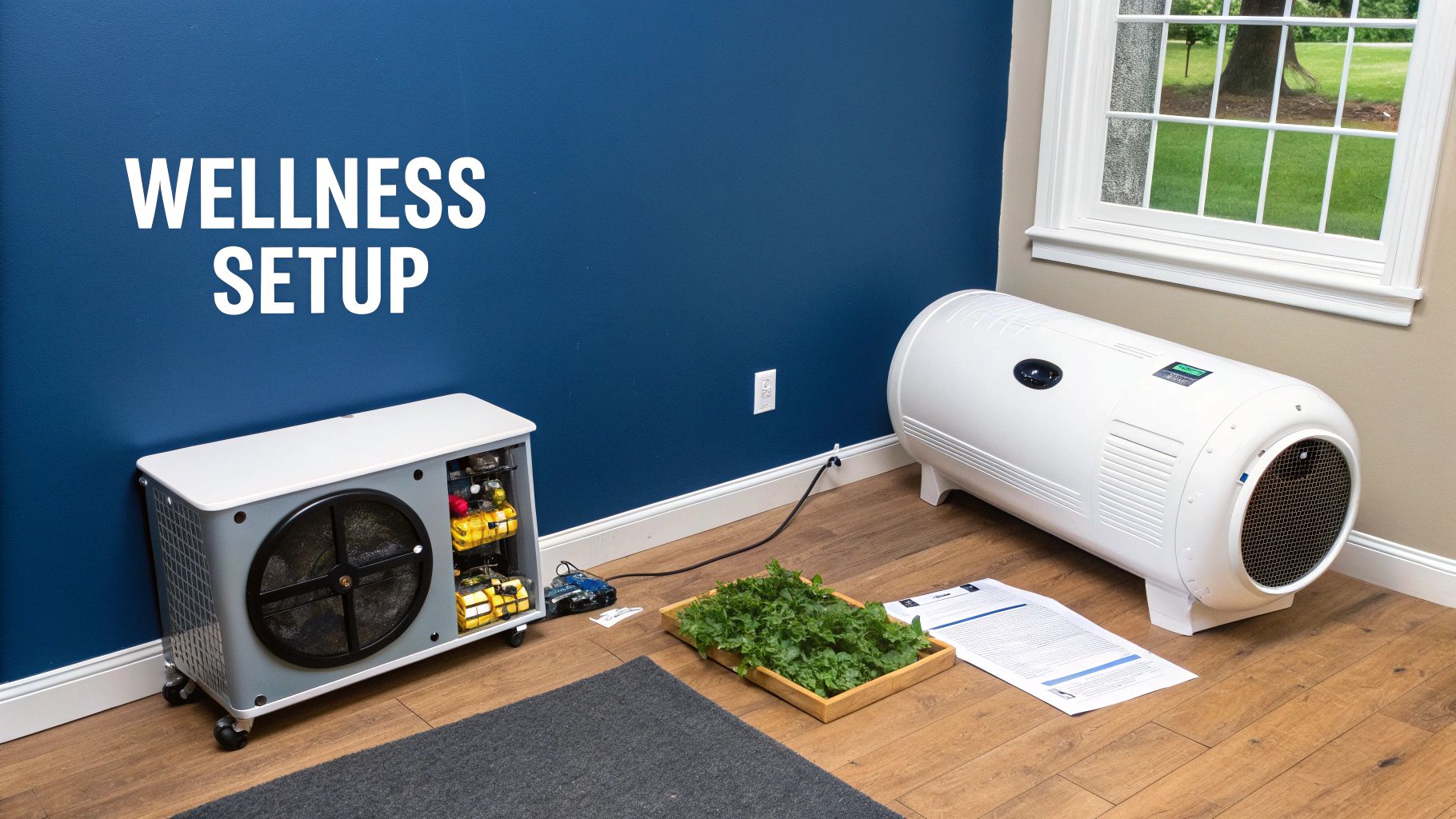
The whole process, from unboxing to your first dive, is incredibly intuitive. Most soft-shell models can be put together by one or two people in less than an hour. Just like that, a spare room or a corner of your home gym is transformed.
Planning Your Space and Power
Let's clear up one of the biggest myths right away: you don't need to rewire your house. Most people assume they'll need a special electrical setup, but that’s rarely the case.
The vast majority of home chambers, from soft-shell units to many hard-shell monoplace models, are designed to run on a standard 110V household outlet. It’s true plug-and-play convenience. If you can plug in a treadmill, you can plug in your hyperbaric chamber. No electrician needed.
As for the physical footprint, here’s what you can expect:
- Soft-Shell Chambers: These are the ultimate space-savers. They typically need about 3 feet by 7 feet of floor space—think of it as the size of a twin mattress. This makes them a perfect fit for apartments, guest rooms, or that empty corner in your workout space.
- Hard-Shell Chambers: While a bit larger, the monoplace hard-shell units are still very manageable. You'll want to plan for a space around 4 feet by 8 feet, plus a little extra clearance to get in and out comfortably.
A little planning goes a long way. If you’re figuring out how to best integrate new equipment into your home, this guide on how to build a home gym has some fantastic layout tips.
Understanding the Components and Operation
Your hyperbaric system really only has a few key parts: the chamber itself, an air compressor to pressurize the inside, and an oxygen source. For the oxygen supply, many users pair their chamber with a device like the Rhythm Toc3 Transportable Oxygen Concentrator, which simply pulls ambient air from the room and delivers a purified, concentrated stream of oxygen.
Noise is another common worry, but modern compressors are surprisingly quiet. The sound is usually described as a gentle hum, similar to a high-end air purifier. It easily fades into the background, so your sessions can be peaceful and meditative.
Creating a true wellness sanctuary is about more than just the equipment; it's about crafting an environment that promotes calm and restoration. The quiet, non-disruptive design of today’s home hyperbaric systems is central to that experience.
Keeping your chamber in top shape is also a breeze. Routine maintenance is minimal, usually just wiping down the interior after a session and checking the filters on your compressor and oxygen concentrator every so often. This simple care routine ensures your chamber remains a clean, safe, and effective recovery tool for years. For more tips on creating your ideal health space, visit the MedEq Wellness Journal.
Safe and Effective Home Hyperbaric Sessions
Bringing a hyperbaric chamber for home use into your routine is an incredible step, and your safety is what makes the technology truly effective. Think of it like learning any new skill—mastering a few fundamentals is the key to unlocking its full potential.
The first and most important technique is learning how to equalize your ears. If you’ve ever felt that pressure change on an airplane, you know exactly what this feels like. As the chamber gently pressurizes, that same sensation of fullness is completely normal.
You can easily manage it by swallowing, yawning, or pinching your nose and gently blowing (this is called the Valsalva maneuver). Getting this right from the start ensures every session is smooth and comfortable.
Crafting Your Personal Session Protocol
Once you’ve got the basics down, you can start tailoring your sessions to your goals. Whether you’re chasing faster post-workout recovery or simply want to boost your overall vitality, your "dive" duration and frequency are your main dials to turn. There’s no single magic formula, but some solid guidelines will get you started on the right foot.
For general wellness and athletic recovery, most people find their sweet spot with sessions lasting 60 to 90 minutes. When you're just starting, it's wise to ease into it. Begin with shorter sessions, maybe 45-60 minutes, just to let your body get used to the new environment.
- For Workout Recovery: Try using the chamber on training or competition days. It's a fantastic way to help calm inflammation and give your muscles the oxygen they need to repair.
- For General Wellness: A consistent schedule of 3-5 sessions per week is a popular and effective protocol for supporting energy and long-term vitality.
Remember, consistency beats intensity every time. Regular, comfortable sessions will deliver far better results than pushing for longer dives before you’re ready. And of course, always check the manufacturer’s guide for your specific model.
Understanding Important Contraindications
While home hyperbaric therapy is remarkably safe, it’s not for everyone. Certain pre-existing health conditions, known as contraindications, mean that HBOT should be avoided. Knowing what they are is non-negotiable for your safety.
A responsible wellness journey begins with understanding your own health landscape. Being aware of contraindications is a non-negotiable step to ensure every hyperbaric session is both safe and beneficial.
The biggest one is an untreated pneumothorax, which is a collapsed lung. Other conditions that require a doctor's green light include chronic sinus issues, certain lung diseases like COPD, or even just having a high fever.
This is exactly why we always recommend a consultation with your healthcare provider before you begin. They can look at your personal health history and give you the confidence that a hyperbaric chamber for home use is a great choice for you.
For more deep dives into building a powerful wellness routine, check out our articles on the MedEq Wellness Journal.
The Real Cost and Return on Your Wellness
Think of a hyperbaric chamber for home use less like a purchase and more like an investment in your health and performance. The price tag is just the starting point; the real value lies in what you get back day after day.
It's about the return on your wellness. That return shows up as deeper sleep, quicker bounce-back after workouts, and a sharper mind. This isn't just about dollars and cents—it's about upgrading your daily life.
The Initial Investment: What Are You Paying For?
The price of a home hyperbaric chamber really comes down to two things: how much pressure it can generate and what it’s made of.
- Soft-Shell Chambers: These are a fantastic entry point, usually running between $5,000 and $15,000. They deliver pressures from 1.3 to 1.5 ATA, which is ideal for general wellness goals like reducing inflammation and speeding up recovery from exercise.
- Hard-Shell Chambers: As you move into clinical-grade units, you’re looking at a bigger investment—anywhere from $20,000 to over $100,000. These chambers push pressures up to 2.0 ATA and beyond, designed for those who need the most powerful therapeutic effects.
When you buy a chamber, you're not just buying the shell. You're paying for serious engineering, crucial safety certifications, and durable materials that can handle consistent pressure, session after session.
Doing the Math on Your Wellness Return
The true value of owning a chamber clicks into place when you compare the one-time cost to what you’d spend at a local wellness clinic. A single session out-of-pocket can easily set you back $150 to $400.
Let's say you do a standard 20-session protocol. At a clinic, you're looking at a bill of $3,000 to $8,000. Over a year of consistent use, that number could balloon into the tens of thousands. And that's before you even factor in the time spent booking appointments, driving across town, and sitting in a waiting room.
Owning your own chamber flips the script. Recovery stops being a chore you have to schedule and becomes a seamless part of your day. The freedom to hop in after a brutal workout or before a high-stakes meeting is an advantage you can't put a price on.
Think about the long-term impact of that convenience. Instead of waiting until you’re already sore or burned out to seek treatment, you can use your chamber proactively to keep inflammation at bay and your energy topped off. That shift from reactive care to proactive wellness is where the real ROI is found.
For a deeper look at budgeting for your health and exploring financing, check out the MedEq Wellness Journal. We've put together resources to help you make smart, informed decisions on your wellness journey.
Here are the most common questions we get about bringing a hyperbaric chamber home. We'll give you clear, straight-to-the-point answers so you have everything you need to make the right call for your health.
Think of this as your final checklist. It’s all about making sure you can bring this incredible recovery tool into your life safely, effectively, and with total confidence.
How Long Is a Typical Session?
For general wellness and athletic recovery, most sessions last between 60 and 90 minutes. When you're just starting out, it's a good idea to ease into it with shorter sessions—maybe 45 to 60 minutes—to let your body get used to the feeling.
Remember, consistency is what drives results. A solid routine for most people is 3-5 sessions a week. This frequency helps keep inflammation down and gives your cells the steady support they need to repair and rebuild. Of course, always stick to the guidelines for your specific model.
What Does It Actually Feel Like Inside?
Most people find it incredibly relaxing. As the chamber pressurizes, you'll feel a bit of fullness in your ears, a lot like the feeling you get when a plane is taking off. That's totally normal. Swallowing, yawning, or gently pinching your nose and blowing will clear it right up.
Once you’re at pressure, the sensation disappears completely. You’re free to read, meditate, listen to music, or just zone out. Our chambers are built with clear windows and run quietly, so the whole experience feels less like a treatment and more like a private retreat.
Do I Need a Prescription to Buy One?
Yes. In the U.S., the FDA classifies hyperbaric chambers as Class II medical devices, which means you'll need a prescription from a licensed healthcare provider to purchase one.
This isn’t just a hoop to jump through—it’s an important safety check. It ensures a professional has confirmed that hyperbaric oxygen therapy is a good and safe fit for you. We help guide our customers through this simple process to make sure everything is smooth, compliant, and easy.
Can I Stack HBOT with Other Therapies?
Absolutely. Hyperbaric therapy is a fantastic team player in any wellness routine. It works incredibly well with other modalities, creating a powerful synergy that takes your recovery to another level.
By stacking therapies, you’re creating a dynamic environment for healing. The oxygenating effect of HBOT can amplify the benefits of other practices, delivering results that are far greater than what any single therapy could achieve on its own.
A popular combination is using it with a cold plunge as part of a contrast therapy routine. The cold brings down inflammation, and the hyperbaric session immediately afterward floods those same tissues with oxygen to supercharge the repair process. It also pairs perfectly with red light therapy and infrared saunas. We dive deep into these advanced wellness stacks over at the MedEq Wellness Journal.
At MedEq Fitness, we're here to equip you with proven, science-backed wellness tools to unlock your highest potential. Take a look at our collection of home hyperbaric chambers and take the next step in mastering your recovery.


