

Hyperbaric Oxygen Therapy: A Guide to Health, Wellness, and Recovery
What if you could give your body's healing powers a serious upgrade? That’s the simple idea behind hyperbaric oxygen therapy (HBOT). It’s a fascinating wellness process that uses increased atmospheric pressure and highly concentrated oxygen to super-saturate your body’s tissues, accelerating workout recovery and boosting overall health.
For more wellness insights, visit our blog: https://medeqfitness.com/blogs/medeq-wellness-journal
How Hyperbaric Oxygen Therapy Supercharges Healing
At its core, HBOT is a way to dramatically increase the amount of oxygen your blood can carry. In normal life, the air we breathe is only about 21% oxygen, and our red blood cells do all the heavy lifting to transport it. HBOT completely changes that game.
It works by having you relax in a pressurized chamber while breathing nearly pure oxygen. Think of it like trying to dissolve sugar in a glass of water. You can only stir in so much before it stops dissolving. But what if you could increase the pressure on that water? You could force much more sugar to dissolve directly into the liquid.
HBOT does the same thing with oxygen in your body. The increased pressure allows your lungs to gather up to 15 times more oxygen than they normally could. This isn't just a small boost; it's a fundamental shift in your body's ability to heal and perform.
Flooding Your Tissues With Oxygen
This extra oxygen doesn't just hitch a ride on red blood cells. It dissolves directly into all of your body's fluids—your blood plasma, lymph, and even the fluids surrounding your brain and spinal cord.
This oxygen-rich plasma is the real game-changer. It can bypass circulatory restrictions and reach areas of injury or inflammation that your blood supply might struggle to get to. Once it arrives, this flood of oxygen fuels the healing process on a cellular level, enhancing your overall wellness.
By delivering a surplus of oxygen deep into the body's tissues, HBOT provides the essential fuel that cells need to repair damage, fight infection, and reduce inflammation, effectively kickstarting the body's own regenerative processes.
This enhanced oxygen delivery is critical for cellular energy production. It directly supports your mitochondria, the powerhouses inside your cells. You can dive deeper into how this works in our article on improving mitochondrial health.
This simple diagram breaks down how pressure and oxygen work together to unlock the body's healing potential.
As you can see, it's the combination of controlled pressure and concentrated oxygen that makes all the difference. The therapy’s real power isn’t just about providing more oxygen, but in using pressure to deliver it far more effectively than your body ever could on its own.
Let's break down exactly what's happening at a physiological level. The table below summarizes the core mechanism and its effects.
How HBOT Unlocks Your Body's Healing Potential
| Concept | Description |
|---|---|
| Increased Pressure | The pressure inside the chamber is raised to between 1.5 and 2.0 times normal atmospheric pressure. |
| Concentrated Oxygen | You breathe 90-97% pure oxygen, compared to the 21% in normal air. |
| Gas Laws at Work | Henry's Law dictates that more oxygen gas will dissolve into the blood plasma under higher pressure. |
| Super-Oxygenation | This process saturates your blood plasma and tissues with up to 15 times the normal amount of oxygen. |
| Enhanced Delivery | Oxygen-rich plasma can travel past circulatory blockages to reach damaged or oxygen-starved tissues. |
| Cellular Fuel | This massive oxygen surplus provides the essential energy cells need for repair, regeneration, and fighting infection. |
This elegant process triggers a cascade of powerful health and wellness benefits deep within the body.
The Science of Cellular Repair
So, what does all this extra oxygen actually do? It triggers a number of powerful biological responses grounded in basic physiology:
- Stimulates New Blood Vessel Growth: Over time, HBOT encourages the formation of new capillaries (a process called angiogenesis), which is crucial for restoring blood flow to damaged tissues.
- Reduces Swelling and Inflammation: High oxygen levels cause blood vessels to constrict slightly, which helps reduce swelling and edema without starving the area of the oxygen it needs to heal.
- Enhances Immune Function: The therapy supercharges your white blood cells, making them far more effective at killing bacteria and fighting off infection.
- Promotes Stem Cell Mobilization: Research shows HBOT can significantly increase the number of circulating stem cells—the body's master repair cells—which are essential for regenerating damaged tissue.
Ultimately, hyperbaric oxygen therapy isn't about adding a foreign substance or a new drug. It’s about amplifying one of the body’s most critical resources—oxygen—to create the perfect internal environment for healing to happen faster and more completely.
The Surprising History of Pressurized Healing
Hyperbaric oxygen therapy might feel like a cutting-edge wellness tool, but its roots go back way further than you'd think—centuries, in fact. This isn't some new fad. The idea of using pressure to heal has a long, fascinating history of scientific curiosity and validation, giving it a level of credibility that newer trends just don't have. The journey of HBOT actually started before we even knew what oxygen was.

It all began back in 1662 with a British physician named Nathaniel Henshaw. He built the very first pressurized chamber, a massive 15-by-15-foot structure he called the 'Domicilium.' Amazingly, it could reach pressures between 2 to 4 atmospheres—that's more powerful than many of today's mild chambers.
Henshaw used this chamber to treat lung and digestive issues by switching between high and low pressures. He was a true pioneer, working more than a hundred years before oxygen was even officially discovered. You can dig deeper into this incredible backstory and the full history of hyperbaric oxygen therapy.
From Caissons to Clinical Use
For almost two hundred years, the concept of pressurized therapy was mostly forgotten. It took the Industrial Revolution to bring it roaring back, not for health, but out of necessity for worker safety. During the 19th century, engineers were building bridge foundations underwater inside huge, pressurized chambers called caissons.
Workers coming out of these caissons often suffered from a strange, debilitating illness with severe joint pain and paralysis. They gave it a grim nickname: "the bends." It didn't take long to figure out that putting the workers back into a pressurized environment made the symptoms disappear. This discovery led directly to the first recompression chambers, built specifically to treat what we now call decompression sickness.
This was the first time hyperbaric therapy was used on a large scale. Treating divers and tunnel workers proved that changing atmospheric pressure could produce powerful physiological effects and solve a life-or-death medical problem.
The Modern Era of HBOT
The 20th century is when hyperbaric oxygen therapy really came into its own and became a staple of mainstream medicine. The game-changing moment was when researchers started combining high pressure with breathing pure oxygen. That's what unlocked the therapy's true healing potential.
A few key moments really pushed it forward:
- The 1930s: A Brazilian doctor, Álvaro Osório de Almeida, published groundbreaking research on how high-pressure oxygen affected a wide range of diseases.
- The 1950s: Dr. Ite Boerema, a Dutch surgeon, performed a now-famous cardiac surgery inside a large hyperbaric chamber, proving its value in critical medical situations.
- The 1960s: The Undersea and Hyperbaric Medical Society was founded. This was huge, as it established official protocols and safety standards that made HBOT a legitimate medical specialty.
From Henshaw’s early experiments to its crucial role in diving medicine, the history of HBOT is a story of persistent scientific drive. It shows that using pressure and oxygen to kickstart the body's own healing mechanisms is a powerful and well-established concept. To see more on today's leading wellness tech, check out our MedEq Wellness Journal.
What HBOT Actually Does for Your Health and Wellness
Flooding your body with concentrated oxygen doesn't just give you a temporary boost—it triggers powerful, system-wide health benefits. Think of it as creating the perfect internal environment for your body to repair, regenerate, and defend itself far more efficiently than it could on its own.
One of the most profound health benefits is angiogenesis, which is just a technical term for the creation of new blood vessels. After an injury or in areas affected by disease, blood flow is often choked off, starving tissues of the oxygen they desperately need. HBOT systematically encourages the growth of new capillaries, essentially rebuilding the supply lines for nutrients and waste removal. This is the foundation of true, long-term healing.
This goes hand-in-hand with its ability to dial down chronic inflammation. While a little inflammation is a normal part of healing, the chronic kind causes ongoing pain and tissue breakdown. The high-oxygen environment created during an HBOT session helps calm this overactive response, providing relief and letting your body's repair crews get to work without interference.
From Clinical Powerhouse to Wellness Staple
In the medical world, hyperbaric oxygen therapy isn't a fringe idea—it’s a proven, FDA-approved treatment for serious conditions where poor circulation is the core problem. Its effectiveness isn't based on anecdotes; it's backed by decades of hard science and real-world clinical use.
Since the 1960s, HBOT has been put through its paces in over 10,000 clinical trials and studies, with the vast majority showing positive results. Take diabetic foot ulcers, which tragically lead to around 185,000 amputations each year in the US alone. HBOT can increase healing rates by 25-35% and slash amputations by 15-20%. It’s also a game-changer for chronic bone infections (osteomyelitis), achieving an 85% remission rate, and for radiation-damaged tissue, where it improves outcomes in 70-90% of patients. You can dive deeper into these findings in these comprehensive HBOT benefit reviews.
These powerful medical applications show just how effective HBOT is at its core mission: healing damaged tissue. Now, that same fundamental mechanism is being embraced in the wellness world for proactive health and performance.
Sharpening Your Mind and Fighting Off Fatigue
The health benefits aren't just physical. Your brain is an energy hog, devouring roughly 20% of your body's oxygen even when you're resting. By delivering a huge oxygen surplus, HBOT helps sharpen cognitive functions like memory, focus, and overall mental clarity.
This oxygen surge also directly fuels your mitochondria—the tiny power plants in every single cell. More oxygen means more ATP, which is the body's main energy currency. The result? A noticeable drop in fatigue and a real increase in vitality. It’s a powerful wellness tool for anyone looking to cut through brain fog and perform at their best.
By boosting oxygen to the brain and powering up cellular energy, HBOT helps sharpen cognitive performance while fighting the drain of mental and physical fatigue.
This makes it an incredible asset for professionals, students, or anyone dealing with high stress who needs to stay on top of their game.
A Modern Take on Anti-Aging and Cellular Repair
The conversation around "anti-aging" is shifting away from surface-level fixes and toward true cellular health and wellness. HBOT is right at the center of that shift. At its core, aging is the accumulation of cellular damage over time. By kickstarting a robust repair process, HBOT directly addresses this.
Here’s how it works on a cellular level:
- Stimulates Collagen Production: More oxygen helps your body synthesize collagen, the protein that gives skin its elasticity and strength.
- Mobilizes Stem Cells: Studies show HBOT significantly increases the number of circulating stem cells. These are your body's master repair cells, ready to regenerate damaged tissue anywhere they're needed.
- Reduces Oxidative Stress: It might seem backward, but regular HBOT sessions actually upregulate your body's own antioxidant defenses, helping it neutralize damaging free radicals more effectively over the long run.
By supporting your body at the most fundamental level, HBOT offers a proactive strategy for maintaining health and resilience as you age. For more on cutting-edge wellness, check out the articles on the MedEq Wellness Journal.
Gaining a Competitive Edge with Faster Workout Recovery
Every serious athlete knows the real secret isn't just how hard you train, but how well you recover. You're constantly breaking down muscle tissue to rebuild it stronger, but the time it takes to bounce back is always the biggest roadblock. This is where hyperbaric oxygen therapy comes in, giving you a serious upper hand by hitting fast-forward on the entire workout recovery cycle.
When you push your body to its limits, you’re creating micro-tears in your muscles and flooding your system with metabolic junk like lactic acid. That’s what causes the delayed onset muscle soreness (DOMS) we all know and love—or hate—along with the inflammation and fatigue that can sideline you. HBOT tackles this head-on by flooding your body with oxygen, creating the perfect internal environment for your body to get to work and repair itself.
This massive influx of oxygen supercharges your body's natural healing processes. It helps mend those micro-tears, drives down swelling, and clears out the waste products that make you feel sore and sluggish. The result? You spend less time on the couch and more time training harder and more often.
The Synergy of HBOT and Modern Recovery Stacks
Today’s elite performers don’t just rely on one thing for recovery. They build what’s called a "recovery stack"—a smart combination of different tools that work together to create an effect far greater than any single therapy could achieve on its own. Hyperbaric oxygen therapy slides perfectly into this strategy, boosting the benefits of other popular methods.
One of the most powerful pairings is HBOT and contrast therapy, which involves switching between hot and cold environments, like a sauna and an ice bath. The idea is that the cold constricts your blood vessels and the heat dilates them, creating a natural "pumping" action that flushes out inflammation and metabolic waste accumulated during a tough workout.
When you throw HBOT into that mix, you’re taking your workout recovery to a whole new level.
First, you use contrast therapy to open up your circulation and clear out inflammation. Then, you follow it up with a hyperbaric session that delivers its super-oxygenated payload to your tired muscles with maximum efficiency. It's a powerful one-two punch for superior workout recovery.
Combining Therapies for Optimal Performance
So what does this look like in the real world? Let’s say you just finished a monster leg day. The damage is done, and the inflammation is already kicking in. Here’s how you could stack your recovery:
- Step 1: Ice Bath (Cold Therapy): Right after your workout, jump into a cold plunge. This will constrict your blood vessels, helping to knock down that initial wave of inflammation and numb the immediate soreness.
- Step 2: Sauna (Heat Therapy): After you’ve cooled down, a sauna session will do the opposite, dilating your blood vessels to ramp up blood flow. This helps carry away waste products and deliver the first round of nutrients for repair.
- Step 3: HBOT (Oxygen Therapy): Finally, a session in the hyperbaric chamber saturates all that fresh, circulating blood with oxygen. You’re essentially giving your cells the premium fuel they need for repair and regeneration.
This kind of stacked protocol does more than just make you feel less sore; it actively speeds up the biological processes that rebuild muscle. For any athlete looking to get the most out of their body, understanding the specific hyperbaric chamber benefits for athletes is a critical part of building a workout recovery strategy that actually works.
Choosing the Right HBOT Chamber for Your Goals
So you're ready to dive into hyperbaric oxygen therapy. The next big question is: which chamber is right for you? It's a critical decision, because not all chambers are built the same. The best choice really boils down to your specific goals, whether they're clinical, athletic, or for general wellness.
You'll quickly find there are two main players in the game: hard-shell chambers and soft-shell chambers. They look different, operate at different pressures, and are designed for entirely different purposes. Let's break down what separates them.
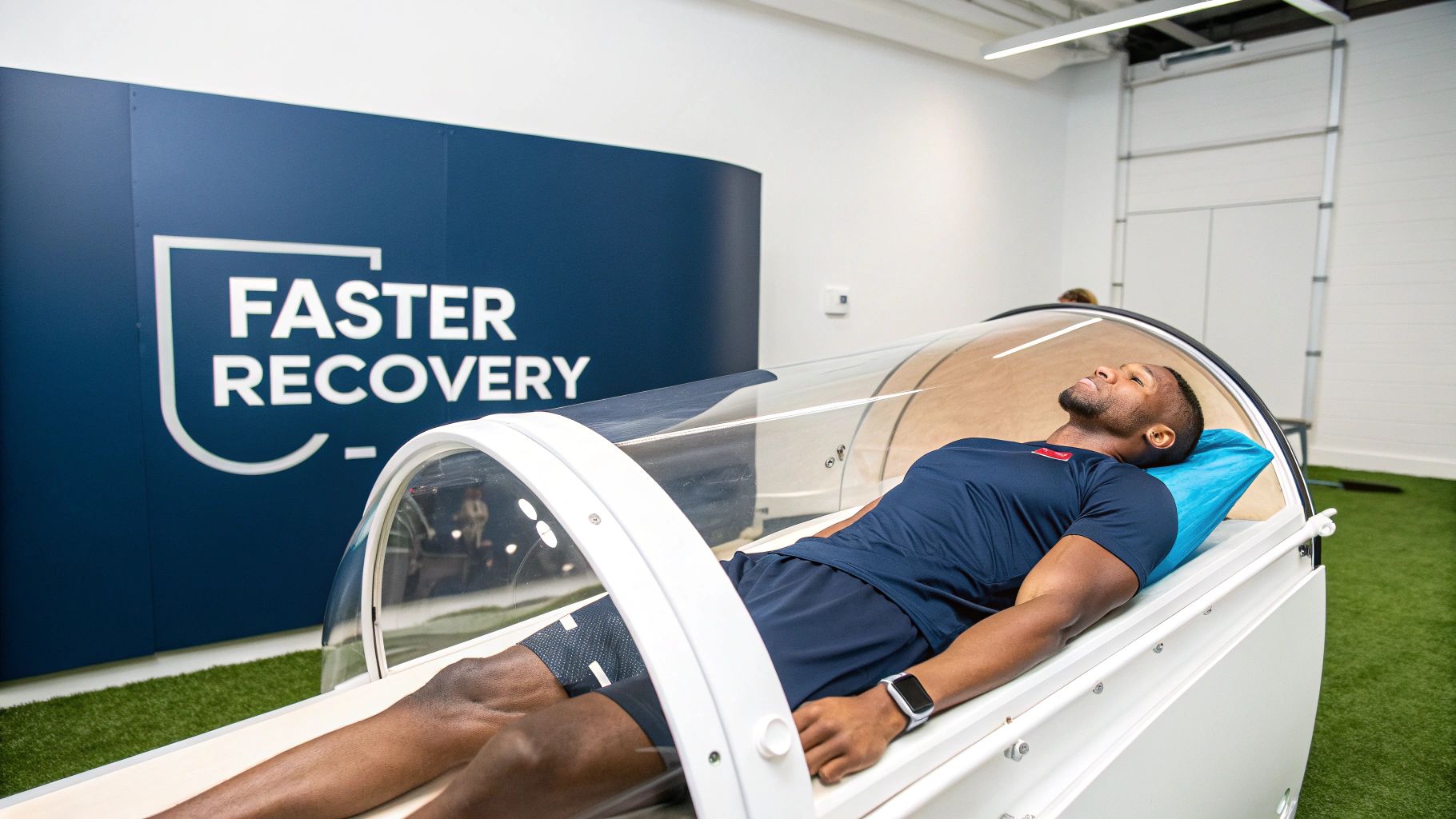
High-Pressure Hard-Shell Chambers
Think of hard-shell chambers as the heavy-duty, clinical workhorses of the HBOT world. Made from tough materials like steel and acrylic, these are the medical-grade units you'll see in hospitals and specialized treatment centers.
Their biggest advantage is their ability to reach much higher atmospheric pressures, safely operating at 2.0 ATA (atmospheres absolute) or even more. This isn't just a nice-to-have feature; it's a requirement for all 14 FDA-approved medical treatments, including healing diabetic wounds, treating radiation injuries, and reversing carbon monoxide poisoning.
Because they're built to strict medical standards, these chambers are a serious investment. But their robust construction is what allows them to deliver the powerful, high-pressure protocols needed for serious medical conditions.
Mild-Pressure Soft-Shell Chambers
On the other end of the spectrum, we have soft-shell chambers. These have been a game-changer, making hyperbaric oxygen therapy far more accessible for home use and general wellness. Often called "mild hyperbaric chambers," they are inflatable units constructed from durable, yet flexible, materials like polyurethane.
The key difference is their operating pressure, which is quite a bit lower. Soft-shell chambers typically top out between 1.3 ATA and 1.5 ATA. While this "mild" pressure isn't enough for those FDA-approved medical treatments, it's perfect for wellness applications like accelerating athletic recovery, reducing inflammation, and sharpening mental focus.
The lower pressure and more approachable cost have made soft-shell chambers the go-to choice for wellness centers, athletic facilities, and people who want the benefits of HBOT at home.
They are portable, much easier to set up, and come at a price point that opens the door for so many more people. If you're curious about what it takes to get one in your own space, our guide on the hyperbaric chamber for home use has all the details.
Hard Shell vs Soft Shell Which Hyperbaric Chamber Is for You
To really see the differences side-by-side, this table should make your decision a lot clearer. It’s a straightforward comparison to help you match a chamber to your specific needs, whether you're a clinic owner, athlete, or just focused on your personal health journey.
| Feature | Hard-Shell Chamber | Soft-Shell Chamber |
|---|---|---|
| Pressure Level | High pressure, typically 2.0 ATA or more. | Mild pressure, typically 1.3 ATA to 1.5 ATA. |
| Primary Use | FDA-approved medical treatments in hospitals & clinics. | Wellness, athletic recovery, and home use. |
| Materials | Rigid steel and acrylic construction. | Flexible, inflatable materials like polyurethane. |
| Oxygen Delivery | Uses 100% medical-grade oxygen from tanks. | Uses an oxygen concentrator to deliver up to 95% oxygen. |
| Cost | High initial investment ($20,000+). | More affordable ($5,000 - $15,000). |
| Portability | Stationary and requires professional installation. | Portable and relatively easy to set up and move. |
At the end of the day, the right chamber is the one that fits your purpose. For treating serious, approved medical conditions, a hard-shell chamber is non-negotiable. But for boosting workout recovery, enhancing wellness, and getting a performance edge, a soft-shell chamber is an incredibly effective and accessible tool.
What to Expect During Your HBOT Session
So, you're considering your first hyperbaric session. It’s natural to feel a bit curious, maybe even a little apprehensive, but the whole experience is actually quite straightforward and relaxing. Knowing what happens step-by-step can help you walk into your first treatment feeling confident and ready to focus on your wellness goals.
Your session starts when you get comfortable inside the chamber. Once you're settled, the door is sealed, and the pressurization process begins. The very first thing you'll likely notice is a feeling of fullness in your ears—it’s the exact same sensation you get when a plane descends for landing. This is completely normal and the most common thing people experience with hyperbaric oxygen therapy.
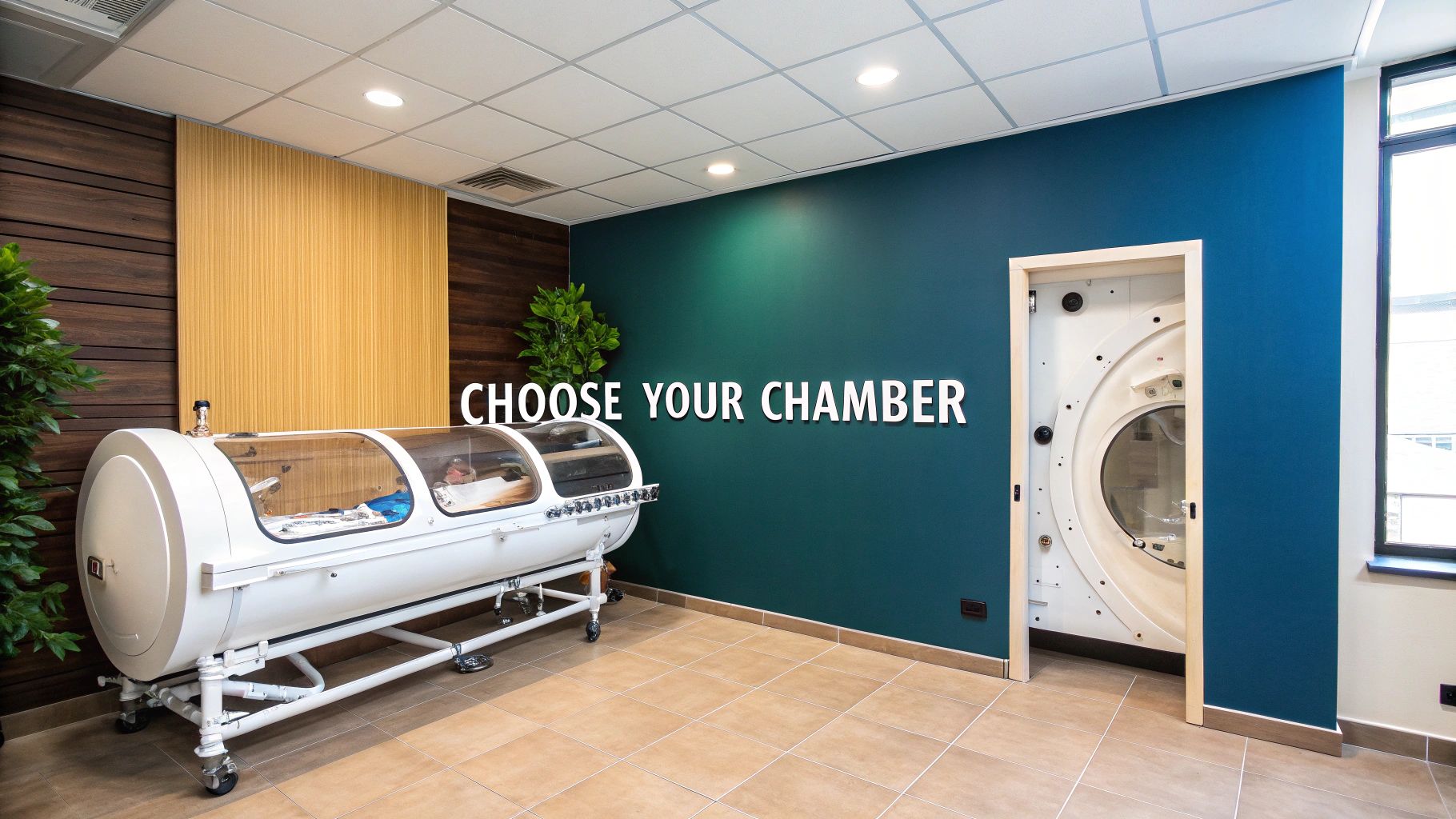
Managing Ear Pressure Comfortably
That ear-popping sensation is just your eardrums responding to the change in air pressure. Your session operator will be right there to guide you through a few simple tricks to keep you comfortable. Most people find these work perfectly:
- Swallowing: Keep a bottle of water handy and take small sips.
- Yawning: A big, wide yawn is a surprisingly effective way to open your Eustachian tubes.
- The "Scuba" Trick: Gently pinch your nose and blow out softly, just like you would to clear your ears on a flight.
This feeling only lasts for the first few minutes as the chamber pressurizes and then again at the end when it depressurizes. Once you're at the target pressure, the sensation vanishes completely. You can then just lie back and relax for the rest of the session, which usually lasts between 60 to 90 minutes.
Important Safety Considerations
While HBOT is overwhelmingly safe, it isn't the right fit for everyone. Being upfront about contraindications is key to making sure your experience is both positive and safe. It's absolutely vital to go over your full medical history with your provider before you start.
The most significant contraindications for hyperbaric oxygen therapy involve certain lung conditions. Because the therapy works by changing air pressure, a history of a collapsed lung (pneumothorax) or the presence of specific lung blebs can pose a serious risk.
Other conditions that need careful review include severe claustrophobia, recent ear or sinus surgery, or taking certain types of chemotherapy drugs. An honest conversation with a qualified professional is always the best path forward. Understanding both the process and the precautions will help you confidently decide if HBOT is the right choice for your wellness journey.
For more insights into cutting-edge wellness tools and therapies, feel free to explore our MedEq Wellness Journal.
Your HBOT Questions, Answered
Diving into hyperbaric oxygen therapy naturally brings up a few questions. Let's tackle some of the most common ones that come up for athletes, wellness enthusiasts, and anyone looking to optimize their health.
How Many HBOT Sessions Do I Really Need?
There’s no one-size-fits-all answer, as the ideal number of sessions really depends on what you want to achieve.
For general wellness or to kickstart a health goal, many people start with a block of 10 to 20 sessions. Stacking them close together helps fully saturate your tissues with oxygen, creating a powerful, lasting effect.
If you're an athlete focused on workout recovery, your approach can be a bit more fluid. Some use HBOT on an as-needed basis—say, after a major competition or a killer training week. Others build one or two sessions into their weekly routine to consistently keep soreness at bay and speed up muscle repair.
What Does It Actually Feel Like Inside The Chamber?
It’s surprisingly calm and painless. As the chamber pressurizes, you'll feel a fullness in your ears, a lot like the sensation during takeoff or landing in an airplane. It's a temporary feeling that only lasts for the first few minutes.
Once you're at the target pressure, that sensation vanishes. From there, you just lie back and breathe normally. It’s a great opportunity to relax, meditate, listen to music, or even catch a quick nap while your body gets to work.
The experience inside a hyperbaric chamber is generally serene. Apart from the initial pressure change, the session is quiet and comfortable, providing an opportunity for deep relaxation while your body is hard at work repairing itself.
Is Hyperbaric Oxygen Therapy Safe?
Absolutely. When managed by trained professionals, HBOT has a fantastic safety profile. The most common side effect is that mild ear pressure, which is easily managed with simple techniques like swallowing or yawning.
That said, safety always comes first. A thorough medical screening is a must before you start. It’s vital to review your full health history with a qualified provider, because certain conditions—especially those affecting the lungs—can be contraindications. This step ensures the therapy is a good and safe fit for you.
If you're exploring different wellness modalities, you might find it helpful to look at the frequently asked questions about red light therapy for comparison.
Where Can I Learn More About Wellness Tech Like HBOT?
Staying on top of your health means staying informed. For more deep dives, guides, and practical insights into a whole range of wellness tools, the MedEq Wellness Journal is a great place to continue learning.
At MedEq Fitness, our mission is to provide physician-led, science-backed solutions for wellness and recovery. We invite you to explore our curated selection of professional-grade equipment, including top-tier hyperbaric chambers designed to accelerate your recovery and elevate your daily capacity. Visit us at https://www.medeqfitness.com.


.%20It%E2%80%99s%20a%20fascinating%20wellness%20process%20that%20uses%20increased%20atmosphe...)