How to Build a Home Gym: Your Ultimate Wellness and Recovery Hub
Building a home gym is an investment in your total well-being. It’s about creating a personal sanctuary dedicated to your health goals, free from distractions and commutes. The journey starts with a simple three-part plan: define your health goals, assess your available space, and set a realistic budget.
This blueprint is your foundation. Get it right, and every piece of equipment you bring in will have a purpose, moving you closer to better health, stronger performance, and greater mental clarity.
Defining Your Personal Wellness Blueprint
Think of your home gym as a long-term commitment to your physical health, mental resilience, and overall wellness. The process doesn't start with a shopping spree—it begins with a clear vision of what you're trying to achieve. Nail this down first, and you’ll build a space that supports your health journey day after day.
Before you measure the garage or look at squat racks, take a moment for an honest self-assessment. Your 'why' is what truly matters. It will guide every decision you make, from the kind of flooring you need to the workout recovery tools you invest in.
Pinpoint Your Primary Training Goals
What are you really training for? Your answer is the cornerstone of your entire gym design. Are you chasing raw strength, building cardiovascular health, working on flexibility, or creating a sanctuary for recovery and mental wellness? Each path requires a different set of tools.
- Strength and Power: If your goal is to lift heavy and build muscle, your gym will revolve around a solid squat rack, a quality barbell, and a full set of weight plates. These are your non-negotiables for building a strong, resilient body.
- Endurance and Cardio: Training for a marathon or focusing on heart health? Foundational pieces like a manual curved treadmill or a low-impact wooden rower will be the workhorses of your space, improving circulation and stamina.
- Holistic Wellness and Recovery: For those focused on total well-being, the setup might blend functional fitness gear with high-end recovery equipment like a cold plunge, a sauna, or a professional-grade massage chair to enhance your body's natural healing processes.
This isn’t just a niche trend. People are seriously investing in personalized wellness at home, especially in North America, which accounts for 37.19% of the global home fitness market. With U.S. residential construction spending hitting USD 774.9 billion in 2021, it’s clear that creating high-quality wellness environments at home is a priority.
To help you get started, this checklist breaks down the initial planning phase into actionable questions.
Home Gym Planning Checklist
Use this table as a quick guide to make sure you've covered all your bases before you start buying anything. It's designed to prompt the kind of thinking that leads to a well-designed, functional space that promotes your health.
| Planning Phase | Key Questions to Ask | Example Action Item |
|---|---|---|
| Goal Definition | What health benefits do I want? (Strength, heart health, recovery?) | Write down my top 3 wellness goals for the next year. |
| Space Assessment | How much room do I really have? Are the ceilings high enough? | Measure the length, width, and height of my dedicated space. |
| Budgeting | What's my total budget for equipment, flooring, and installation? | Create a spreadsheet with a budget for each category. |
| Equipment Needs | What core equipment aligns with my primary wellness goal? | List the 3-5 "must-have" pieces of equipment to start with. |
Walking through these questions will save you headaches and money, ensuring you build a gym that truly serves your health and wellness needs from day one.
The Mind-Body Connection in Your Blueprint
As you map out your wellness blueprint, remember that a holistic approach involves both body and mind. A disciplined mindset fuels consistent physical effort, which is essential for achieving long-term health benefits like improved mood, reduced stress, and better cognitive function.
Exploring concepts around strength training for your mind can give you a powerful framework for building the mental resilience needed to hit your physical goals. That kind of fortitude is just as critical as any piece of equipment you'll buy.
Your home gym should reflect this integrated approach—it's a space where you strengthen both your body and your resolve. For more ideas on creating a space that supports your total well-being, check out the articles on our MedEq Wellness Journal.
Alright, you've got your plan and your space dialed in. Now for the fun part: picking the gear that will become the heart and soul of your home gym.
This isn't just about buying equipment; it's about making smart investments that align perfectly with your strength and cardio goals. Think of these as the foundational pieces of your personal wellness space—the tools you'll rely on day in and day out to improve your health.
Instead of just running down a list of popular machines, let's get into the practical side of things. We'll break down the real differences between key types of equipment so you can figure out if one powerhouse machine or a few specialized pieces is the right move for you.
Strength Equipment: The Big Decision
When you're talking strength, the conversation almost always lands on free weights versus all-in-one machines. Both will make you stronger and improve bone density, but they cater to very different training styles and wellness goals.
- Free Weights (Barbells, Dumbbells, Plates): This is the classic path to building raw strength and functional muscle. A solid barbell is the centerpiece; it’s your direct link to the weight, so don't skimp. The beauty of free weights is that they force your body to stabilize itself, firing up more muscle groups and building strength that translates directly to real-world activities and injury prevention.
- All-in-One Functional Trainers: If you're tight on space but crave variety, something like a Force USA G12 is a total game-changer. These units pack a cable system, Smith machine, and squat rack into one footprint. That single machine opens up a massive library of exercises—think lat pulldowns, cable crossovers, and chest flys—that are tough to do with free weights alone, providing a comprehensive full-body workout.
The bottom line: It’s not about which is "better." It's about what’s better for you. If your main goal is pure powerlifting, a rack and barbell are non-negotiable. But if you want the most exercise variety possible in a compact space, a functional trainer is a brilliant investment for your overall wellness.
This decision path can help you visualize the choice based on your specific needs.
As you can see, it all starts with your primary goal. From there, the realities of your space and budget will naturally guide you toward the right equipment.
Cardio Machines For Different Missions
Cardio equipment is not a one-size-fits-all situation. Different machines support different performance and health goals, such as improving circulation, lowering blood pressure, and boosting mood. The most important thing? Pick something you actually like using. Consistency is everything when it comes to heart health.
Take a manual curved treadmill, for example. It’s a completely different beast from a standard electric one. Since you’re the motor, it forces more muscle engagement and can burn up to 30% more calories. It also naturally improves your running form, making it a fantastic tool for both high-intensity sprints and longer endurance work.
For a serious, full-body workout that's easy on the joints, a wooden rowing machine is tough to beat. Rowing hits over 85% of the muscles in your body with every stroke, blending strength and cardio into one super-efficient session. Plus, the rhythmic, fluid motion has an almost meditative quality, which is great for mental wellness. Our guide on performance training equipment gets into more detail on how to match equipment to your specific athletic goals.
Putting It All Together
So, how do you make the final call? Let's walk through a quick scenario. Say you've got a 10x12 foot room and your goal is to build functional strength while improving your cardiovascular health.
- The Specialist Route: You could go with a quality squat rack, a barbell with plates, and a separate wooden rower. This setup is perfect for building serious strength with progressive overload and gives you an amazing, low-impact cardio option for a healthy heart.
- The Versatile Route: Or, you could opt for an all-in-one functional trainer paired with a manual curved treadmill. This gives you endless exercise variety for strength work and a high-octane cardio machine that will actively improve your running mechanics.
Neither choice is wrong. It all comes down to your personal preference and what will best support your wellness journey. By thinking through these trade-offs, you can build a gym that feels like it was made just for you. For more insights, visit the MedEq Wellness Journal.
Don't Forget Recovery: Building Your Personal Wellness Hub
A home gym is more than just iron and treadmills. The real magic—muscle repair, strength gains, and hormonal balance—kicks in long after you've racked the last weight. That's why building a dedicated workout recovery space isn't a luxury; it's a core component of a high-performance wellness setup.
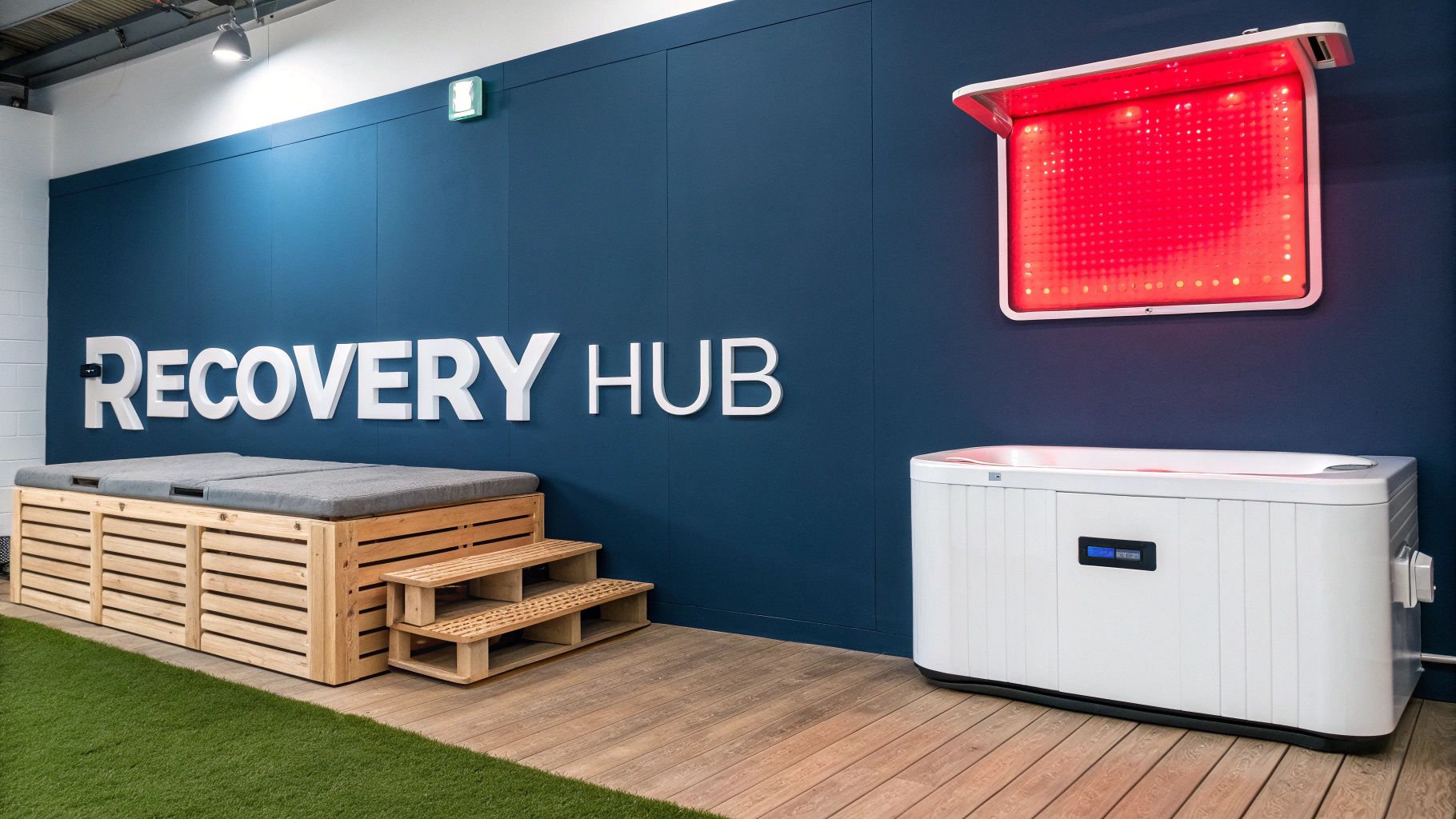
Bringing recovery modalities once exclusive to pro sports facilities into your home can drastically speed up your results and improve your overall health. We're talking about tools that work on a deep, cellular level to fight training stress, reduce inflammation, and turn your gym into a sanctuary for renewal.
Saunas & Cold Plunges: The Power of Contrast Therapy
One of the most effective recovery protocols is contrast therapy—the practice of moving between hot and cold environments. A sauna and a cold plunge are your primary tools here, and the health benefits go way beyond just feeling good. This powerful combination can improve circulation, reduce muscle soreness, and strengthen your immune system.
The intense heat of a sauna causes vasodilation, opening up your blood vessels to flood tired muscles with oxygen-rich blood. When you plunge into cold water right after, those vessels constrict (vasoconstriction), pushing blood back toward your core. This process acts like a pump for your circulatory and lymphatic systems, actively flushing out inflammation and metabolic waste.
Contrast therapy isn't passive rest. It's an active workout recovery strategy that accelerates your body's natural healing processes, leading to faster recovery, a more robust immune system, and an incredible tolerance for stress.
Level Up Healing with Hyperbaric Oxygen Therapy
Ready to take workout recovery even further? Hyperbaric Oxygen Therapy (HBOT) is a cutting-edge modality. Inside a hyperbaric chamber, you breathe almost pure oxygen in a pressurized environment, allowing your lungs to absorb far more O2 than at normal pressure.
This super-oxygenated plasma then circulates throughout your body, promoting healing, reducing recovery time, rebuilding damaged tissue, and boosting energy production at a cellular level. It’s like hitting the fast-forward button on your body's natural repair system.
Your Daily Go-To Recovery Tools
While saunas and HBOT are amazing for deep systemic recovery, you also need tools for daily wellness. A high-quality massage chair, for example, gives you on-demand therapy to work out knots, improve circulation, and help you decompress after a long day.
Red light therapy panels are another fantastic addition. They use specific wavelengths of light to penetrate the skin and energize your mitochondria. This can boost collagen, improve skin health, and help repair localized tissue damage. We break down even more options in our guide to the best recovery tools for athletes.
It's no surprise that the connected gym equipment market is expected to hit USD 2.10 billion in 2026 at a 14.02% CAGR. People want to see measurable improvements in their health, and advanced recovery tools deliver on that by improving metrics like heart rate variability (HRV) and sleep scores.
Recovery Tool Comparison for Your Home Gym
So, which tools are right for your wellness journey? It boils down to your personal health goals, space, and budget. This table breaks down the essentials to help you choose the right modalities for your recovery hub.
| Recovery Tool | Primary Health Benefit | Ideal For | Space Consideration |
|---|---|---|---|
| Infrared Sauna | Detoxification & Relaxation | Stress reduction, improved circulation, and deep muscle relaxation | Requires a dedicated indoor or outdoor space (approx. 4'x4' and up) |
| Cold Plunge | Inflammation Reduction & Mood Boost | Athletes and anyone focused on quick recovery and mental resilience | Needs a level surface and access to water/drainage |
| HBOT Chamber | Cellular Repair & Accelerated Healing | Serious biohackers and individuals maximizing tissue repair | Varies from soft shells (like a large tent) to hard shells (room-sized) |
| Massage Chair | Daily Muscle Relief & Stress Management | Anyone seeking consistent, convenient stress and muscle management | Fits in the corner of a room, similar to a large recliner |
By making workout recovery an integral part of your home gym, you elevate it from a place you just exercise to a place you truly rebuild. This focus on wellness is what separates a good setup from a great one. For more information, visit the MedEq Wellness Journal.
Designing a Safe and Functional Workout Space
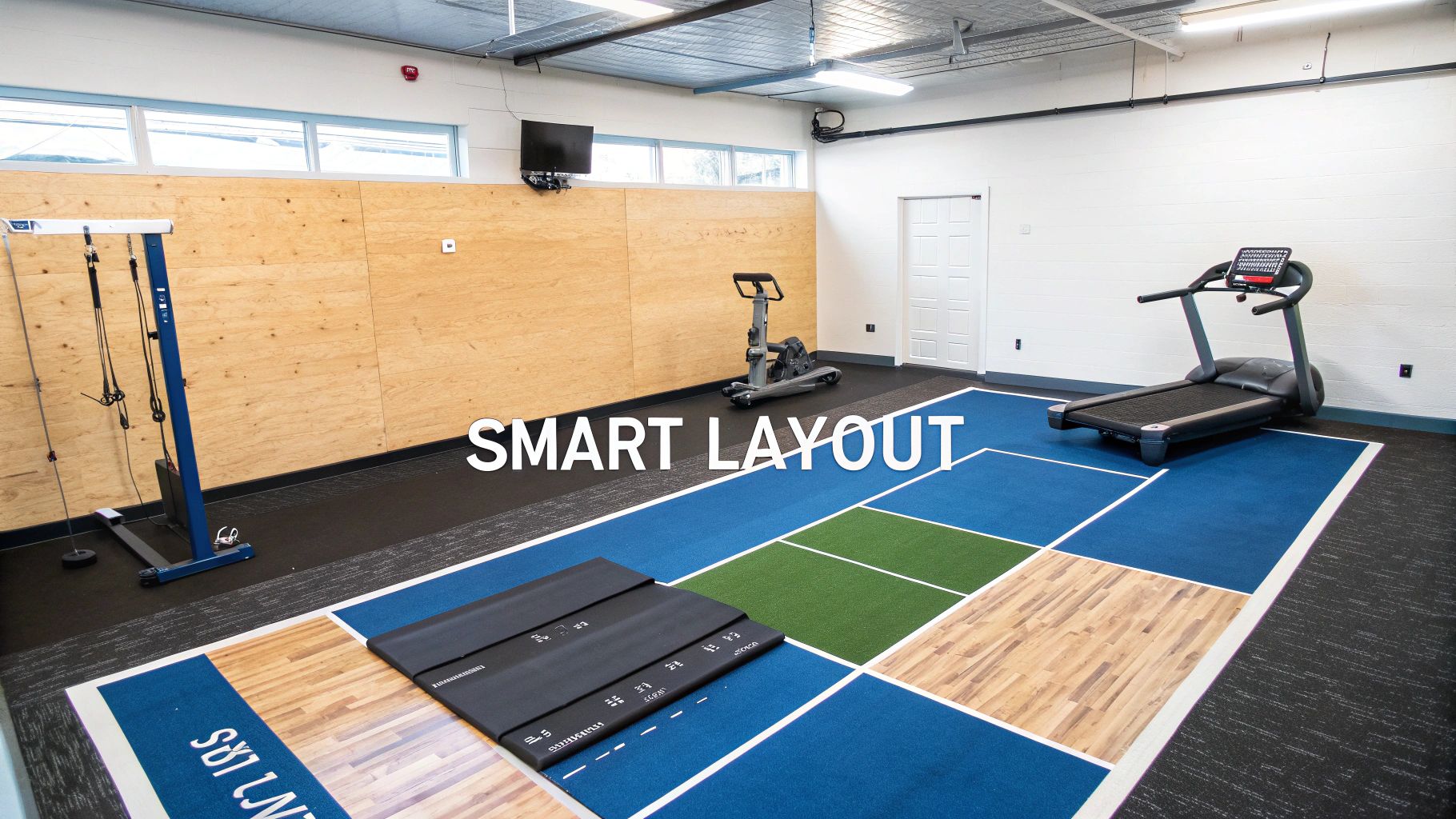
The layout of your home gym is just as important as the gear you fill it with. A smart design isn't just about looking good—it creates a safe, motivating space that promotes wellness and makes you want to train. This is where you go from having a pile of equipment to a fully functional health hub.
And it all starts from the ground up. Literally. The right flooring is your first line of defense, protecting your joints, your equipment, and your house itself.
Build Your Foundation with the Right Flooring
Think of your floor as the most-used piece of equipment in the entire gym. It needs to absorb impact during high-intensity sessions and provide a rock-solid base for heavy lifts to protect your body and prevent injuries.
- Rubber Flooring: This is the gold standard for a reason. Whether you choose tiles or rolls, rubber is incredibly durable, absorbs shock like a champ, and gives you a stable, non-slip surface for lifting. For areas where you might drop heavy weights, go for something 8mm thick or more.
- Vinyl Flooring: A solid choice for cardio zones or functional fitness areas. Luxury vinyl tile (LVT) is tough, water-resistant, and a breeze to clean. Just know it offers less shock absorption, so it’s not ideal for deadlift days.
- Foam Mats: These interlocking tiles are easy on the wallet, but they’re best reserved for lighter activities like yoga or bodyweight circuits. They’re too soft for heavy lifting—they’ll compress under the load and create an unstable surface.
Create Logical Workout Zones
A little organization goes a long way. Setting up distinct zones helps your workouts flow smoothly and keeps your space safe and efficient. It creates a mental map that makes training more intuitive and a whole lot less frustrating.
Map it out based on how you actually train.
- Strength Zone: This is the heart of the gym. Put your squat rack or functional trainer against a solid wall, making sure there's plenty of room to move. A good rule of thumb is to leave at least three feet of clearance around both ends of your barbell.
- Cardio Zone: Group your machines, like a treadmill and rower, together. If you can, position them to face a window or a TV to make those longer sessions more enjoyable. Don't forget to check the power requirements and place them near outlets. Unsure what type of machine fits your space? Our guide on manual treadmills vs electric ones can help.
- Recovery and Mobility Zone: Carve out a dedicated corner for stretching, foam rolling, or using a massage chair. Physically separating this space helps you mentally shift from high-gear training to restorative wellness practices.
A well-zoned gym just feels right. You should be able to move seamlessly from warm-up to your main lifts, to a cardio finisher, and into workout recovery without any awkward backtracking.
Optimize Your Environment for Peak Performance
The vibe of your gym can make or break your motivation and impact your overall wellness experience. Two things people often overlook are ventilation and lighting, but they're critical for creating a healthy space you enjoy being in.
Good ventilation is a must. Stale air gets loaded with carbon dioxide and moisture, which not only makes your workout feel tougher but can also encourage mold. A simple fan helps, but an exhaust fan or even an open window can make a world of difference for air quality.
Lighting is a huge factor, too. Dim, yellow light can leave you feeling sluggish, while bright, cool-toned LEDs can boost your energy and focus. Consider installing dimmable lights so you can crank up the brightness for a heavy lifting session and soften it for a yoga flow. For more tips on creating a holistic wellness environment, check out the MedEq Wellness Journal.
Maintaining Your Home Gym for Lasting Performance
You’ve invested in your health by building a home gym. Now, it’s time to protect that investment. Like any high-performance machine, your equipment needs consistent care to stay safe, effective, and ready for your next wellness session.
Think of it less as a chore and more as part of your wellness ritual. A few minutes of upkeep each week will dramatically extend the life of your gear, preventing small issues from becoming big, expensive problems.
The home fitness market is exploding, projected to hit USD 19.92 billion by 2032. With more advanced and specialized equipment available than ever, a solid maintenance routine is non-negotiable for ensuring safety and longevity.
Nail Down a Simple Maintenance Schedule
The key is to keep it simple. Breaking tasks down into daily, weekly, and monthly checks makes upkeep manageable and removes the guesswork.
Daily Habits (2-5 Minutes)
- Wipe It Down: After every workout, give a quick wipe to everything you touched—benches, dumbbell handles, cardio grips, and mats. This isn't just about cleanliness; it prevents the slow, corrosive buildup of sweat and grime.
- Put It Away: Re-rack weights and organize accessories. A clean space is a safe space and promotes a clear, focused mindset for your next session.
Weekly Checks (10-15 Minutes)
- Deeper Clean: Go beyond a simple wipe-down. Use a gym-safe cleaning solution on high-touch areas like weight plates, barbell knurling, and cardio machine consoles.
- Hardware Inspection: Give your rack, benches, and cable systems a quick once-over. Are there any loose bolts? Frayed cables? Tighten what you can and make a note to replace anything that looks worn. This is your first line of defense against equipment failure.
Caring for Specialized Equipment
Your high-tech cardio and workout recovery tools have their own specific needs. Ignoring them is a fast track to costly repairs and frustrating downtime that can derail your wellness routine.
Cardio machines, for instance, need lubrication. Check the owner's manual for your treadmill or rower—most require you to lubricate belts and chains every few months to keep them running smoothly and quietly. Don't skip this.
Keeping your equipment in top shape is foundational to your wellness journey. A well-maintained gym is a safe gym, allowing you to push your limits with confidence.
Maintaining Your Recovery Tools
Your sauna and cold plunge are central to your workout recovery protocol, which means their hygiene is just as important as their function for your health.
- Saunas: Regularly wipe down the benches and walls with a damp cloth. Never use harsh chemicals, as they can damage the wood and release fumes when heated. A quick check of the heater and stones ensures everything is working as it should.
- Cold Plunges: Clean water is everything. Follow the manufacturer's instructions for filtration and sanitation to the letter. This usually involves changing filters regularly and using an approved, gentle sanitizer to keep things safe and hygienic.
Ultimately, maintaining your gym is about honoring the commitment you made to your health. To get the most out of that commitment, you need routines that last. This guide on workout consistency is a great place to start. For more specific tips on caring for your gear, check out the MedEq Wellness Journal.
Common Questions We Get About Home Gyms
Even with the best plan laid out, you're going to have questions. Everyone does. Let's tackle some of the most common ones we hear so you can move forward with confidence and build a space that truly enhances your wellness.
How Much Space Do I Really Need?
This is always the first question, and the answer is usually a relief: probably less than you think. You don’t need a massive, dedicated room to build a seriously effective gym. We’ve seen incredible setups in the corner of a garage, a spare bedroom, or a section of a basement.
A space as small as 8x8 feet can be plenty for a solid strength foundation—think a squat rack, bench, and barbell. If you're adding cardio machines like a manual treadmill or a rower, just be sure to account for their footprint plus about two feet of clearance on all sides for safety. The trick is to choose versatile, smart equipment.
The goal isn't to build a smaller version of a commercial gym. It's to create an efficient space that serves your wellness. Focus on the quality of the space, not just the square footage.
Is a Home Gym a Good Financial Investment?
Without a doubt, especially when you frame it as a long-term investment in your health and wellness. Yes, there's an upfront cost. But that cost often pays for itself within just a few years when you stop paying recurring gym membership fees. More importantly, the convenience of a home gym removes the biggest barrier to exercise for most people: time.
This consistency leads to profound health benefits, including better cardiovascular health, improved stress management, stronger bones, and more restorative sleep. You are investing in your most valuable asset—your well-being.
Can I Still Get a Full-Body Workout?
Yes. And honestly, it’s often a more focused and effective one. It’s a huge misconception that a home gym is limiting. With just a few key pieces, you can hit every muscle group and achieve comprehensive fitness and wellness goals.
A simple, powerful combination looks something like this:
- Functional Trainer: This one machine is a game-changer for hitting both major and minor muscle groups with exercises like lat pulldowns, cable crossovers, leg extensions, and bicep curls.
- Wooden Rower: This is your low-impact cardio powerhouse. A good rower engages over 85% of your body's muscles in every stroke, making it a full-body workout that's great for heart health.
- Adjustable Dumbbells: Get a huge range of weights for all your accessory work without dedicating an entire wall to a dumbbell rack, saving space while enabling progressive overload.
That simple setup right there gives you everything you need to build strength, boost your endurance, and maintain a balanced, healthy physique.
For more deep dives into wellness strategies and training guides, head over to our MedEq Wellness Journal.
At MedEq Fitness, our entire mission is to equip you with science-backed tools. We want to help you build a space that supports both peak performance and deep, meaningful recovery. Explore our curated selection of professional-grade wellness and recovery equipment to find the final pieces for your ideal home gym.