

The Ultimate Guide to Accessories for Treadmills: A Wellness Approach
The right accessories for treadmills aren't just bells and whistles; they transform a simple cardio machine into a command center for your health and wellness. Think of them as strategic investments—tools that boost performance, lock in your safety, and critically, enhance your workout recovery.
Transform Your Treadmill Into a Complete Wellness Hub
Your treadmill is the engine of your home fitness routine. But what if you could upgrade that engine for better efficiency, rock-solid safety, and a much longer lifespan? The right accessories do just that, turning a basic run into a sophisticated, science-backed session aimed at achieving peak physical condition and holistic well-being.
This guide is about showing you how specific gear can deepen your workout, shield you from injury, and—most importantly—accelerate your body's recovery process for profound health benefits.
We're moving beyond the basics. The goal is to build a complete ecosystem around your treadmill, one where every session is paired with a powerful renewal process. Each accessory becomes a vital component in your overall health strategy, supporting both physical exertion and mental clarity.
The Growing Demand for Enhanced Home Workouts
The desire for more from our home workouts is more than just a passing trend; it's a fundamental shift in how we approach fitness and wellness. The global treadmill market hit USD 4.12 billion in 2023, and a big reason for that growth is that people are using accessories to supercharge their routines.
Industry analysis predicts the market will climb to USD 6.45 billion by 2032, all fueled by a rising tide of health awareness. This growth tells a clear story: people want more from their equipment. They’re looking for smart ways to integrate performance tracking, comfort, and, crucially, workout recovery into every single session.
To really build a wellness hub, it helps to lean on broader holistic health principles that see physical activity as just one part of a much bigger picture of well-being.
Your treadmill setup shouldn't just be a place to run. It should be a dedicated space for both physical exertion and mental renewal. Each accessory you add ought to serve this dual purpose, supporting your workout and your recovery.
By carefully choosing and integrating the right tools, you're building a personalized fitness environment that supports every facet of your health journey. It’s a physician-led, science-backed approach—making smart investments that pay dividends in your long-term wellness. Find more insights like this on our MedEq Wellness Journal.
Building a Foundation of Safety and Comfort
A great workout doesn't just happen when you press 'start'. It actually begins with setting up a safe and comfortable space that promotes your well-being. The right foundational accessories for treadmills are all about protecting two things: your body and your home. These small investments prevent injuries, reduce joint stress, and make your daily run a more enjoyable, sustainable part of your wellness routine.
First up, think of a high-density treadmill mat as the unsung hero of your setup. It's the essential shock absorber. As you run, your treadmill's motor and the thud of your feet create a surprising amount of vibration. A mat absorbs this energy, reducing noise and protecting your floors from damage.
From a health perspective, its most important job is reducing vibration. Less vibration translates to less cumulative stress on your joints over thousands of steps, which is crucial for long-term joint health and faster workout recovery. The mat also provides a stable, non-slip surface and catches sweat, making cleanup simple.
Prioritizing Your Personal Safety Systems
Beyond protecting your home, the most critical gear is what protects you. Let’s start with the humble safety key. It’s standard on almost every treadmill for a reason, and using it is non-negotiable for your well-being. This little magnetic clip is your emergency brake, designed to kill the power instantly if you trip or lose your footing.
Making a habit of using it is a core wellness practice. A bad fall on a moving belt can cause serious injury, setting your fitness goals back by weeks or even months. Always clip it securely to your clothes before you even think about starting your workout.
Just as important are the shoes on your feet. Running on a treadmill isn't the same as hitting the pavement; the belt has a consistent give, but the motion is incredibly repetitive, which puts a unique kind of stress on your joints.
Think of your running shoes as a personalized suspension system for your body. The right pair absorbs the shock that would otherwise travel up your ankles, knees, and hips, reducing the risk of impact-related injuries and supporting better workout recovery.
Investing in a good pair of shoes designed specifically for running—with the right cushioning and support for your foot type—is one of the smartest health decisions you can make for your treadmill routine.
Crafting a Comfortable Workout Zone
Let's be clear: comfort isn't a luxury. It's what keeps you consistent. When your workout zone feels good, you're just more likely to stick with it and maybe even push a little longer. A few ergonomic add-ons can make a huge difference here.
These simple accessories solve the common little annoyances that often cut a workout short:
- Clip-On Cooling Fans: These give you direct airflow to help regulate your core body temperature. Staying cool helps you maintain your target intensity for longer, improving cardiovascular health benefits.
- Accessible Water Bottle Holders: Staying hydrated is key for performance and recovery. Proper hydration aids muscle function and helps flush metabolic waste post-workout.
- Cushioned Hand Grips: If you use the handrails for stability, especially on steep inclines or during cooldowns, cushioned grips can save your hands from fatigue and calluses.
These might seem like minor details, but together, they have a major impact on your overall wellness. By getting rid of those small points of friction, you create a positive feedback loop. Your workouts feel less like a chore and more like dedicated time for yourself. This focus on building a supportive environment is at the heart of long-term success. For more strategies like this, backed by experts, check out our MedEq Wellness Journal.
Train Smarter: How Tracking and Entertainment Boost Performance
It’s time to stop just putting in the miles and start making those miles count for your health. Technology has completely changed the game, turning a simple treadmill run into a precision-guided training session. Performance-tracking accessories are your instruments, giving you the real-time feedback you need to optimize your cardiovascular health and recovery.
These tools don’t just spit out numbers; they tell you a story about how your body is responding to every minute of your workout. This allows you to dial in your effort, train in the right heart rate zones for specific health benefits, and, just as importantly, nail your recovery. It’s all about turning your sweat into real, measurable progress.
This is exactly why the home fitness world is exploding with smart accessories. They’re the secret sauce that elevates a basic machine into a personal wellness hub. It's no surprise that electric models hold 70.7% of the market share—their ability to connect with these add-ons is a huge draw. The treadmill market itself, currently valued at USD 5.75 billion, is on track to hit USD 9.72 billion by 2033, a boom driven by our demand for smarter wellness at home.
Getting Real Data With Precision Trackers
Let's be honest, the data you get isn't always good data. Those handgrip sensors built into most treadmills? They’re okay for a quick check, but they just don't have the accuracy you need for serious training. If you want insights that can improve your health, you’ll need to bring in some dedicated gear.
Two of the most impactful tools you can add to your arsenal are chest-strap heart rate monitors and foot pods.
- Chest-Strap Heart Rate Monitors: There’s a reason these are the gold standard for wellness. Strapped around your chest, they give you EKG-level accuracy on your heart rate, which is essential for training in specific zones to burn fat or build endurance. More importantly, they track your Heart Rate Variability (HRV), a critical metric for understanding your nervous system's recovery status. We dive deep into this in our guide on what HRV training is and why it matters for your overall health.
- Foot Pods: These tiny sensors clip right onto your shoe and act like a personal running coach. They measure things like your cadence and stride length. This data helps you iron out inefficiencies in your form, making you a smoother, more injury-resistant runner and reducing long-term joint strain.
And if you’re already using a smartwatch, exploring the best smartwatch accessories can take your data collection to the next level.
Why Entertainment Is a Serious Wellness Tool
It's easy to write off a tablet holder as just a way to kill boredom. But from a wellness standpoint, it’s a powerful tool for something called habit stacking. The idea is simple: you pair a new habit you're trying to build (your workout) with something you already love to do (like binging a show or listening to a podcast).
When you make your treadmill time genuinely enjoyable, you're far more likely to stick with it. Consistency is the single biggest key to achieving long-term health benefits. An accessory that helps you extend your workout by 15% isn't a distraction—it's a game-changer for your well-being.
A good, sturdy holder that doesn't vibrate will keep your device secure, letting you get lost in your content instead of worrying about it falling. This one simple addition can be the difference between a rushed 20-minute jog and a solid 45-minute session, completely changing your weekly fitness output.
Choosing Your Performance Tracking Accessory
So, what’s the right tracker for you? It really boils down to your personal wellness goals. Are you all about heart health and recovery, or are you laser-focused on running faster and more efficiently?
This table breaks down the main options to help you find your perfect match.
| Accessory Type | Primary Metric Tracked | Best For | Integration Level |
|---|---|---|---|
| Chest-Strap Monitor | Heart Rate & HRV | Athletes focused on zone training, cardiovascular health, and recovery optimization. | High |
| Foot Pod | Cadence & Stride Length | Runners aiming to improve form, running economy, and reduce injury risk. | Medium |
| Smartwatch | Heart Rate & GPS | General fitness enthusiasts who want all-in-one tracking for multiple activities. | High |
| Treadmill Console | Speed, Distance & Incline | Users needing basic workout feedback without in-depth physiological data. | Low |
Choosing the right tool gives you the power to push your limits intelligently and recover even better. It’s about making every step count for your health. To keep learning, visit our MedEq Wellness Journal.
Protecting Your Investment With Essential Maintenance
Think of your treadmill as a high-performance engine for your health. Like any sophisticated machine, it needs regular tune-ups to keep running smoothly. This isn't a chore; it's a critical part of your wellness practice. The right accessories for treadmills aren't just add-ons—they are essential tools to keep your equipment safe, quiet, and reliable for the long haul.
Taking care of your machine is a direct investment in your fitness goals. A little preventative maintenance goes a long way, helping you avoid costly future repairs and ensuring every workout is as solid as your first one.
It’s no surprise that as more people build out their home gyms, the market for these accessories is booming. The global treadmill market was already valued between USD 3.8 and 5.75 billion in 2023-24. Experts predict it will surge to as much as USD 9.08 billion by 2033, with savvy consumers snapping up products that extend the life of their equipment. You can dig deeper into these numbers by checking out this treadmill market analysis.
The Heart of Treadmill Care: Lubrication
Silicone lubricant is the lifeblood of your treadmill. Seriously. Every time you run, the belt glides over the deck thousands of times, creating a massive amount of friction. Left unchecked, that friction builds heat that can warp the deck, destroy the belt, and put a huge strain on your motor.
A quick application of 100% silicone lubricant is the answer. It’s specifically made for this job and immediately cuts down on that damaging friction. This one simple step has a few massive health and wellness payoffs:
- Saves Your Motor: When the belt moves easily, the motor doesn't have to work as hard. This prevents overheating and premature burnout.
- Guarantees a Smooth Run: It gets rid of those annoying jerks or stutters in the belt, giving you a steady, reliable surface that's much safer for your joints.
- Quiets Things Down: Less friction means less noise. Your workouts become much more peaceful and focused, contributing to mental wellness.
Always check your owner's manual for the exact schedule, but a good rule of thumb is to inspect the lubrication every three to six months. It is, without a doubt, the most important maintenance task you can perform.
Specialized Cleaning For Peak Performance
Sweat, dust, and grime are your treadmill's worst enemies, especially when it comes to the electronics. Wiping down the machine after you use it is a fantastic habit, but for a real clean, you need the right tools. Your average household cleaner is way too harsh and can easily damage the console screen or other sensitive surfaces.
A specialized treadmill cleaning kit is your best defense. These kits usually come with a gentle, non-abrasive spray that's safe for electronics and a microfiber cloth that cleans without leaving behind scratches or lint.
Cleaning the console, handrails, and side rails regularly stops corrosive sweat from building up. Even more important, it keeps dust from getting sucked into the motor compartment, where it can clog up moving parts and cause the machine to overheat. Protecting these vital components is key, and for total peace of mind, you can safeguard your entire investment with a 2-year extended warranty.
A simple dust cover also adds a powerful layer of protection. When the treadmill is idle, a cover blocks airborne dust, pet hair, and other gunk from settling on the belt and making its way inside. It’s a small, inexpensive accessory that does a huge job of preventing the internal buildup that leads to long-term damage. For more tips on building a healthy routine, check out our MedEq Wellness Journal.
Integrating Advanced Recovery Tools With Your Treadmill Routine
The real health benefits of fitness aren't just found in that final, lung-burning minute on the treadmill. They're forged in the hours and days that follow. Your workout is the stimulus, but workout recovery is where the magic happens—it’s when your body actually rebuilds, manages inflammation, and gets stronger.
By pairing your treadmill routine with advanced recovery tools, you're doing more than just cooling down. You're creating a powerful wellness cycle that bridges the gap between exertion and true progress. This is how you move from just working out to building a complete system for your long-term health.
The Science Of A Powerful Cooldown
Your body doesn't just slam on the brakes after a hard run. Your muscles are inflamed, your nervous system is buzzing, and your cells are crying out for repair. Strategic workout recovery is all about managing that response. The goal is to flush out metabolic byproducts and kickstart the rebuilding process right away for optimal health benefits.
Think of it like this: your treadmill session is the controlled stress that tells your body it needs to adapt. Recovery tools are the high-quality materials it uses to make those adaptations happen efficiently. Skip them, and you risk overtraining, injury, and burnout.
When you intentionally pair a tough treadmill workout with a targeted recovery method, you take the driver's seat in your body's adaptation process. You aren't just hoping for results; you're actively building them at a cellular level for enhanced wellness.
Harnessing Contrast Therapy For Rapid Renewal
One of the most effective ways to accelerate workout recovery is contrast therapy—the practice of alternating between hot and cold temperatures. A powerful example is following up a challenging treadmill run with a session in a cold plunge.
This immediate, intense cold exposure causes blood vessels to constrict, which helps dramatically reduce inflammation and soothe sore muscles. Key health benefits include:
- How It Works: The cold shock triggers a flood of norepinephrine, a hormone and neurotransmitter that powerfully dials down inflammation and sharpens your focus.
- The Benefit: Studies have shown this can significantly reduce delayed onset muscle soreness (DOMS). This means you can return to your next treadmill session feeling fresher and more prepared to perform.
Amplifying Recovery With Heat and Light
While cold is your go-to for acute inflammation, heat and light therapies tackle a different—but equally critical—part of the recovery puzzle. Their focus is on deep relaxation, improved circulation, and cellular repair for comprehensive wellness.
Infrared Saunas Using a sauna after your cooldown isn't just about relaxing your muscles. The deep-penetrating heat revs up the production of heat shock proteins. These proteins act as your body's cellular repair crew; they work to repair damaged cells and protect them from future stress, making you more resilient over time.
Red Light Therapy Another wellness game-changer is red light therapy. This involves exposing your body to specific wavelengths of red and near-infrared light. This light penetrates deep into your tissues and energizes your mitochondria—the power plants inside your cells. This process boosts cellular energy, directly fueling muscle repair and regeneration for faster workout recovery.
You can learn more about picking the right gear for your goals by checking out our guide to the best recovery tools for athletes.
When you start seeing your treadmill and your recovery tools as two halves of a single wellness system, you unlock a completely new level of performance and health.
Building Your Complete Workout Ecosystem
Think of your treadmill as the engine of your home fitness setup. But an engine is only part of the equation. By adding the right accessories for treadmills, you're not just buying gear; you're building a complete wellness ecosystem that supports both the hard work and the crucial workout recovery that follows. This is where real, sustainable health benefits come from.
When you finish a tough cardio session and immediately step into a deliberate recovery protocol, you amplify the benefits of your workout. It’s about creating a smart, science-backed system where every piece works in concert to enhance your overall wellness.
The visual below shows exactly how these recovery tools plug into your core treadmill workout, creating a powerful cycle of stress and repair.
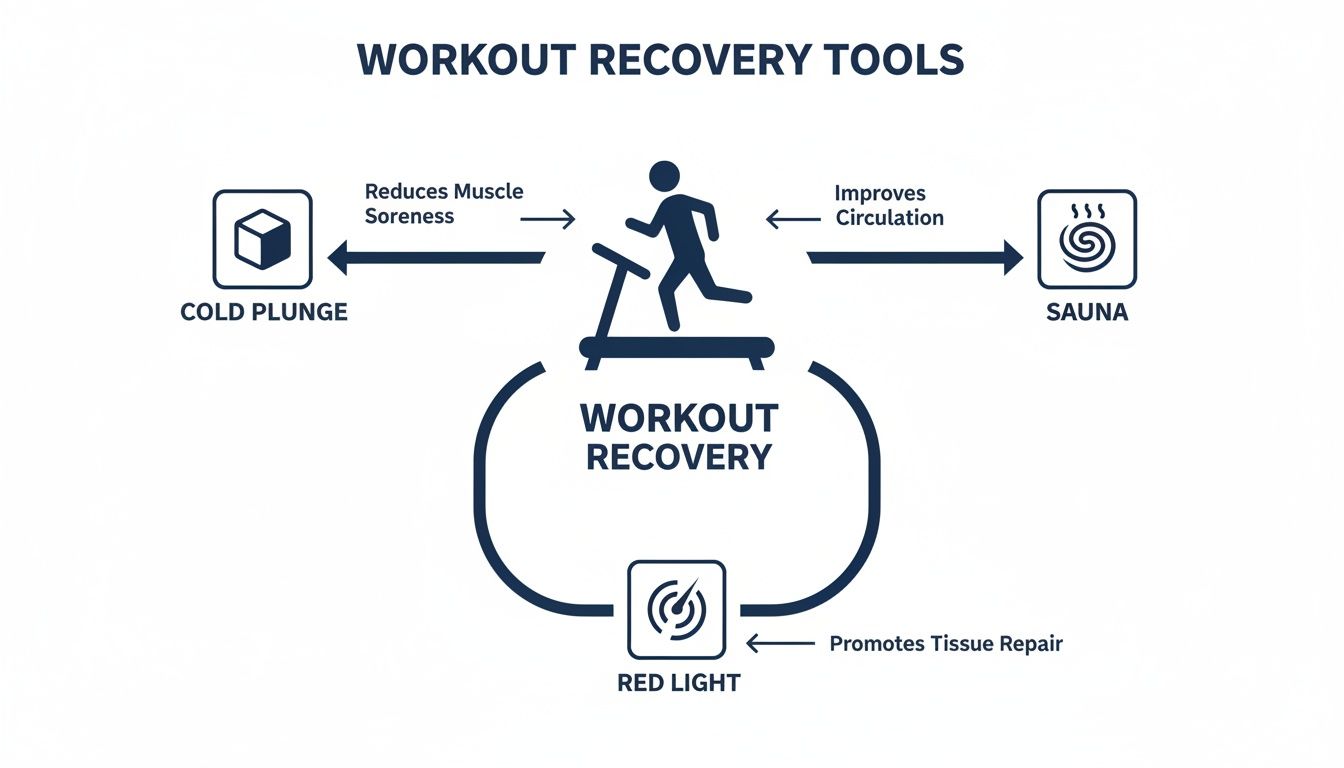
This isn’t about just cooling down. It’s a roadmap showing that what you do after the run is just as important, with each tool playing a specific role in getting your body back to 100% and maximizing your health gains.
A Holistic Approach to Performance
A truly complete fitness plan understands that the gains you fight for on the treadmill are actually cemented during your workout recovery. For example, jumping into a cold plunge after a hard run isn't just about grit—it's contrast therapy in action. This process drastically cuts down inflammation, which means less muscle soreness and a faster return to your next session. It's a proactive strategy to stay consistent and sidestep overtraining.
In the same way, an infrared sauna session can trigger the release of heat shock proteins, which act like a microscopic cleanup crew for your cells. This doesn't just help your muscles bounce back; it builds their resilience against future stress, a key component of long-term wellness.
By bringing these powerful tools into your routine, you move beyond just "working out." You become the architect of your body's stress-and-recovery cycle. You’re not just running anymore—you're orchestrating your own wellness.
Optimizing your health is a journey, not a destination. To keep learning and refining your approach, dive into the expert articles on our MedEq Wellness Journal. It’s your best resource for staying on top of the science behind peak fitness and recovery.
Got Questions About Treadmill Accessories? We've Got Answers.
When you start adding new gear to your treadmill setup, questions are bound to come up. Getting it right is crucial for creating a workout space that’s both safe and effective for your wellness journey. Here are some straightforward, expert answers to the questions we hear most often.
What are the absolute must-have accessories for a beginner?
If you're just starting out, your focus should be laser-sharp on two things: safety and consistency. These are the cornerstones of any successful wellness plan.
The three most critical pieces of gear for health and safety are:
- A high-quality treadmill mat to protect your floors, reduce noise, and dampen joint-stressing vibration.
- A reliable safety key (and a system for using it every single time to prevent serious injury).
- Proper running shoes built to absorb the specific impact of treadmill running, protecting your joints.
These three items create a secure foundation that supports your long-term health and makes your routine sustainable.
Can I just use any old tablet holder on my treadmill?
I wouldn't recommend it. It’s far better to get a holder designed specifically for the high-vibration environment of a treadmill. They’re built to clamp down hard and absorb the constant shaking that would send a generic holder—and your expensive tablet—flying.
Before you buy, always double-check that the holder is compatible with your treadmill’s handlebar design and can support your tablet's weight. A secure fit is non-negotiable; it lets your entertainment or training app work for you, enhancing the mental wellness aspect of your workout.
A well-designed accessory should feel like a natural part of your machine, not an afterthought. The goal is seamless integration that allows you to focus entirely on your performance and recovery.
How often do I really need to lubricate my treadmill belt?
The manufacturer's guidelines are your best source, but a good rule of thumb is to check the lubrication every three to six months or after about 150 miles of use. Always use the specific type of silicone lubricant recommended in your user manual.
Don't skip this. Proper lubrication is the single most important maintenance task you can perform. It keeps the belt running smoothly, protects the motor from burning out, and ultimately safeguards your entire investment in your health.
Are chest strap heart rate monitors actually better?
Absolutely, yes. For anyone serious about their health and training, a chest strap is miles ahead of the grip sensors on the handlebars. Those handlebar sensors are notoriously unreliable because your grip shifts and sweat interferes with the reading.
A chest strap provides continuous, EKG-accurate data. This isn't just a minor improvement; it's essential for proper heart rate zone training and for tracking advanced workout recovery metrics like Heart Rate Variability (HRV). It gives you a true window into how your body is performing and recovering, which is a cornerstone of effective wellness management.
For more expert advice on optimizing your fitness journey, visit the MedEq Wellness Journal.
At MedEq Fitness, we believe your workout is just one part of a complete wellness ecosystem. To see how our physician-led, science-backed recovery equipment can elevate your results, explore our curated selection. Shop now at MedEq Fitness.


