Manual Treadmill for Running: A Guide to Peak Performance and Wellness
A manual treadmill for running is exactly what it sounds like: a self-powered machine where you are the motor. Your own stride is what moves the belt. Unlike a conventional motorized treadmill that pulls the belt along for you, this design forces you to fully engage your posterior chain—glutes, hamstrings, calves—turning every run into a far more honest test of your strength, conditioning, and overall wellness.
The Machine Redefining Home Fitness and Health
Think about the difference between riding an e-bike and a regular road bike. The e-bike assists you, making hills feel flatter and the ride easier. A road bike, on the other hand, demands your full effort. Every pedal stroke is yours, connecting you directly to the work and the reward. That's the core idea behind a manual treadmill for running.
It’s built on a beautifully simple principle: you are the engine. The belt moves when you push off, and it stops the instant you do. This creates a workout that isn’t just about putting in the miles; it's about being mentally dialed in, rewarding proper form and conscious, powerful effort, which directly translates to significant health benefits.
A Surge in Popularity
The fitness world is really starting to catch on to this powerful simplicity. The global market for manual treadmills was valued at around USD 1.3 billion and is on track to more than double, hitting a projected USD 2.5 billion by 2032. This isn't just a fad; it’s a major shift toward more authentic, motor-free running that delivers a bigger punch for your health. You can read more about the market growth of manual treadmills and find detailed statistics.
So, what's driving this trend? A few key health benefits really resonate with people serious about their wellness and performance:
- Higher Calorie Burn: You provide all the power, so your body just flat-out works harder. Studies have consistently shown you can burn up to 20-30% more calories compared to running at the same speed on a motorized unit, making it a highly efficient tool for weight management.
- Zero Energy Consumption: No motor means no plug. These treadmills have a zero-carbon footprint and won't drive up your electricity bill, making them a smart, eco-friendly choice for any home gym.
- Improved Running Form: The signature curved deck of most modern manual treadmills naturally encourages a better, mid-foot strike. This reduces the heavy heel-striking impact so common on flat surfaces and promotes a healthier, more efficient running gait that protects your joints.
At its core, a manual treadmill for running is about taking back control. It strips away the passive assistance of a motor and puts you, the athlete, in the driver's seat of your own performance and recovery journey.
At MedEq Fitness, we specialize in bringing these clinic-quality wellness tools to high performers who demand an effective and authentic training experience. We focus on equipment that supports both intense workouts and optimal recovery, helping you build a complete wellness ecosystem right at home.
For more deep dives into health, performance, and recovery, check out our MedEq Wellness Journal.
The Biomechanical Advantage of Manual Running
The real magic of a manual treadmill for running is how it completely changes your interaction with the ground, leading to profound health benefits. Think about a standard motorized treadmill: a moving belt literally pulls your feet backward. This creates a slightly artificial running environment that can let you get away with some lazy, inefficient habits. A self-powered treadmill flips that whole dynamic on its head.
You are the engine. The belt only moves because you push it backward. This one simple, yet massive, difference encourages a much more natural running form. It guides you toward a midfoot or forefoot strike instead of the jarring heel strike that plagues so many runners. It’s the difference between being a passenger on a moving walkway and actually driving the car yourself.
This concept map breaks down the relationship between you, the belt, and the wellness-focused workout you get on a self-powered system.
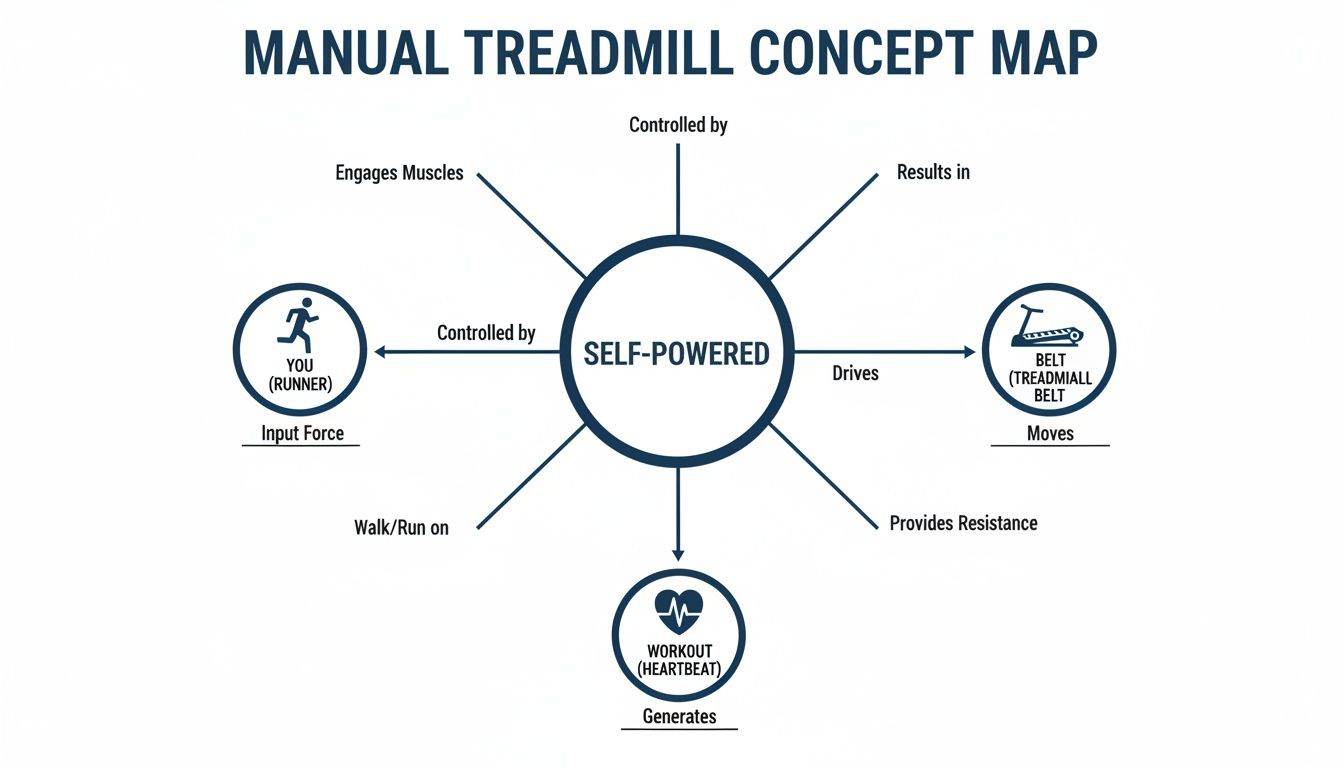
As you can see, you’re in total control. Your effort is directly tied to the belt's speed, which determines your workout's intensity. There’s no motor setting the pace or giving you a free ride with its momentum.
Correcting Form and Reducing Impact
One of the most common culprits behind running injuries is overstriding—letting your foot land way out in front of your body's center of gravity. Every time you do that, you’re basically hitting the brakes and sending a shockwave right up your leg. On a curved manual treadmill, overstriding just feels wrong and clumsy.
The curve naturally encourages your foot to land more directly underneath your hips. This simple shift cleans up your posture, promotes better alignment all the way up your kinetic chain, and dramatically cuts down on the harsh impact forces battering your knees, hips, and lower back.
By rewarding a good foot strike and making bad habits feel inefficient, a manual treadmill doesn't just give you a workout—it actively teaches you how to be a better, more durable runner.
This self-correcting feature is a huge reason why physical therapy clinics and elite athletes use these machines to refine form and bulletproof their bodies against injury.
Igniting Your Posterior Chain
The benefits don’t end with healthier joints. To get that belt moving, you need a powerful push-off that lights up your entire posterior chain. That’s the powerhouse muscle group running down the back of your body: your glutes, hamstrings, and calves. They are your primary engines for running fast and strong.
In fact, studies have shown that running on a self-propelled treadmill can activate these key muscles up to 30% more than running on a motorized one. This massive increase in muscle recruitment has some pretty incredible downstream health benefits:
- Higher Calorie Burn: Firing up more muscle costs more energy. The result is a much higher calorie burn, even when the workout feels just as hard.
- Building Functional Strength: You aren't just building cardio endurance. You're building raw, functional strength that makes you a more powerful runner and a more capable athlete overall.
- Better Muscular Balance: So many of us are "quad-dominant," relying too much on the muscles at the front of our thighs. Manual treadmills force your glutes and hamstrings to wake up and do their fair share of the work, correcting that imbalance.
If you're looking for other ways to amp up your training intensity, our guide on the benefits of a resistance treadmill has some great insights.
A More Complete Approach to Wellness
When you put it all together, the biomechanical advantages of a manual treadmill deliver a more complete, well-rounded workout. It’s a seamless blend of cardiovascular training and functional strength work that motorized treadmills just can't match.
You’re not just jogging in place. You’re actively developing a more efficient stride, strengthening your most important running muscles, and protecting your body from long-term wear and tear. This is why a manual treadmill for running is so much more than a piece of cardio equipment—it’s a genuine tool for boosting performance, speeding up workout recovery, and building a foundation for lifelong wellness.
For more wellness insights, explore the MedEq Wellness Journal.
Accelerating Workout Recovery and Enhancing Performance
Beyond its power to correct your running form, a manual treadmill for running is an incredible tool for optimizing your body’s recovery and smashing through performance plateaus. Its self-propelled design makes it a perfect match for one of the most effective training methods out there: High-Intensity Interval Training (HIIT).
Trying to do real interval work on a motorized treadmill can feel clumsy. You’re always waiting for the motor to catch up—speeding up or slowing down—which chews up valuable time in your work and rest periods. With a manual treadmill, the speed is all you. Sprint by driving harder; slow to a walk just by easing off. That instant control creates seamless transitions, making your HIIT sessions sharper and far more effective.
This kind of training—short, all-out bursts followed by active recovery—is a proven way to supercharge your cardiovascular health. It pushes your heart and lungs in a way that steady-state cardio just can't, leading to big gains in how your body uses oxygen and performs under pressure.
Mastering Your Recovery with Heart Rate Variability
One of the most vital metrics for tracking your body's readiness to perform is Heart Rate Variability (HRV). It’s a measure of the tiny variations in time between your heartbeats, and it's controlled by your autonomic nervous system. A higher HRV is a great sign; it means your body is rested, recovered, and ready for more. On the flip side, a low HRV can signal fatigue, stress, or that you're overtraining.
The intense, controlled bursts you can perform on a manual treadmill are fantastic for improving your HRV over time. By pushing your system to its limits and then letting it recover, you’re training your nervous system to be more adaptable and bounce back from stress more efficiently.
A manual treadmill lets you train in a way that directly improves your HRV, giving you a clear, data-driven window into your recovery. This empowers you to make smarter calls about when to go hard and when to prioritize rest.
By keeping an eye on your HRV, you can start to see exactly how your body responds to training. This allows you to fine-tune your entire schedule, ensuring you’re pushing hard enough to make progress without sliding into chronic fatigue, which can lead to injury and burnout.
Creating a Complete Wellness Cycle with Contrast Therapy
Peak performance isn't just about the work you put in; it’s just as much about how well you recover from it. This is where a manual treadmill for running fits perfectly into a complete wellness cycle. After a tough HIIT session, your body is primed for recovery methods that can multiply your results. One of the most powerful is contrast therapy.
Contrast therapy is all about alternating between hot and cold temperatures—think pairing a sauna session with a cold plunge. This quick temperature shift creates a "pumping" action in your blood vessels as they constrict in the cold and dilate in the heat. This process helps to:
- Flush out metabolic waste like lactic acid that builds up in your muscles.
- Reduce inflammation and muscle soreness.
- Boost circulation, delivering fresh, oxygen-rich blood to your tissues.
This powerful combination of intense training followed by intentional recovery creates a virtuous cycle. The hard work on the treadmill provides the stimulus for your body to adapt, while the contrast therapy speeds up the entire repair process. The result? You recover faster, train harder, and see better results.
For athletes and high-performers, optimizing this cycle is everything. It leads to deeper sleep, better energy levels, and a more resilient body that can handle a greater training load. By bringing tools like these together, you move past just exercising and start building a systematic approach to long-term health and performance. You can dive deeper into this topic in our guide on the best recovery tools for athletes.
How To Choose The Right Manual Treadmill
Buying a manual treadmill is a serious investment in your performance and wellness. You're not just getting a piece of cardio equipment; you're getting a tool specifically designed to refine your running mechanics and deliver an unmatched workout. But to get it right, you have to know what separates a high-performance machine from a basic one that'll just gather dust.
This is about more than just bells and whistles. It's about finding the treadmill that fits your specific goals, whether you're an elite athlete chasing podiums, a patient in physical therapy, or simply building out a home gym that can keep up with you.
Understanding Curve Geometry And Its Impact
The most obvious feature of a modern manual treadmill is its curved deck. This isn't just for looks—the curve geometry is the secret sauce that dictates the entire running experience. A steeper, more aggressive curve forces you to work harder to get the belt moving and keep it there, which is phenomenal for building power in sprints and HIIT workouts.
On the other hand, a gentler, more gradual curve feels a lot more like running on flat ground. This design is better suited for steady-state cardio and endurance sessions where you’re settling into a rhythm for the long haul. The right choice comes down to how you train.
- Steeper Curve: Demands a powerful forward lean and a higher knee drive, making it perfect for developing explosive speed.
- Shallower Curve: Encourages a more natural, consistent pace, which is exactly what you want for building aerobic capacity.
The Critical Difference Between Slat Belts And Traditional Belts
The running surface itself is probably the most important component you'll evaluate. The best manual treadmills use a slat belt design, which is made up of individual rubberized slats all linked together. This is a massive leap forward from the single-piece fabric belts you find on cheaper, entry-level models.
A slat belt gives you a firm, responsive surface underfoot that feels much more like running on a track. They are also incredibly durable, often rated to last over 150,000 miles with very little upkeep. The initial cost is higher, no doubt, but for serious runners, the superior feel and longevity of a slat belt are non-negotiable. If you're looking for a machine built to last, take a look at our MedEq Fitness resistance treadmills.
The belt is your direct point of contact with the machine. Choosing a durable, high-quality slat belt ensures a consistent, safe, and effective running experience for years to come.
Build Quality, Frame Materials, And Weight Capacity
Think about it: a manual treadmill has to absorb the full force of your self-propelled stride, over and over again. That's why you need to look for frames built from heavy-gauge steel. This provides the rock-solid stability you need for all-out sprints without any unnerving wobbling or shaking. The frame’s quality is directly tied to the machine's durability and your safety.
Always check the maximum user weight capacity. A higher rating—usually 350 lbs or more on quality models—is a dead giveaway of a robust frame and high-quality bearings. Even if you're a lighter runner, that high capacity signals that the machine is over-engineered with superior materials designed to handle intense, daily use. And as you think about your purchase, it's smart to understand the basics of general maintenance of gym equipment to protect your investment for the long term.
It's fascinating to see how far these machines have come. Modern curved manual treadmills really started gaining traction with elite trainers around 2010. Now, they're a huge part of the market, partly because they're safer—the belt only moves when you do, which drastically cuts injury risk. They’re also incredibly reliable, boasting a 99% uptime compared to about 85% for electric models, making them a bulletproof choice for clinics and serious home users alike.
Before you make your final decision, a quick checklist can help you compare models and ensure you're getting the right features for your needs.
Feature Checklist For Your Manual Treadmill Purchase
| Feature To Consider | What To Look For | Why It Matters For Performance |
|---|---|---|
| Curve Geometry | Steeper for sprints/HIIT, gentler for endurance. | Matches the machine's feel to your primary training style. |
| Belt Type | Slat belt over a traditional single-piece belt. | Provides superior durability, responsiveness, and a more realistic running feel. |
| Frame Material | Heavy-gauge steel construction. | Ensures stability during intense workouts and contributes to long-term durability. |
| Weight Capacity | 350 lbs or higher. | Indicates a robust build with high-quality components that can withstand heavy use. |
| Bearing Quality | Precision-engineered, sealed bearings. | Delivers a smooth, quiet, and low-maintenance glide for the running belt. |
| Display Console | Clear metrics: time, distance, speed, calories, watts. | Allows for accurate workout tracking and performance monitoring. |
| Footprint | Dimensions (L x W x H) that fit your space. | Ensures the treadmill fits comfortably and safely in your home or clinic. |
This checklist isn't exhaustive, but it covers the core components that will have the biggest impact on your training day in and day out.
Practical Considerations: Noise And Footprint
Especially for home gym users, the little details can make a big difference. One of the best side effects of a motorless design is how quiet it is. Without an engine humming away, the only sounds are your footsteps and the whisper-smooth glide of the belt. High-end models from MedEq Fitness are engineered with precision bearings for nearly silent operation, which is a lifesaver for apartment living or those early morning sessions.
Finally, break out the tape measure. Manual treadmills are often more compact than their motorized cousins, but you still need to plan for their footprint. Make sure you have enough clearance on all sides of the machine for safe mounting, dismounting, and general use.
For more wellness insights, explore the MedEq Wellness Journal.
Putting Your Manual Treadmill to Work: Sample Training Protocols
A manual treadmill is an incredible tool, but just jumping on and running isn't the whole story. You're the engine, which means you're in total control of the intensity. To get the most out of it—and stay safe—you need a smart approach. A structured warm-up, workout, and cool-down are non-negotiable for effective training and optimal workout recovery.
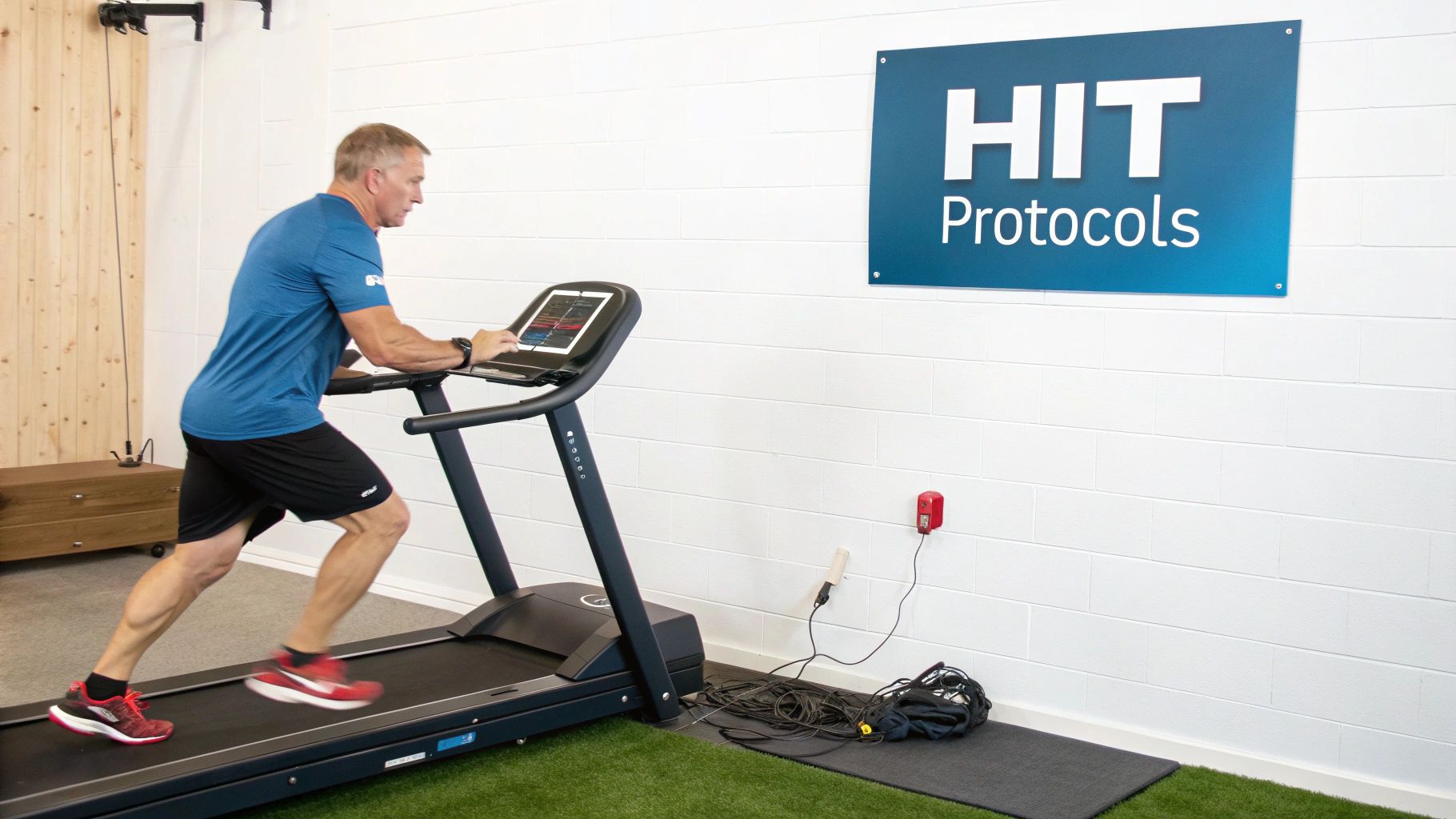
These protocols aren't just for elite athletes; they're foundational for anyone, from beginners in rehab to seasoned pros looking for an edge.
Phase 1: The Dynamic Warm-Up
Seriously, don't skip the warm-up. This isn't just about "getting loose." You're priming your body for a self-propelled workout by boosting blood flow, waking up your nervous system, and getting your joints ready for what’s next.
- Start Slow: Hop on and just walk for 3-5 minutes. Get a feel for how the belt responds to your stride and find a natural rhythm.
- Get Moving: Step off the treadmill for a few minutes of dynamic stretches. Think leg swings (front-to-back and side-to-side), high knees, and butt kicks. You're opening up your hips and firing up your glutes and hamstrings.
- Ramp It Up: Get back on and transition from your walk into a light jog over another 2-3 minutes. By the end, your heart rate should be elevated, and you should feel ready to work.
Phase 2: The HIIT Workout
This is where your manual treadmill really shines. High-Intensity Interval Training (HIIT) feels completely different here. The machine reacts instantly to your effort, letting you hit clean, powerful intervals that motorized treadmills just can't replicate.
Here's a simple but brutal structure to get you started.
The 1:2 Work-to-Rest Rule
This is a classic for a reason. For every second you go all-out, you recover for two. It’s the sweet spot for building anaerobic power while giving you just enough time to catch your breath and hit the next interval hard.
Let's put it into a 20-minute session:
- Work Interval (Sprint): Explode into a sprint at 90% of your maximum effort for 30 seconds. You have to drive hard with your legs to get that belt flying.
- Recovery Interval (Walk): As soon as the 30 seconds are up, pull back into a controlled walk for 60 seconds. Concentrate on getting your breathing under control.
- Repeat: Go through this cycle for 8-10 rounds.
To really level up your performance, understanding the principles of building endurance for running is a game-changer. It’s all about training smarter, not just harder.
Phase 3: The Recovery Cool-Down
The cool-down is just as vital as the work you just did. It’s your body’s off-ramp, letting your heart rate come down gradually and kick-starting the recovery process to minimize that next-day soreness.
Spend 5-10 minutes walking slowly on the treadmill. Let your heart rate and breathing return to normal. Afterward, step off and do some light static stretches for your major muscle groups—hamstrings, quads, calves, and glutes. Hold each stretch for 20-30 seconds. This phase is critical for workout recovery, reducing muscle stiffness and promoting blood flow to help your body repair and adapt.
This complete cycle of warm-up, work, and recovery is the key to unlocking peak performance safely. For more in-depth training guides from our experts, be sure to check out the MedEq Wellness Journal.
Why North America is Leading the Charge on Manual Treadmills
The surge in popularity for manual treadmills for running isn't just a random blip; it's a global movement with a clear leader. North America has firmly established itself as the epicenter of this trend, and it's no accident. The reason comes down to two powerful forces: a deeply rooted home gym culture and a growing obsession with high-performance, data-backed health and wellness.
For the millions of people carving out their own workout spaces at home, the appeal is obvious. A zero-electricity, compact machine that delivers a superior workout without needing an outlet? It's a perfect fit for the modern fitness enthusiast.
The Powerhouse of Home Gyms and Clinics
North America isn't just participating in the manual treadmill market—it's dominating it, claiming a massive 38.4% of the global market share. The U.S. is the single biggest driver, responsible for 24.7% of worldwide demand all on its own. It’s a direct reflection of a culture that lives and breathes fitness, where a well-equipped home gym is the new standard. You can dive deeper into the manual treadmill market data to see just how significant this growth is.
But this isn't just a home-based revolution. The trend is just as strong in professional settings.
Physical therapy clinics and elite training centers have embraced these machines for their incredible effectiveness and, just as importantly, their enhanced safety. Because the user powers the belt, it only moves when they do. This simple fact dramatically cuts the risk of accidents, a critical feature for therapists guiding patients back from injury. It allows for a more natural, controlled, and ultimately safer recovery.
The dual appeal of a manual treadmill—perfect for the dedicated home athlete and indispensable for the professional clinician—cements its position as a smart investment for both individuals and businesses seeking a stronger return on wellness.
A Smarter Path to Wellness
Whether you're a home user or a clinical pro, the logic holds up. A manual treadmill is a durable, low-maintenance investment that pays off with better biomechanical results and significant health benefits. Homeowners get a quiet, brutally effective tool for HIIT and endurance work. Clinics get a bulletproof machine that improves patient outcomes and tightens up safety protocols.
This powerful combination of real-world practicality and high-level performance is exactly why the North American market has embraced the self-powered running experience. It’s a shift fueled by a demand for more authentic, effective, and safer ways to train.
For more deep dives into industry trends and wellness education, check out the articles on our MedEq Wellness Journal.
Your Questions About Manual Treadmills Answered
Even with all the health benefits laid out, I get it—stepping onto a self-powered machine for the first time can feel a little different. Let's tackle some of the most common questions head-on so you can feel confident adding one to your training and wellness arsenal.
Is a Manual Treadmill Good for Long-Distance Running?
Absolutely. While they've earned a reputation as HIIT machines, manual treadmills are fantastic for endurance work. Holding a steady pace is all on you; it demands more muscular control and mental focus, which is exactly what builds a stronger, more efficient runner.
Think of it as the ultimate tool for tempo runs and pure stamina building. It’s a different kind of challenge than just setting a speed on a motorized deck, but the payoff in real-world functional strength and improved running economy is huge.
How Loud Is a Curved Manual Treadmill?
This is one of the biggest real-world wins: they are incredibly quiet. Since there's no motor humming away, high-quality manual treadmills are a world apart from their noisy, motorized cousins.
The only sounds you'll hear are your own footsteps and the whisper-quiet glide of the belt over the bearings. This makes them a game-changer for apartments, shared spaces, or anyone who trains while the rest of the house is asleep. Our MedEq Fitness models, for example, are specifically engineered for near-silent operation.
The quiet operation of a manual treadmill removes a common barrier to at-home fitness, allowing you to train intensely without disturbing your household or neighbors.
Can Beginners Use a Manual Treadmill for Running?
Yes, and they are arguably better for beginners. There’s a short learning curve as you get the feel for driving the belt with your own stride, but they’re fundamentally safer than motorized treadmills.
The belt stops the second you do. There's no runaway motor or moving surface to catch you off guard, which completely eliminates the risk of being thrown off. The best way to start is by simply walking, holding the handrails lightly, until controlling the pace feels second nature.
What Kind of Maintenance Does a Manual Treadmill Require?
Here's another reason people love them: the maintenance is next to nothing. By getting rid of the motor, complex electronics, and wiring, you've just eliminated all the things that typically break on a traditional treadmill.
Routine care is as simple as it gets:
- Regular Cleaning: Just wipe the machine down after your workout.
- Occasional Checks: Give the bolts and fasteners a quick check now and then to make sure everything is tight.
The premium slat belts on high-end models are built like tanks and are designed to last for years without ever needing adjustments, making ownership totally hassle-free.
For more wellness insights, explore the MedEq Wellness Journal.