Hyperbaric Chamber Sleep for Peak Recovery and Wellness
Think of it as putting your body’s recovery into hyperdrive while you’re not even awake. That’s the simple promise behind using a hyperbaric chamber for sleep. It's a wellness strategy that soaks your body in pressurized, pure oxygen to kickstart healing and promote profound rest, right down to the cellular level.
This isn't just some fringe science anymore. It’s becoming a go-to tool for anyone serious about dialing in their health, performance, and overall well-being.
The New Frontier of Cellular Restoration
Hyperbaric Oxygen Therapy (HBOT) used to be something you'd only find in specialized clinics. Now, it's becoming a cornerstone for elite home wellness setups, and for good reason. The concept is straightforward but incredibly effective: when you increase the air pressure around your body, your lungs can absorb far more oxygen than they ever could at sea level.
This oxygen-rich blood then travels everywhere, supercharging your body's natural repair crews. It's like upgrading your internal delivery service from a bicycle courier to a high-speed express network, ensuring every single cell gets the fuel it needs to function at its peak.
To put it simply, here's a quick rundown of what's happening and why it matters for your sleep and recovery.
Hyperbaric Chamber Sleep at a Glance
| Aspect | Description |
|---|---|
| Core Principle | Breathing nearly pure oxygen in a pressurized environment to dramatically increase oxygen absorption in the blood and tissues. |
| Primary Benefits | Accelerates muscle repair, reduces systemic inflammation, enhances brain function, and promotes deeper, more restorative sleep cycles. |
| Ideal Users | Athletes, biohackers, and wellness-focused individuals looking to optimize recovery, cognitive performance, and overall vitality. |
By targeting the very foundation of cellular health, HBOT offers a powerful way to enhance the body's innate ability to heal and recharge.
Key Health Benefits for Wellness and Recovery
The buzz around hyperbaric therapy isn't just hype; it's backed by tangible health benefits that are transforming how we approach wellness. The advantages tie directly into better recovery, optimized physical performance, and most importantly, better sleep.
- Accelerated Workout Recovery: Flooding your muscles with oxygen helps flush out lactic acid and other metabolic waste faster. The result? Less soreness and quicker tissue repair, getting you back to peak performance sooner.
- Reduced Inflammation: High oxygen levels act as a potent anti-inflammatory. This is a game-changer for bouncing back from tough training sessions or managing chronic aches and pains.
- Enhanced Mental Clarity: Your brain is an oxygen hog. Giving it more fuel can sharpen focus, cut through brain fog, and leave you feeling more alert and dialed-in.
- Improved Sleep Quality: An evening session can calm the nervous system and lower physical stress, setting the stage for deeper and more restorative sleep.
This blend of technology and biology is fueling a massive market shift. The global HBOT market is absolutely exploding and is projected to hit USD 6.71 billion by 2034. North America is leading the charge, becoming the hub for high-performers integrating these chambers into their routines. You can dig into the numbers yourself in the latest market analysis from Precedence Research.
For more strategies to optimize your health and performance, be sure to check out our MedEq Wellness Journal.
How Pressurized Oxygen Unlocks Deeper Recovery
To really get how a hyperbaric chamber sleep session can revolutionize your recovery, think of your body’s circulatory system like a big city's highway network. Normally, oxygen delivery trucks—your red blood cells—are pretty good at their job, but they’re stuck on the main roads. When there's a traffic jam from inflammation or an injury, they get gridlocked.
Hyperbaric oxygen therapy (HBOT) is like giving those oxygen deliveries an all-access pass. By increasing the atmospheric pressure, oxygen isn’t just riding on red blood cells anymore. It dissolves straight into all your body’s fluids—blood plasma, lymph, and even the fluid around your brain and spinal cord.
Suddenly, every side street, bike path, and back alley is open for oxygen delivery. Tissues that were choked off, inflamed, or starved for fuel get a flood of the one thing they need most to heal and generate energy. This supersaturation of oxygen is what kicks off a powerful chain reaction of biological benefits.
The Science of Cellular Repair
This isn't just theory; it’s straight physiology. Once your system is flooded with oxygen, several key processes shift into a higher gear, and all of them contribute to better sleep and faster recovery from your workouts.
Here’s what’s happening under the hood:
- Drastic Inflammation Reduction: Oxygen is a potent natural anti-inflammatory. It calms the body’s stress response from intense training or chronic issues, which is why you feel less muscle soreness and joint stiffness.
- New Blood Vessel Growth: HBOT stimulates angiogenesis, the formation of new capillaries. Think of it as building more permanent roads for nutrients and oxygen to reach damaged tissues, long after your session is over.
- Boosted Cellular Energy: Your mitochondria need oxygen to produce ATP, the fuel that runs your cells. More oxygen means more raw energy for everything your body does, from repairing muscle fibers to powering your brain.
- Enhanced Collagen Production: Collagen is the literal scaffolding for your skin, muscles, and connective tissues. HBOT ramps up its synthesis, helping repair those micro-tears from training and improving your overall tissue strength.
This concept map helps connect the dots between these core pillars of hyperbaric therapy and deep recovery.
You can clearly see how better oxygenation leads to the real-world benefits of healing and recovery—the foundation for truly restorative sleep.
From Theory to Tangible Results
These cellular-level changes add up to results you can actually feel. Athletes find they can train harder and bounce back faster, with way less downtime from soreness. Biohackers track improvements in their cognitive scores and often report feeling sharper and more focused.
For anyone chasing better sleep, the effect is huge. A session before bed helps switch your nervous system from a stressed "fight-or-flight" state into a calm "rest-and-digest" mode, priming you for sleep. By tackling inflammation and cellular stress head-on, HBOT creates the ideal internal environment for your body to fully repair itself while you rest.
Of course, understanding the nuts and bolts of sleep itself is also key. It helps to know what is REM sleep and why it matters to appreciate the full scope of cognitive and physical restoration.
By getting to the root of recovery—the cell—hyperbaric therapy doesn't just put a band-aid on fatigue. It builds a more resilient, energetic, and efficient system from the inside out.
This foundational repair work is what it's all about. You can dive deeper into the specifics of the therapy in our guide on what is hyperbaric oxygen therapy.
Choosing the Right Hyperbaric Chamber for Your Goals
Picking the right hyperbaric chamber isn't just a small detail—it's the most critical decision you'll make when bringing this powerful wellness tool into your home. The chamber you choose directly shapes the results you'll get, especially if your main goal is to improve your hyperbaric chamber sleep and bounce back faster from tough workouts.
The choice really boils down to two main types: soft-shell and hard-shell chambers.
Soft-shell chambers, often called mild Hyperbaric Oxygen Therapy (mHBOT) units, are practically designed for home use. They're built from tough, flexible materials and typically pressurize up to 1.3 to 1.5 atmospheres absolute (ATA). For general wellness, calming inflammation, and priming your nervous system for deeper sleep, this pressure range is the sweet spot.
Hard-shell chambers, on the other hand, are the heavy-duty units you'll see in clinics. Made from steel and acrylic, they can hit much higher pressures, often 2.0 ATA or more. While those levels are essential for certain medical treatments, a 1.5 ATA soft chamber delivers an incredible blend of results, affordability, and convenience for almost all wellness and recovery goals.
Soft-Shell vs Hard-Shell Chambers
Let's break down the key differences to help you match a chamber to your goals, space, and budget. This side-by-side comparison should make the decision crystal clear.
Soft-Shell vs Hard-Shell Hyperbaric Chambers
A direct comparison to help you decide which type of hyperbaric chamber best suits your wellness goals, space, and budget.
| Feature | Soft-Shell Chambers (e.g. 1.5 ATA) | Hard-Shell Chambers (e.g. 2.0 ATA) |
|---|---|---|
| Primary Use | Home wellness, sleep optimization, workout recovery, and general anti-inflammatory benefits. | Clinical applications, advanced protocols, and specific medical conditions requiring higher pressure. |
| Pressure Level | Typically reaches 1.3 to 1.5 ATA, which is ideal for boosting oxygenation for recovery. | Reaches 2.0 ATA and higher, providing more intensive oxygen saturation for clinical needs. |
| Material & Portability | Made from flexible, durable materials. Lighter, often portable, and easier to set up or move. | Constructed from rigid steel and acrylic. Heavy, stationary, and requires professional installation. |
| Cost | More affordable, making it a practical investment for home gyms and personal wellness. | Represents a significant financial investment, usually reserved for professional facilities. |
| Noise Level | Modern models are designed for very quiet operation, ensuring a peaceful and relaxing session. | Generally louder due to more powerful compressors needed for higher pressures. |
For anyone serious about sleep and recovery, the answer is pretty clear. The quiet, peaceful environment and highly effective 1.5 ATA pressure of a soft-shell chamber make it the hands-down winner for home use.
Key Factors for Your Home Setup
Once you've settled on the type of chamber, a few practical details will make or break your experience.
- Pressure Levels (ATA): For dialing in sleep and crushing workout recovery, 1.5 ATA is the gold standard. It gives you a serious oxygen boost without the intensity of clinical-grade pressures.
- Physical Footprint: Get out the tape measure. Even though soft chambers are compact, you need to account for the chamber, its compressor, and enough space to get in and out comfortably.
- Noise and Comfort: This one’s non-negotiable. A quiet compressor is essential for a session that's actually relaxing and sleep-promoting. Look for models specifically built for low-decibel operation.
- Ease of Assembly: Most home soft-shell chambers are a breeze to set up. You want something you can put together quickly without a toolbox and a PhD in engineering.
For individuals focused on sleep quality, Heart Rate Variability (HRV), and athletic recovery, single-person monoplace chambers are by far the most popular option. These solo-session units are perfectly sized, cost-effective, and easy to maintain, which explains why they accounted for 42% of total installations worldwide. If you want to dive deeper into market trends, you can review the latest research on Precedence Research.
Making the right choice from the start ensures your chamber becomes a seamless, powerful part of your daily routine. Ready to see what's out there? Check out our guide on choosing the best hyperbaric chamber for home use.
Your Protocol for Optimal Sleep and Recovery
Having the right gear is one thing, but knowing how to use it is what separates casual users from those who get real results. Creating a consistent protocol is what turns your hyperbaric chamber into a powerhouse for better sleep and faster workout recovery.
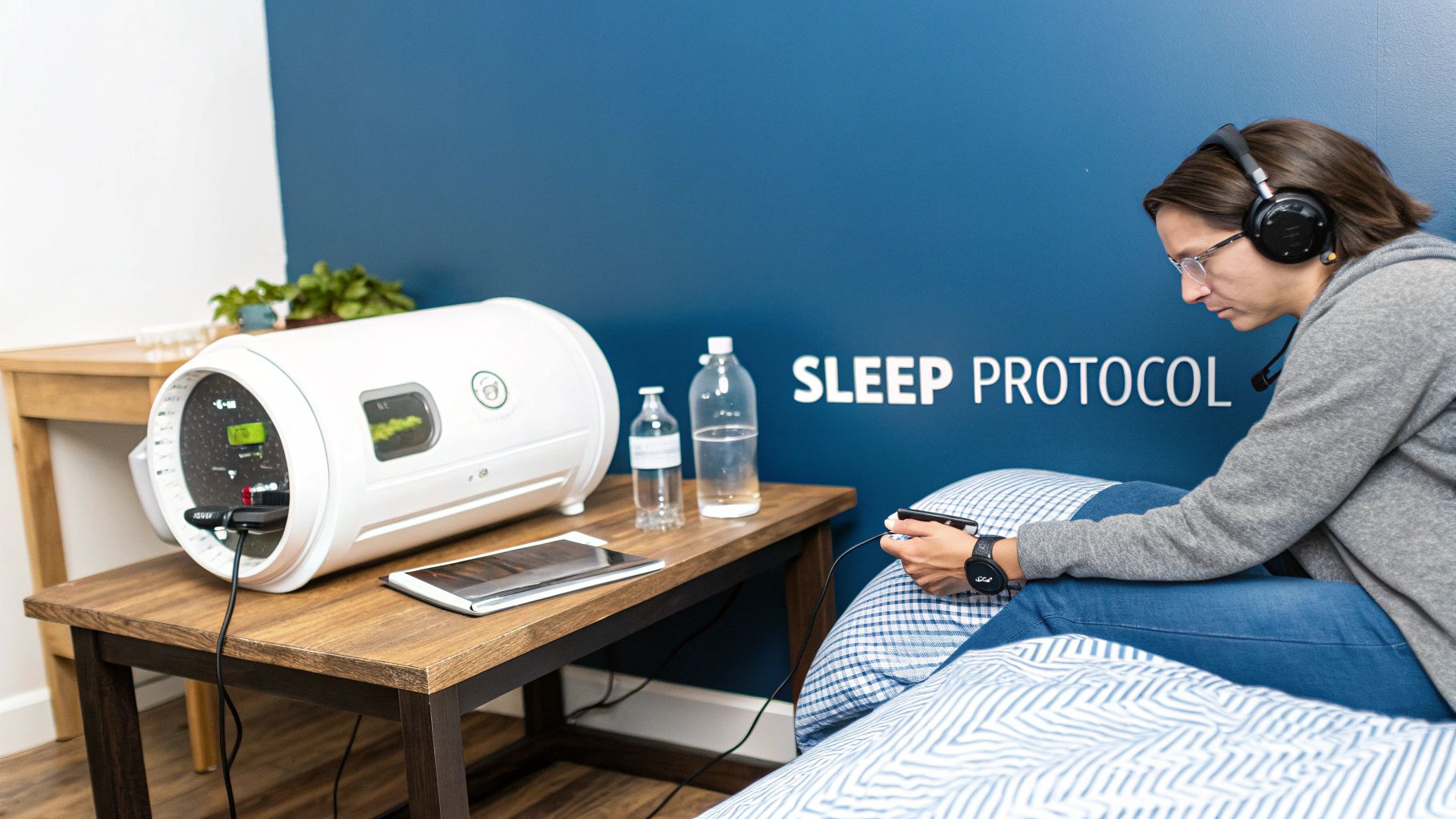
Let's talk timing. For sleep, this is everything. The sweet spot is an evening session of 60 to 90 minutes. This window is perfect for down-regulating your autonomic nervous system—shifting you out of that "fight-or-flight" stress mode and into a calm "rest-and-digest" state. It's the ultimate pre-bedtime ritual, actively clearing out the day's inflammation and stress to prime your body for truly restorative rest.
Creating a Consistent Schedule
A single session can feel great, no doubt. But the real magic happens with consistency. To see cumulative benefits you can actually feel and track on your wearables, aim for 3-5 sessions per week.
This steady exposure helps keep your baseline inflammation low, supports continuous cellular repair, and compounds the positive changes to your sleep architecture night after night. It’s no wonder the medical single hyperbaric oxygen chamber market is expected to hit USD 347 million by 2034, with biohackers reporting 15-25% better sleep scores after making HBOT a regular habit. You can dig into the numbers and trends in this in-depth industry report.
Recovery Stacking for Synergistic Results
Want to take your wellness journey to the next level? Start "recovery stacking"—that is, strategically pairing HBOT with other complementary therapies. This creates a powerful synergy that can fast-track your progress.
-
Red Light Therapy Before HBOT: A quick 10-15 minute session with a red light therapy panel beforehand can precondition your cells. It helps fire up your mitochondria, making them more receptive to the flood of oxygen they're about to receive in the chamber.
-
Contrast Therapy on Alternate Days: Avoid cramming too much into one day. Instead, alternate your HBOT days with contrast therapy like a cold plunge and infrared sauna. This combination of hot and cold therapy is fantastic for boosting circulation and flushing out inflammation, complementing the cellular repair from HBOT. If you want to dive deeper, we break down several powerful techniques in our article on how to increase deep sleep.
Integrating hyperbaric therapy is about creating a pre-sleep sanctuary. By calming the body and mind, you're not just preparing for sleep—you're preparing for profound cellular restoration.
And don't forget the fundamentals. Simple additions like exploring different forms of magnesium for sleep can provide foundational support for your nervous system, making everything else work even better.
Your Pre-Session Checklist
Finally, a simple routine before you get in will make sure every minute counts.
- Hydrate Well: Sip water throughout the day, but don't chug a huge bottle right before you zip up.
- Avoid Large Meals: Give yourself at least an hour or two to digest after a heavy meal.
- Wear Comfortable Clothing: Think loose, breathable fabrics. You're here to relax.
- Practice Mindfulness: Use this time to meditate, do some deep breathing exercises, or just listen to calming music.
For more wellness tips and product insights, visit the MedEq Wellness Journal.
Safety Protocols and Monitoring Your Progress
Stepping into a hyperbaric chamber is incredibly safe, but knowing the right protocols is key to getting the health benefits you want with confidence. Like any powerful wellness tool, responsible use comes first.
The first thing you’ll notice is a slight pressure in your ears as the chamber pressurizes—think of it like the feeling you get when a plane takes off. It’s totally normal. Just swallow, yawn, or gently pinch your nose and blow. Once the chamber hits its target pressure, that sensation vanishes, and you can just relax.
Hyperbaric therapy isn't some new fad; it has a long, trusted history. It was first developed to treat decompression sickness back in the 1960s and evolved into a go-to for elective recovery by the '90s. Today, with over 500,000 sessions happening each year in the U.S. for wellness, the safety protocols are rock-solid. You can dig deeper into its established use by checking out the latest industry intelligence reports.
Key Safety Considerations
While mild hyperbaric therapy has an excellent safety record, there are a few things to be aware of. It's always smart to talk with your doctor before starting any new therapy, especially if you have pre-existing health issues.
Here are a few conditions to absolutely discuss with a physician:
- Untreated Pneumothorax: A collapsed lung is a no-go, as pressure changes can make it worse.
- Certain Ear Conditions: If you have trouble equalizing pressure on a flight, you'll want to get checked for issues like Eustachian tube dysfunction.
- Some Lung Diseases: Conditions like COPD or asthma might require a doctor's okay first.
Tracking Your Success with Data
Safety is one half of the equation; the other is tracking your progress. This is what separates a good routine from a great one. The best approach combines what you feel with what the data shows.
Start with the subjective stuff. Are you waking up feeling more refreshed? Is your energy steady all day? How's that post-workout soreness? These qualitative wins are often the first sign that the therapy is doing its job.
To get more precise, pull data from your favorite wearable. This is where you get objective feedback that confirms what you're feeling and often reveals even deeper changes happening inside your body.
Tracking your biometrics provides undeniable proof of progress. When you see your deep sleep duration increase or your HRV climb, you know you're not just feeling better—you're getting fundamentally healthier.
Keep an eye on trends in these key metrics:
- Heart Rate Variability (HRV): A rising HRV is the gold standard for better recovery and a more balanced nervous system.
- Resting Heart Rate (RHR): A lower RHR is a classic sign of improved cardiovascular fitness and less systemic stress.
- Deep and REM Sleep Duration: Watch for increases in the time you spend in these crucial restorative sleep stages.
This mix of safety awareness and diligent tracking lets you use your chamber with total confidence. For more on optimizing your routine, check out the MedEq Wellness Journal.
Your Blueprint for Deeper Sleep and Faster Renewal
We’ve covered a lot of ground, and hopefully, you now see the incredible potential of hyperbaric chamber sleep for unlocking a new level of recovery and wellness. By flooding your body with oxygen, you're not just sleeping—you're accelerating healing, taming inflammation, and supercharging your cells for deeper, more restorative rest.
The result? You wake up ready to perform at your peak.
This isn't some far-off, futuristic tech anymore. It's a real, accessible tool for anyone serious about optimizing their health and taking their recovery to the next level. Think of it as the missing link between your hard work in the gym and true, cellular-level repair.
Taking the Next Step in Your Wellness Journey
Diving into hyperbaric therapy is really an investment in your body's own amazing ability to heal itself. The health benefits speak for themselves: faster workout recovery, a calmer nervous system, and a more resilient, energetic you. It’s not just about feeling better today; it’s about building a solid foundation for vitality that lasts.
And the market is catching on. The industry is projected to hit USD 6.5 billion by 2033, growing at a steady 6.8% CAGR. It's the monoplace chambers—perfect for individual sleep sessions at home—that are really leading the charge, making up 42% of all installations. Their compact design and ease of use are making this technology more accessible than ever. You can dig into the full market breakdown and future trends over at Intellect Market Research.
Creating Your Ultimate Recovery Protocol
To really get the most out of your chamber, try stacking it with other powerful wellness practices.
- Contrast Therapy: On your off days from the chamber, an ice bath and sauna session is a fantastic way to keep circulation high and inflammation low.
- Mindfulness: Don't just lie there! Use your chamber time to meditate or do some deep breathing exercises. It’s a great way to double down on the calming effects for your nervous system.
- Consistency is Key: Like anything, you get out what you put in. Sticking to a regular schedule is the secret to keeping inflammation down and supporting constant cellular repair.
By making hyperbaric therapy a cornerstone of your routine, you are actively building a more resilient, energetic, and high-performing version of yourself.
Ready to take your recovery seriously? The next step is to check out our curated selection of hyperbaric chambers. For more pro tips on building out your ideal recovery stack, head over to the MedEq Wellness Journal or connect with our team today.
Frequently Asked Questions
When you're diving into advanced wellness tools, it's natural to have a few questions. We've compiled the most common ones we hear about using a hyperbaric chamber for sleep and recovery, so you can move forward with confidence.
Can I Actually Sleep All Night in a Hyperbaric Chamber?
It's a common question, and while the idea of "hyperbaric chamber sleep" sounds intriguing, that's not really how it works. Most protocols don't involve spending the entire night in the chamber.
Instead, think of it as a powerful pre-sleep ritual. A dedicated 60- to 90-minute session in the evening, a couple of hours before you actually plan to sleep, is the sweet spot. This session dials down systemic inflammation and calms your nervous system, basically priming your body for an incredible night of deep, restorative sleep in your own bed.
What Does It Feel Like Inside the Chamber?
Relaxing and surprisingly quiet. As the chamber gently pressurizes, you'll feel a bit of fullness in your ears—the same sensation you get when a plane takes off.
It’s easy to manage. Just swallow, yawn, or gently pinch your nose and blow. Once the target pressure is reached, that feeling vanishes completely. From there, you're free to just rest, meditate, read, or listen to music. Modern chambers are designed for quiet operation, making your session a truly peaceful escape.
How Quickly Will I Notice Benefits for Sleep and Recovery?
The effects are both immediate and cumulative. Many people report a profound sense of calm after their very first session, which often translates to better sleep that same night. If you’re an athlete, you might wake up with way less muscle soreness after a brutal workout.
The real magic, though, happens with consistency. Deeper, more lasting health benefits—like a consistently higher Heart Rate Variability (HRV), a lower resting heart rate, and sustained energy—build over time. Sticking to a protocol of 3-5 sessions per week is where you'll see those significant, measurable shifts in your sleep data and performance.
Can I Combine HBOT with Contrast Therapy?
Yes, and it's an incredibly powerful recovery stack. The key is to perform them on alternate days, not back-to-back. This lets you get the unique benefits of each modality without over-stressing your system.
A great schedule might look like this: Use your hyperbaric chamber on Monday, Wednesday, and Friday to focus on deep cellular repair. On Tuesday and Thursday, hit a contrast therapy circuit with a cold plunge and sauna to flush inflammation and boost circulation. This creates a balanced, highly effective wellness and recovery routine.
Is a Hyperbaric Chamber a Smart Investment for a Home Gym?
Without a doubt. If you're serious about optimizing your health and performance, a hyperbaric chamber is one of the most high-impact tools you can add to your home wellness setup. It's a one-time investment in the recovery side of the equation—something that pays dividends for years to come.
Today’s soft-shell chambers are durable, surprisingly easy to set up, and operate quietly, so they fit right into a home environment. Having that kind of clinic-level recovery on your own schedule is a game-changer. It means you can recover faster, train harder, and truly unlock your potential.
At MedEq Fitness, we specialize in providing elite, science-backed wellness equipment to help you bridge the gap between exertion and renewal. Explore our curated selection of hyperbaric chambers and take the next step in building your ultimate recovery protocol.
For more expert insights, be sure to visit the MedEq Wellness Journal.