Infrared Sauna for Recovery: Unlocking Peak Athletic Performance
Using an infrared sauna for recovery is more than just a relaxing way to end a workout—it's a science-backed wellness strategy for helping your body heal faster and more efficiently. Unlike traditional saunas that simply heat the air, infrared light penetrates directly into your muscle tissue, boosting circulation and calming inflammation where it matters most.
This focus on targeted healing results in faster relief and a more profound sense of well-being, making it an essential tool for anyone serious about their health and workout recovery.
Your Guide to Faster Workout Recovery
Every time you push yourself in a workout, you create tiny micro-tears in your muscle fibers. That soreness you feel the next day—what we call Delayed Onset Muscle Soreness (DOMS)—is your body getting to work on repairs. True wellness and recovery aren't just about resting; they're about giving your body the right tools to rebuild stronger.
This is where an infrared sauna becomes such a powerful wellness ally.
Think of your circulatory system as a network of highways delivering healing supplies—like oxygen and nutrients—to your tired muscles. Infrared heat acts as an expert traffic manager, opening up those highways through a process called vasodilation. This improved blood flow doesn't just speed up repairs; it also helps flush out metabolic waste like lactic acid that contributes to soreness and fatigue, promoting overall health.
How Infrared Heat Optimizes Healing
The real magic of infrared technology is its ability to warm your body from the inside out. This deep, penetrating warmth offers several key health benefits that are difficult to achieve as comfortably with a traditional sauna.
Here’s how it supercharges your post-workout wellness routine:
- Accelerated Muscle Repair: By increasing circulation, it ensures your damaged muscle tissues get the oxygen and nutrients they need to rebuild quickly.
- Reduced Inflammation: The infrared waves help dial down inflammation at a cellular level, a major cause of post-exercise pain and stiffness.
- Enhanced Pain Relief: The gentle heat is incredibly soothing for nerve endings and tight muscles, providing immediate relief from aches.
- Improved Flexibility: Warming up your muscles and connective tissues helps increase your range of motion and can lower your risk of future injuries.
To get the most out of your routine, you can pair sauna sessions with other essential workout recovery tips for even better results.
An infrared sauna doesn't just make you feel good. It actively supports the physiological processes that turn soreness into strength, helping you bounce back faster so you can train harder and enhance your overall wellness.
Let's break down how these mechanisms deliver real-world benefits, whether you're a pro athlete or just serious about your home workouts. You can also explore more of the best recovery tools for athletes in our in-depth guide on the MedEq Wellness Journal.
Key Mechanisms of Infrared Sauna Recovery
Here's a quick look at how infrared saunas directly impact the physiological processes that are critical for workout recovery.
| Recovery Mechanism | How Infrared Sauna Helps | Primary Benefit |
|---|---|---|
| Improved Circulation | Expands blood vessels (vasodilation) to increase blood flow. | Faster delivery of oxygen and nutrients to muscles. |
| Inflammation Reduction | Penetrating heat helps decrease inflammatory markers in tissues. | Less muscle soreness and quicker reduction of swelling. |
| Pain Alleviation | Gentle heat soothes nerve endings and reduces muscle tension. | Immediate relief from post-workout aches and stiffness. |
By targeting these core recovery pathways, infrared saunas offer a smart, effective way to enhance your body's natural healing capabilities.
How Infrared Heat Accelerates Muscle Repair
Think of your muscles after a hard workout. They're depleted, damaged, and in need of resources to start rebuilding. An infrared sauna for recovery doesn't just apply surface heat; it sends a specialized repair crew deep into your tissues to get the job done right, promoting a powerful healing response.
It’s like the difference between misting a plant’s leaves and watering its roots. Traditional saunas heat the air around you, which is helpful, but infrared's specific light wavelengths penetrate deep into your soft tissue. This is where the real work of healing begins.
This deep heat has a direct, powerful effect on your cellular power plants: the mitochondria.
Boosting Cellular Energy Production
At the very core of muscle repair is cellular energy. Infrared light gives your mitochondria a nudge, encouraging them to ramp up production of Adenosine Triphosphate (ATP). ATP is the universal energy currency for every cell in your body, fueling everything from muscle contractions to tissue growth.
By increasing ATP, an infrared sauna session gives your exhausted muscles the raw fuel they need to rebuild faster and more thoroughly. This surge in cellular energy cuts down on your recovery time, getting you back to training stronger and sooner. It's a direct biological upgrade to your body's natural repair mechanisms.
It’s like this: Your muscle cells are construction workers with a massive repair job to do, but their generators are running on fumes. An infrared sauna is like wheeling in a high-powered generator, supercharging their ability to get the work done.
This infographic captures the key health benefits that come from this deep healing.
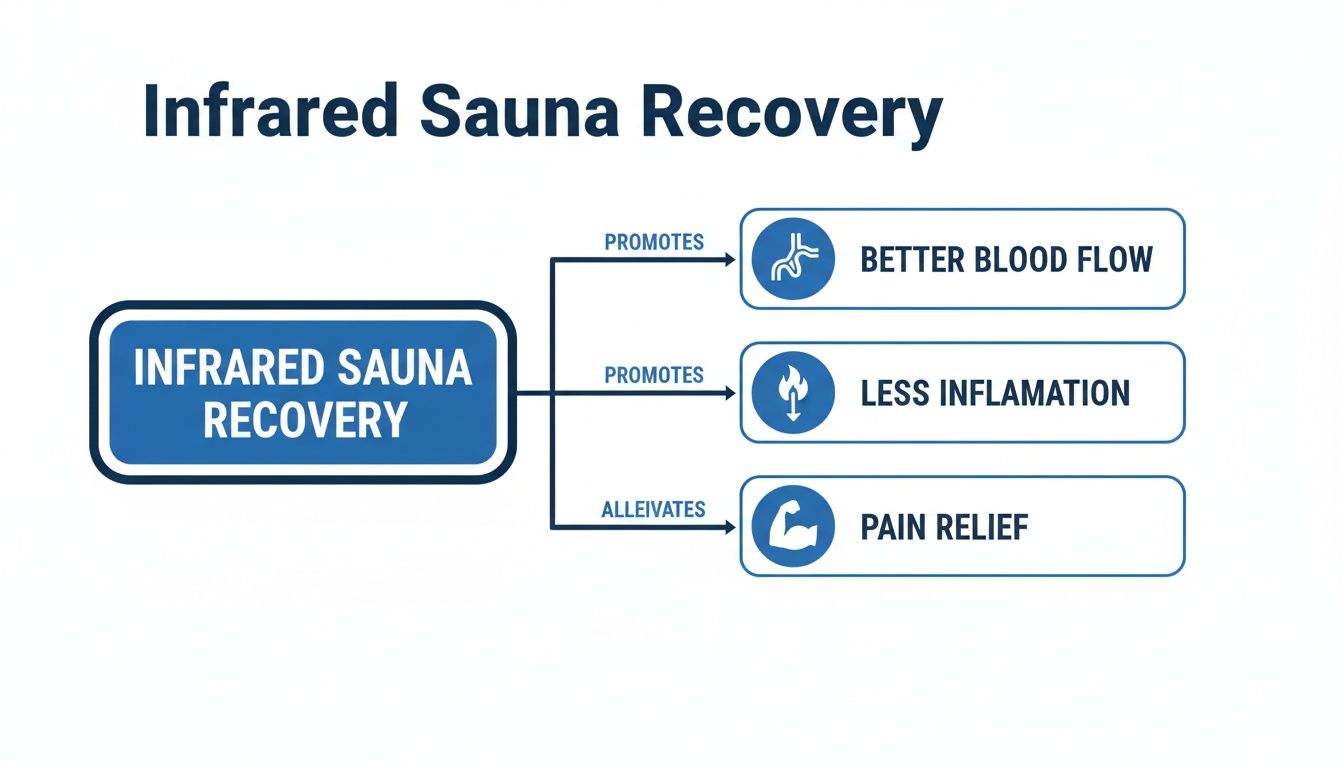
You can see how better blood flow, less inflammation, and direct pain relief all feed into a powerful recovery cycle.
Expanding Your Circulatory Highways
Beyond the cellular level, the most immediate effect you'll feel from infrared heat is vasodilation—the widening of your blood vessels. As your core body temperature gently rises, your arteries and capillaries expand, opening the floodgates for increased blood flow.
This isn’t just a cozy feeling. It’s a critical physiological response that turns your circulatory system into a super-efficient delivery and waste-removal service.
- Nutrient and Oxygen Delivery: These wider "highways" allow your blood to rush a fresh supply of oxygen and essential nutrients straight to your damaged muscle fibers, giving them the building blocks they need.
- Metabolic Waste Removal: At the same time, the increased circulation acts like a cleanup crew, flushing out metabolic byproducts like lactic acid that cause soreness and fatigue.
This one-two punch ensures your muscles get more of what they need to heal and less of what’s slowing them down. For more expert insights on wellness and recovery, check out the MedEq Wellness Journal.
Combat Muscle Soreness and Boost Performance
That boost in circulation and cellular energy we just talked about? It’s not just an abstract concept—it translates directly into real, tangible results you can feel after a tough workout. This is where we move from general wellness to measurable gains in your physical output. An infrared sauna for recovery can be the very thing that helps you smash through a plateau or just stay on top of your game during a grueling training block.
Let’s be honest, one of the biggest hurdles for any athlete is Delayed Onset Muscle Soreness (DOMS). We all know that ache that creeps in 24-48 hours after a heavy session. It can completely derail your next workout, wreck your range of motion, and tank your power.
Infrared saunas go straight to the source, targeting the inflammation and micro-tears in your muscles that cause DOMS in the first place. By flooding that tissue with oxygen-rich blood, the sauna helps flush out all the metabolic junk that makes you feel sore and stiff. The end result? You feel better, faster, and you're ready to get back to work sooner.
Preserving Neuromuscular Power
It’s one thing to feel better, but it’s another to actually perform better. Infrared saunas help maintain your neuromuscular system’s ability to fire on all cylinders. Think of this system as the high-speed communication network between your brain and your muscles—it’s what generates explosive power, speed, and agility. When you train hard, this system gets fatigued, and performance drops.
Imagine you're deep into a heavy training cycle, pushing your body day after day. Without proper recovery, your vertical jump starts to dip, and your sprint times get a little slower. That's neuromuscular fatigue setting in. Targeted recovery with an infrared sauna helps stop that decline, letting you train harder for longer without burning out.
An infrared sauna doesn't just soothe sore muscles; it helps preserve the explosive strength and coordination that are critical for athletic success. It’s the difference between merely surviving a tough training week and thriving through it.
You’re not just recovering from your last workout; you’re actively preserving your ability to generate force for the next one. For more strategies on this, check out our complete guide on how to reduce muscle soreness and stay at the peak of your game.
Evidence of Enhanced Performance
This isn't just theory; the performance impact of infrared saunas is backed by solid research. A landmark study from the University of Jyväskylä in Finland produced some game-changing results. Researchers had athletes use infrared saunas after their workouts and tracked their performance.
The findings were pretty remarkable. The sauna sessions prevented the usual drop in jump performance that athletes see during intense training periods. Not only did their loaded jump heights remain strong, but their muscle soreness plummeted. Even better, regular use actually boosted their maximum sprint speed over the first few meters by improving neuromuscular adaptations. It allowed them to train harder without being dragged down by fatigue. You can dive into the full findings on neuromuscular performance yourself to see the raw data.
This study draws a clear line between infrared therapy and the ability to maintain—and even improve—key performance metrics.
- Sustained Power: Athletes kept their explosive jump performance steady, even during the toughest training blocks.
- Reduced Soreness: They reported significantly less muscle soreness, which meant higher-quality training sessions day after day.
- Increased Speed: The therapy actually enhanced neuromuscular function, leading to faster sprint times.
What this all means is that an infrared sauna is a seriously powerful tool for anyone looking to optimize their performance. It helps you bounce back stronger and avoid those frustrating dips that come with pushing your limits. It's about performing better, not just feeling better.
Creating Your Ideal Recovery Protocol
Alright, we’ve covered the science. Now, let’s get practical. Using an infrared sauna for recovery isn't about just sitting in a hot box and hoping for the best—it's about creating a personalized protocol that actually fits your health and wellness goals. A competitive athlete’s needs are worlds apart from a weekend warrior nursing sore quads or someone just looking to improve their overall wellness.
The magic really happens when you learn to dial in three key variables: how long you’re in, how hot it is, and when you do it. Nailing these down transforms a sauna from a simple luxury into a precision recovery tool, letting you target everything from acute muscle repair to chronic pain and even deep, restorative sleep.

Timing Your Sessions for Maximum Impact
When you hop in the sauna is just as important as how. Timing your session can dramatically shift the health benefits you receive.
- Post-Workout Recovery: Think of this as the "golden window." Getting into the sauna within an hour of your training session capitalizes on your body’s already ramped-up metabolic rate. It boosts circulation, helping to flush out metabolic junk and rush nutrients to those tired muscle fibers. It's a proactive strike against DOMS.
- Evening Wind-Down: If better sleep and less stress are what you're after, an evening session is your ticket. The deep, gentle heat is fantastic for calming the nervous system, helping to lower cortisol, and encouraging a nice release of endorphins. It’s the perfect primer for a deep sleep cycle, which is when the real repair work happens anyway.
Setting the Right Temperature and Duration
Unlike old-school saunas that feel like a furnace, infrared saunas work their magic at much more comfortable temperatures. The goal isn't to endure scorching air; it's to let those infrared waves penetrate deep into your tissues.
For most recovery applications, the sweet spot is somewhere between 40-60°C (104-140°F). This moderate heat allows for longer sessions without putting your body under unnecessary stress. As for how long, 30-40 minutes is the general rule of thumb. That’s enough time to get your core body temp up and let the circulatory benefits really kick in.
Here's the bottom line: consistency trumps intensity. A regular habit of 30-minute sessions at a comfortable temperature will do far more for your long-term recovery and wellness than occasional, blistering-hot sessions that just leave you drained.
The data backs this up. A 2015 study looked at athletes after a brutal workout and found that a far-infrared sauna (FIRS) session gave them a significant recovery edge. After a tough endurance test, the athletes who used FIRS saw their countermovement jump height bounce back to 0.34 meters—noticeably better than the 0.32 meters of the group that didn't use a sauna. Their heart rate recovery was also more efficient, dropping to an average of 71 beats per minute compared to 92 bpm after a traditional sauna. It’s a perfect illustration of infrared’s deep, gentle power. You can dig into the specific performance findings from that study yourself.
Customized Protocols for Your Goals
Your personal needs should be the driver behind your sauna protocol. To make it simple, we've put together a guide to help you customize your sessions based on what you're trying to achieve.
Infrared Sauna Protocols for Different Recovery Goals
This table provides a simple framework to help you dial in your infrared sauna sessions, whether you're an athlete, clinician, or home user focused on wellness.
| Recovery Goal | Recommended Duration | Ideal Temperature Range | Optimal Timing |
|---|---|---|---|
| Acute Muscle Repair | 30-40 minutes | 50-60°C (122-140°F) | Immediately post-workout |
| Chronic Pain Relief | 25-35 minutes | 45-55°C (113-131°F) | Morning or evening |
| Improved Sleep Quality | 20-30 minutes | 40-50°C (104-122°F) | 60-90 minutes before bed |
| General Wellness | 20-30 minutes | 40-55°C (104-131°F) | 3-4 times per week, anytime |
Using this as your starting point, you can shift from just passively relaxing to actively targeting your recovery. To keep learning, be sure to explore more expert insights on our MedEq Wellness Journal.
Stacking Therapies for Ultimate Recovery
An infrared sauna is a powerhouse for recovery all on its own, but what if you could take it a step further? To really kick your body's healing process into high gear, you can combine it with other therapies.
This strategy is often called "stacking," and it’s all about layering different treatments to create a synergistic effect—where the whole is truly greater than the sum of its parts. Think of it as building a complete, holistic recovery ecosystem right in your own home or facility.
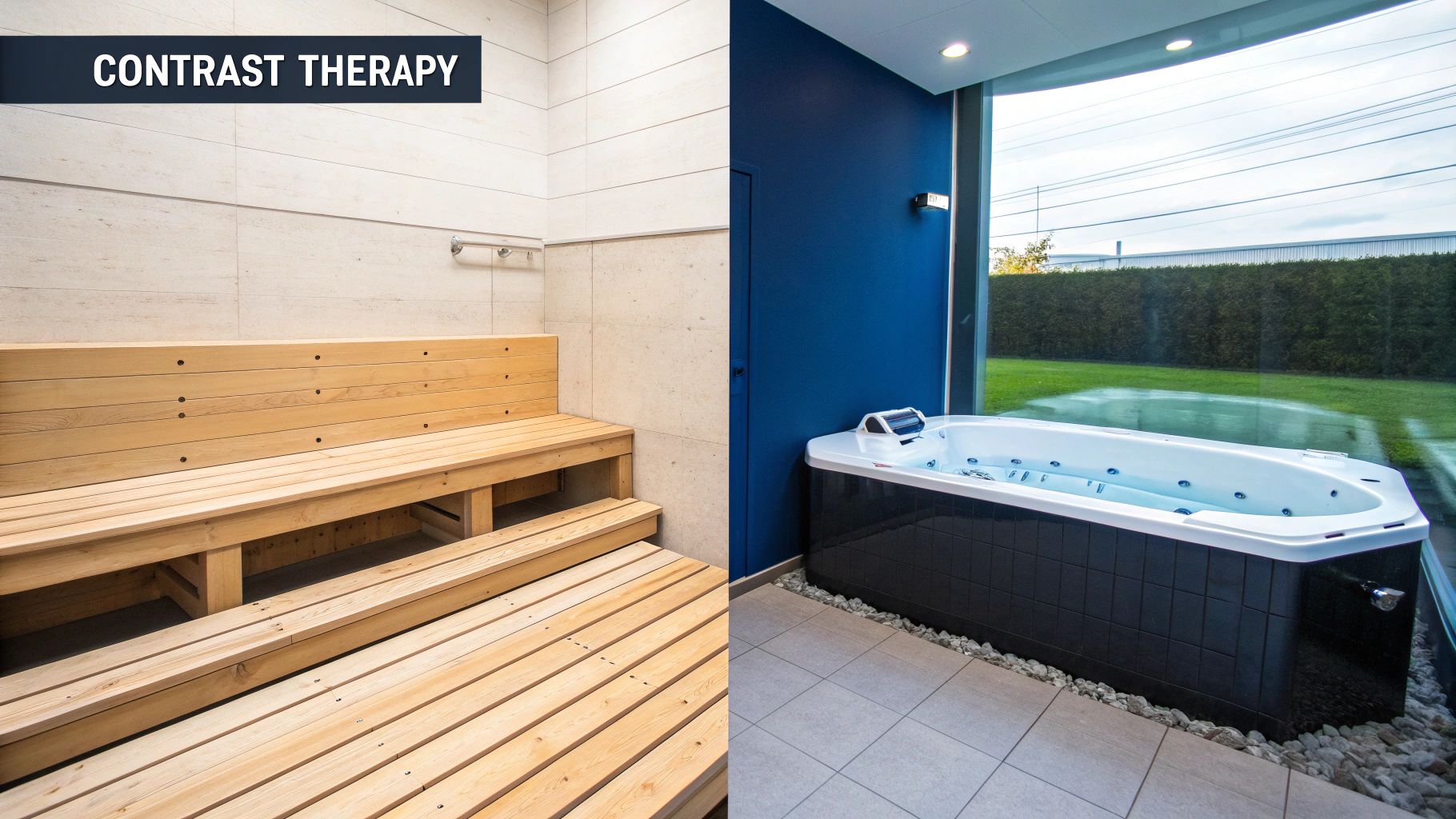
This isn't just about soothing sore muscles anymore. Stacking targets multiple biological pathways at once, from your circulation down to your cellular energy production, driving a much deeper and faster renewal. When you intelligently sequence these therapies, you build a routine that not only enhances performance but also fortifies your long-term resilience and overall wellness.
The Power of Contrast Therapy
One of the most potent stacking methods is contrast therapy: the practice of alternating between the deep, penetrating heat of an infrared sauna and the crisp, invigorating shock of a cold plunge.
This rapid hot-to-cold transition forces a powerful "pump" effect throughout your entire circulatory system. While you’re in the sauna, your blood vessels relax and widen (vasodilation), pushing blood flow to the surface. The moment you hit the cold plunge, they clamp down and constrict (vasoconstriction). This cycle is like a workout for your blood vessels, aggressively flushing out metabolic waste while pulling in fresh, nutrient-rich blood.
The health benefits of this circulatory flush are immediate and profound:
- Drastically Reduces Inflammation: The pumping action efficiently clears fluid buildup from overworked or injured tissues.
- Accelerates Waste Removal: It speeds up the clearance of byproducts like lactic acid that cause post-workout soreness.
- Drives Nutrient Delivery: Fresh, oxygenated blood is forced deep into muscles and connective tissues, fueling the repair process.
To really get into the weeds on this powerful technique, check out our complete guide to contrast therapy and its benefits.
Integrating Red Light Therapy
Red light therapy (RLT) is another fantastic partner for your infrared sauna. While both use specific wavelengths of light, they work on completely different levels to supercharge your recovery.
Infrared heat penetrates deep into muscle and joint tissue to boost circulation and ease aches from the inside out. Red light, on the other hand, works closer to the skin's surface, targeting cellular health directly.
Think of red light therapy as a charger for your cells' mitochondria. It provides a direct energy boost (ATP) that helps skin and superficial tissues repair themselves far more efficiently.
This makes it the perfect complement. The infrared sauna handles the deep, systemic work—circulation, core temperature, and detoxification—while red light provides targeted, on-site cellular repair. Using them together creates a comprehensive, full-body recovery experience that addresses healing from every angle.
A Layered Approach to Healing
Combining these therapies is especially effective because infrared saunas bring unique advantages to the table that traditional saunas just can't match. As Dr. Rhonda Patrick points out, the red light wavelengths found in some infrared saunas directly help reduce inflammation by optimizing mitochondrial function—a health benefit you won't get from conventional heat.
On top of that, research from the Cleveland Clinic has shown that the cardiovascular response from a single sauna session is comparable to a moderate walk. This improves circulation, which can help lower blood pressure and speed up muscle recovery. You can read the full analysis of infrared's impact on athlete performance to learn more.
Building your ultimate recovery routine is all about smart integration. By stacking proven therapies like contrast and red light with your infrared sauna sessions, you create a powerful, multi-faceted approach to healing that helps you bounce back faster and stronger every single time.
Your Top Questions About Infrared Sauna Recovery, Answered
Adding a new wellness tool to your routine always comes with a few questions. That's a good thing—it means you're being thoughtful about your health. Since an infrared sauna for recovery is a serious investment in your well-being, feeling confident is key. Let’s clear up some of the most common questions we get.
How Is an Infrared Sauna Different From a Traditional Sauna?
The magic is in how they heat you, and it completely changes the game for recovery.
A traditional sauna works by heating the air around you to scorching temperatures, usually between 70-100°C (158-212°F). Your body gets hot because the air is hot. It’s effective, sure, but that oppressive heat can feel suffocating and hard to tolerate for more than a few minutes.
Infrared saunas work differently. They use infrared light to warm your body directly, kind of like how the sun warms your skin on a cool day. The air itself stays at a much more comfortable 40-60°C (104-140°F). This allows the heat to penetrate deeper into your muscles and tissues without you having to endure that intense, stifling air.
Because the heat is gentler and more direct, you can stay in longer and get more profound therapeutic and health benefits. It's a more efficient way to boost circulation and kickstart cellular repair right where you need it most.
Are Infrared Saunas Safe for Everyone?
For most healthy people, absolutely. But they aren't a one-size-fits-all solution, and a few precautions are smart.
If you have a pre-existing health condition, you need to be cautious and chat with your doctor first. This is especially true for:
- Cardiovascular Issues: Conditions like unstable angina, a recent heart attack, or severe aortic stenosis don't mix well with heat stress.
- Low Blood Pressure (Hypotension): Heat can lower your blood pressure even more, which might lead to dizziness or fainting.
- Conditions That Affect Sweating: If your body can’t sweat properly (a condition called anhidrosis), you’re at a higher risk of overheating.
Pregnant women are also generally advised to skip the sauna, as raising core body temperature can pose risks. And for everyone, hydration is non-negotiable. Drink water before you get in, during your session, and after you get out. If you're new to it, start slow—15-20 minutes at a lower temp—and see how your body feels.
How Quickly Will I Notice Recovery Benefits?
This one varies, but you don't have to wait long to feel something.
Many people report feeling a deep sense of relaxation and less muscle tension after their very first session. For acute workout recovery, the effects are pretty quick. You can often feel a real difference in muscle soreness (DOMS) within 24 hours of a post-workout sauna. In fact, some research has shown that neuromuscular power, like the ability to jump, can bounce back just 30 minutes after a session.
The big, lasting health benefits—like better sleep, a more balanced nervous system, and the ability to train harder—come from consistency. Aim for 2-4 sessions a week to really build those benefits. And remember, recovery is a full-body effort; combining sauna use with other proven strategies, like the right supplements for muscle recovery, creates an even more powerful effect.
Can I Use My Phone Inside an Infrared Sauna?
We strongly recommend leaving it outside.
Even though the air isn't as hot as a traditional sauna, the sustained warmth and humidity can still do a number on your phone's sensitive electronics. It’s just not worth the risk of frying the battery or internal circuits.
More importantly, your sauna time is a golden opportunity to disconnect. The mental reset is just as crucial for your wellness as the physical one. When you allow your brain to switch off along with your body, the health benefits are so much deeper. Use the time for meditation, light stretching, or just quiet reflection. Detaching from the digital noise helps your nervous system truly shift into a restorative state. For more ideas on integrating wellness into your life, check out the MedEq Wellness Journal.
At MedEq Fitness, we believe in empowering you with the best science-backed tools for renewal. Our curated selection of infrared saunas is designed to meet the rigorous demands of athletes and wellness seekers alike, delivering clinic-quality recovery to your home.
Explore Our Collection of Infrared Saunas and Elevate Your Recovery