Infrared Sauna for Athletes: Science, Protocols & Results
You've got a hard training block, your legs are flat, and the staff room conversation turns to recovery. Someone wants a cold tub, someone else is talking about heat, and the athlete who just finished a two-a-day wants the simplest answer: what helps me feel and perform better tomorrow?
That's where infrared sauna for athletes has earned its place. Not as a shortcut, not as a replacement for sleep or smart programming, but as a targeted recovery tool that fits into real training rooms, travel days, and late-season grind. Used well, it's less about chasing a wellness trend and more about preserving readiness when the schedule keeps asking for more.
Why Athletes Are Turning to Infrared Sauna
The strongest case for infrared sauna usually starts after the session ends, not during it. A coach watches a group come off the field, everyone's breathing hard, and the usual recovery routine kicks in, band work, mobility, fluids, maybe a short conversation about who looks cooked and who looks ready for another load tomorrow. In that setting, heat is attractive because it feels efficient, low friction, and easy to repeat.
That practical appeal is part of why infrared sauna for athletes has moved from a luxury amenity into serious recovery spaces. It's the kind of modality that can be built around a team schedule without taking over the whole day. Athletes, coaches, recovery specialists, and facility managers usually want the same thing from it, a tool that supports comfort, readiness, and consistency without turning into another complicated ritual.
The useful mindset here is simple. Infrared sauna is most credible as a recovery and readiness tool, not a magic performance booster. It belongs in the same conversation as sleep, nutrition, load management, and the boring basics that keep athletes training. If you're also trying to understand adjacent recovery habits, the magic of bath salts is a useful contrast, because it shows how wellness practices can feel restorative even when the training-specific effects are very different.
For athletes who want a broader starting point on heat-based recovery, the sauna for sports recovery guide offers a helpful companion read. The key takeaway is not that heat replaces training. It's that well-timed heat can make hard work easier to repeat.
Practical rule: if a recovery method sounds like it should replace sleep, food, or smart loading, it's probably being oversold.
That's the lens that makes infrared sauna useful. It's a controlled dose of heat that can sit inside an athlete's week without demanding faith, hype, or a full lifestyle overhaul.
How Infrared Heat Reaches Muscle
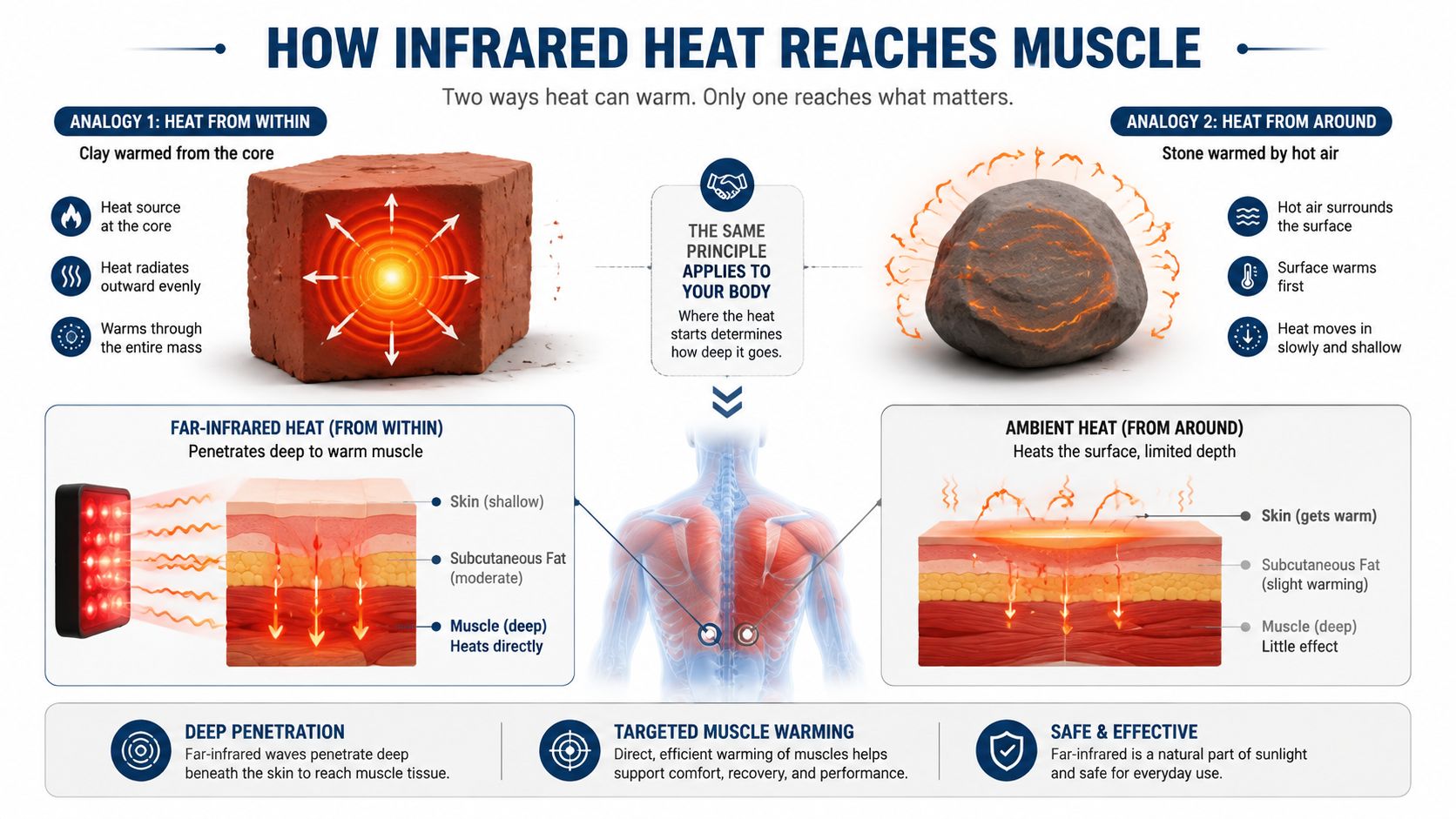
A cold room warms the air first. Infrared heat sends energy toward the body itself, so the athlete feels the load in tissue rather than only in the surrounding space. That difference is why far-infrared sauna is discussed separately from a conventional hot sauna.
Deep heat changes the working tissue, not just the air
The body responds to heat, tissue temperature, circulation, and the total stress the session adds on top of training. Reviews of far-infrared sauna describe a typical environment around 35 to 50°C with 25 to 35% humidity, and note that the infrared component can penetrate roughly 3 to 4 cm into tissue, which helps explain why it has been studied in recovery settings (PMCID: PMC4493260).
For athletes, that deeper warming can change how muscles and joints feel after hard work. A warmer muscle usually moves more comfortably, and a body that is less braced up is easier to return to on the next session. After eccentric work, sprint exposure, or repeated change-of-direction efforts, the practical goal is to reduce the sense that everything is locked down.
The effect is not just about comfort. A 2025 randomized study in team-sport athletes found that a single 10-minute post-exercise infrared sauna session improved next-day recovery of explosive strength, reduced soreness, and improved perceived recovery without harming acute autonomic recovery or sleep quality (PMC10286597). That is why practitioners pay attention to it. The aim is to help the athlete recover more cleanly inside the normal training week, not to create a shortcut around training.
Why mild heat often feels better than aggressive heat
The other advantage of infrared protocols is dose control. Mild heat around the ranges described above can feel restorative without the shock some athletes associate with higher-heat exposure. That matters in team environments where athletes arrive in very different states, some fresh, some sleep-deprived, some already carrying fatigue.
If you are looking for a practical home-recovery reference point, the best sauna for home recovery page is a useful companion because it frames infrared sauna around recovery use, not just comfort. For athletes, the key point is simple. Warmer is not automatically better. The right dose is the one that improves readiness the next day without adding avoidable strain.
A session should leave the athlete looser and calmer, not wrung out.
The working model is straightforward. Infrared heat is useful when it helps you recover into the next training dose, not when it just makes you sweat more.
What the Research Shows
The evidence has moved in a fairly clear sequence. Early endurance work first suggested that sauna could influence adaptation, later physiology reviews helped define the heat environment and its tissue effects, and recent athlete trials have shifted the focus toward readiness, soreness, and short-term performance after hard sessions.
Early work pointed to endurance adaptation
The classic reference point is the 2007 endurance-runner study. After training, 12 sauna sessions over 3 weeks increased running time to exhaustion by 32%, improved endurance performance by about 2%, and raised plasma and red-cell volume by 7.1% versus control. That study mattered because it showed heat exposure could influence performance-related physiology, not just relaxation, and the original sports-performance discussion is summarized in the interacthealthpro.com article.
For athletes, the practical takeaway is narrower than the headline. Heat can support endurance adaptation under some conditions, but it does not mean every athlete needs sauna blocks to get faster. The result is encouraging, not universal.
More recent trials are about recovery, not hype
The newer work is more relevant to day-to-day coaching. Research in team-sport athletes has shown that post-exercise infrared sauna can reduce soreness, improve perceived recovery, and preserve explosive output the next day (University of Jyväskylä). A 2024 review also reported that repeated post-exercise infrared sauna use did not significantly change hypertrophy, but may improve long-term power production, including loaded jump tests and faster 5 m sprint split times (PMC11913669).
That difference matters. Coaches care about whether an athlete can produce force, jump, and sprint with better quality between sessions. They are not usually asking whether a recovery tool creates muscle on its own. A 2025 trial in 40 female team-sport athletes found that repeated post-exercise infrared sauna helped preserve jump and sprint-related performance and reduced soreness over 6 weeks, but did not increase hypertrophy over that period.
If you want a broader practitioner overview, the MedEq Fitness infrared sauna guide collects the same recovery theme in a more consumer-facing way. The evidence pattern is consistent enough to matter, but still narrow enough to stay honest.

Bottom line: the best-supported outcomes are soreness reduction, perceived recovery, and better neuromuscular readiness, not muscle growth.
The most defensible reading of the research is that infrared sauna helps athletes recover into their next output window. That is valuable, but it is not the same thing as making the training stimulus itself bigger.
Building a Practical Protocol
The protocol should fit the athlete, not the other way around. A heavy training week, a taper week, and a travel week all call for different heat doses, and the main decisions are timing, duration, temperature, frequency, and hydration.
Start with timing and session length
Post-workout is the most practical choice when recovery is the goal. That is also the setting used in athlete trials that reported less soreness and better next-day readiness. Evening sessions can work when they do not interfere with sleep, while off-day sessions make sense for athletes who want a lower-stress recovery block.
The studied range in sports-recovery literature is roughly 35 to 50°C, with practical protocols often sitting in the mild-to-moderate zone rather than pushing maximum heat. The post-exercise sessions described above are short, and the 10-minute protocol from the 2025 team-sport trial shows that meaningful recovery outcomes do not always require long exposure (PMC10286597).
A workable coaching approach looks like this:
- Post-workout on heavy days: keep it short, especially after sprinting, lifting, or repeated eccentric work.
- Evening on moderate days: use it when the athlete is calm, fed, and not already overheated.
- Off-day recovery: use it when the goal is tissue warmth and relaxation rather than acute performance prep.
Adjust the dose to the athlete, not the calendar
A bigger, sweatier, more heat-acclimated athlete may tolerate the same cabin differently than a lighter athlete or someone training in a hot climate. Same-day training load matters too. If the session already included high sprint volume or a brutal lifting block, the sauna dose should stay conservative.
Hydration and cooldown are not optional. Practical athlete-facing guidance consistently emphasizes pre-session water, post-session fluids, and a few quiet minutes to normalize before jumping straight back into the day (saunacloud.com). For a simple weekly pattern, heavy training weeks usually favor shorter, post-session use, while taper weeks can tolerate slightly more flexibility because the athlete is not carrying as much accumulated fatigue.
If the athlete leaves the sauna dehydrated, lightheaded, or flat for the next session, the dose was too aggressive.
That is also the point where a commercial recovery setup may be worth considering. A home or facility unit from MedEq Fitness can make consistent use more realistic for teams and private athletes, but the same rules still apply. Equipment does not fix poor dosing.
Infrared Sauna Versus Cold Plunges and Contrast
The recovery world loves false choices. Heat gets sold as if cold doesn't matter, and cold gets sold as if heat is soft. In practice, each modality serves a different problem, and athletes do better when the choice matches the training stress.
Match the method to the workout
Infrared sauna is a better fit after hard sport-specific work when the goal is to preserve neural output and feel ready again. Cold exposure makes more sense when the immediate priority is to calm swelling, especially after late-day hypertrophy sessions or when tissue irritation is the main issue. Contrast therapy sits in the middle for athletes who want both, but it should be planned instead of improvised.
The old “always ice after training” rule doesn't fit every sport. Explosive-sport athletes, field players, and skill-based performers often care more about how their nervous system feels tomorrow than whether today's session was aggressively blunted. That's why the heat-versus-cold choice needs context.
Sequence matters more than branding
A sequenced contrast approach is usually best when the athlete has a clear reason to use both modalities, not because it sounds advanced. Heat first can help the athlete downshift and restore comfort, while cold at the end may be better when the main objective is reducing the sense of swelling after late-day loading. There isn't a universal winner.
For athletes who use both regularly, the key question is what the next training session demands. If the next day requires crisp jumps, fast feet, or technical work, heat often makes more sense. If the athlete is carrying obvious local irritation or post-lift swelling, cold may deserve the last word.
If you're comparing recovery stacks, the sauna cold plunge for sleep discussion is a useful companion because sleep is where these choices often show up. The point isn't to worship one modality. It's to use the right one for the right adaptation problem.
What Infrared Sauna Will Not Do for You
An infrared sauna session can leave an athlete feeling looser, calmer, and more ready to train again. It will not build muscle on its own. It will not fix a poorly designed program, and it will not make up for short sleep, low protein intake, or a training load that never gets backed off. Repeated post-exercise infrared sauna has not shown meaningful hypertrophy gains, even though it may help power and readiness in some settings.
That boundary matters in practice. Athletes can mistake recovery comfort for adaptation, then keep using heat while the underlying issue, sleep, calories, or total stress, stays untouched. If the sauna is being used to avoid dealing with that problem, it becomes a distraction instead of a tool.
The sports talk around “detox” and broad longevity promises does little for actual training decisions. The better question is direct, does the session help the athlete come back tomorrow with better readiness? If yes, it earns a place in the recovery plan. If it only feels pleasant, it can still have a role, but that role is limited to a low-risk wellness add-on.
A better way to judge it is with readiness markers, not mood alone. Soreness, jump output, sprint sharpness, HRV trends, sleep quality, and whether the athlete still has pop in the next session all matter more than how impressive the heat feels in the moment. When those markers move in the wrong direction, the sauna dose is probably too large or too close to hard work.
Safety, Hydration, and Who Should Adjust the Dose
The safety conversation needs to stay specific. Infrared sauna is usually studied in fairly mild thermal ranges, but athletes also deal with dehydration, travel fatigue, menstrual cycle variability, hot climates, and accumulated heat load from training and competition.
Who should modify or avoid the session
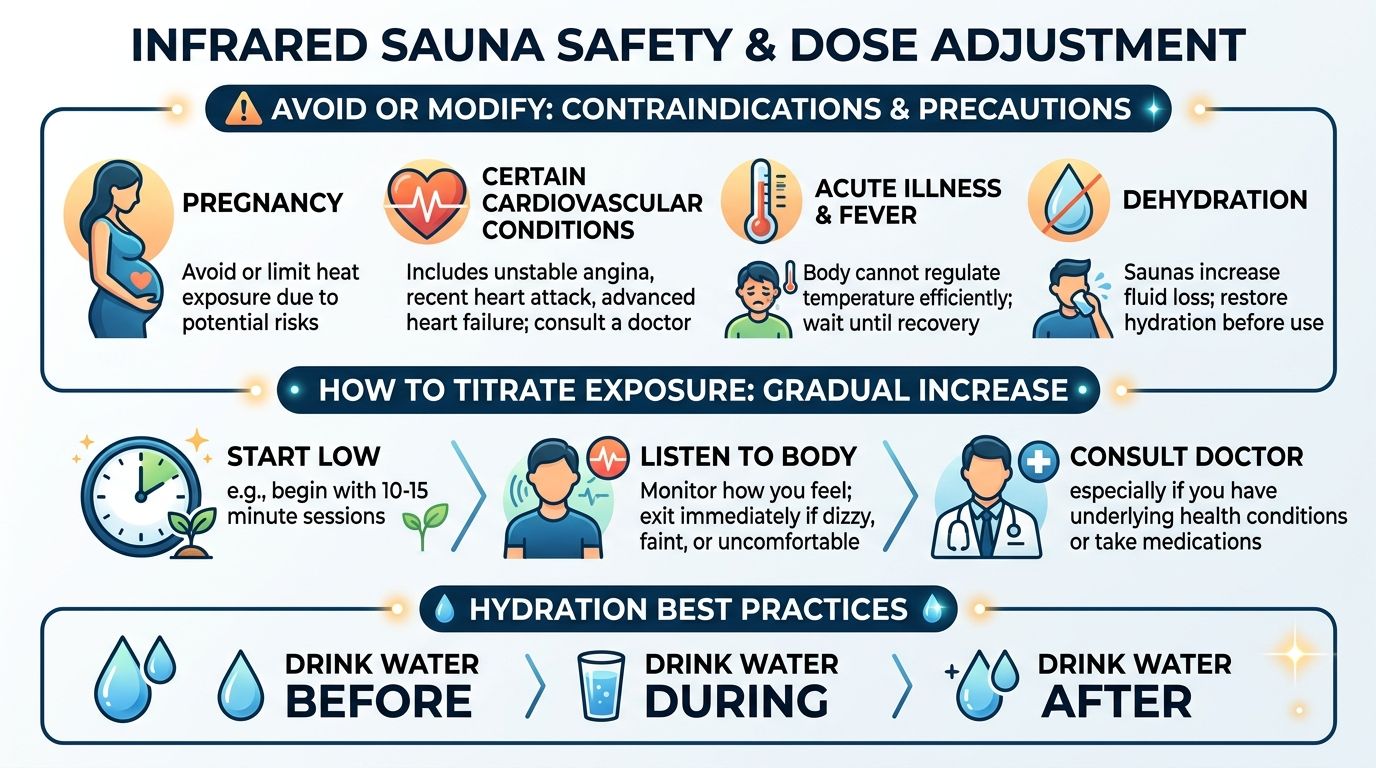
Pregnancy, certain cardiovascular conditions, acute illness, and dehydration are clear reasons to pause or avoid the session. Athletes with heat intolerance, recent gastrointestinal illness, or a history of poor fluid replacement should also scale back and get individualized guidance. For trained athletes, the practical range described in the literature is usually a session around 35 to 50°C or 43±5°C for 20 to 40 minutes, with hydration and cool-down built in.
Women, masters athletes, and high-volume trainees in hot environments should be cautious about stacking sauna on top of already stressful sessions. Heavier athletes and those who sweat heavily may tolerate more heat, but that does not mean they should automatically use more. The dose still needs to match the total training day and the athlete's current recovery state.
Use hydration and acclimation like training variables
A sensible checklist is boring, and that is a good thing.
- Start low: keep the first sessions short and easy to exit.
- Watch the body: dizziness, headache, nausea, and unusual fatigue mean the dose is too high.
- Hydrate before, during if needed, and after: treat fluids as part of the protocol, not an afterthought.
- Cool down deliberately: give the body time to normalize before rushing to the shower, car, or next meeting.
- Get medical input when needed: especially if the athlete has a health condition, is pregnant, or is returning from illness.
For athletes who want a broader safety discussion around the sweating response, the sweating in an infrared sauna article is a useful companion. Sweat is not the goal by itself, and more sweat is not always better.
The safest protocols are the ones athletes can repeat without getting flattened. That means conservative heat, good fluid habits, and honest feedback from the body. When the sauna leaves an athlete flatter, more dehydrated, or slower to rebound, the first fix is usually shorter sessions and better timing, not more heat.
Putting It All Together in Your Training Week
A strength-and-power athlete in-season usually does best with short post-workout sessions on the hardest days, then backs off or skips sauna when travel, sleep loss, or heat stress start to pile up. During a deload week, the goal shifts toward comfort and readiness, so the timing can be more flexible. In competition week, sauna often belongs away from the main event window, especially if weigh-ins, travel, or environmental heat already push the athlete close to the edge.
Track whether the protocol is working with simple markers. Use soreness scores, a short readiness questionnaire, jump or grip output, HRV trends, and sleep quality. If the athlete looks flatter, less hydrated, or more irritable after sauna use, reduce the duration first, then reconsider timing.
For athletes and facilities building a longer-term recovery setup, MedEq Fitness offers recovery equipment that includes full-spectrum infrared saunas, along with other tools used in sports recovery spaces. If you want to compare recovery modalities and build a setup that matches your training load, visit MedEq Fitness and choose the option that fits your program, your space, and your schedule.