
How to Lower Resting Heart Rate: A Guide to Enhancing Your Wellness
If you've ever wondered what that "resting heart rate" number on your fitness tracker really means for your overall wellness, you're in the right place. Learning how to lower it is one of the most powerful things you can do for your health, blending smart exercise with strategic workout recovery and a few key lifestyle tweaks.
A lower number isn't just a vanity metric; it's a sign of a stronger, more efficient heart, which directly impacts your long-term health, longevity, and how you feel every single day.
Why Your Resting Heart Rate Is a Vital Health Metric

Think of your resting heart rate (RHR) as a direct window into your cardiovascular engine. It's the number of times your heart beats per minute (bpm) when you're completely relaxed, and it shows how hard your heart has to work just to keep the lights on.
A lower RHR is a hallmark of a strong, efficient heart and a key indicator of overall wellness. Just like lifting weights builds your biceps, consistent training strengthens your heart muscle. A fit heart can pump more blood with every single beat, which means it doesn't have to beat as often to supply your body with the oxygen it needs, reducing wear and tear over a lifetime.
Understanding the Ranges: Normal vs. Optimal
You'll often hear that a "normal" adult RHR is between 60 and 100 bpm. But honestly, that's a massive range. Most health and performance experts agree that consistently sitting below 80 bpm is a much better indicator of good cardiovascular health.
For people who are active, an "optimal" RHR often drops into the 40 to 60 bpm range. Some elite endurance athletes even dip into the high 30s.
When you look at it that way, a higher RHR means your heart is working overtime, even when you're just kicking back on the couch. Over months and years, that sustained strain can add up, increasing the risk for long-term health issues.
Your RHR is one of the most accessible and telling metrics you can track. A downward trend over time is a clear sign that your fitness and recovery strategies are paying off, leading to improved longevity, better daily performance, and enhanced overall wellness.
What the Numbers Mean
To give you a clearer picture, here's a quick breakdown of where your RHR might fall on the fitness spectrum. Use this table to see where you are now and what you can aim for.
Resting Heart Rate Categories and What They Mean
| RHR Category | Beats Per Minute (BPM) | Associated Fitness Level |
|---|---|---|
| Excellent | < 60 | Athlete-level cardiovascular fitness and excellent health |
| Good | 60-69 | Strong cardiovascular health, often seen in active individuals |
| Above Average | 70-79 | Decent fitness, but with clear room for improvement |
| Average | 80-89 | Indicates a more sedentary lifestyle; a good starting point for change |
| Poor | 90+ | Suggests very low fitness and potentially elevated health risks |
This table isn't a medical diagnosis, but it’s a great tool for personal benchmarking. Seeing your number move from "Average" to "Above Average" is incredibly motivating.
The Clear Link Between Activity and a Lower RHR
The connection here is undeniable: get moving, and your heart gets stronger. Regular aerobic exercise is the single most effective tool for lowering your RHR.
Need proof? A study comparing cardiovascular fitness in active and inactive male students found the active group's average RHR was 68.2 bpm. The inactive group? 75.6 bpm. That’s a difference of more than 7 beats every single minute of every day.
The data confirms what we know from experience: a more active lifestyle leads directly to a more efficient, healthier heart.
Here’s a quick summary of the health benefits of a lower RHR:
- Improved Heart Efficiency: A stronger heart pumps more blood per beat, reducing its total workload and promoting longevity.
- Reduced Risk of Cardiovascular Events: A lower RHR is consistently associated with a decreased risk of heart-related issues down the road.
- A Barometer for Recovery: Watching your RHR can tell you how well your body is bouncing back from workouts and daily stress.
- Enhanced Longevity: Studies show that a consistently lower RHR is linked to a longer, healthier life.
Ultimately, putting in the work to lower your resting heart rate is a direct investment in your long-term health, building a foundation for vitality and resilience. For more insights on building a healthier, stronger body, check out our MedEq Wellness Journal.
f you want to dive deeper, you can learn more about how to improve heart rate variability right here.
Building Your Aerobic Engine with Smart Cardio

When it comes to lowering your resting heart rate, consistent cardiovascular exercise is the undisputed champ. But there’s a difference between just logging miles and training smart. The goal is to build a more powerful, efficient heart, and that requires intention.
Instead of a one-size-fits-all approach, a truly effective cardio plan blends different intensities. The two power players here are low-intensity, steady-state training (often called Zone 2) and high-intensity interval training (HIIT). They might seem like opposites, but they work together perfectly to strengthen your entire cardiovascular system.
The Power of Zone 2 Training
Zone 2 is the foundation of your entire aerobic base. This is your "conversational pace" cardio—an intensity where you could chat with a friend without gasping for air. It often feels deceptively easy, but don’t be fooled. The real magic is happening at the cellular level.
Training in Zone 2 makes your body incredibly efficient at burning fat for fuel. More importantly, it stimulates the growth of mitochondria, which are the tiny power plants inside your cells. More mitochondria means your body can produce more energy with less effort, putting far less stress on your heart over the long haul.
This type of training directly strengthens the heart's left ventricle, the chamber that pumps oxygenated blood to your entire body. A stronger ventricle pushes out more blood with each beat (this is your stroke volume), so your heart doesn't have to beat as often when you're resting. This is a core health benefit of consistent exercise.
Zone 2 isn't about redlining; it's about building a deep, resilient aerobic engine. Think of it as laying a strong foundation for a house—the better the foundation, the more you can build on top of it. A solid goal is to aim for 150-180 minutes of Zone 2 cardio each week.
The key to consistency is finding a form of Zone 2 cardio you actually enjoy. Running is a classic, but there are plenty of other options. Our guide on low-impact cardio machines is a great place to find alternatives that are easier on the joints but just as effective.
Strategic Bursts of High-Intensity Interval Training
If Zone 2 builds the foundation, High-Intensity Interval Training (HIIT) raises the roof. HIIT involves short, all-out efforts followed by brief recovery periods. This is an incredibly potent tool for improving your VO2 max—the maximum amount of oxygen your body can utilize during intense exercise.
A higher VO2 max is tightly linked to a lower resting heart rate and fantastic cardiovascular health. HIIT workouts force your heart to adapt to rapid changes in demand, making it more robust and responsive.
But with HIIT, more is definitely not better. It’s incredibly demanding on your nervous system, so one to two sessions per week is plenty for most people. Trying to do too much can actually spike your stress hormones and raise your RHR, completely undermining your goal.
A simple, effective HIIT protocol could be:
- Warm-up: 5-10 minutes of light movement.
- Intervals: 30 seconds of max effort (like sprinting on a bike) followed by 60-90 seconds of easy recovery. Repeat this 6-8 times.
- Cool-down: 5-10 minutes to bring your heart rate down.
Creating a Balanced Weekly Cardio Schedule
The real secret to dropping your resting heart rate is combining these two training styles. This approach builds both your deep endurance and your peak capacity, all without leading to burnout.
Here’s a look at how you could structure a week:
Beginner Schedule:
- Monday: 30-45 minutes Zone 2 (brisk walking, light cycling)
- Wednesday: 45 minutes Zone 2
- Friday: 30 minutes Zone 2
Intermediate Schedule:
- Monday: 45-60 minutes Zone 2 (jogging, rowing)
- Tuesday: 20-minute HIIT session
- Thursday: 60 minutes Zone 2
- Saturday: 30 minutes Zone 2
This kind of blend ensures you're consistently stimulating your aerobic system while also pushing your limits just enough to keep improving. If you want to dive deeper into building that engine, check out comprehensive guides on how to improve running endurance.
At the end of the day, consistency is king. Whether you're walking, running, or rowing, dedicating time each week to smart cardio is a direct investment in a stronger, healthier heart.
Mastering Workout Recovery for Sustained Progress

The real magic in fitness happens not during that final, grueling rep, but in the hours of recovery that follow. This isn't just about putting your feet up. Smart workout recovery is an active strategy for calming your nervous system and clearing out inflammation—both of which have a direct impact on your resting heart rate (RHR).
Think of your body as running on two different systems. You’ve got the sympathetic "fight-or-flight" mode that kicks in during a tough workout, and the parasympathetic "rest-and-digest" mode that handles all the repair work. The faster you can switch from high-alert to chill-out after training, the more efficient your recovery becomes.
If your RHR is consistently high, it’s often a sign that your body is stuck in a low-grade stress mode, never fully shifting into that crucial repair state. By deliberately adding recovery practices into your routine, you’re training your nervous system to make that switch faster and more completely. The result? A stronger heart that doesn't have to work so hard when you're at rest.
Activating Your "Rest-and-Digest" System
The entire goal of a good workout recovery plan is to flip that parasympathetic switch. This is the system in charge of slowing your heart rate, improving digestion, and getting down to the business of cellular repair. When you consistently do things that encourage this state, your body adapts, and your baseline RHR will start to drop.
A few simple techniques are incredibly effective here:
- Deep Belly Breathing: It sounds almost too simple, but slow, deep, diaphragmatic breaths can immediately lower your heart rate. Just five minutes of focused breathing after a workout sends a powerful signal to your brain that the "threat" is over and it's time to relax.
- Gentle Movement: We're talking about active recovery here—a light walk, an easy spin on the bike, or some foam rolling. This kind of low-intensity movement helps flush metabolic byproducts like lactate from your muscles without piling on more stress.
- Mindfulness & Meditation: Even a quick 5- or 10-minute meditation session can do wonders for your nervous system. It helps dial down the stress hormones that keep your heart rate unnecessarily elevated long after your workout is done.
These practices are the bedrock of smart recovery. They help you bounce back faster and pave the way for a healthier, lower resting heart rate.
The ability to consciously shift your nervous system from a stressed state to a relaxed one is a trainable skill. The more you practice it, the lower your baseline stress level—and your resting heart rate—will become.
Advanced Recovery Tools for Heart Health
For those ready to take recovery to the next level, some advanced tools can give your body’s natural repair processes a serious boost. Two of the most effective for cardiovascular health and overall wellness are contrast therapy and red light therapy.
Contrast therapy is the practice of alternating between hot and cold environments, such as a sauna and a cold plunge. This creates a powerful "pump" for your entire circulatory system. The heat causes your blood vessels to open up (vasodilation), and the cold forces them to narrow (vasoconstriction). This rapid switching acts like a workout for your blood vessels, improving their elasticity and boosting circulation. The process flushes out inflammation and delivers fresh, oxygen-rich blood to your tissues more effectively, reducing the overall load on your heart and accelerating workout recovery.
Red light therapy is another game-changer. It works on a cellular level, using specific wavelengths of light to energize your mitochondria—the tiny powerhouses inside your cells. This helps fight oxidative stress and inflammation, two major culprits behind an elevated RHR.
Here’s a quick breakdown:
| Recovery Modality | How It Works | Key Wellness Benefits for RHR |
|---|---|---|
| Contrast Therapy | Vasodilation & Vasoconstriction | Improves circulation, reduces inflammation, enhances workout recovery. |
| Red Light Therapy | Mitochondrial Stimulation | Lowers oxidative stress, reduces systemic inflammation, aids cellular repair. |
By incorporating these focused strategies, you're not just recovering; you're actively teaching your body to be more efficient at repair and relaxation. This builds a more resilient cardiovascular system, something you’ll see reflected in a steadily decreasing RHR. To explore more advanced wellness tools, check out our MedEq Wellness Journal.
Manage Stress, Sleep, and Nutrition to Lower Your RHR
What you do in the hours outside the gym often has the biggest impact on your heart health. Your daily habits around stress, sleep, and nutrition are powerful levers for lowering your resting heart rate.
Think of it this way: these habits calm your nervous system, reducing the background static that keeps your heart working harder than it needs to.
When you're constantly under pressure, your body is flooded with stress hormones like cortisol. This keeps your "fight-or-flight" response chronically switched on, leading to an elevated heart rate that sticks around long after the stressor is gone.
Tame Your Stress Response
To effectively lower your RHR, you have to learn how to intentionally shift your body back into its "rest-and-digest" state. This isn’t about eliminating stress—that’s impossible. It’s about managing your reaction to it.
Simple, consistent practices can make a world of difference.
Techniques like box breathing (inhale for four, hold for four, exhale for four, hold for four) can immediately soothe your nervous system. Even five minutes of mindfulness meditation each day trains your brain to be less reactive to daily triggers.
For anyone feeling like their stress response is stuck in overdrive, it can be incredibly helpful to understand the nervous system's role in trauma responses. This knowledge offers powerful context for why your body might be holding onto stress.
Prioritize Quality Sleep—It’s Non-Negotiable
Sleep is when your body does its most important repair work, a cornerstone of any effective wellness plan.
During deep sleep, your heart rate and blood pressure finally drop, giving your entire cardiovascular system a much-needed break. Skimping on sleep denies your body this critical recovery window, leaving your nervous system frayed and your RHR stubbornly high.
Aiming for 7-9 hours of quality sleep each night is non-negotiable for heart health. This is what allows your body to complete all the necessary sleep stages for hormonal balance and cellular repair. If your heart rate stays high all night, it's a glaring sign your body isn't fully recovering.
A consistent sleep schedule is one of the most powerful tools for lowering your resting heart rate. Your heart rate naturally follows a curve during sleep, ideally reaching its lowest point around the middle of the night. That dip is a sign of true recovery.
To improve your sleep, focus on building a solid evening routine. Try shutting off screens an hour before bed, keeping your room cool and dark, and hitting the hay at the same time each night. If you’re struggling to get that restorative rest, check out our guide on how to increase deep sleep.
Fuel Your Body for a Calmer Heart
Your diet provides the building blocks for every single function in your body, and that includes heart regulation. A few simple nutritional tweaks can have a surprisingly direct impact on your RHR.
- Hydration is Key: Dehydration thickens your blood, forcing your heart to pump harder. Staying hydrated is one of the easiest wins for supporting a lower RHR.
- Limit Stimulants: Caffeine and nicotine directly rev up your heart rate. Cutting back, especially in the afternoon and evening, helps keep your RHR in a healthier range.
- Moderate Alcohol: A drink might feel relaxing, but alcohol often disrupts sleep and elevates your heart rate overnight as your body works to metabolize it.
These daily habits, along with factors like age and gender, play a huge role in your heart rate trends. A global analysis of wearable data showed that average resting heart rates tend to decrease after age 40, and women generally have a slightly higher RHR than men. It also highlighted how lifestyle and location matter, with users in the U.S. and Singapore averaging a higher RHR (65.9 bpm) than those in Italy (61.8 bpm). You can dive into more of these fascinating findings here.
How To Track Your Progress And Spot Red Flags
Lowering your resting heart rate is a long game. It's a marathon, not a sprint. To stay motivated and make sure you’re actually moving the needle, you need a smart way to track your progress and understand what the numbers are telling you.
Think of your RHR as a direct line of communication with your cardiovascular system. It gives you honest feedback on how your training, workout recovery, and lifestyle are all clicking together.
Getting An Accurate RHR Measurement
Accuracy is everything. A bad measurement can send you down a rabbit hole of unnecessary worry or, worse, give you a false sense of security. Whether you’re using a fancy wearable or just your own two fingers, when and how you measure matters.
The best time is right when you wake up—before you get out of bed, before the coffee hits, and definitely before you start scrolling through your phone. This is when your body is in its most rested state, giving you the cleanest baseline possible.
You've got two main options here:
- Wearable Devices: Smartwatches and fitness trackers are great because they do the work for you, often averaging your RHR while you sleep or during periods of total stillness. It’s the easiest way to collect data over the long haul.
- The Manual Method: No tracker? No problem. Just place two fingers (not your thumb!) on the inside of your wrist or the side of your neck. Count the beats for 30 seconds and double that number to get your beats per minute.
Whichever way you go, just be consistent. Measuring at the same time and under the same conditions every day is what builds a dataset you can actually trust.
Focus On The Trend, Not The Daily Blips
Look, your RHR is going to bounce around. A rough night's sleep, a stressful workday, or a heavy dinner can all cause a temporary spike. If you get hung up on these daily fluctuations, you'll drive yourself crazy.
Instead, zoom out. Pay attention to your weekly and monthly averages. A steady downward trend over several weeks is the real prize—it's a clear signal that your heart is getting stronger and more efficient. That long-term view is where you’ll see your hard work paying off.
Don’t freak out over one high reading. A successful journey is defined by the overall downward trend, not by daily perfection. Celebrate the big-picture progress.
Interpreting Your RHR Trends What to Look For
So, what do those trends actually mean? Your RHR data is telling you a story about how your body is responding to training, stress, and recovery. This table breaks down a few common patterns and what they might be signaling.
| RHR Trend | Potential Cause | Recommended Action |
|---|---|---|
| Steady Decline | Improved cardiovascular fitness, better workout recovery. | Keep up the great work! Your current plan is effective. |
| Sudden, Sharp Spike | Illness, overtraining, high stress, poor sleep. | Prioritize rest, hydration, and stress management. Consider a deload week. |
| Gradual Increase | Overtraining creeping in, accumulated life stress. | Review your training volume and intensity. Increase recovery activities. |
| Stagnant or Plateaued | Your body has adapted to your current routine. | Introduce new stimuli: vary your workouts, add interval training, or adjust intensity. |
This isn't about diagnosing anything, but rather about learning to listen to your body's feedback. Use these trends as a guide to fine-tune your approach and stay on the right track.
When To Pay Closer Attention: The Red Flags
While day-to-day changes are normal, some patterns are worth a closer look and might even warrant a chat with your doctor.
A consistently high RHR (say, above 85-90 bpm) that doesn't budge despite your best efforts is one of those flags. Another is a sudden, sustained jump in your RHR that hangs around for several days without an obvious cause like being sick or under immense pressure.
This flowchart gives you a quick mental checklist for those moments when your heart rate seems a bit high.
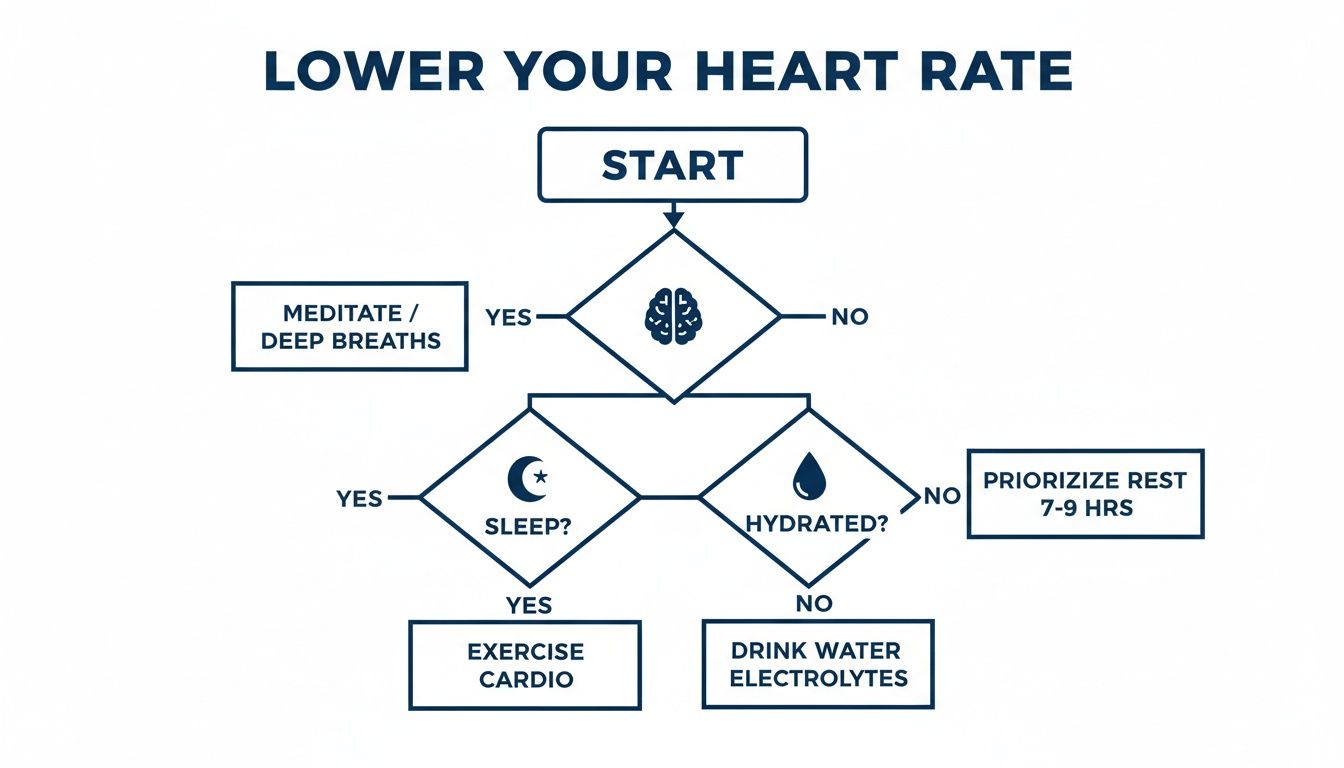
As you can see, the basics—stress, sleep, hydration—are often the first and most powerful levers to pull.
It's also worth keeping an eye on your heart rate variability (HRV), which measures the tiny variations in time between heartbeats. A higher HRV is a fantastic indicator of a well-rested, resilient nervous system. If you want to dive deeper, you can learn more about how to improve heart rate variability right here.
Your Questions About Lowering Heart Rate Answered
As you start working on your resting heart rate, some questions are bound to come up. It's totally normal. Getting the details straight is what keeps you moving in the right direction without getting discouraged. Let’s tackle some of the most common ones I hear.
How Long Does It Take To Lower My Resting Heart Rate?
This is always the first question, and the honest answer is: it really depends on where you're starting and how consistent you are. You won't see a huge drop overnight. Generally speaking, if you stick to a solid routine of aerobic exercise, better sleep, and stress management, you can expect a noticeable downward trend in about 8 to 12 weeks.
You might see some small, initial changes in just a few weeks as your nervous system starts to adapt. But the deep, lasting changes—the ones that come from your heart muscle literally getting stronger—take a bit more time. Patience and consistency are everything here.
Can Strength Training Also Help Lower RHR?
Absolutely. Its effect is a bit more indirect than cardio, but it plays a powerful supporting role. While aerobic exercise is the main driver for lowering your RHR, strength training is crucial for building a more efficient body. More muscle mass boosts your overall metabolic rate, which helps with weight management—a major factor in reducing the strain on your heart.
Plus, a good strength program makes your body more resilient. It lowers the total stress load on your system, which in turn helps calm your nervous system and contributes to a lower RHR over time. Think of it as upgrading your body's engine and chassis all at once.
Why Is My RHR High Even Though I Exercise?
This can be a really frustrating one, but it’s often a clear sign that another piece of your wellness puzzle needs attention. If your workouts are on point but your RHR is still high, it's time to look beyond the gym.
The usual suspects include:
- Overtraining: Pushing too hard, too often, without enough workout recovery time will keep your body in a stressed-out state, jacking up your RHR.
- Chronic Stress: If life or work has you constantly on edge, your "fight-or-flight" system stays switched on, and that directly impacts your heart rate.
- Poor Sleep: A lack of deep, quality sleep means your body never fully repairs itself, leading to an elevated baseline RHR.
- Dehydration or Poor Nutrition: Even being a little dehydrated forces your heart to work harder. The same goes for a diet heavy in stimulants or processed foods.
If your heart rate stays high despite consistent exercise, don't just train harder. Treat it as a signal. Your body is telling you to investigate your recovery, stress, and sleep. Your RHR reflects your total load, not just your workout.
What Is the Best Time to Measure My RHR?
For the most accurate reading, measure your resting heart rate first thing in the morning. I mean right after you wake up—before you get out of bed, before you grab your phone, and definitely before that first cup of coffee. This is when your body is in its most rested state.
Measuring at this exact time gives you a clean, reliable baseline. It filters out all the noise from daily activity, food, and stress. Doing it consistently is what allows you to see your true progress over weeks and months. For more tips like this, check out the MedEq Wellness Journal.
At MedEq Fitness, we believe optimizing your recovery is just as important as your training. Our curated selection of science-backed wellness equipment, from cold plunges and saunas to red light therapy devices, is designed to help you lower your heart rate, improve sleep, and accelerate your progress. Explore our collection of professional-grade recovery tools today.


