Infrared Sauna Vs Traditional Sauna: Choosing Your Path to Wellness
When you're looking at an infrared sauna vs a traditional sauna, the real difference comes down to how they make you sweat. It's a tale of two heating methods, each offering a unique pathway to enhanced wellness and recovery.
An infrared sauna uses light to heat your body directly. Think of it like the sun's warmth on your skin, but without the harmful UV rays. This creates a deep, penetrating heat at much lower temperatures. A traditional sauna, on the other hand, is all about heating the air around you with an electric or wood stove, which in turn heats your body.
One isn't automatically better than the other, but one will absolutely be a better fit for your personal wellness goals. Are you focused on deep tissue recovery after a tough workout? Or are you chasing that intense, cardiovascular rush for heart health? The answer will point you in the right direction. For more insights into wellness strategies, explore the MedEq Wellness Journal.
Infrared Vs Traditional Sauna: A Quick Breakdown
The experience in each sauna is night and day. A traditional sauna hits you with a blast of intense, ambient heat, while an infrared session feels gentler, warming you from the inside out for a deep, therapeutic sweat.
This is the core difference in a nutshell:
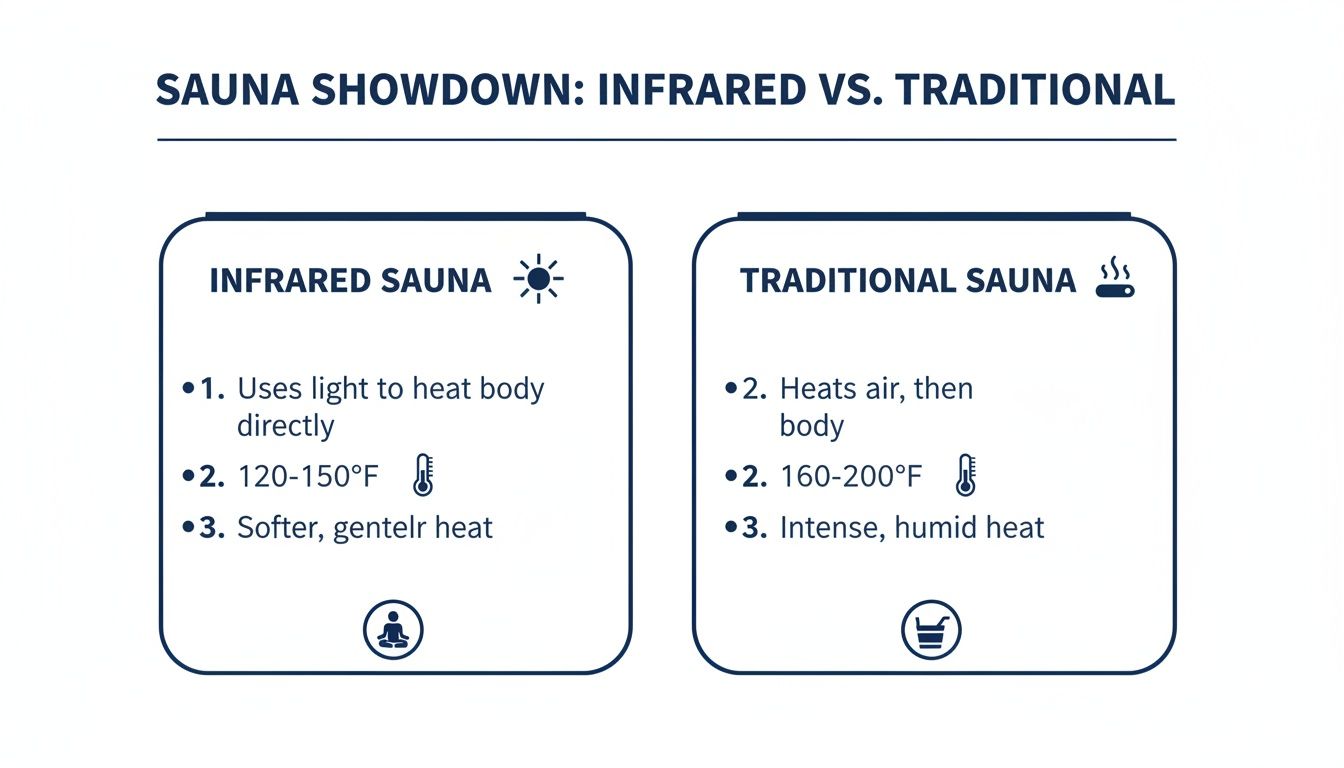
As you can see, traditional saunas run significantly hotter, creating a powerful heat experience that challenges the body. Infrared saunas achieve profound health benefits in a much milder environment.
Key Differences At a Glance
To make it even clearer, let's put them side-by-side. This table cuts through the noise and lays out the fundamental differences you need to know to align a sauna with your health and wellness objectives.
| Feature | Infrared Sauna | Traditional Sauna |
|---|---|---|
| Heating Method | Uses infrared light to heat your body directly with radiant heat. The air stays cooler. | Uses an electric or wood heater to warm rocks, heating the surrounding air via convection. |
| Operating Temperature | Milder, typically 120°F to 150°F (49°C to 65°C). | More intense, typically 160°F to 200°F (71°C to 93°C). |
| Session Atmosphere | A dry, gentle heat that warms you deeply, allowing for longer, more comfortable sessions. | An extremely hot environment where you can add water to the rocks to create steam ("löyly"). |
| Heat Penetration | Infrared waves are designed to penetrate body tissues, raising your core temperature from within. | Heat is transferred from the hot air to your skin, warming you from the outside in. |
| Primary Health Focus | Targeted muscle recovery, detoxification, pain relief, and anyone who finds intense heat uncomfortable. | Intense cardiovascular conditioning, promoting a heavy sweat, and mimicking the benefits of moderate exercise. |
Ultimately, these differences in technology and feel are what matter most when matching a sauna to your personal health goals. Whether you’re looking to sharpen athletic performance, improve heart health, or find mental clarity, understanding these distinctions is the first step toward optimizing your wellness routine.
For more deep dives into science-backed wellness protocols, check out the MedEq Wellness Journal.
Understanding the Science Behind the Heat
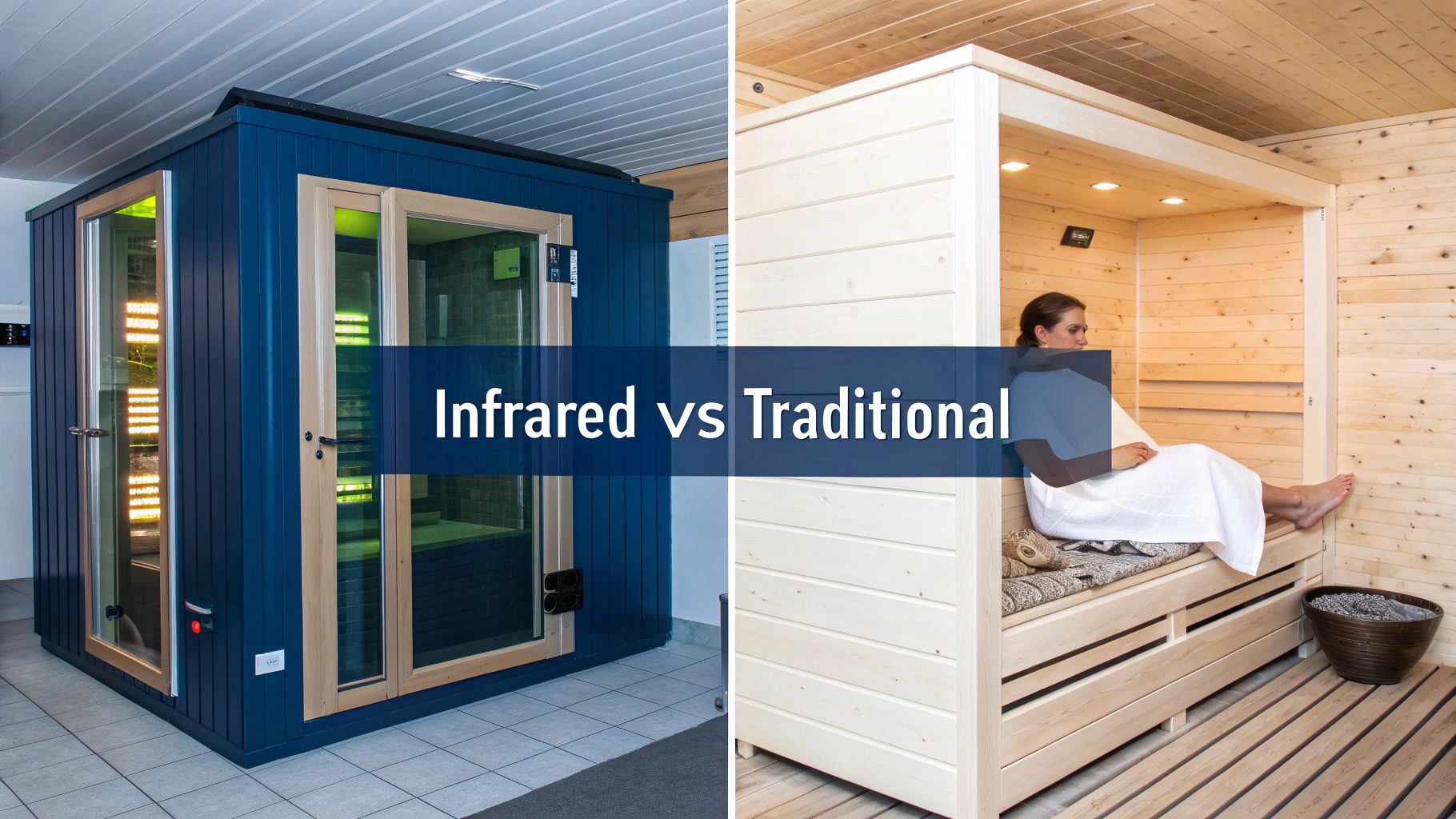
To really get to the bottom of the infrared sauna vs traditional sauna debate, we have to look at how they actually work. The biggest difference isn't just the temperature on the thermostat; it's the fundamental physics of how that heat gets into your body. One heats the air around you, while the other heats you directly. This is what creates two completely different wellness experiences.
The Immersive Heat of Traditional Saunas
Think of a classic Finnish sauna. It operates on the simple principles of convection and conduction. An electric or wood-fired stove heats up a pile of rocks until they're literally glowing.
Those rocks then radiate intense heat, warming the air inside the cabin to anywhere from 160°F to 200°F. This is convection in action—turning the whole room into a blistering hot environment. When you step inside, your body starts absorbing that heat from the air.
Pouring water over the hot rocks creates a blast of steam known as löyly, which spikes the humidity and makes the heat feel even more intense on your skin. It’s a classic “outside-in” heating method where the room has to be scorching to raise your core temperature and trigger powerful health benefits.
The Targeted Warmth of Infrared Saunas
Infrared saunas take a completely different approach by using radiant heat. It’s the same principle as the sun warming your skin on a cool day; you feel the heat directly, even if the air itself isn’t hot.
Instead of a traditional stove, infrared saunas use special emitters that produce specific wavelengths of infrared light. These light waves penetrate directly into your body's soft tissues, warming you from the inside out. Because the energy is transferred straight to you, the air in the cabin stays much cooler, typically between 120°F and 150°F.
This direct heating is what allows infrared saunas to make you sweat deeply and profusely at a far more comfortable temperature. It's a game-changer for workout recovery because you get deep-seated therapeutic benefits without the intense environmental stress of a traditional sauna.
This core difference in heat delivery explains why each type of sauna produces unique physiological effects. The high ambient heat of a traditional sauna forces a powerful cardiovascular response to cool the body down. Meanwhile, the penetrating radiant heat of an infrared sauna gets to work on a more cellular level, targeting deep tissue for pain relief and workout recovery. For a deeper dive into the technology, check out our in-depth guide to infrared sauna mechanics.
Understanding how the science works is the key to choosing the right tool for your specific goals—whether that’s the systemic challenge of high heat or the targeted benefits of radiant energy.
Analyzing the Health and Recovery Benefits
When you start comparing an infrared sauna vs a traditional sauna, the conversation always comes back to health and wellness. While both get you hot and make you sweat, how they do it creates very different physiological responses. This means one might be a better fit for your specific goals, whether that's workout recovery, heart health, or managing chronic pain.
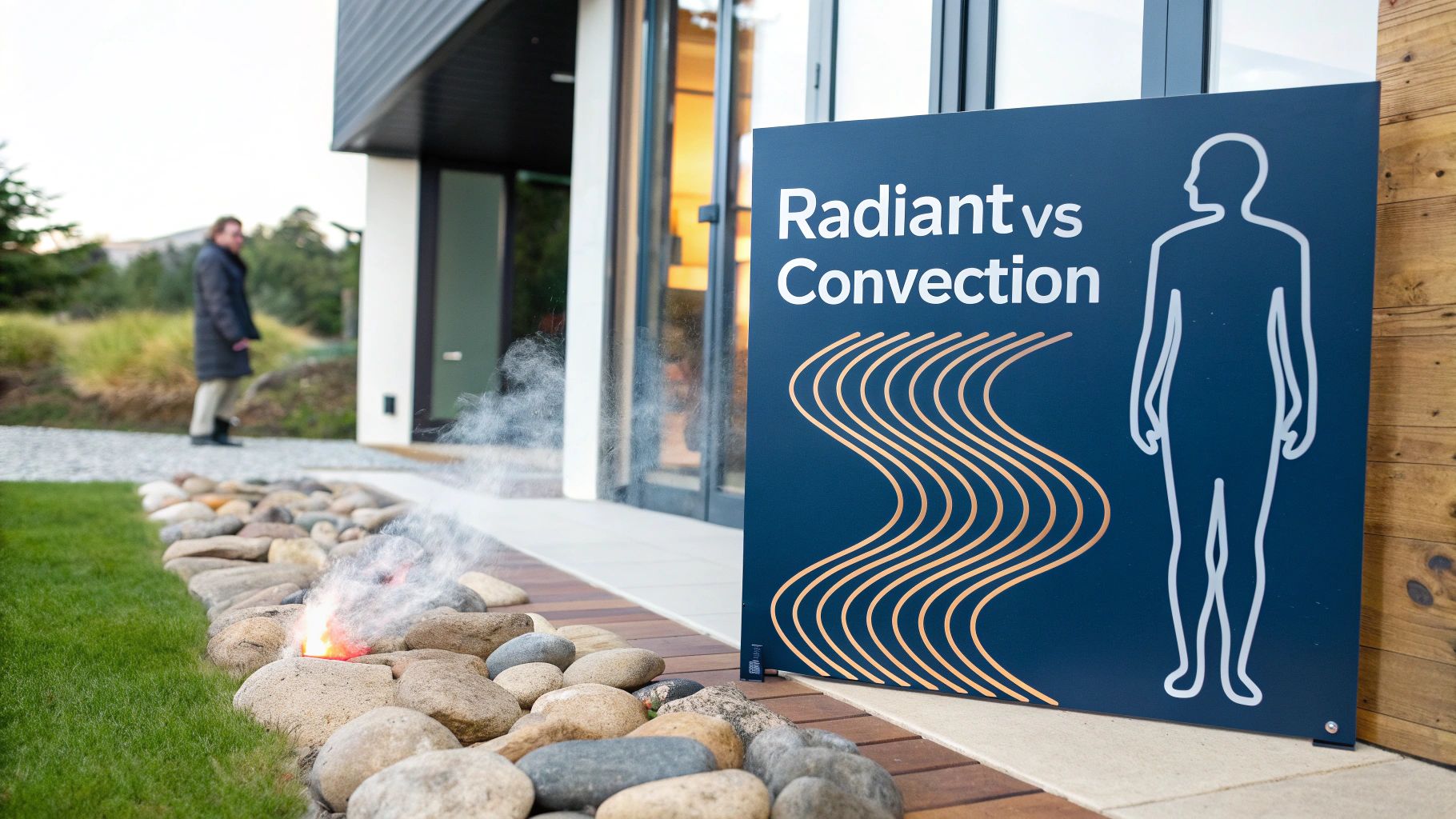
The real difference is how they heat your body. A traditional sauna uses high ambient heat to create a systemic stress response, almost like a workout. An infrared sauna, on the other hand, uses deeply penetrating radiant heat for more of a targeted, cellular-level therapy. Grasping this distinction is the key to understanding why each has its own unique advantages for your well-being.
Traditional Saunas for Cardiovascular and Systemic Health
The intense, immersive heat of a traditional sauna—often climbing to 190°F or higher—puts a powerful, positive stress on the body. It’s a lot like moderate cardio. This extreme heat forces your heart to pump harder and faster to push blood to the surface and cool you down.
This process, known as vasodilation (the widening of your blood vessels), is a serious workout for your cardiovascular system. And the science backs it up. Research consistently shows traditional saunas have an edge for high-heat protocols linked to reduced all-cause mortality and chronic disease risk. Studies point to superior blood pressure reduction and better cardiovascular markers, effects that often outperform the milder heat of infrared saunas.
A key takeaway here is the traditional sauna’s proven ability to trigger a robust physiological stress response. This is a classic example of hormesis—a beneficial level of stress—that drives significant improvements in heart function and contributes to a lower risk of mortality.
This makes the traditional sauna a fantastic tool for anyone looking to challenge and strengthen their cardiovascular system as part of a comprehensive wellness plan. Plus, the ability to pour water over the rocks to create steam (löyly) just intensifies the whole experience, making you sweat even more.
Infrared Saunas for Targeted Workout Recovery and Pain Relief
Infrared saunas work differently, making them a superior choice for post-workout recovery. They operate at much lower air temperatures, usually between 120°F and 150°F. Their magic comes from the far-infrared wavelengths that penetrate deep into your muscles and joints, heating your body directly from the inside out. This targeted approach is a game-changer for athletic recovery and managing pain.
This deep-tissue warming helps to:
- Increase localized blood flow right where you need it—in sore muscles and stiff joints—to speed up repair.
- Reduce inflammation at the cellular level, which is a primary cause of muscle soreness and joint pain.
- Promote muscle relaxation, easing tightness and improving your flexibility after a tough training session.
Because the heat can penetrate up to 1.5 inches into soft tissue, it’s far more effective at soothing deep aches and pains than the surface-level heat of a traditional sauna. This is why infrared is often the top pick for athletes trying to beat delayed onset muscle soreness (DOMS) or for people dealing with conditions like arthritis. Of course, both sauna types are great for muscle soreness, and for a deeper dive into recovery methods, you can explore various strategies to reduce muscle soreness.
Contrast Therapy and Complementary Benefits
Both sauna types are power players in a contrast therapy routine, where you alternate between hot and cold. This practice takes the vasodilation from the sauna and pairs it with the vasoconstriction (narrowing of blood vessels) from a cold plunge. The result is a powerful circulatory "pump" that flushes out inflammation and kicks workout recovery into high gear.
Whether you prefer the intense heat of a traditional sauna or the deep warmth of an infrared unit, following it up with a cold plunge will elevate your entire wellness protocol. You can learn more about this incredible combo in our guide on the benefits of sauna and cold plunge therapy.
So, what's the final word? It really comes down to your primary health goal. If you're after robust cardiovascular conditioning and a scientifically proven way to reduce mortality risk, the intense, systemic heat of a traditional sauna is hard to beat. But for targeted muscle recovery, cellular repair, and deep-seated pain relief, the penetrating radiant heat of an infrared sauna has a clear edge.
Installation Costs and Long-Term Upkeep
Let’s get practical. Beyond the physiological health benefits, the real-world logistics of installing and maintaining a sauna are huge factors in your decision. For both home gym owners and wellness clinic managers, understanding the upfront investment and ongoing costs is non-negotiable. The differences in electrical requirements, assembly, and daily upkeep between infrared and traditional saunas are pretty stark.
Getting Set Up: The Initial Effort
An infrared sauna is built for convenience, pure and simple. Most are pre-fabricated, self-contained units you can put together in an hour or two with just a few basic tools. The biggest selling point? Many smaller models plug right into a standard 120V household outlet. Installation is often as easy as finding an open corner in a room.
Traditional saunas, on the other hand, are more of a project. They almost always require a dedicated 240V circuit—the same kind your electric stove uses—which means you’ll be hiring a licensed electrician. On top of that, you have to manage high heat and humidity, making proper ventilation absolutely essential and adding another layer of complexity to the build.
Cost and Logistics Breakdown
The financial commitment is where the two types really diverge. Infrared saunas are generally the more accessible option, lowering the barrier for anyone wanting to bring heat therapy into their wellness routine at home. Here's a quick look at how the numbers stack up.
| Factor | Infrared Sauna | Traditional Sauna |
|---|---|---|
| Upfront Cost | Typically $2,000 - $10,000 | Can range from $10,000 - $30,000+ |
| Installation Needs | Often DIY, plugs into 120V outlet | Requires electrician for 240V circuit, plus ventilation |
| Operating Cost | Lower electricity use, heats in 10-20 mins | Higher electricity use, heats in 30-60 mins |
| Maintenance | Minimal; wipe down interior after use | Regular cleaning, periodic rock replacement |
As you can see, the plug-and-play nature of an infrared sauna often eliminates professional installation costs, saving you hundreds or even thousands right off the bat. That efficiency extends to your daily electricity bill, making it a much more economical choice over the long run.
Day-to-Day Maintenance
The upkeep routines also highlight these practical differences. Maintaining an infrared sauna is incredibly straightforward. You just wipe down the interior surfaces after you use it to keep the wood clean. The solid-state infrared emitters are built to last for years and don't need any regular service.
A traditional sauna requires a bit more hands-on care. You'll need to inspect the heater and rocks from time to time, as they can crack and will eventually need to be replaced to radiate heat effectively. Because of the steam, consistent cleaning is also critical to prevent any mold or mildew from developing.
Ultimately, the choice comes down to balancing your budget and desire for convenience against the specific wellness experience you want. Infrared models offer an accessible, low-maintenance way to get your daily dose of heat therapy. Traditional saunas deliver that authentic, powerful experience but demand a greater commitment in both cost and care.
When you're ready to find the perfect fit for your wellness goals, you can explore our curated collection of high-quality saunas.
Using Your Sauna for Peak Performance and Wellness
Knowing the difference between an infrared and a traditional sauna is just the start. The real magic happens when you know exactly how to use them to unlock specific health benefits and get the results you’re after.
With the right protocol, your sauna stops being a simple hot box and becomes a powerful tool for performance and well-being. Whether you're an athlete chasing faster workout recovery or just trying to improve your heart health, a specific, goal-oriented approach is what turns theory into tangible results.
Protocols for Athletes: Post-Workout Recovery
For any athlete, the post-workout goal is clear: speed up recovery, reduce muscle soreness, and get back to training at 100%. An infrared sauna is your best bet here, hands down. Its ability to send heat deep into muscle tissue and joints is exactly what your body needs to repair and rejuvenate.
Recommended Infrared Sauna Protocol for Workout Recovery:
- Timing: Wait 30-60 minutes after your workout. You want your heart rate to come back down to near-resting levels before you introduce more heat stress.
- Temperature: Set it between 120°F and 140°F (49°C to 60°C). The aim isn't to bake yourself, but to get that deep tissue penetration for maximum therapeutic benefit.
- Duration: A 30 to 40-minute session is the sweet spot. This gives the infrared waves enough time to boost circulation and calm inflammation in tired muscles.
- Hydration: Don't forget to drink 16-20 ounces of water before you get in and another 16-20 ounces when you get out. Proper hydration is critical for recovery.
By warming your muscles from the inside out, this protocol helps flush metabolic waste like lactic acid and delivers oxygen-rich blood to damaged tissues, significantly cutting down on delayed onset muscle soreness (DOMS).
Level Up Your Recovery with Contrast Therapy
If you want to take your wellness to the next level, pair your sauna session with a cold plunge. This is called contrast therapy, and it creates a powerful “pump” in your circulatory system that flushes inflammation and accelerates workout recovery.
A solid contrast therapy circuit looks like this:
- Hot: Spend 15 minutes in the sauna (infrared or traditional works).
- Cold: Immediately get into a cold plunge for 1 to 3 minutes.
- Repeat: Go through this hot-cold cycle 2 to 3 times.
- Finish Cold: Always end on cold. This keeps inflammation suppressed long after you’re done.
This powerful combination is one of the most effective recovery tools available for managing soreness and jump-starting your body's natural repair processes.
Protocols for General Wellness and Cardiovascular Health
For those more focused on long-term wellness and heart health, a traditional sauna is a fantastic choice. The intense, ambient heat challenges your circulatory system in a way that’s very similar to a moderate workout, offering profound cardiovascular benefits.
Recommended Traditional Sauna Protocol for Cardiovascular Health:
- Frequency: For the best results, get in 3 to 4 sessions per week.
- Temperature: Heat the sauna to 170°F to 195°F (77°C to 90°C). You need this high heat to get that robust cardiovascular response.
- Duration: Keep your sessions to 15 to 20 minutes. At this intensity, shorter is both safer and more effective.
- Best Practices: Sit on a middle or upper bench where it’s hotter. If you're new to this, start with 10 minutes on a lower bench and work your way up.
By matching your sauna choice and protocol to your goals, you can make a real difference in your overall health. Whether you need the deep, targeted relief of an infrared sauna or the systemic conditioning of a traditional one, the right strategy is everything.
For more expert advice on building your wellness routine, check out the articles on our MedEq Wellness Journal.
Frequently Asked Questions
When you're deciding between a traditional sauna and an infrared model, a few questions always seem to pop up. Let's get straight to them. We’ll cover the most common queries we hear, from detoxification and contrast therapy to the practicalities of setting one up in your home wellness space.

Which Sauna Is Better for Detoxification
The debate here really comes down to the quality versus the quantity of sweat. Both will make you sweat, and that’s the body's primary way of expelling certain toxins and promoting overall wellness.
A traditional sauna uses high ambient heat to trigger a very high volume of sweat. It’s a powerful, full-body flush that's great for clearing out water-soluble toxins and heavy metals from the skin's surface.
An infrared sauna works differently, heating your body directly from the inside out to raise your core temperature. Advocates point out that this deeper heat may help mobilize fat-soluble toxins stored in your tissues. You might produce a bit less sweat overall, but some evidence suggests it can contain a higher concentration of non-water-based compounds.
The bottom line? For a high-volume, surface-level sweat driven by intense external heat, a traditional sauna is hard to beat. For a deeper, core-driven sweat that may release different types of toxins, an infrared sauna has the edge.
Can I Use a Sauna with a Cold Plunge
Absolutely. In fact, combining a sauna with a cold plunge is one of the most effective wellness and recovery protocols you can do. This is the essence of contrast therapy, a practice that supercharges circulation, crushes inflammation, and significantly speeds up post-workout recovery.
Both sauna types are excellent for the "hot" cycle.
- Traditional Sauna: The intense, enveloping heat gives you that classic, dramatic temperature shift when you hit the cold water.
- Infrared Sauna: It offers a gentler but equally effective way to raise your core body temperature before you take the plunge, which is ideal for recovery.
A tried-and-true protocol is 15-20 minutes in the sauna, followed immediately by 1-3 minutes in the cold plunge. Repeating this circuit a few times creates a powerful circulatory "pump" that maximizes the health benefits. For more in-depth, science-backed protocols, check out the articles in the MedEq Wellness Journal.
Which Is More Practical for a Home Gym
For most people setting up a home gym or wellness space, an infrared sauna is the more practical option. It just boils down to a few key logistical wins that make it much easier to integrate into a personal wellness space.
Infrared saunas are typically smaller and designed for simple, do-it-yourself assembly. The biggest advantage is that many models plug right into a standard household outlet. Their lower energy needs also mean they're cheaper to run over time.
A traditional sauna, on the other hand, is a bigger project. It almost always requires a dedicated 240V circuit installed by an electrician, plus more robust ventilation to manage the high heat and steam. It's an amazing addition to a home, but it definitely demands more space, budget, and planning upfront.
Is One Sauna Type Safer Than the Other
Both types of saunas are very safe when you use them correctly, but the main safety considerations are slightly different for each.
With a traditional sauna, the primary risk is overheating or heat exhaustion from the high ambient air temperature, which can hit 160-200°F. This is why it's so important to limit your sessions to around 15-20 minutes and to hydrate relentlessly before, during, and after.
An infrared sauna runs at a much cooler 120-150°F, which significantly lowers the risk of heat exhaustion. This milder heat is often more tolerable for longer sessions (30-45 minutes) and is a better starting point for anyone sensitive to extreme temperatures.
No matter which way you lean in the infrared sauna vs traditional sauna discussion, the golden rule is the same: listen to your body. If you ever feel dizzy, lightheaded, or unwell, get out immediately. We always recommend checking with your doctor before starting a regular sauna routine, especially if you have cardiovascular conditions or other health concerns.
At MedEq Fitness, our goal is to equip you with the highest-quality, science-backed tools to help you reach peak performance and recovery. Explore our curated collection of professional-grade saunas designed for both home and clinical use.