How to cool down after workout: A Guide to Optimal Post-Workout Recovery
A proper cooldown is your bridge from intense effort back to a state of wellness and rest. It involves gradually dialing down your exercise intensity with light cardio and intentional static stretching.
Think of it this way: a cooldown isn't the end of your workout; it's the beginning of your workout recovery. This crucial step supports your overall health by helping your heart rate and breathing return to normal, preventing post-workout dizziness, and signaling to your body that it’s time to repair and rebuild for enhanced wellness.
Why A Cooldown Is Your Workout's Most Crucial Final Step
After crushing a tough workout, the temptation to just stop, drop, and collapse on the couch is very real. We've all been there. But what if those final 5 to 10 minutes could be the deciding factor between making real progress and hitting a wall of burnout?
Skipping your cooldown is like slamming on the brakes of a car instead of easing to a stop. It’s a jolt to the entire system and a missed opportunity for holistic workout recovery.
Guiding Your Body Back To Balance
During a workout, your body goes into a “fight-or-flight” mode, run by the sympathetic nervous system. Your heart rate skyrockets, your core temperature climbs, and blood pumps furiously to your working muscles. A cooldown acts as a gentle off-ramp, guiding your body out of that high-alert state and back into its resting "rest-and-digest" mode, a cornerstone of wellness.
This isn’t just about feeling better—it's a critical physiological shift with clear health benefits. An active cooldown supports this transition by:
- Gradually lowering your heart rate to stop blood from pooling in your limbs, which is what causes that lightheaded feeling.
- Helping regulate your core body temperature, letting heat dissipate slowly and safely.
- Aiding in the clearance of metabolic byproducts, like lactate, from your muscles, which is a key part of workout recovery.
A common myth is that cooldowns exist to "flush out lactic acid." The real health benefits are promoting healthy circulation, enhancing flexibility, and giving your nervous system the green light to kickstart the repair and recovery cycle.
The table below breaks down exactly what's happening inside your body during those crucial few minutes.
Immediate Health Benefits of a Post-Workout Cooldown
| Health Benefit | What Happens in Your Body | Why It Matters for Wellness & Performance |
|---|---|---|
| Heart Rate Regulation | Gradually slows the heart, preventing a sudden drop in blood pressure. | Prevents dizziness and fainting, ensuring a safe transition from high to low intensity. |
| Circulation Support | Keeps blood flowing, preventing it from pooling in the lower extremities. | Helps deliver oxygen and nutrients to muscles, kickstarting the repair process for effective workout recovery. |
| Nervous System Shift | Encourages a switch from the sympathetic (fight-or-flight) to the parasympathetic (rest-and-digest) nervous system. | Reduces stress hormones, improves sleep quality, and accelerates overall recovery, enhancing your wellness. |
| Flexibility & Mobility | Static stretching on warm muscles can improve range of motion over time. | Reduces post-workout stiffness and lowers the long-term risk of muscle strain injuries. |
Ultimately, a well-executed cooldown primes your body to recover more efficiently, so you can come back stronger and healthier for your next session.
An Investment In Future Performance
Don’t think of your cooldown as a chore. See it as a direct investment in your long-term wellness and performance.
This mindset shift is happening on a massive scale. The fitness recovery market is projected to explode from USD 8,219.7 million in 2025 to over USD 24,528.9 million by 2035, according to a report from Future Market Insights. This incredible growth shows just how much people are starting to value workout recovery. We now know that cooldowns boost parasympathetic activation, which can lead to better sleep and fewer injuries.
By dedicating just a few minutes to wind down, you actively reduce post-workout stiffness and seriously improve your recovery. For a deeper dive into tackling those next-day aches, check out our guide on how to reduce muscle soreness. This small commitment pays huge wellness dividends, ensuring you feel ready to go when it's time for your next workout.
Building Your Perfect 10-Minute Cooldown Routine
So, what does a good cooldown actually look like? It’s way simpler than you might think. A powerful, effective cooldown isn’t about spending another half hour in the gym with complicated movements. It’s about a simple, structured transition from all-out effort back to a state of rest to maximize health benefits.
The best part? You can build a perfect routine that works after any workout—a heavy lift, a long run, a HIIT class—by breaking it into three phases. Think of it as a flexible blueprint for smarter workout recovery, not a rigid prescription.
The whole thing should only take about 10 minutes. Let's break down each phase and its wellness impact.
Phase 1: Low-Intensity Movement (3–5 Minutes)
The second your workout ends, fight that urge to just stop cold. The very first thing you should do is shift into 3–5 minutes of low-intensity movement. This is the critical first signal to your body that the hard work is done.
This gentle activity keeps blood moving properly, preventing that dizzy feeling you get when it pools in your legs after a sudden stop—a crucial health benefit.
Here’s what that looks like in the real world:
- After a run: Slow down to a jog, then a brisk walk, and finish with a slow, easy stroll.
- After cycling: Drop all the resistance and just spin the pedals slowly.
- After lifting: A slow walk on the treadmill or some simple bodyweight movements like arm circles will do the trick.
This step is non-negotiable for bringing your heart rate down gradually and supporting your body's natural workout recovery process.
Phase 2: Static Stretching (3–5 Minutes)
Once your heart rate has settled a bit, it’s time to stretch. Your muscles are warm and much more receptive to it now, making this the perfect window to work on flexibility and ease out all that tension. Give this another 3–5 minutes.
Focus on the main muscle groups you just blasted. Hold each stretch for about 20–30 seconds, and whatever you do, don't bounce. You're looking for a gentle pull, never pain.
This isn't just about feeling less sore tomorrow. Making static stretching a consistent part of your post-workout routine is one of the best ways to improve your long-term range of motion and seriously cut down your risk of future injuries, boosting overall wellness.
Phase 3: Mindful Breathing (2–3 Minutes)
Alright, the final piece. Spend the last 2–3 minutes of your cooldown on nothing but mindful, deep breathing. This might be the most important step of all, because it's what actively switches your nervous system from that "fight-or-flight" panic mode into a calm "rest-and-digest" state, which is vital for recovery.
Find a comfortable spot to sit or lie down. Close your eyes and focus entirely on your breath. Breathe in slowly through your nose for a count of four, feeling your stomach rise, then exhale slowly through your mouth for a count of six. It’s a simple action that lowers stress hormones like cortisol and kickstarts the deep workout recovery your body needs to repair and grow stronger.
For more wellness insights and recovery strategies, be sure to explore our MedEq Wellness Journal.
Customizing Your Cooldown for Any Type of Training
Your workout isn’t one-size-fits-all, so your cooldown shouldn't be either. The dynamic routine that helps you recover from a long run just won't cut it after a heavy lifting session. To really get the health benefits, you need to match your cooldown strategy to the specific demands of your training.
This means shifting your focus. After a HIIT workout, it's all about carefully managing a rapid heart rate decline. After a strength session, the goal is to decompress your joints and stretch out those heavily taxed muscles to enhance your workout recovery.
Let's break down how to build the perfect cooldown for whatever you've got on the schedule.
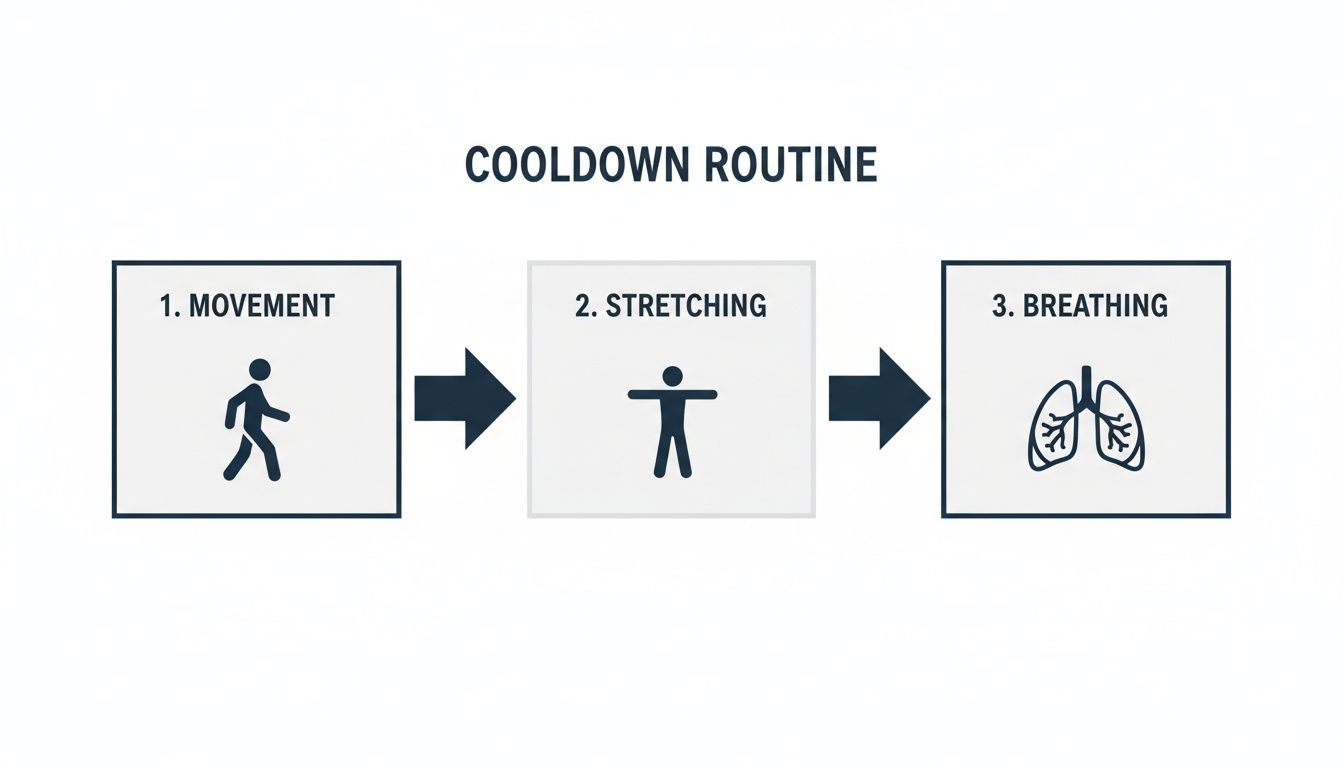
As you can see, any great cooldown boils down to three core components: gentle movement, targeted stretching, and mindful breathing to bring your body back to a state of rest.
The Post Strength Training Cooldown
After a heavy lifting session, your muscles are shortened and your central nervous system is firing on all cylinders. The main goal here is to release that muscular tension, decompress the spine, and gently signal to your body that it's time to rest. Good blood circulation is also crucial for delivering the nutrients needed for repair.
Your routine should prioritize active recovery and stretches that open up the body parts you just worked.
- Light Cardio (3-5 minutes): Hop on a treadmill for a slow walk or get on a stationary bike for a gentle spin. This keeps the blood flowing without adding any more stress.
- Targeted Stretches (5-7 minutes): Zero in on the major muscle groups from your session. If it was an upper body day, focus on chest openers like a doorway pectoral stretch. After leg day, make sure you hit the quads, hamstrings, and glutes.
- Breathing and Decompression (2-3 minutes): Finish up with some deep, diaphragmatic breathing in a restorative pose like Child's Pose. This is a great way to calm the nervous system and get a gentle stretch in your back.
Expert Tip: After heavy compound lifts like squats and deadlifts, your spine is under a lot of compressive load. A simple hanging stretch from a pull-up bar can provide immediate relief and seriously aid your workout recovery.
Incorporating specific lower back stretches into your post-lifting routine can also help address common tension spots and improve overall flexibility.
The Post HIIT Cooldown
High-Intensity Interval Training (HIIT) sends your heart rate through the roof and puts a massive demand on your entire body. The top priority for a HIIT cooldown is to bring your heart rate down gradually. Stopping abruptly can cause blood to pool in your legs and lead to dizziness.
A HIIT cooldown needs to be a bit more drawn out than others.
- Extended Active Recovery (5-7 minutes): Your low-intensity movement phase needs to be longer here. After your last interval, transition into a jog, then a brisk walk, and finally a slow walk. Don’t stop moving until your breathing feels completely under control.
- Full-Body Static Stretches (3-5 minutes): HIIT is a full-body effort, so your stretching should be too. Make sure to hit the quads, hamstrings, glutes, chest, and shoulders. Hold each stretch for a solid 20-30 seconds.
- Mindful Breathing (2-3 minutes): Lie flat on your back with your feet on the floor. Focus on deep belly breaths. This helps activate the parasympathetic nervous system—your body’s “rest-and-digest” mode.
The Post Cardio Cooldown
After endurance work like a long run or a big cycling session, your muscles—especially in your lower body—are tight and fatigued from all that repetitive motion. The goal here is to release that built-up tension and help your muscles return to their normal length.
Here’s a simple routine for any endurance athlete:
- Tapered Movement (5 minutes): Just like with HIIT, never come to a dead stop. Gradually dial back your pace from a run to a jog, and then down to a walk.
- Focus on the Legs (5-7 minutes): Your stretches should zero in on the powerhouse muscles you just used. Prioritize your hamstrings, quads, calves, and hip flexors. Using a foam roller during this phase can be incredibly effective for working out any knots.
- Elevate and Breathe (2-3 minutes): Finish by lying on your back and putting your legs up against a wall. This simple inversion is amazing for circulation, helps reduce any swelling, and is a great time to practice your deep breathing.
For more tips to optimize your fitness journey, visit our blog: https://medeqfitness.com/blogs/medeq-wellness-journal
Elevating Recovery with Advanced Tools and Techniques
Once you have the fundamentals of a good cooldown dialed in, it's time to explore some powerful tools that can take your workout recovery to the next level. This is where you get into practices like contrast therapy, cold water immersion, and targeted heat therapy—all designed to supercharge your body's natural repair processes.
Think of these techniques as a way to actively accelerate recovery, helping you bounce back faster and feel stronger for your next workout, which is a significant wellness benefit.
The Power of Temperature Contrast Therapy
One of the most effective recovery methods is contrast therapy, which involves alternating between hot and cold environments. This process acts like a pump for your circulatory system. The heat causes vasodilation (your blood vessels widen), and the cold causes vasoconstriction (they narrow). This rapid cycling creates a powerful flushing effect, which has incredible health benefits.
So, what does that actually do for your workout recovery?
- Reduces Inflammation: It helps move stagnant fluid and metabolic waste out of your muscles.
- Decreases Muscle Soreness: By pushing fresh, oxygenated blood into damaged tissues, you speed up the repair job.
- Stimulates the Nervous System: These sharp temperature changes can boost alertness and trigger a positive hormonal response, contributing to overall wellness.
The core idea behind contrast therapy is using temperature as a tool to actively manage circulation and inflammation, rather than just passively waiting for your body to complete its workout recovery on its own.
Diving into Cold Water Immersion
Cold water immersion, usually in a cold plunge pool, is an absolute game-changer for post-workout recovery. Its primary health benefit is the ability to rapidly drop your core body temperature and constrict blood vessels. This combination significantly reduces inflammation and can even numb nerve endings to relieve muscle pain.
A structured cooldown that ends with a cold plunge can bring your body temperature back to normal far faster than just resting. This isn't just theory—the results are why these tools have become so popular. One study even found that a 5-minute cold exposure can drop core temperature by 0.5°C per minute, cutting delayed onset muscle soreness (DOMS) by 33% compared to doing nothing.
Unwinding with Heat Therapy
On the flip side, we have heat therapy, typically from a sauna. While cold therapy is all about clamping down on inflammation, heat is fantastic for promoting deep muscle relaxation and increasing blood flow. It’s perfect for soothing stiffness and improving the elasticity of your tissues, enhancing your wellness routine.
Adding a sauna session after your cooldown can help:
- Relax Tight Muscles: Heat boosts flexibility and melts away the tension built up during a tough workout.
- Support Detoxification: Sweating is one of your body’s best ways to flush out toxins and metabolic byproducts.
- Calm the Nervous System: The warmth has a deeply calming effect, which can help lower stress hormones and set you up for better sleep.
By strategically adding these advanced tools to your routine, you can make a huge difference in how you feel and perform. For a deeper look at the science and how to apply it, check out our guide on the benefits of contrast therapy.
Fueling Your Cooldown With Smart Hydration and Nutrition
What you do after your last stretch is just as important as the cooldown itself. Think of it this way: your workout depletes the tank, and your cooldown is the first pit stop to start refueling. This is where smart hydration and nutrition come in, giving your body the raw materials it needs to repair and rebuild—a critical component of workout recovery.
First things first: rehydrate. When you sweat, you're not just losing water; you're putting a strain on your whole system. Replenishing fluids helps bring your core temperature down and supports all the cellular processes that kick into high gear for recovery, offering immediate health benefits.
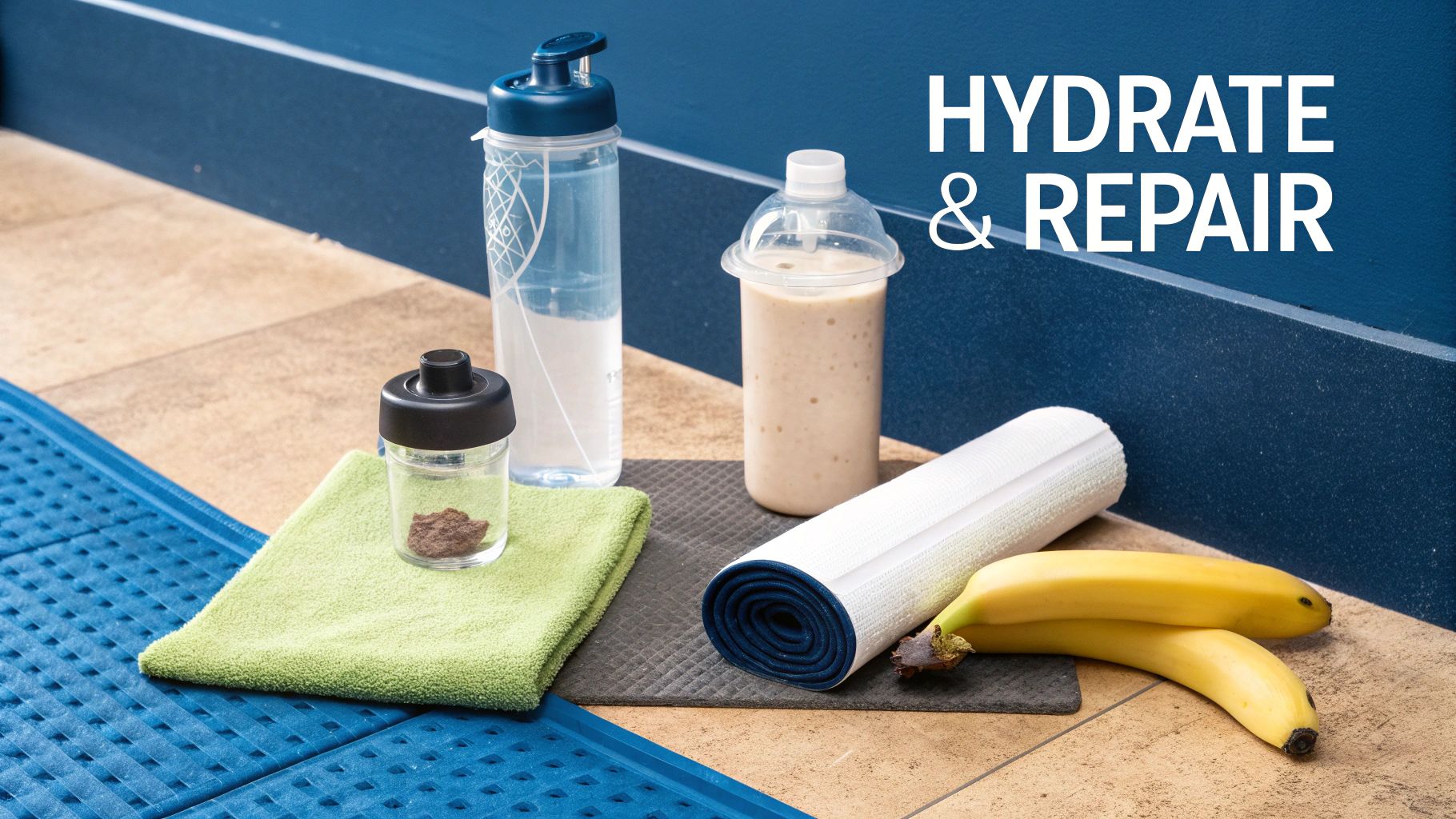
A good rule of thumb I tell my clients is to drink 16-24 ounces of water for every pound of body weight lost during their session. For most of us, though, just sipping water consistently over the next hour is enough to get back in balance.
Replenish Energy and Repair Muscle
Hydration is only half the battle. To really maximize your workout recovery and wellness, you need to think about the best post-workout recovery foods. Don't worry, this doesn't mean you need to cook up a gourmet meal. It's actually about two simple building blocks your body is craving after a tough workout.
- Protein: This is essential for repairing the tiny micro-tears in your muscles that happen when you train hard. It’s the foundation of muscle growth.
- Carbohydrates: Think of these as your energy-store replenishers. They restock the glycogen you just burned through.
Try to get a snack or meal with a 3:1 or 4:1 ratio of carbs to protein within an hour of finishing. This simple combo jump-starts the entire recovery process, helps cut down on muscle soreness, and gets you ready for your next workout. If you want to dive deeper into this, we break it all down in our guide on how to speed up muscle recovery.
Seriously, keep it simple. A glass of chocolate milk, a banana with some peanut butter, or a protein shake with a piece of fruit are all fantastic, easy options. They give your body that perfect balance of nutrients it needs right away.
Find more informative articles on our blog: https://medeqfitness.com/blogs/medeq-wellness-journal
Got Questions About Your Cooldown? We've Got Answers.
Let's cut through the noise and tackle some of the most common questions we hear about cooldowns. Think of this as your expert-backed cheat sheet for refining your post-workout routine and making sure you get every last drop of health and wellness benefit from your recovery time.
How Long Should a Cooldown Really Be?
There’s no magic number here, but a solid ballpark is somewhere between 5 and 15 minutes. Honestly, the best indicator is your own body—the goal is to feel your heart rate gently coming back down to earth, which is key for a safe workout recovery.
If you just wrapped up a beast of a session, like a HIIT class or a heavy lifting day, you'll want to lean closer to that 10–15 minute window. This gives your system enough time to flush out metabolic byproducts and shift out of high gear. For lighter cardio or a yoga class, a quick but focused 5-minute routine is usually plenty.
Should I Bring My Foam Roller or Massage Gun into the Mix?
Absolutely. These tools are game-changers for a good cooldown and overall wellness. The sweet spot for using them is right after your first 3–5 minutes of light cardio, once your heart rate has started to drop.
Using a massage gun or foam roller at this point helps drive fresh blood to the muscles you just hammered, releasing that immediate post-workout tightness and seriously cutting down on next-day soreness. Just focus on the main muscle groups you trained, spending about 30–60 seconds on any spots that feel extra tight.
Think of it this way: the cooldown's job is to transition your body from high alert back to a state of rest. Recovery tools like these are your allies, directly targeting muscle tension to speed up that process.
Ice Bath vs. Sauna: What's the Better Post-Workout Move?
This one totally depends on your goal for the day. An ice bath is your go-to for battling inflammation. It's fantastic after a really high-impact workout or anything that leaves you feeling wrecked, as it’s incredibly effective at minimizing muscle soreness.
A sauna, on the other hand, is all about promoting blood flow and deep muscle relaxation. It’s perfect for recovery on less intense days when you just want to loosen up. Some athletes swear by contrast therapy—alternating between hot and cold—but just remember to always complete your active cooldown before you step into either.
So, What Really Happens if I Just Skip the Cooldown?
Skipping your cooldown here and there probably won't hurt, but making a habit of it can cause a few issues down the line. For starters, you're setting yourself up for more intense muscle stiffness and delayed onset muscle soreness (DOMS). This is a missed opportunity for effective workout recovery.
Over time, it can also hamstring your flexibility and slow down your recovery between workouts, meaning you won't be at 100% for your next session. More immediately, you risk feeling dizzy or lightheaded, since stopping cold can cause blood to pool in your legs. You're essentially yanking the emergency brake instead of letting your body coast to a stop, robbing it of the signal to switch from "work" mode to "repair" mode, which is vital for your health.
For more deep dives into wellness science, check out the resources on our MedEq Wellness Journal.
At MedEq Fitness, we build the science-backed tools you need to master your recovery. From our cold plunge pools to our infrared saunas, every piece of equipment is designed to bridge the gap between hard work and deep renewal. See how you can elevate your own wellness journey at https://medeqfitness.com.