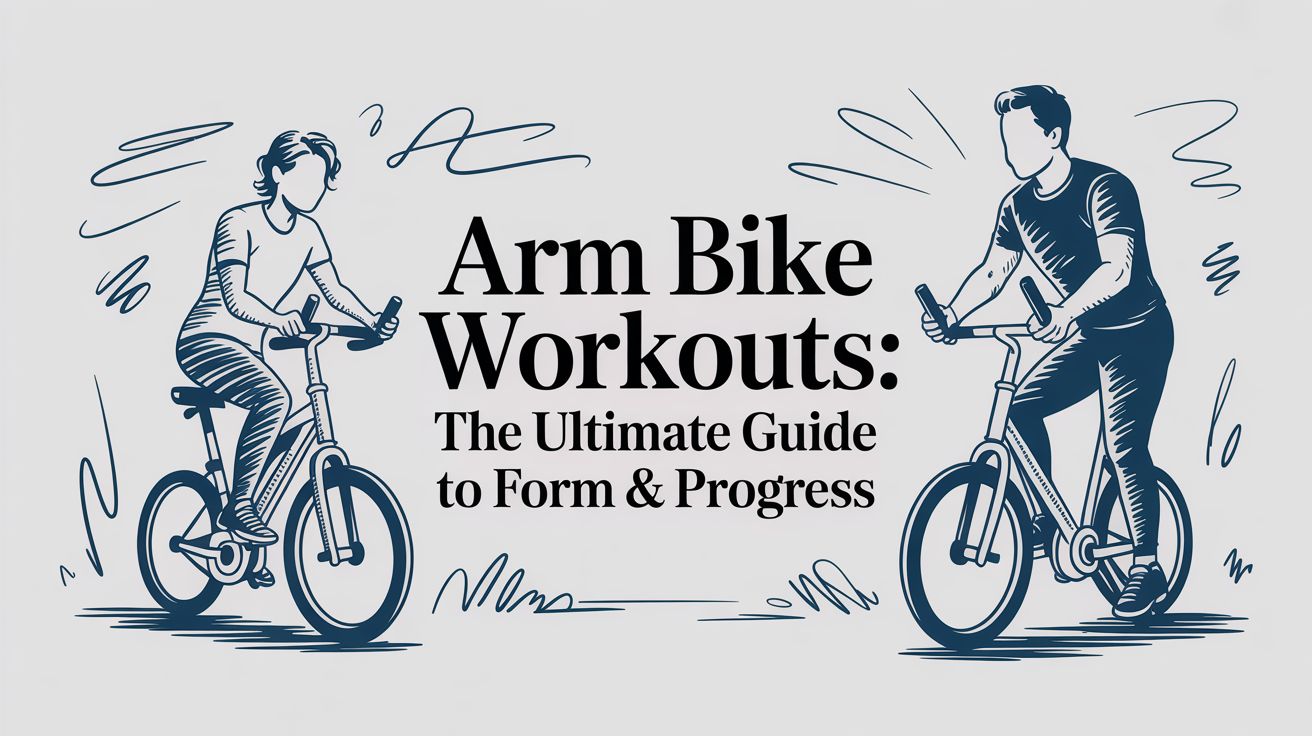
Arm Bike Workouts: The Ultimate Guide to Form & Progress
Some people find the arm bike after an injury. Others find it when running starts irritating their joints, when lower-body training volume is already high, or when they need a conditioning option that fits rehab instead of fighting it. That’s usually when the upper body ergometer stops looking like a “backup machine” and starts proving its value.
Used well, arm bike workouts can build real conditioning, challenge the upper body, and fit neatly into a recovery-focused wellness plan. Used poorly, they become a shoulder-irritation machine with too much resistance, sloppy posture, and not enough actual cardiovascular work.
A practitioner mindset matters. Setup, cadence, interval structure, and recovery all change the result. If you want more context on low-impact training and recovery-based wellness, the MedEq Wellness Journal is a useful place to keep reading.
Why Arm Bike Workouts Deliver Unique Health Benefits
A runner with an irritated knee, a lifter in a heavy squat block, and a patient returning from shoulder surgery can all end up using the same machine for different reasons. The arm bike works because it creates training stress without asking the hips, knees, and ankles to absorb more load than they can handle that week.
That makes it useful far beyond rehab. It gives people a repeatable way to train the heart, lungs, and upper body when lower-body fatigue, pain, or impact tolerance is the limiting factor. In practice, that changes adherence. People stick with training when the tool fits both the work they need and the recovery they can support.
Where the evidence is strongest
Arm cycle ergometry has strong clinical support for improving cardiorespiratory fitness. A Level 1a evidence summary on arm cycle ergometry reports that training 3 sessions per week for 8 to 12 weeks improves cardiorespiratory fitness, measured by VO2peak.
The same review highlights a study by Kim et al. in 15 participants with spinal cord injuries at levels C5 to T11, where 6 weeks of training, 3 days per week for 60 minutes per session, improved VO2peak and upper-body strength compared with control groups, while also lowering insulin and HOMA-IR and increasing HDL cholesterol from baseline in the exercise group (study summary in the same evidence review).
Those findings matter because they show a real physiological payoff. Arm bike sessions can build aerobic capacity and support metabolic health in people who cannot rely on lower-body exercise to do that job.
Clinical takeaway: The arm bike gives clinicians, coaches, and active adults a low-impact conditioning option that can serve rehab, general fitness, and performance planning in the same training week.
Why this matters outside rehab
Healthy athletes benefit too. Distance runners use the arm bike to keep conditioning volume up during lower-leg flare-ups. Lifters use it to add aerobic work without interfering with lower-body strength sessions. Older adults and deconditioned clients use it because resistance and duration are easy to scale, and the movement is controlled.
The main advantage is not novelty. It is training access.
That access matters even more when recovery is part of the plan, not an afterthought. A hard arm bike interval session creates local muscular fatigue through the shoulders, arms, and trunk, but it usually spares the joint pounding and tissue stress that come with many lower-body cardio options. For someone trying to balance performance, pain management, and weekly workload, that trade-off is often favorable. If you are comparing options for that role, this guide to low-impact cardio machines for joint-friendly conditioning shows where the arm bike fits.
The practical upside
Arm bike workouts tend to fit best when the goal is one or more of the following:
- Cardiovascular training with minimal lower-body loading
- Upper-body muscular endurance under controlled resistance
- Conditioning during injury recovery or return-to-play
- A joint-friendly option for general wellness
- Extra training volume without adding more leg fatigue
That range is why arm bikes show up in physical therapy clinics, performance centers, cardiac conditioning settings, and home gyms. The machine is simple to use. The programming choices, and the recovery strategy around them, are what determine whether it becomes light movement, productive conditioning, or a smart bridge back to full training.
Mastering Your Arm Bike Setup and Ergonomics
A lot of arm bike sessions go off course before the warm-up ends. The rider is reaching too high, gripping too hard, or cranking against resistance that turns the movement into a shoulder grind instead of useful conditioning.

Good setup changes the training effect. It also changes the recovery cost. If the goal is conditioning you can repeat several times per week, ergonomics matter because they determine whether the workload lands in the cardiovascular system, the target muscles, or the neck and front of the shoulders.
Start with crank height
Set the seat so your shoulders line up with the crank axis.
That position usually gives the cleanest arm path and the least compensation through the neck and low back. If the cranks are too high, the upper traps start doing work they should not be doing. If the cranks are too low, riders often slump forward, lose rib cage position, and close down the front of the shoulder.
The test is simple. Reach the handles and pedal a few easy revolutions. You should not have to shrug to the top or dip your torso to the bottom.
Build a stable posture
After crank height is set, clean up the rest of the position:
-
Keep the shoulders relaxed, not shrugged
A small amount of shoulder blade movement is normal. Constant elevation is not. -
Match your chest to the working height of the cranks
This helps keep the force line direct instead of turning the motion into a reach-and-pull pattern. -
Maintain a soft bend in the elbows
Repeated lockout makes the cycle harsher and often shifts stress into the elbows and wrists. -
Brace the trunk lightly
The torso should stay quiet enough to support the arms without feeling like a max lift. -
Hold the handles with neutral wrists
Bent-back wrists waste energy and can irritate the forearms during longer sessions.
A stable position should feel controlled, not stiff.
Choose resistance that matches the goal
The common setup error is starting too heavy. That usually shows up as slow grinding, early arm burn, and breathing that never catches up because local muscle fatigue hits first.
In rehab observations summarized in the same technique reference, 70% of novice sessions showed poor posture that contributed to shoulder strain, and 80% of users initially selected resistance that was too high. Too much resistance also dropped cadence below 50 rev/min, which limited the cardiovascular effect the machine is often meant to train (source).
For most riders, the better starting point is lighter resistance and smoother turnover. Get the cadence under control first. Then raise resistance if the workout calls for more muscular demand. That order matters if you want training you can recover from and repeat later in the week.
Chase smooth cadence, controlled posture, and the right heart rate response for the session. Resistance comes after that.
A quick self-check before each session
Use this screen before the first work set:
- Crank alignment: Shoulders line up with the crank axis.
- Seat position: You can reach the handles without rounding hard through the upper back.
- Neck tension: If your neck tightens during the first minute, reset your shoulder position and reduce reach.
- Cadence feel: The handles should turn smoothly, not stall at the top or bottom.
- Breathing response: During the warm-up, breathing should rise before the arms are overwhelmed. If the shoulders and forearms are burning right away, back off the load.
Equipment setup matters too. A stable base helps the bike stay planted during harder intervals and makes getting on and off safer between work bouts. If you train at home, this guide to choosing a mat for exercise bike use can help.
Warm up with intention
Start with easy resistance and use the first few minutes to check mechanics, not just body temperature.
A practical warm-up looks like this:
- Easy forward pedaling to find rhythm
- Easy reverse pedaling to expose side-to-side differences
- A breathing check to make sure the ribs stay down and the shoulders stay quiet
- A brief posture reset before the first interval or steady block
By the end of the warm-up, the motion should feel smooth and repeatable. If it still feels cramped, jerky, or neck-dominant, adjust the setup before you add intensity. That small reset often does more for performance and next-day recovery than pushing through a bad position.
Workout Blueprints for Every Fitness Goal
A good arm bike plan starts with the limiting factor. Sometimes the goal is rebuilding tolerance after an injury. Sometimes it is getting a hard conditioning dose without lower-body impact. Sometimes it is simple recovery support between heavier training days.
Those goals need different session shapes.
Arm Bike Workout Plan Comparison
| Goal | Session Duration | Intensity (RPE) | Structure Example |
|---|---|---|---|
| Rehabilitation and active recovery | 10 to 20 minutes | Easy to moderate | Continuous easy pedaling with short direction changes |
| Low-impact cardiovascular conditioning | 20 to 30 minutes | Moderate | Steady intervals with controlled breathing |
| Upper-body HIIT | About 20 minutes of interval work, plus warm-up and cool-down | Hard during work bouts | 30 seconds hard, 30 seconds easy |
| Endurance building | 30 to 60 minutes | Moderate to moderately hard | Longer blocks with periodic forward and reverse changes |
If you are comparing modalities, this guide to fan bike exercise differences and use cases helps clarify where full-body air bike work differs from upper-body dominant ergometer training.
Rehabilitation and active recovery
Use this format after a flare-up, during return-to-exercise phases, or on days when hard training would only add fatigue.
The target is circulation, repeatable motion, and a small aerobic effect. The session should leave the shoulders feeling freer, not cooked.
How to run it
- Warm-up: 3 to 5 minutes of easy pedaling at very low resistance
- Main set: 30 to 90 seconds forward, then 30 to 60 seconds reverse, repeated at a conversational pace
- Finish: 2 to 3 easy minutes, then gentle shoulder motion off the bike if tolerated
Keep resistance low enough that cadence stays smooth. Reverse pedaling is useful here because it often exposes side-to-side differences early, before they turn into neck tension or compensatory shrugging.
A simple test works well. You should be able to finish the session feeling better than when you started.
Practical rule: If pain builds, posture degrades, or you feel arm fatigue more than general warmth, reduce the resistance or shorten the work block.
Low-impact cardiovascular conditioning
This is the everyday conditioning option for people who want a training effect without impact, jumping, or long sessions on machines that load the legs.
The work should stress breathing and circulation first. If the forearms and shoulders fail before your heart rate rises, the resistance is too high or the cadence is too slow.
A reliable conditioning template
Use this structure:
- Warm-up: 4 to 5 minutes easy, with a short reverse block
- Main work: 6 to 10 rounds of 1 minute moderate effort, 1 minute easy
- Cool-down: 3 to 5 minutes easy until breathing settles
This format is more useful than one long grind for many people because it keeps technique clean. It also gives enough recovery to reset shoulder position before the next round.
Signs the dose is right:
- Breathing is quickened but controlled
- The handles keep turning without stalling
- Neck muscles stay quiet
- You can speak in short phrases
Upper-body HIIT
The arm bike can drive heart rate up fast. That makes it useful, but it also makes dosing important.
For true HIIT, use brief hard intervals with a cadence you can sustain cleanly. A practical starting point is 8 to 12 rounds of 30 seconds hard, 30 to 60 seconds easy, after a full warm-up. Hard means fast handle turnover and strong breathing, not grinding against so much resistance that the crank slows down halfway through the bout.
Who should use it
HIIT on the arm bike fits best for:
- court and combat athletes who need extra conditioning without more running
- clients who cannot tolerate lower-body impact
- experienced exercisers with good shoulder control
- people training on a tight schedule
What makes it work
Cadence matters.
If resistance is too heavy, the session shifts toward local muscular fatigue in the shoulders and forearms. If resistance is too light, you spin fast without enough cardiovascular demand. The sweet spot is a load that lets you keep rhythm, breathe hard, and finish each interval without losing posture.
Keep the recovery honest too. Easy pedaling works better than trying to win the rest period.
Use HIIT two or three times per week at most in most programs. More than that is usually where recovery starts to break down, especially if the same shoulders are already handling lifting, wheelchair propulsion, throwing, or contact work.
Endurance building
Longer arm bike sessions build work capacity, but they punish poor pacing. Start too hard and the session turns into a shoulder survival test.
Steady work wins here.
A practical endurance format
Build the session around repeatable blocks:
- Warm up for 5 minutes at an easy pace.
- Ride 8 to 12 minutes at a steady moderate effort.
- Pedal easy for 2 minutes.
- Repeat 2 to 3 times if posture and cadence stay consistent.
- Cool down for 3 to 5 minutes.
Direction changes help distribute load and keep the pattern from getting stale. Use them sparingly at first. For example, ride forward for several minutes, then add 30 to 60 seconds in reverse before returning to forward work.
Progress this type of session by adding time before adding resistance. That approach builds capacity with less irritation in the elbows, wrists, and front of the shoulders.
A good endurance session should feel controlled at the halfway point. If form is falling apart there, the opening pace was too aggressive.
Choosing the right blueprint
Match the session to the job.
- Use rehab and active recovery when tissue tolerance, soreness, or joint irritation is the limiter.
- Use moderate conditioning when you want sustainable cardio and repeatable weekly volume.
- Use HIIT when time is short and your shoulders already handle load well.
- Use endurance work when you are building capacity across weeks, not chasing one hard day.
The bigger training payoff comes from pairing the right workout with the right recovery response. Hard interval days need easier follow-up work. Recovery sessions should improve circulation without adding more strain. That work to recovery loop is what keeps the arm bike useful over months, not just for one tough session.
Refining Technique and Avoiding Common Mistakes
A lot of people treat the arm bike like a machine you can brute-force. That’s usually where trouble starts.

The chest and back myth
One common assumption is that pushing forward on the handles will train the chest and pulling back will train the back in a direct strength-training sense. That sounds intuitive, but the biomechanics are less favorable than people think.
According to the analysis summarized in this movement critique, those seated forward and backward actions are perpendicular to gravity, which tends to create deltoid dominance rather than meaningful loading of the chest and back. The same summary notes EMG analyses showing deltoid activation 40 to 60% higher than target muscles in those positions.
That doesn’t make the arm bike useless. It means you should stop pretending it’s a replacement for pressing and rowing.
What the arm bike is good at
The arm bike shines as a tool for:
- Cardiovascular conditioning
- Upper-body endurance
- Warm-up and circulation
- Low-impact training
- Structured interval work in rehab or performance settings
It’s not the best choice for building maximal chest or lat strength. If that’s your goal, use gravity-opposed exercises such as rows, pull-ups, presses, pulldowns, or cable patterns after the arm bike, not instead of them.
The arm bike is a conditioning tool first. Treat it that way and it performs well.
Common technique errors
The most frequent mistakes are easy to spot once you know what to watch for:
-
Grinding heavy resistance
This shifts the session away from cardio and into compensatory shoulder work. -
Shrugged shoulders
Upper traps take over, the neck tightens, and the shoulder joint loses a clean position. -
Leaning and twisting through the trunk
That usually means the upper body can’t control the current load. -
Ignoring reverse pedaling
Staying only in the forward pattern can overload the same tissues repeatedly.
Use bidirectional training on purpose
One of the simplest upgrades is to alternate direction instead of riding one pattern for the entire session.
A practical model described in the verified data uses forward and reverse pedaling in 5-minute blocks for 30 to 60 minutes total, with forward work biasing biceps and pecs and reverse work biasing triceps and delts. For more advanced training, that same guidance includes 1 to 2 minute intervals at 70 to 90% Wpeak or zone-based work using a heart rate monitor.
This is also a good point to see movement in action:
A cleaner coaching cue set
Instead of telling someone to “work chest and back” on the arm bike, use cues like these:
- Drive a smooth circle
- Keep the rib cage stacked
- Relax the neck and jaw
- Let the shoulders stay heavy
- Change direction before one pattern gets sloppy
Those cues produce better sessions because they match what the machine trains. Cleaner mechanics usually mean better tolerance, steadier cadence, and fewer irritated shoulders.
Supercharge Your Recovery After Arm Bike Training
Arm bike workouts can look deceptively simple, but the recovery side matters more than commonly understood. Upper-body ergometry places a different stress on the system than leg-driven cardio, and if you train hard without respecting that, fatigue builds faster than progress.
Research comparing arm and lower-body exercise shows that at the same absolute intensity, arm crank ergometry evokes a lower stroke volume, higher heart rate, and greater sympathetic nervous system response than lower-body exercise, as reviewed in this comparative analysis. In practical terms, the work can feel disproportionately stressful relative to how simple it looks.
That’s why recovery isn’t an optional add-on. It’s part of the training effect.
Start with the basics that still matter
The first layer of recovery is simple and still effective.

After a demanding session, focus on:
- Hydrate so you replace fluid losses and support normal cardiovascular recovery
- Stretch the forearms, triceps, posterior shoulder, and chest gently
- Fuel with a balanced meal or snack that supports tissue repair
- Rest so the nervous system has room to downshift
If soreness tends to linger, this guide on how to reduce muscle soreness is a useful companion.
Contrast therapy has a practical place
When arm bike sessions are frequent or intense, contrast therapy can fit well because it addresses both circulation and perceived recovery. A simple hot-cold sequence after training can help athletes and general fitness users create a clearer shift from exertion to recovery mode.
The practical benefit isn’t magic. It’s routine.
For someone stacking upper-body conditioning, strength work, and everyday life stress, contrast therapy gives the body a deliberate recovery window. Heat can help you relax and unwind. Cold can feel useful after tougher sessions when the shoulders and arms feel worked. Alternating the two creates a structured reset many people can repeat consistently.
Recovery works best when it becomes a repeatable habit, not an emergency response after you’ve already overreached.
Recovery should match the type of session
A short easy recovery ride doesn’t need a complicated protocol. Hard interval work usually does.
Use this simple match-up:
| Session type | Best immediate recovery focus |
|---|---|
| Easy aerobic work | Hydration, light mobility, normal meals |
| Moderate conditioning | Mobility, easy walking, structured rehydration |
| Hard intervals | Cool-down, calm breathing, nutrition, more deliberate recovery work |
| High-frequency training week | Sleep protection, load management, heat or cold exposure as tolerated |
Where HBOT can fit
For people who train often, work in rehab settings, or prioritize deeper recovery practices, hyperbaric oxygen therapy can be part of the larger wellness plan. The appeal is straightforward. It supports a more recovery-centered environment when tissue stress, cumulative fatigue, and performance demands start stacking up.
If you want to learn more, MedEq has a detailed guide on benefits of hyperbaric chamber use, along with options for soft shell hyperbaric chambers and hard shell hyperbaric chambers.
A simple post-arm-bike recovery sequence
You don’t need an elaborate biohacking routine. A clean post-session flow often works best:
- Cool down on the bike until breathing settles.
- Do light upper-quarter mobility without forcing end range.
- Rehydrate and eat within your normal routine.
- Use heat, cold, or contrast when the session was demanding enough to justify it.
- Protect sleep that night because that’s where a lot of adaptation happens.
Individuals often underdose the cool-down and overdose the “push through it” mentality. With arm bike training, especially when intervals get hard, that trade-off usually catches up quickly.
Tracking Progress and Building Long-Term Consistency
The best arm bike workouts aren’t the hardest single sessions. They’re the sessions you can repeat, progress, and recover from.
That means tracking more than time alone. Time matters, but it doesn’t tell you whether your posture held up, whether your effort was appropriate, or whether your recovery supported the next session.
What to monitor
Three metrics work especially well:
- Heart rate helps you see whether the same workload is becoming easier over time.
- RPE keeps effort honest, especially when daily readiness changes.
- Session notes catch patterns such as shoulder irritation, cadence drop-off, or improved tolerance in reverse pedaling.
If you want a recovery-focused metric too, heart rate variability can add useful context for day-to-day readiness. This guide on what HRV training means explains how to use it without overcomplicating the process.
How to progress without stalling
A strong long-term model is boring in the best way. You make one change at a time.
The verified advanced protocols support alternating forward and reverse pedaling every 5 minutes and using heart rate zoning such as maintaining 80% max HR for 20 minutes in structured work, based on this arm bike programming reference. That same source describes a 12-week interval program of 40 to 60 minutes, 2 to 3 times per week, with improvements in VO2peak and a 10 to 15% boost in leg performance in older adults through functional cross-over.
That gives you a practical progression ladder:
- Increase session quality first.
- Add duration second.
- Add interval density after that.
- Add resistance last, and only if cadence and posture stay clean.
Better control is progress. Better recovery is also progress.
Use outside markers too
Performance isn’t the only thing worth tracking. If your broader goal includes body composition, recovery status, and general health trends, it helps to use tools you understand well. For readers who want a clearer picture of body-composition tracking at home, this guide can help you find your perfect scale for body fat and understand results.
Consistency comes from fit, not hype
People stay with arm bike workouts when the sessions fit their body, their schedule, and their current training reality. That might mean two short weekly interval sessions. It might mean using the arm bike on lower-body deload days. It might mean keeping it as a permanent rehab-to-fitness bridge.
The machine is more versatile than it looks. Used with good setup, honest programming, and deliberate recovery, it can support health, performance, and long-term training continuity.
For more ideas on blending conditioning, recovery, and home wellness equipment, explore the MedEq Wellness Journal.
If you’re building a more complete training and recovery setup, MedEq Fitness offers physician-led wellness and recovery equipment for home gyms, clinics, and performance spaces, including hyperbaric chambers, cold plunges, saunas, treadmills, rowers, and other tools that help bridge the gap between exertion and renewal.