
The Ultimate Guide to Air Resistance Rower Workouts
An air resistance rower works by harnessing the power of air itself. At its heart is a large flywheel fan. When you pull the handle, that fan spins, and the air pushing against its blades creates the resistance you feel.
The physics are beautifully simple: the harder and faster you row, the faster the fan spins, and the more air it has to move. That means more resistance. It’s a dynamic system that responds directly to your effort, just like rowing a real boat on the water.
Why an Air Rower Is Your All-in-One Wellness Solution
What if one machine could give you a heart-healthy cardio session, build functional strength across your entire body, and scale its difficulty to your exact wellness level in real-time? That’s exactly what an air rower does. It’s built to engage over 85% of your muscles in a single, fluid motion, making it a cornerstone of holistic health.
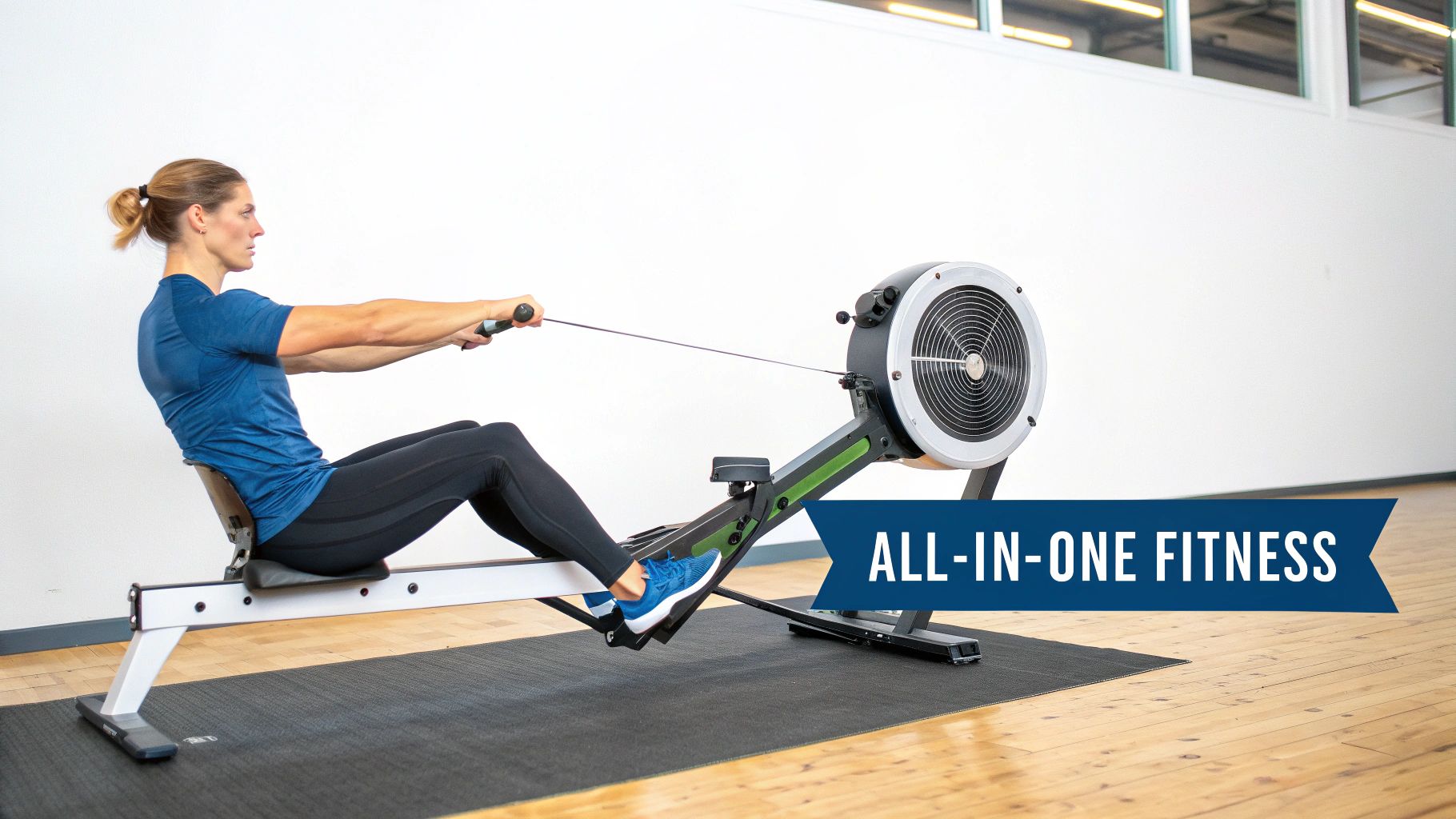
The feeling is intuitive. Pull harder, and the workout gets tougher. Ease off, and the resistance lightens up. This "variable resistance" means the machine never holds you back or pushes you too far—you are always in complete control of the intensity, making it perfect for both peak performance and gentle recovery.
A Versatile Tool for Health and Wellness
This responsive design is why you’ll find air rowers everywhere, from elite CrossFit gyms and physical therapy clinics to thousands of home gyms. They are incredibly versatile tools for enhancing your well-being.
- Full-Body Engagement: Rowing isn't just a leg or arm workout; it’s a true total-body movement. Every stroke powers through your legs, stabilizes with your core, and finishes with your back and arms for comprehensive strengthening.
- Low-Impact Cardio: The seated position and smooth, gliding motion protect your joints. It’s an ideal way to get your heart rate up and improve cardiovascular health without the pounding of running. You can explore more options in our guide to low-impact cardio machines.
- Enhanced Workout Recovery: A light rowing session is fantastic for active recovery. It gets blood flowing to tired muscles, helping to flush out metabolic waste and speed up the repair process after a tough workout, reducing soreness and improving overall wellness.
This isn't just a niche piece of equipment anymore. The air resistance rowing machine market hit a value of around $1.2 billion in 2023, and it's only growing as more people discover its profound health benefits.
For anyone building a personal workout space, an air rower is fantastic resistance training equipment for home. It delivers both cardio and strength training in one compact footprint.
Here at MedEq Fitness, we believe in giving you the knowledge and the tools to optimize your performance and recovery. This guide will break down everything you need to know about mastering the air rower for a healthier life. For more wellness insights, visit our MedEq Wellness Journal.
Understanding the Science of Air Resistance
So, what’s the secret behind an air resistance rower? It’s surprisingly simple—and that’s exactly what makes it so effective. The machine uses the air in the room to create a workout that’s perfectly matched to your effort.
Think about sticking your hand out of a moving car window. The faster you go, the more the air pushes back. That’s the core principle right there.
The rower’s flywheel, with its large fan blades, works the same way. When you pull the handle, you spin the fan. The harder and faster you pull, the more air it has to move, and the tougher the resistance gets. It’s a beautifully direct relationship.
The Power of Variable Resistance
This is what we call variable resistance, and it’s the defining feature of an air rower. Unlike other machines, you’re not fiddling with dials or buttons to set the difficulty. The intensity is generated entirely by you, stroke by stroke.
This means the workout instantly adapts to your strength and stamina in real-time. You can’t "outgrow" an air rower. The harder you work, the harder it pushes back.
The resistance is self-powered and self-regulating. The force you feel is a direct result of how fast and hard you drive. You are in total control, making it the perfect tool for everything from explosive power sessions to gentle recovery rows.
This immediate feedback loop is what makes the air resistance rower such a versatile piece of equipment for almost any wellness goal.
Why This Matters for Your Health and Wellness
The physics don’t just make for a good workout; they translate directly into some serious health benefits, especially for your joints and long-term vitality.
- Joint Protection: Rowing is a smooth, fluid motion without any harsh impact. The resistance builds progressively through the stroke, so there's no sudden, jarring force on your knees, hips, or ankles.
- Natural Motion: The feel of an air rower is often compared to rowing on actual water. It encourages a natural, biomechanically sound movement that your body will thank you for.
- Enhanced Recovery: This gentle, non-weight-bearing motion is perfect for active recovery. A light row gets the blood flowing to tired muscles, delivering nutrients and flushing out waste products without adding more stress, promoting faster healing.
Perfect for High-Intensity Training
The instant response of air resistance is also tailor-made for High-Intensity Interval Training (HIIT). You can go from an all-out sprint to a recovery pace without ever stopping to adjust a setting. The machine just reacts.
This lets you push your cardio limits, burn a ton of calories, and improve your VO₂ max—a key marker of heart health. Every single session is exactly as hard as you make it.
Whether you're an athlete chasing performance gains or just focused on long-term wellness, the science of air resistance delivers a safe, effective, and endlessly scalable workout. To explore more ways to support your fitness journey, visit our MedEq Wellness Journal.
Comparing Rower Types: Air vs. Magnetic, Water, and Hydraulic
When you’re looking to bring a rower into your space, the options can feel a bit overwhelming. The single most important decision you'll make is the resistance type, because it completely defines how the machine feels and performs. Let's walk through the four main players on the market: air, magnetic, water, and hydraulic.
An air resistance rower is the gold standard for athletes and serious fitness enthusiasts for a good reason. It uses a flywheel fan that creates a responsive, dynamic feel that’s the closest you’ll get to actually rowing on open water. The harder you pull, the more air the fan has to move, and the tougher the resistance gets. This gives it a virtually unlimited intensity ceiling, making it perfect for anything from all-out HIIT sprints to long, steady cardio sessions.
On the other hand, magnetic rowers use a different approach. They rely on magnets moving closer to or farther from a metal flywheel to adjust the resistance. This is all controlled electronically, so you get a very fixed and predictable difficulty level. The biggest win for magnetic rowers? They are whisper-quiet. With no friction involved, they're the perfect fit for apartments or any home where noise is a major concern.
The Feel and Sound of Your Workout
The user experience between these machines is night and day. Air rowers give you that powerful, connected feel, accompanied by an audible "whoosh" that many people find incredibly motivating. That sound is a direct audio cue of your effort—a gentle recovery row is quiet, while a max-effort pull is loud and satisfying.
Water rowers are designed to replicate the on-water experience down to the last detail. A flywheel churning through an actual tank of water creates a uniquely smooth and consistent resistance. The sound is a gentle, soothing slosh, which turns your workout into a more meditative, immersive experience. You can learn more about their unique appeal by exploring our deep dive on water rowing machine benefits.
Finally, you have hydraulic rowers. These typically use pistons attached to the handles for resistance and are often the most compact and budget-friendly choice. The trade-off, however, is that the rowing motion can feel less natural and a bit choppy compared to the other types. They also might not have the long-term durability needed for really intense, frequent use.
A Focus on Wellness and Recovery
When your goal shifts to wellness or workout recovery, the type of rower you choose becomes even more important. This is another area where an air rower really shines, thanks to its user-driven intensity. You can hop on for a very light recovery session to get blood flowing and help your muscles repair without putting any jarring impact on your joints. To take this a step further, combining your rowing with contrast therapy—alternating between hot and cold exposure—can dramatically accelerate recovery by boosting circulation and reducing inflammation.
This decision tree gives you a great visual for how your goal—whether it's peak fitness or active recovery—should guide your effort on an air rower.
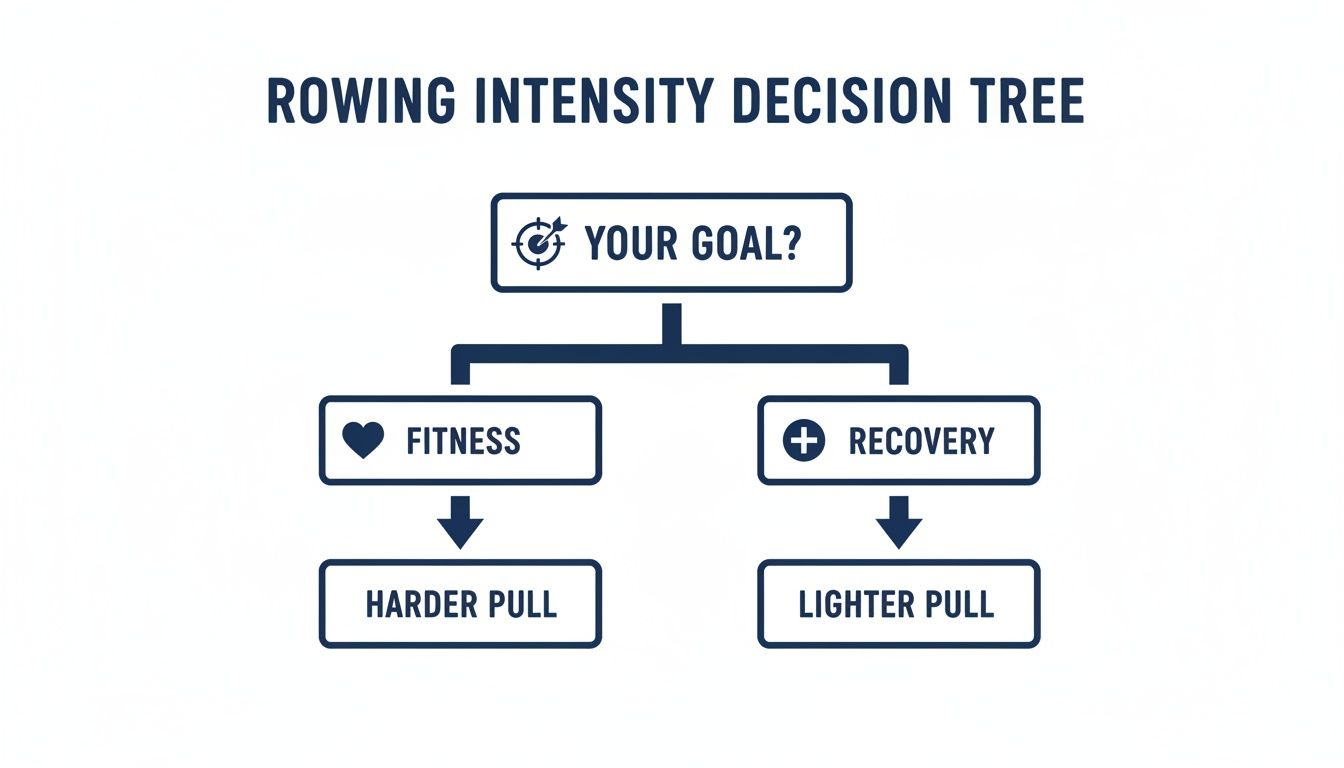
The key takeaway here is that the machine adapts to you. You are in complete control of the resistance with every single pull.
Magnetic rowers are also great for controlled, low-impact workouts, but their resistance levels are capped. Water rowers offer a smooth, non-weight-bearing motion that’s also incredibly gentle on the body. It really boils down to your personal preference for the sound and feel during those lighter sessions.
To make comparing these options easier, here’s a quick breakdown of how the four main resistance types stack up against each other.
Rowing Machine Resistance Type Comparison
| Feature | Air Rower | Magnetic Rower | Water Rower | Hydraulic Rower |
|---|---|---|---|---|
| Resistance Feel | Dynamic, infinite, responds to user effort | Smooth, predictable, set levels | Smooth, consistent, mimics water | Mechanical, can feel less fluid |
| Noise Level | Loudest (whooshing sound) | Quietest (near-silent) | Moderate (soothing sloshing) | Moderate (piston sounds) |
| Best For | HIIT, athletes, wellness & recovery | Home gyms, quiet spaces, apartments | Immersive workouts, joint-friendly cardio | Small spaces, budget-conscious users |
| Maintenance | Clean flywheel, lubricate chain | Virtually maintenance-free | Water purification tablets | Check piston seals periodically |
Each type has its own distinct personality and purpose. Your ideal match depends entirely on what you're looking to achieve with your training and where you'll be using it. For more wellness tips, check out the MedEq Wellness Journal.
Noise Levels and Maintenance Needs
Let's be practical—noise matters, especially in a home gym. As a general rule, magnetic rowers are the quietest, humming along at around 51 decibels (dB). Air rowers are easily the loudest, capable of hitting 73 dB or more when you're really pushing it. Water rowers land comfortably in the middle with a sound that’s present but generally considered pleasant.
Maintenance is the other big differentiator you'll want to consider.
- Air Rowers: You'll need to regularly clean the flywheel cage to keep dust from building up and impacting performance. The chain also needs a bit of lubrication from time to time.
- Magnetic Rowers: These are almost entirely maintenance-free because of their enclosed, frictionless design.
- Water Rowers: The water needs to be treated with purification tablets every so often to keep it clean and clear.
- Hydraulic Rowers: You might need to check on the piston seals occasionally to make sure they aren't leaking any fluid.
Ultimately, the best air resistance rower—or any rower, for that matter—is the one that fits your specific goals, your environment, and your personal preferences. Whether you thrive on the high-performance feedback of an air rower, need the silence of a magnetic machine, or love the authentic feel of water, understanding these core differences is the key to making the right choice for your wellness journey.
The Health and Wellness Benefits of Rowing
An air resistance rower is so much more than a cardio machine. Think of it as a complete system for improving your overall health, delivering a powerful, low-impact workout that strengthens your heart and lungs without punishing your joints like running can. This makes it a fantastic choice for building sustainable, long-term fitness and vitality.
The real magic of rowing is that it’s a true full-body workout. Every single stroke engages an incredible 86% of your body's muscles. You drive with your legs, brace with your core, and pull with your back and arms in one fluid motion. This total-body activation is what makes it so uniquely effective for holistic wellness.
A Powerful Tool for Weight Management
Because rowing fires up so many muscle groups simultaneously, it’s an absolute powerhouse for burning calories. A tough session can torch anywhere from 400 to over 800 calories per hour, depending on how hard you’re working and your body weight. This makes it one of the most efficient ways to create the calorie deficit needed for healthy weight management.
By combining serious cardio with muscle toning, regular rowing sessions are a cornerstone of effective weight loss strategies. You’re not just burning calories; you're building a stronger, more metabolically active body. You can dive deeper in our guide on using a rowing machine for weight loss.
Enhancing Workout Recovery and Rehabilitation
One of the most profound health benefits of an air rower is its role in recovery. The smooth, non-weight-bearing motion is perfect for active recovery days and is a go-to tool for physical therapists helping clients regain strength and mobility.
A light rowing session boosts circulation to tired, sore muscles. This helps flush out metabolic waste like lactic acid and delivers fresh, oxygen-rich blood to speed up tissue repair, which can seriously cut down on muscle soreness and recovery time.
This is exactly why you’ll find air rowers in performance training centers and physical therapy clinics everywhere. They’ve been a staple in the fitness world since the 1980s, with Concept2's iconic Model D becoming the gold standard you'll find in over 35% of commercial gyms. Its PM5 monitor, launched in January 2020, perfectly mimics the feel of real-world wind drag by automatically adjusting to your effort—ideal for athletes and clinics like those served by MedEq Fitness.
Optimizing Wellness with Contrast Therapy
If you really want to take your recovery to the next level, try pairing your rowing workout with contrast therapy. This technique involves switching between hot and cold temperatures to kickstart circulation and crush inflammation, boosting your overall wellness.
Here’s a simple routine to try:
- Warm-Up: Start with a 10-15 minute easy row to get your muscles warm and your blood flowing.
- Workout: Crush your main rowing session, whether it’s steady-state cardio or high-intensity intervals.
- Cool-Down: Wind down with 5-10 minutes of very light rowing to let your heart rate settle.
- Cold Plunge: Right after your cool-down, hop into a cold plunge for 1-3 minutes. This constricts blood vessels, helping to slash inflammation and soreness.
- Heat Exposure: Follow that up with 10-15 minutes in a sauna or a hot shower. This opens the blood vessels back up, promoting nutrient delivery and deep relaxation.
This powerful one-two punch uses both active recovery and thermal stress to accelerate muscle repair, boost circulation, and leave you feeling incredible. By making rowing and smart recovery a regular habit, you can see real improvements in key wellness metrics like Heart Rate Variability (HRV) and sleep quality. For more health tips, visit the MedEq Wellness Journal.
How to Choose the Right Air Resistance Rower
Finding the perfect air resistance rower isn't about picking the most expensive model; it’s about matching the machine to your mission. Are you a biohacker chasing peak performance metrics, a clinic guiding patient recovery, or someone building a no-compromises home gym? Knowing what matters will make sure your investment serves your health and wellness for years to come.
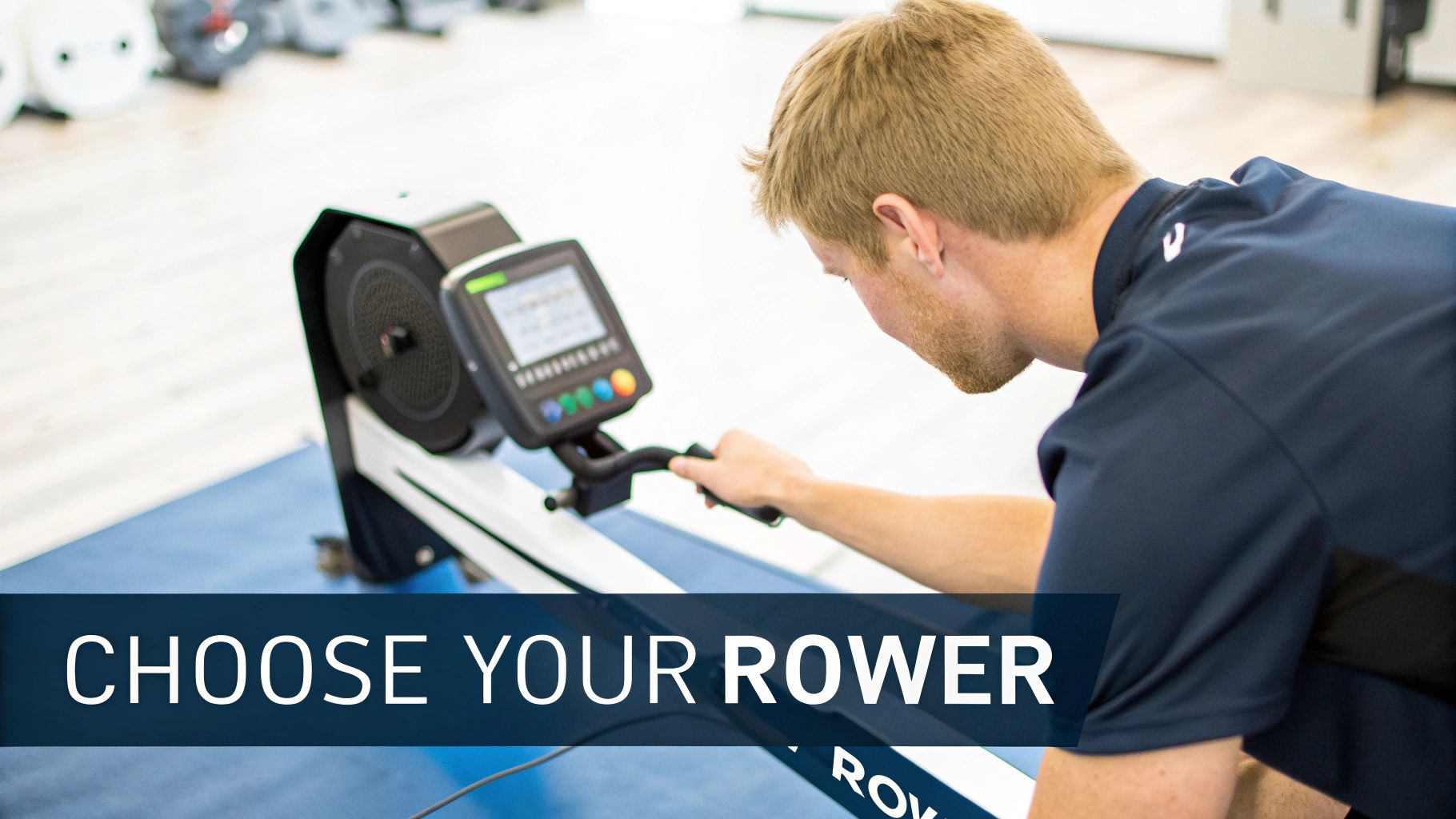
The process doesn’t need to be overwhelming. If you focus on a few key areas—build quality, monitor capabilities, and smart design features—you can cut through the noise and find a rower that feels like it was made for you.
Evaluating Build Quality and Durability
The soul of a great rower is its frame. Look for solid steel or aluminum construction. This is what provides the rock-solid stability you need for everything from all-out sprints to steady-state recovery rows. A solid build eliminates wobble and ensures the machine can take a beating, which is non-negotiable in a clinic or multi-user gym.
Zoom in on the details: the rail, the chain, and the seat. A smooth monorail is what gives you that seamless gliding motion, making every stroke fluid and connected. And a nickel-plated or stainless steel chain isn't just a minor upgrade—it’s a commitment to durability and less maintenance down the road.
The Importance of the Performance Monitor
Think of the monitor as the rower's brain. Its features can completely change your training experience. A biohacker digging into performance data needs something very different from a patient using the rower for gentle rehabilitation.
At a bare minimum, any good monitor should clearly display the core metrics:
- Pace: Your time per 500 meters—the universal standard for rowing speed.
- Watts: A pure measure of your power output, perfect for tracking strength gains.
- Stroke Rate: How many strokes you’re taking per minute (SPM).
- Time and Distance: The fundamentals for tracking any workout.
For anyone serious about data-driven wellness, look for monitors with advanced features like Bluetooth. This is how you sync your workouts with fitness apps, see your progress over months or years, and connect to a heart rate monitor for truly precise training zones.
A feature like "Drag Factor" is a total game-changer. It actually measures the flywheel's deceleration, giving you a consistent feel no matter what machine you're on or what the ambient conditions are. For anyone needing to replicate specific training protocols, this is critical.
Practical Considerations for Your Space
Beyond the numbers, you have to consider how the rower fits into your actual life. Noise is a big one. While all air rowers have that signature "whoosh," modern designs have come a long way. The sound directly correlates with your effort, typically ranging from a quiet 51 dB at a recovery pace to around 73 dB during a sprint.
Storage is another key point. Many of the best air rowers are engineered to separate into two pieces or stand upright, which slashes their storage footprint. For home gyms or clinics where every square foot counts, this is an essential feature.
Finally, think about the feel of the machine. An ergonomic handle prevents unnecessary strain on your hands and wrists, while adjustable footrests let you lock in a secure and powerful position. These are the small details that make the difference between a workout you have to do and one you want to do.
For more insights on building out a wellness-focused space, check out our articles on the MedEq Wellness Journal.
Your First Air Rower Workouts for Any Fitness Level
Hopping on a new piece of equipment can feel a little intimidating, but the air resistance rower is incredibly welcoming no matter where you are in your wellness journey. The key is to start by nailing your form. Building that solid foundation is what unlocks the machine's full health benefits and keeps you injury-free.
Always start with a proper warm-up to get your muscles and cardiovascular system ready for action. A light, 5-10 minute row at a low, easy pace is perfect. Once you’re done, mirror that with a cool-down of the same length to let your heart rate come down gradually and kickstart your recovery.
The Beginner Form-Focused Workout
For your first few rows, just forget about the clock. Your only job is to master the rowing stroke. This session is all about building muscle memory so you can move efficiently and powerfully.
- Duration: 15 minutes
- Structure: Row for 2 minutes, then rest for 1 minute. Repeat this cycle 5 times.
- Intensity: Keep it light. The stroke rate should be low and controlled, somewhere around 18-22 strokes per minute.
- Primary Goal: Really concentrate on the four phases of the stroke: Catch, Drive, Finish, and Recovery. You want to feel the power coming from your legs first, followed by your core and back, with your arms finishing the movement.
The Intermediate Interval Challenge
Once your form feels second nature, you can start pushing the pace with some interval training. This workout plays with intensity to seriously boost your heart health and overall fitness.
Intervals are so effective because they force your body to adapt to different levels of effort. This is where an air rower really shines—the resistance instantly responds to how hard you’re pulling.
Here’s a simple but effective protocol to follow:
- Work Period: Row hard for 1 minute.
- Rest Period: Row very lightly for 1 minute.
- Rounds: Knock out 10-12 rounds, which gives you a great 20-24 minute workout.
- Intensity: During the "hard" minute, find a powerful pace you can sustain for the full 60 seconds. The "light" minute is all about active recovery.
The Advanced Power and Endurance Test
For the experienced rowers out there, this workout is designed to push you right to your limits. It combines short, all-out sprints with minimal rest to build serious anaerobic endurance and raw power.
- Structure: 10 rounds of 500 meters.
- Pacing: Hit each 500-meter piece at a near-sprint pace.
- Rest: Take exactly 90 seconds of rest between each round. No more, no less.
- Goal: The real challenge? Try to keep your split time consistent across all 10 rounds.
When you pair these workouts with smart recovery practices like contrast therapy, you'll amplify your results even further. To find more ways to optimize your health journey, check out our MedEq Wellness Journal.
Common Questions About Air Resistance Rowers
It's natural to have questions when you're looking into new fitness equipment. Let's tackle some of the most common ones about air rowers to help you figure out exactly where they fit into a health and wellness routine.
Are Air Rowers Too Loud for Home Use?
The "whoosh" of an air rower is its signature sound, but modern designs are often quieter than people think. The noise level is a direct result of your effort—a gentle warmup will be pretty quiet, while an all-out sprint will naturally be louder.
Honestly, a lot of people find the sound motivating. It’s like an audible cue of the work you're putting in. But if you live in an apartment or a shared space where silence is golden, a magnetic or water rower might be a better fit.
How Does an Air Rower Aid in Workout Recovery?
This is where the air resistance rower really shines as a tool for active recovery and overall wellness. Its smooth, continuous motion is incredibly low-impact, meaning you can get your body moving without adding stress to your joints. A light rowing session is fantastic for increasing blood flow to muscles all over your body.
This boost in circulation helps flush out the metabolic waste from tough workouts while delivering the oxygen and nutrients your muscles need to repair. Since you have total control over the intensity, a gentle row can speed up muscle repair and works perfectly alongside other recovery methods like contrast therapy with cold plunges or saunas.
Can I Build Muscle with Just an Air Rower?
Absolutely. Rowing is a unique mix of cardio and resistance training. A single, powerful stroke calls on about 86% of your body's muscles—your legs, glutes, core, back, and arms are all firing at once.
While it won't pack on the kind of bulk you'd get from heavy lifting, an air rower is amazing for building lean, functional strength and muscular endurance. It helps create a balanced, athletic physique, making it a powerful cornerstone for any wellness-focused fitness plan. To dig deeper into similar topics, check out our MedEq Wellness Journal.
At MedEq Fitness, we provide science-backed equipment designed to bridge the gap between exertion and renewal. Discover our curated selection of professional-grade recovery tools to elevate your daily capacity.