

Hyperbaric Chambers for Athletes: Faster Recovery and Peak Performance
In the relentless pursuit of a competitive edge, elite athletes are increasingly turning to a powerful, science-backed recovery tool: hyperbaric oxygen therapy (HBOT). This isn't just about resting; it's about actively supercharging the body's natural healing processes for optimal wellness. HBOT is a proven method for slashing workout recovery time by flooding tissues with the one thing they crave most after intense work—oxygen.
The Modern Athlete's Edge in Recovery
Every athlete knows the real secret to getting stronger isn't just the workout. It's the recovery. Pushing your limits creates micro-damage in your muscles and tissues. The magic happens in the hours and days that follow, as your body rebuilds itself to be more resilient than before. This is where hyperbaric chambers for athletes come in, offering a way to dramatically accelerate and enhance that crucial healing phase.
Think of it like giving your body’s natural repair crew a high-octane fuel source. That’s exactly what HBOT does. By breathing nearly pure oxygen inside a pressurized chamber, you dissolve far more oxygen into your bloodstream than you ever could at normal atmospheric pressure. This oxygen-rich plasma can then permeate areas that regular circulation might struggle to reach due to swelling or injury, kickstarting repair at the cellular level for profound health benefits.
Why This Matters for Peak Performance
For an athlete, the wellness benefits are direct and profound. Faster, more complete workout recovery means you can train harder and more often, all while reducing the risk of the nagging overuse injuries that can sideline you.
This table summarizes the primary health advantages of incorporating hyperbaric oxygen therapy into an athletic training and recovery regimen.
HBOT Benefits for Athletes at a Glance
| Benefit Category | Mechanism of Action | Impact on Athletes |
|---|---|---|
| Muscle Repair | Increased oxygen delivery to damaged muscle fibers fuels cellular regeneration and protein synthesis. | Drastically shortens the time needed to recover from intense training sessions and competitions. |
| Inflammation Control | Promotes vasoconstriction (narrowing of blood vessels), helping to reduce swelling and flush out metabolic waste. | Less post-workout soreness and faster resolution of minor strains and sprains. |
| Energy & Stamina | Enhances mitochondrial function and ATP (cellular energy) production throughout the body. | Improved endurance, reduced fatigue during training, and better overall performance capacity. |
By optimizing these key areas, HBOT allows athletes to maintain a higher training volume and intensity without breaking down.
This isn't some fleeting trend. The use of hyperbaric oxygen therapy in sports medicine has exploded over the last 30 years. Since the 1990s, its adoption for treating training and competition injuries has surged, driven by its undeniable ability to speed up recovery by boosting oxygen delivery to damaged tissues. For a truly holistic approach, many athletes also incorporate complementary sports massage therapy to address muscular tension and improve flexibility.
By integrating HBOT, athletes stop being passive participants in their recovery. They are taking active control, gaining a powerful wellness advantage that can make all the difference when it counts. For more insights on cutting-edge recovery tech, check out our MedEq Wellness Journal.
How HBOT Supercharges Your Body's Healing Engine
Let's break down the science behind hyperbaric chambers for athletes, but without the dense textbook language.
Think of your bloodstream as a highway and your red blood cells as delivery trucks. Their job is to haul oxygen to every muscle and tissue in your body. On a normal day, they do a fantastic job.
But after a brutal workout or an injury, a problem pops up: swelling. This swelling is like a massive traffic jam, blocking those oxygen trucks from reaching the damaged areas that are desperate for fuel to start repairs. This is a huge bottleneck for workout recovery.
The Oxygen Bypass System
This is where Hyperbaric Oxygen Therapy (HBOT) completely changes the equation. When you're inside a hyperbaric chamber, two things happen: you breathe nearly 100% pure oxygen, and the air pressure around you is cranked up.
This added pressure does something amazing—it allows your body to dissolve a massive amount of oxygen directly into your blood plasma (the liquid part of your blood).
You’re essentially turning the entire highway into an oxygen delivery system, not just the trucks. This super-oxygenated plasma can easily flow right past the "traffic jam" caused by swelling, delivering life-giving oxygen to starved cells that the red blood cells couldn't get to.
By saturating the blood plasma with oxygen, HBOT creates a biological bypass, ensuring that healing resources can penetrate deep into injured or overworked tissues, dramatically speeding up the natural repair process.
This is the core of how HBOT works, giving your body a powerful tool to recover on a cellular level.
This concept map shows exactly how hyperbaric therapy helps athletes bounce back faster—it drives muscle repair, cuts down inflammation, and ultimately sharpens that competitive edge.
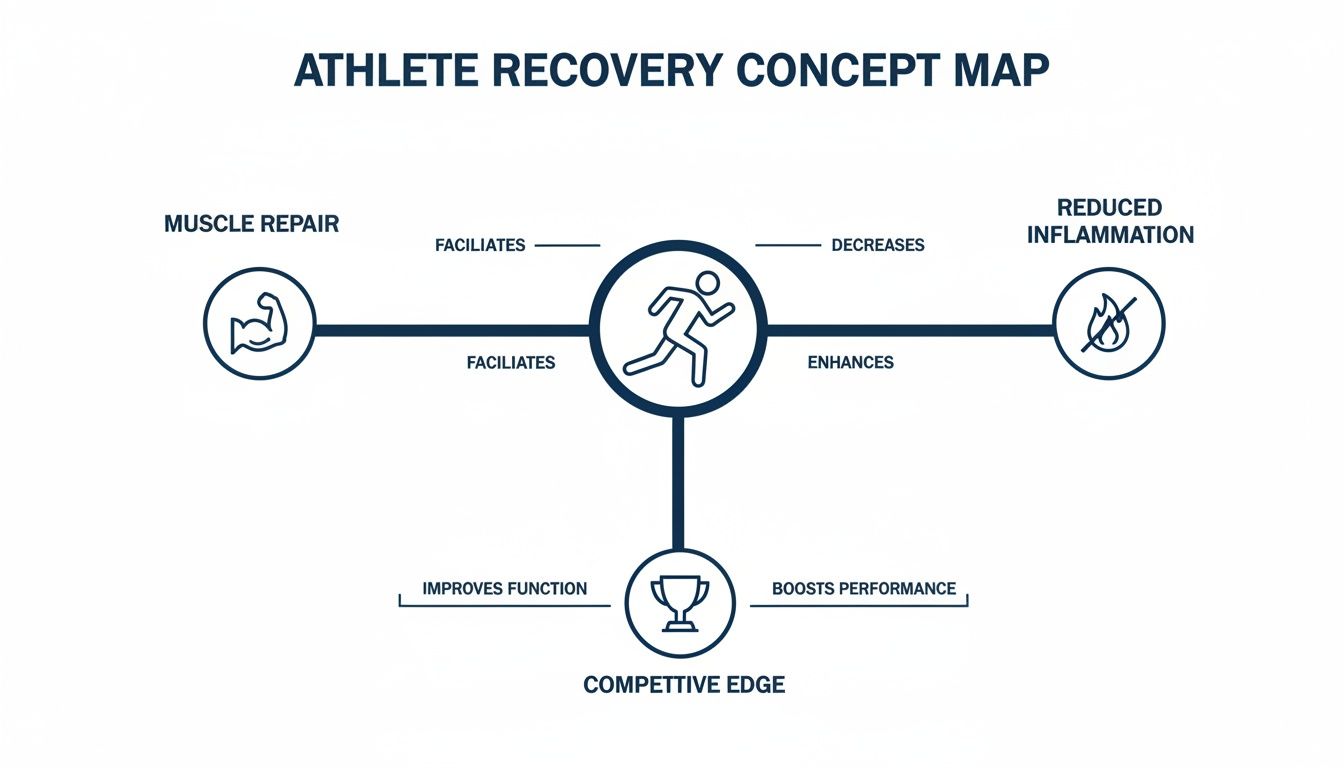
You can see the clear path from treatment to the real-world results every athlete is chasing.
Key Physiological Health Benefits for Athletes
This flood of oxygen kicks off several healing processes that are absolutely critical for any athlete looking to stay on top of their game.
- Drastic Inflammation Reduction: That high oxygen concentration causes vasoconstriction, which just means your blood vessels temporarily narrow. This helps shut down acute swelling and inflammation—the main culprit behind pain and slow workout recovery.
- Stimulated Blood Vessel Growth: HBOT promotes angiogenesis, or the creation of new capillaries. This builds new, permanent pathways for blood to deliver nutrients and oxygen, making your tissues stronger and more resilient over the long haul.
- Accelerated Muscle and Tissue Repair: All that extra oxygen fuels your mitochondria (the powerhouses of your cells), giving them the energy they need for cellular repair, collagen production, and rebuilding damaged muscle fibers.
This isn't just about masking soreness. It's about fundamentally upgrading your body's ability to heal itself from the inside out. For athletes dealing with nagging issues, understanding the best approaches for healing running injuries is crucial, and HBOT offers a direct path to getting back on track faster.
Even better, this supercharged healing environment stacks perfectly with other recovery tools. Pair it with contrast therapy, and the effects are even more powerful. A cold plunge knocks down immediate inflammation, while a follow-up sauna session gets the blood moving. HBOT then delivers the final piece of the puzzle—deep oxygen penetration—to complete a workout recovery cycle that gets you ready for whatever comes next.
For more insights on cutting-edge recovery tech, check out our MedEq Wellness Journal.
The Clinical Evidence That Backs HBOT for Athletes
While the physiological theory behind hyperbaric chambers is solid, the real confidence comes from the clinical evidence. Anecdotes from pro athletes are one thing, but hard, measurable data is what really cements HBOT’s place as a serious tool for workout recovery.And the research is backing it up.
The studies go beyond just theory and look at specific biological markers—the stuff that tells the true story of what's happening inside your body. Think of these markers as a report card for your recovery, showing exactly how well you’re bouncing back from the grind.
Translating Science into Real-World Results
Every time an athlete pushes their limits, they create microscopic tears in their muscles. This is normal, and it triggers an inflammatory response. One of the key indicators of this damage is an enzyme called creatine kinase (CK).
When CK levels are high in your bloodstream, it’s a clear signal of significant muscle breakdown. The faster you can get those levels down, the faster you recover. Period.
This is exactly where HBOT shines. Research consistently shows that a series of hyperbaric sessions can slash these inflammatory markers. By dialing down this biochemical stress, the therapy gets right to the root cause of delayed onset muscle soreness (DOMS) and that lingering fatigue that kills your next training session.
By directly targeting the biochemical markers of muscle damage, HBOT offers a scientifically validated method to accelerate the body’s natural healing timeline, allowing for a quicker and more complete return to peak performance.
It's not just about feeling better. It’s about creating an internal environment where your body can genuinely repair itself more efficiently.
Key Findings from Clinical Trials
The body of research supporting hyperbaric chambers for athletes is getting bigger every year, and the studies are pointing to some critical health benefits. These aren't just minor tweaks; they're significant, validated outcomes that every serious competitor should know about.
- Reduced Muscle Damage Markers: Study after study tracks a sharp drop in creatine kinase (CK) and myoglobin levels in athletes who use HBOT after a workout. This is clear proof of less muscle damage and a faster start to the repair cycle.
- Decreased Perceived Soreness: Athletes consistently report feeling less muscle soreness and pain after their sessions. This subjective feedback lines up perfectly with the objective biochemical data.
- Accelerated Injury Healing: For common sports injuries like ligament sprains and muscle tears, HBOT has been shown to shorten recovery timelines. The super-oxygenated environment helps kickstart collagen synthesis and the formation of new blood vessels—both essential for rebuilding busted tissue.
These findings build a powerful case for making HBOT a cornerstone of any serious workout recovery protocol. For a deeper dive into how this all works, check out our guide on what is hyperbaric oxygen therapy.
A landmark 2019 randomized controlled trial really drove this point home. Researchers followed 41 athletes with exercise-related muscle injuries. The group that received HBOT showed massive reductions in creatine phosphokinase (CK) and other damage markers by their tenth session, and the benefits stuck around for two weeks after treatment ended.
Even better, their self-reported pain scores also dropped dramatically. This highlights just how powerful HBOT is for speeding up that critical early-stage recovery.
This is the kind of clinical validation that elevates HBOT from a simple wellness trend to an essential piece of recovery technology. It’s proven its worth where it matters most.
For more insights on cutting-edge recovery tech, check out our MedEq Wellness Journal.
Choosing Your Chamber: Hard Shell vs. Soft Shell
Deciding to bring recovery hardware in-house is a big move. When you start looking at hyperbaric chambers, you’ll find two main roads you can go down: the flexible, soft-sided chambers and the rigid, hard-sided models. Getting a handle on what makes them different is the first step to picking the right tool for your body and your wellness goals.
This isn't just about looks or materials—it's about physics. The real game-changer is the amount of pressure each chamber can safely handle. That pressure, measured in atmospheres absolute (ATA), directly controls how much oxygen your body can absorb. More pressure, more oxygen saturation, more therapeutic firepower.
Think of it like this: a soft chamber is your trusty set of resistance bands. It's fantastic for general conditioning, day-to-day maintenance, and keeping things tuned up. A hard chamber? That’s the full squat rack. It's built for the heavy lifting required to drive serious physiological change and bounce back from major setbacks.
Understanding Pressure and Performance
Soft-sided chambers are designed for what’s called mild hyperbaric oxygen therapy (mHBOT). These are inflatable units, usually made from tough synthetic fabrics, that can get up to pressures of 1.3 or 1.5 ATA. It’s a gentle but meaningful bump from the normal air pressure we live in (1.0 ATA), perfect for boosting general wellness, knocking down minor inflammation, and speeding up recovery from a tough workout.
Hard-shell chambers, on the other hand, are beasts built from steel and acrylic. That rock-solid construction lets them operate at much higher pressures, often hitting 2.0 ATA and beyond. This is where you unlock the full spectrum of HBOT’s power, especially for healing significant sports injuries and triggering deep cellular repair.
The key takeaway is simple: the pressure level determines how much oxygen gets dissolved into your blood plasma. The higher pressures in a hard-shell chamber create a much more profound therapeutic effect, which can be absolutely critical for an elite athlete who needs to get back in the game fast.
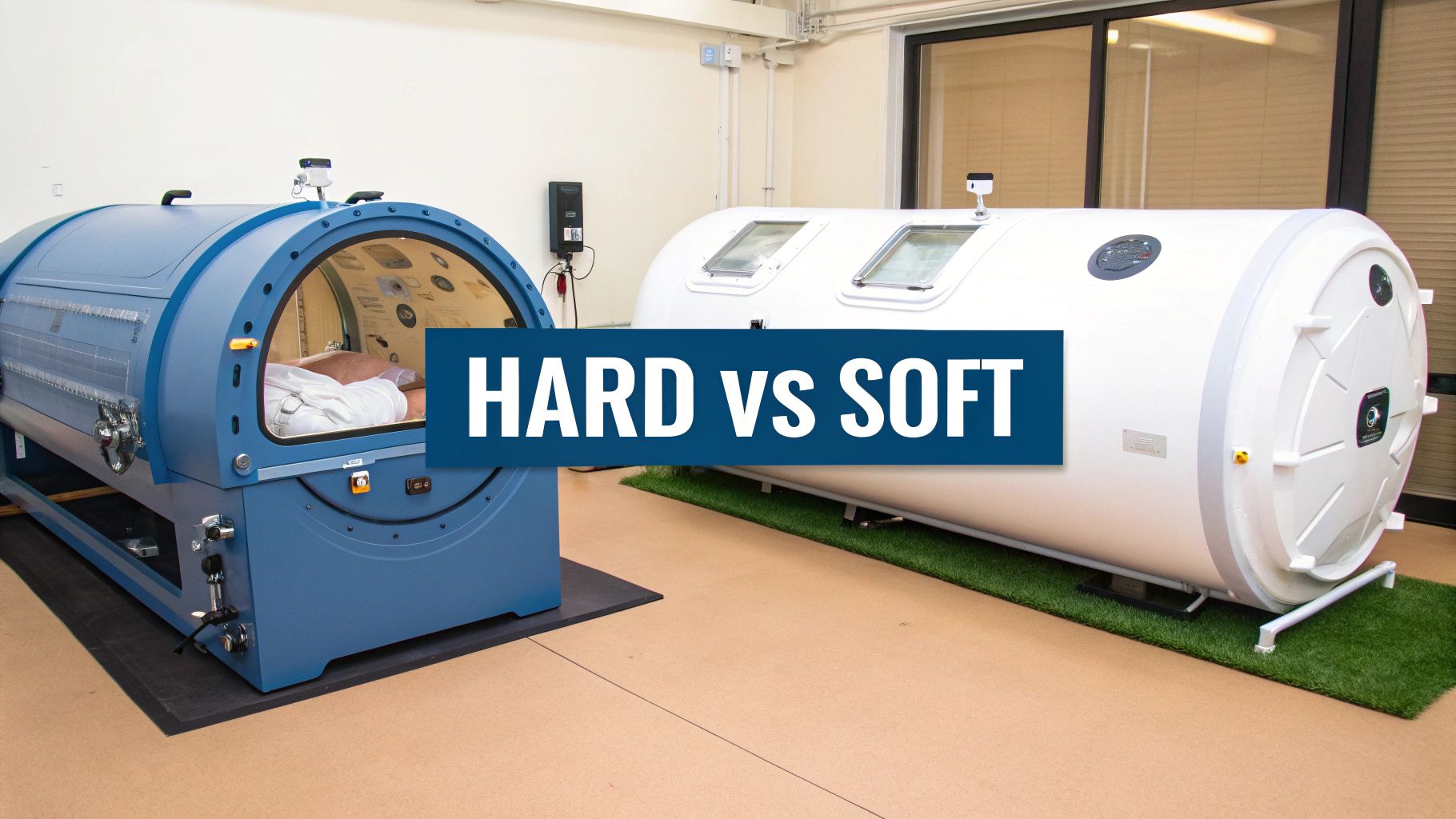
A Side-by-Side Comparison
To really see the difference, let’s put these two types of chambers head-to-head. The table below breaks down the practical distinctions that matter most to an athlete or a clinic owner making a purchase.
Comparison of Soft Shell and Hard Shell Hyperbaric Chambers
| Feature | Soft Shell Chamber (mHBOT) | Hard Shell Chamber (HBOT) |
|---|---|---|
| Max Pressure | Typically 1.3 - 1.5 ATA | 1.5 - 2.0 ATA and higher |
| Ideal Use | General wellness, workout recovery, relaxation | Injury repair, clinical applications, peak performance |
| Construction | Flexible synthetic fabric | Steel and medical-grade acrylic |
| Portability | Highly portable, can be deflated and stored | Stationary, requires professional installation |
| Cost | More affordable initial investment | Higher initial investment, built for longevity |
| Oxygen Delivery | Typically uses an oxygen concentrator | Can use 100% pure medical-grade oxygen |
As you can see, there’s a clear trade-off. Soft chambers deliver amazing convenience and affordability for building a solid wellness foundation. Hard chambers bring the clinical-grade power needed for the most intensive recovery protocols.
If you’re ready to look at specific models, our complete guide on the best hyperbaric chamber for home use is the perfect next step.
Ultimately, your choice boils down to your mission. Are you looking for a daily wellness boost and a way to recover faster from your regular training grind? A soft chamber might be all you need. But if you're rehabbing a serious injury or chasing that extra 1% of physiological optimization, a hard chamber is the superior tool for the job.
For more insights on cutting-edge recovery tech, check out our MedEq Wellness Journal.
Getting Your HBOT Protocol Dialed In
Knowing the science behind HBOT and picking the right chamber is one thing, but putting it all into practice is where the real results happen. To get the most out of your investment, you need a clear, actionable game plan that slots right into your training schedule.
It’s not about hopping in the chamber whenever you feel like it. True progress comes from strategic integration—defining the right session length, frequency, and pressure to match your specific goals, whether that’s coming back from a nagging injury or just staying on top of daily soreness.
Defining Your Sessions: The Core Variables
Think of HBOT like you think about your training: the "dosage" matters. That dosage is a combination of pressure, duration, and how often you get in. You wouldn't follow a random lifting program, and your HBOT protocol should be just as personalized.
Here’s what to focus on:
-
Session Length: For most athletic workout recovery, a 60 to 90 minute session is the sweet spot. This gives your blood plasma enough time to get fully saturated with oxygen and push it deep into your tissues without leaving you feeling drained.
-
Pressure (ATA): Your goal dictates the pressure. For general wellness and bouncing back from a tough workout, 1.3 to 1.5 ATA—typical for soft chambers—works great. But if you’re dealing with a more significant injury like a muscle tear, you’ll likely need the 1.5 to 2.0 ATA found in hard chambers to really drive that healing response.
-
Session Frequency: This is all about consistency. Your schedule has to adapt to what your body is telling you.
Recovery Stacking: HBOT + Contrast Therapy
The smartest athletes know that no single tool does it all. The real magic is in "recovery stacking"—layering different therapies to create an effect greater than the sum of its parts. HBOT is a perfect partner for contrast therapy, the practice of alternating between cold and heat.
Here’s a powerful workout recovery sequence to try:
- Cold Plunge: Right after your workout, a plunge constricts blood vessels. This is huge for shutting down acute inflammation and flushing all that metabolic junk out of your muscles.
- Sauna: Next, the heat of the sauna opens everything back up. This vasodilation gets circulation pumping again and helps your muscles relax.
- HBOT Session: This is your finisher. With inflammation under control and your circulation primed, the super-oxygenated blood can now flood those tissues, delivering the final resources they need for deep cellular repair.
This methodical approach ensures you hit every angle of recovery, from surface inflammation to deep tissue rebuilding. It’s also important to be clear about what HBOT does best. A major 2021 systematic review confirmed that while HBOT is a powerhouse for healing, it doesn’t provide a broad performance-enhancing boost on its own. It's a workout recovery tool, not a pre-workout. You can read the full research here.
When you see HBOT as the cornerstone of a complete recovery system—not just a standalone fix—you build resilience, slash downtime, and make sure you’re always ready for what’s next.
This is how a hyperbaric chamber stops being just a piece of equipment and becomes an essential part of your performance engine. To see how other cutting-edge wellness strategies fit in, head over to the MedEq Wellness Journal.
Bringing HBOT Into Your Facility or Home Gym
Alright, you understand the science. Now, let's talk about the practical side of bringing a hyperbaric chamber into your world, whether that's a commercial facility or a serious home gym. This is a big step, but it’s one that unlocks on-demand access to a recovery tool elite athletes swear by.
For a wellness facility, a hyperbaric chamber isn't just another piece of equipment; it's a statement. It instantly elevates what you can offer and becomes a magnet for high-performance clients who are looking for that next-level advantage. We're talking about a return on investment that goes beyond session fees—it's about building a reputation as a cutting-edge recovery destination.
For a dedicated athlete, the math is just as compelling, but a little different. Think about the hours and dollars you've spent driving to a clinic and paying for sessions. An in-home chamber reclaims all of that. It means this powerful tool is waiting for you the second you need it—right after a brutal competition or during a critical rehab window. That kind of immediate access is the ultimate competitive edge.
Keys to Making It Work
No matter where the chamber lives, a few things are non-negotiable for keeping it running safely and effectively for years.
First up is routine maintenance. This is simple stuff—regularly checking seals, filters, and the oxygen concentrator to ensure everything is performing as it should. It's the key to longevity.
Safety standards are just as critical. This means ensuring proper ventilation, sticking to the manufacturer's protocols for sessions, and making sure everyone who uses it knows what to expect, especially how to manage ear pressure as the chamber pressurizes.
Investing in a hyperbaric chamber is an investment in durable, long-term health and performance. The upfront cost is offset by the cumulative benefits of consistent, convenient access to one of the most effective recovery technologies available today.
Thinking About Your Return
Whether you’re a gym owner or an athlete, the value is clear. When you own the equipment, you own your recovery schedule.
- For Wellness Facilities: You can start offering HBOT packages and create a high-margin revenue stream. A chamber can easily become the star of a premium recovery suite, sitting alongside contrast therapy tools like cold plunges and saunas.
- For Home Gyms: The ROI here is measured in your performance. Consistent use can help you sidestep sidelining injuries, add years to your athletic career, and even provide a powerful wellness tool for the whole family.
Ready to see what's out there? MedEq Fitness has a hand-picked selection of both soft and hard shell hyperbaric chambers built to meet the demands of serious athletes and wellness professionals.
When you look at this as a long-term investment in performance, the decision becomes much clearer. You're not just buying equipment; you're buying results.
For more insights on cutting-edge recovery tech, check out our MedEq Wellness Journal.
Your Top HBOT Questions, Answered
When you're exploring powerful new recovery tools, it's smart to have questions. You're trying to figure out if this is the right move for your body and your goals. Let's clear up some of the most common queries we hear about hyperbaric therapy for athletes.
Is Using a Hyperbaric Chamber Cheating in Sports?
Not at all. Let's be perfectly clear: hyperbaric oxygen therapy is not considered cheating. It isn't banned by the World Anti-Doping Agency (WADA) or any major sports league.
Think of it this way—it’s a natural recovery method. HBOT simply enhances your body's own amazing healing mechanisms, much like an ice bath, a sauna session, or deep tissue massage. It's about optimizing your biology, not artificially manipulating it.
How Quickly Will I See Results?
This really depends on your goal and how your body responds. Many athletes step out of their very first session feeling a noticeable drop in muscle soreness and a boost in energy. It can be that fast for general workout recovery.
But for deeper work, like speeding up an injury or tackling long-term inflammation, consistency is everything. You'll see the most significant, lasting health benefits after a series of sessions—usually somewhere between 5 and 20 treatments.
The real magic of HBOT is cumulative. A single session offers immediate relief, but a consistent protocol is what builds lasting resilience and unlocks truly accelerated healing.
What Does a Session Actually Feel Like?
The main thing you'll notice is a bit of pressure in your ears as the chamber pressurizes, just like when a plane takes off or lands. It's a feeling of fullness.
It’s easy to manage, though. Yawning, swallowing, or gently pinching your nose and blowing will clear it right up. Once you hit the target pressure, that feeling disappears, and you can just relax. Most people use the time to read, listen to a podcast, or even take a nap.
Are There Any Risks or Side Effects I Should Know About?
HBOT is overwhelmingly safe, especially with modern equipment and when following the right protocols. The most common side effect is that temporary ear pressure we just talked about, which is simple to manage.
Serious risks are incredibly rare. Still, it's always best practice to consult with a qualified professional before starting any new therapy. That just ensures it’s the right fit for your specific health situation and performance ambitions.
For a deeper dive into this and other advanced wellness topics, head over to our MedEq Wellness Journal.
At MedEq Fitness, we're committed to equipping high performers with the best science-backed tools for recovery. Explore our curated selection of professional-grade hyperbaric chambers and find the perfect fit for your home gym or wellness facility. https://www.medeqfitness.com


.%20This%20isn't%20just%20about%20resting...)