
Your Guide to the Best Pilates Reformer for Home
Deciding to get a pilates reformer for home isn't just about buying another piece of workout equipment. It’s a real investment in your wellness—a commitment to building a holistic health practice right where you live. You're creating a dedicated space for strength, alignment, and mindful recovery.
Turn Your Home into a Wellness Sanctuary
Bringing a Pilates reformer into your house changes the game. It’s a shift from just "working out" to a more intentional approach to your health and well-being. Think of it as creating a personal sanctuary where you can shut out the noise and focus on building deep core strength, improving posture, and helping your body recover effectively.
The sheer convenience of having this incredibly versatile machine just a few steps away is huge. It removes all the usual excuses that get in the way of consistency, making it so much easier to weave mindful movement into your day. This guide is here to walk you through everything you need to know to pick, use, and absolutely love the perfect reformer for your wellness goals.

The Rise of At-Home Wellness Hubs
Our homes are evolving. They used to be just a place to crash at the end of the day, but now, they're becoming the central hub for our health and vitality. You can see this trend in the exploding demand for professional-grade wellness gear that actually fits into a living space.
The global Pilates reformer market tells the story perfectly. It's projected to more than double, jumping from roughly USD 7.65 billion in 2025 to about USD 16.81 billion by 2035. The home-use segment is a massive driver of this, expected to make up about 45.0% of total revenue in 2025 as more people embrace working out where they live. You can dig into more of these market insights over at Future Market Insights.
This boom isn't just a fad; it shows a deep desire for sustainable wellness routines that don't require a gym commute. A home reformer becomes the cornerstone of that vision, offering a powerful, low-impact workout that benefits both body and mind.
It’s More Than Just a Workout
One of the most significant health benefits of a home reformer is its incredible power for workout recovery.
Unlike high-impact exercises that pound your joints, the reformer uses controlled, spring-based resistance to gently lengthen and strengthen your muscles. This process boosts circulation, eases muscle soreness, and helps realign your body after intense activity. It's a form of active recovery that speeds up the repair process, leaving you feeling stronger and more resilient.
A home reformer practice slots in perfectly with other wellness routines, creating a powerful synergy. For instance, pairing a gentle reformer session with contrast therapy—like hopping between a sauna and a cold plunge—can seriously amplify recovery by boosting circulation and slashing inflammation.
This approach turns your home into a complete wellness ecosystem. It’s not just about exercising; it's about building a holistic system that supports your energy, resilience, and overall health, every single day. For more ideas on creating your personal wellness space, check out the MedEq Wellness Journal.
How a Pilates Reformer Really Works
Forget thinking of a Pilates reformer as just another piece of workout equipment. It’s more like a dynamic partner in your wellness journey, designed to manipulate gravity and resistance in ways that let your body achieve a level of control you just can't get on a mat. It’s a unique system that’s both supportive and demanding, ensuring every single motion is deliberate and controlled.
At its heart, the reformer is a symphony of coordinated parts: a sliding platform called the carriage, a set of color-coded springs that provide resistance, an adjustable footbar, and versatile straps. Together, they create a workout that’s deeply strengthening yet remarkably easy on your joints. The real magic is how it forces your muscles to work against the pull of the springs, not just your own body weight.
The Science of Spring Resistance
The springs are the soul of the reformer. They're what sets this practice apart from almost every other type of exercise. Instead of just hoisting a static weight up and down, you're working against the smooth, progressive tension of a spring. This creates what are known as eccentric muscle contractions—where the muscle lengthens while under tension—which is the secret to building long, lean muscle without adding bulk.
This spring system gives you constant resistance through the entire range of motion, so your muscles stay fired up from start to finish. The result? A more efficient and powerful workout that builds strength from the inside out.
The feedback from a reformer is immediate and honest. If your alignment is off or your core isn't engaged, the carriage will let you know. This constant feedback loop trains your body to move with precision and awareness, correcting imbalances you might not even notice on a mat.
A Full-Body System for Strength and Alignment
A reformer doesn't just isolate muscles; it teaches them to work together as one integrated system. That sliding carriage introduces a subtle (or not-so-subtle) element of instability, forcing your deep core muscles—your abs, back, and pelvic floor—to wake up and stabilize your body through every single exercise.
This is precisely why Pilates is so well-known for improving posture and creating a strong, stable center. You're never just doing a "leg exercise" or an "arm exercise"; you're performing a full-body movement that demands total control.
- Sliding Carriage: This moving platform is your stability test. It forces your core to engage to control the motion, building the deep, functional strength that supports a healthy spine.
- Adjustable Springs: You can dial the resistance up or down by adding or removing springs. What’s interesting is that lighter resistance can sometimes be more challenging for stability, while heavier resistance builds raw strength and power.
- Footbar and Straps: These are your gateways to hundreds of exercise variations. They let you push or pull with your hands or feet, allowing you to work every muscle group from countless different angles.
Beyond the Workout: The Benefits for Wellness and Recovery
Perhaps the most important health benefit of a reformer is its role in protecting your joints and promoting active recovery. The controlled, low-impact movements make it perfect for building strength without adding stress. For an athlete or anyone coming back from an intense training session, a reformer workout can be an incredible tool for restoration.
Gentle, controlled movements on the reformer boost blood flow to tired muscles, which helps flush out metabolic waste and ease soreness. This active recovery process helps your muscle fibers repair and rebuild more effectively, getting you back to peak performance faster.
This focus on controlled lengthening and strengthening is also what makes the reformer an amazing complement to other wellness practices. For instance, using the reformer for a gentle flow after a session of contrast therapy (alternating between a sauna and cold plunge) can amplify the recovery benefits by further promoting circulation and reducing inflammation. It’s the perfect way to build a complete wellness routine at home. For more wellness ideas, explore the MedEq Wellness Journal.
Decoding the Features of a High-Quality Home Reformer
When you start shopping for a Pilates reformer for home, the specs can feel a little intimidating. You're suddenly hit with terms like "carriage glide," "spring tension," and "footbar positions." But getting a handle on these features is exactly how you choose a machine that will actually support your health and recovery goals for years to come.
Think of it like learning the anatomy of a new wellness partner—each part has a specific job. Let's break down what really matters so you can see past the price tag and invest in a reformer that truly fits your body and your ambitions.
This simple diagram shows the core components that work together to create that unique, fluid Pilates experience.
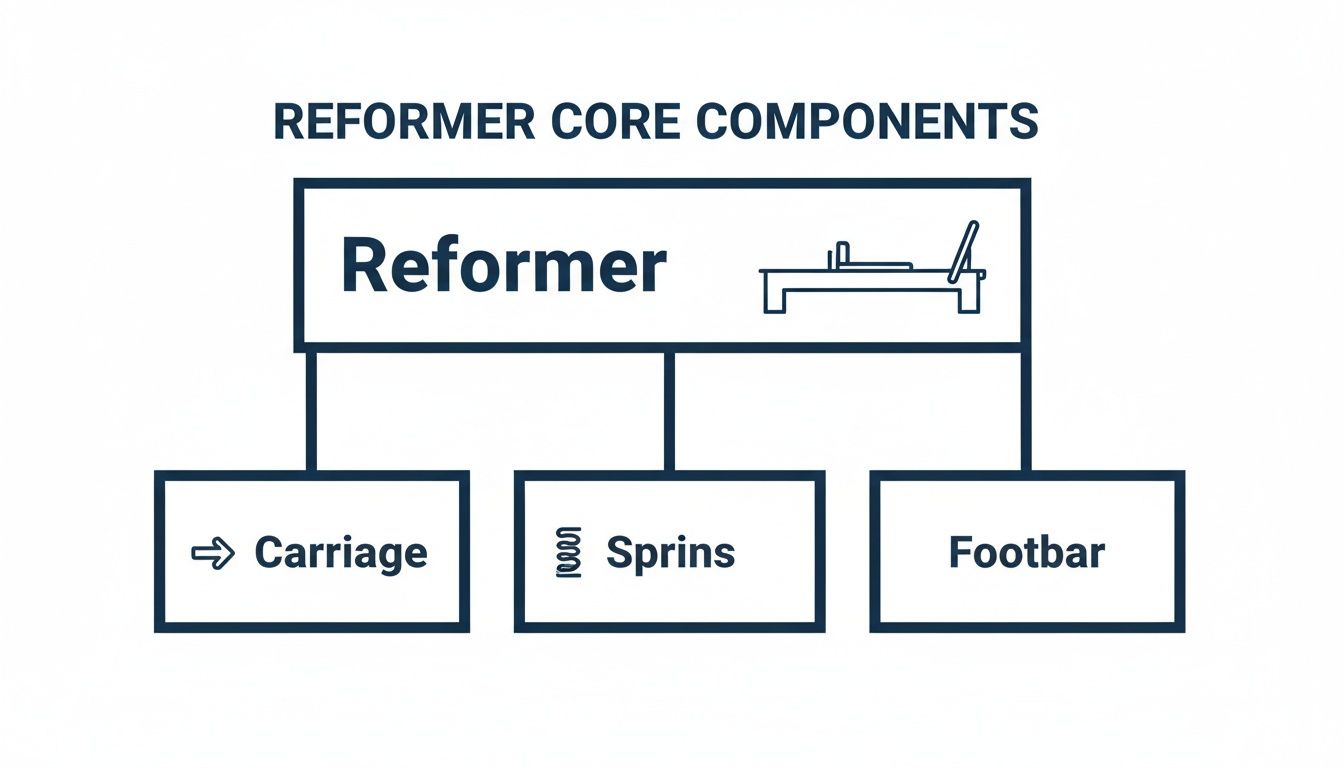
The carriage, springs, and footbar form the functional heart of any reformer. Each one plays a distinct but interconnected role in every single movement you make.
The Foundation: The Frame
The frame is the skeleton of your reformer. It provides the stability you need for safe, controlled, and effective movement. The material it's made from—usually wood or metal—is one of the first choices you'll make, and it sets the tone for both the machine's look and its performance.
Wood Frames: Often built from beautiful hardwoods like maple or oak, wood reformers bring a classic, warm aesthetic to a home. They are incredibly sturdy and have a natural ability to absorb sound, making for a noticeably quieter workout. Many people love the grounded, stable feel of a solid wood frame.
Metal Frames: Typically made from aluminum or steel, metal reformers offer a sleek, modern look. They're often lighter than their wood counterparts, which is a big plus if you ever need to move the machine. High-quality metal frames are exceptionally durable and built to withstand constant, heavy use, which is why you see them so often in professional studios.
Home Reformer Feature Comparison: Wood vs. Metal
Deciding between a wood and metal frame often comes down to balancing aesthetics with practical needs. Here’s a quick breakdown to help you compare.
| Feature | Wood Reformers | Metal Reformers |
|---|---|---|
| Aesthetics | Classic, warm, furniture-like appearance that blends into home decor. | Modern, sleek, and clinical look. |
| Durability | Extremely durable and stable, especially with high-quality hardwoods. | Very robust and resistant to wear and tear, designed for high-frequency use. |
| Weight | Heavier, providing a very grounded feel but more difficult to move. | Generally lighter and easier to reposition or store. |
| Maintenance | May require occasional polishing to maintain the finish. | Typically requires simple wipe-downs; resistant to scratches and scuffs. |
| Acoustics | Naturally absorbs sound for a quieter, smoother workout experience. | Can be slightly louder, though high-end models have excellent sound-dampening. |
| Best For | Home users seeking a quiet, aesthetically pleasing machine for a dedicated space. | High-traffic home gyms, clinics, or users who need to move their reformer. |
Ultimately, your choice here is about personal preference and how you plan to use the machine. A wood frame might be perfect for a quiet home sanctuary, while a metal frame could be the workhorse for a bustling home gym.
The Heartbeat: The Carriage and Springs
The carriage is the sliding platform you lie, sit, or stand on. Its "glide" is probably the single most important indicator of a reformer's quality. A great carriage moves silently and seamlessly along its track—no stuttering, no sticking. That smooth motion is essential for maintaining focus and control, especially during the slow, precise exercises that are so critical for workout recovery.
A truly smooth carriage glide isn't just a luxury; it's a functional necessity. It ensures the resistance you feel comes purely from the springs, not from friction. This is what allows for precise muscle engagement while protecting your joints.
And the springs? They're the soul of the machine. They provide the variable resistance that makes Pilates so uniquely effective.
Most home reformers come with three to five springs, each color-coded for a different tension level (light, medium, heavy). Having a good variety of springs allows for more subtle resistance adjustments, which is vital for progressing your practice or tailoring workouts for different goals. Lighter springs, for instance, can actually make stability exercises more challenging, while heavier springs are fantastic for building pure strength.
This ability to fine-tune resistance is what makes a reformer so versatile, perfect for both intense athletic conditioning and gentle, rehabilitative work. For an even deeper dive into what separates good from great, check out our guide on choosing a professional Pilates reformer.
Adjustability and Versatility: The Footbar and Accessories
The footbar is a simple yet crucial component that your hands or feet push against. Its adjustability is key for accommodating different body sizes and exercise variations. A quality reformer will offer multiple footbar positions, allowing you to maintain proper alignment and target muscles from different angles. This ensures your body is always in the optimal position, reducing strain and maximizing the benefits of every movement.
Finally, don't forget the accessories that can totally expand your reformer's capabilities:
- Jump Board: This padded attachment turns your reformer into a horizontal jumping machine. It offers a fantastic, low-impact cardio workout that's incredibly gentle on the joints.
- Reformer Box: A simple padded box placed on the carriage opens up a huge range of seated and prone exercises that are incredible for improving posture and deep core strength.
These are the building blocks of a great home reformer. Understanding what they do and why they matter will help you choose a machine that will not only last but will also grow with you on your wellness journey.
Integrating Your Reformer into a Wellness Routine
Knowing how a high-quality pilates reformer for home works is one thing. Actually weaving it into the fabric of your life is where the magic happens. A reformer isn't just a machine for hour-long workouts; it’s a wellness tool that can jumpstart your morning, restore your body after a tough day, or deliver a focused session to build real functional strength.
It doesn't matter if you're a seasoned athlete or just starting out. The reformer meets you exactly where you are, giving you the precise level of support and challenge you need to make meaningful progress.
Building Daily Wellness Rituals
Consistency is what unlocks the deep health benefits of Pilates. The sheer convenience of having a reformer at home makes it incredibly easy to build small, sustainable rituals that add up to big changes in how you move and feel.
Forget the all-or-nothing mindset. Think about how short, targeted sessions can fit into your day. These small daily deposits are often far more powerful than one or two intense workouts a week.
Here’s what that can look like:
- 15-Minute Morning Flow: Kick off your day with gentle movements that focus on waking up your spine and firing up your core. Exercises like Footwork, Bridges, and Eve's Lunge get the blood flowing, improve your posture, and set a mindful tone for the day.
- 10-Minute Post-Work Decompression: After hours hunched over a desk, a quick session can undo the damage. Focus on hip openers and gentle spinal twists to release that built-up tension in your lower back and shoulders. You’ll feel instantly refreshed.
- 20-Minute Strength Session: When you have a bit more time, a focused workout can build serious strength. A routine that includes exercises like Long Stretch and Control Front will challenge your entire body, honing your stability and muscular endurance.
The Reformer as a Premier Recovery Tool
One of the most valuable roles a home reformer plays is in active recovery. After high-impact activities like running, lifting, or intense sports, your muscles need to repair. The reformer provides the perfect environment for that process.
Unlike just lying on the couch, active recovery uses gentle, controlled movement to increase blood flow to sore muscles. This circulation helps flush out the metabolic junk that causes stiffness while delivering the oxygen and nutrients needed for repair. The result? Less soreness and faster, more complete recovery.
Using a reformer for recovery is about working smarter, not harder. The spring resistance supports your limbs while guiding them through a full range of motion, gently stretching and strengthening tired muscles without adding strain to your joints.
This controlled, low-impact environment is ideal for rebuilding strength safely. To round out your routine, you can complement your reformer sessions with other powerful bodyweight movements, like the foundational Glute Bridge, which builds core and glute strength.
Creating a Holistic Home Wellness System
Your Pilates reformer doesn't have to be a standalone piece of equipment. It integrates beautifully with other wellness practices to create a powerful, synergistic system that supports your health from every angle. This is how you elevate your home from just a gym to a full-blown wellness sanctuary.
A perfect example of this synergy is pairing reformer workouts with contrast therapy—the practice of alternating between heat (like a sauna) and cold (like a cold plunge).
Here’s how they work together:
- Warm-Up: Start with 15-20 minutes in a sauna to increase blood flow and warm up your muscles, prepping them for movement.
- Reformer Session: Follow up with a 20-30 minute gentle, recovery-focused reformer workout. The controlled movements will feel especially fluid and effective after the sauna.
- Cold Plunge: Finish with a 2-3 minute cold plunge. The cold water constricts blood vessels, which can dramatically reduce inflammation and muscle soreness post-workout.
This cycle of circulation, movement, and inflammation control is a game-changer for accelerating recovery and boosting resilience. It’s a complete system for managing stress, improving performance, and enhancing your daily well-being. For more ideas on crafting your ultimate at-home wellness routine, check out our insights on the MedEq Wellness Journal.
Planning Your Space and Caring for Your Investment
Bringing a reformer home is a fantastic move, but it pays to think through the logistics first. Before you get too far down the road, you need a plan for where this new piece of your wellness routine will live and how you’ll look after it. A little prep work protects your investment and makes sure it stays a safe, effective part of your life for years to come.
First thing's first: measure your space. But don't just measure the footprint of the machine itself. You need to account for its "working footprint"—the space you'll need when you're actually moving on it. This means leaving plenty of room on all sides so you can extend your arms and legs without bumping into a wall or a coffee table.

When you're setting things up, learning how to install fitness equipment like a pro is a huge help, and it all starts with good space planning. A solid rule of thumb is to leave at least 24 inches of clear space around the entire reformer.
Choosing Between Standard and Foldable Models
The space you have will be a big deciding factor. If you've got a dedicated workout room, a standard, non-folding model is hard to beat for stability. But if you're working with a smaller apartment or a multi-use room, a foldable reformer is a game-changer.
- Standard Reformers: These are the heavy-duty workhorses. They’re built to stay in one place, giving you that grounded, studio-quality feel. If you have the room, they’re a fantastic permanent fixture.
- Foldable Reformers: Don't let the "folding" part fool you; modern engineering has made these models incredibly sturdy. They give you the freedom to pack things up and reclaim your floor space, which is perfect for most home environments. High-end options like a folding professional solid wood Pilates reformer deliver serious performance without demanding a permanent spot.
Protecting Your Investment with Simple Maintenance
Once your reformer is set up, a little bit of care goes a long way. Keeping up with simple maintenance keeps your machine running smoothly and safely, and it only takes a few minutes a week.
Think of maintenance as another part of your wellness practice. It's an act of mindfulness that honors the investment you've made in your health and ensures your equipment is always ready to support you.
Here’s a quick checklist to keep that glide feeling perfect:
- Wipe Down Surfaces: After each session, give the vinyl on the carriage, headrest, and shoulder rests a quick wipe with a gentle cleaner. This keeps sweat and oils from breaking down the material over time.
- Inspect Springs and Straps: Before you start a workout, give the springs a quick look for any gaps, wear, or distortion. Check the straps and ropes for any fraying. It’s a 10-second safety check that’s well worth it.
- Clean the Rails: The track is what gives you that signature smooth ride, so keep it clean. A weekly wipe with a dry microfiber cloth is usually all it takes to clear away any dust and keep the carriage gliding silently.
Finding Your Perfect Reformer: A Decision Checklist
Alright, let's cut through the noise. Picking the right Pilates reformer for your home can feel like a huge task, but it really boils down to what you need it for. This checklist is designed to help you zero in on the machine that feels like it was made just for you.
Forget the one-size-fits-all approach. We're going to look at this through two distinct lenses: the home wellness enthusiast and the high-performance athlete. This way, you can shop with confidence and invest in a reformer that you'll actually use and love for years to come.
For The Wellness-Focused Home
If you're creating a calm, personal wellness space, this is your path. The goal here is a machine that fits beautifully into your life, supporting mindful movement, recovery, and a consistent practice for anyone in the household.
- Quiet & Smooth Glide: Does the carriage move almost silently? A peaceful workout is non-negotiable for a relaxing home environment.
- Aesthetic Appeal: Do you love how it looks? Whether it's the warmth of wood or the sleekness of metal, you're far more likely to use a machine that complements your home.
- Ease of Use: How simple is it to adjust the springs and footbar? It should be intuitive enough for everyone, from a total beginner to a seasoned pro, to use safely and comfortably.
- Versatility for Multiple Goals: Can it handle everything from a deep, gentle stretch to a moderate strength session? Your reformer should be able to grow with you as your fitness goals evolve.
For The High-Performance Athlete
Athletes and anyone serious about performance demand a lot more from their gear. This checklist is all about durability, power, and the specific features needed to push your limits and speed up recovery.
- Robust Frame Construction: Is the frame built from high-grade steel or solid hardwood? It absolutely must withstand intense, frequent workouts without a hint of wobble.
- Wide Spring Resistance Range: Does it offer a good mix of spring tensions, especially heavy ones? This is critical for progressive overload and building serious power.
- Durable Jump Board Accessory: Is the jump board solid and well-padded? It needs to take a beating from powerful, repetitive plyometric work for that essential low-impact conditioning.
- Extensive Adjustability: Can the footbar be set in multiple positions? This is key for nailing precise biomechanical alignment to target specific muscle groups for both performance and rehab.
No matter your path, the goal is to choose a reformer that removes friction between you and your wellness goals. The right machine feels intuitive, supportive, and motivating, making consistency feel effortless.
By using the right checklist, you can confidently explore the different models out there and find your perfect match. For more wellness insights, visit the MedEq Wellness Journal.
Got Questions? We’ve Got Answers.
Thinking about bringing a reformer home? It’s a big step, and you probably have a few questions. Let's clear up some of the most common ones so you can feel confident you're making the right move.
How Is a Reformer Different from Mat Pilates?
Think of it this way: Mat Pilates is you versus gravity. A reformer is you versus a dynamic, spring-loaded system. That's the game-changer.
The reformer’s springs don't just add resistance; they provide support. They guide your movements, helping you maintain perfect form while challenging your muscles in a completely new way. You're working against constant tension, building strength through the entire movement—not just on the way out, but on the controlled return, too. This is what builds that long, lean muscle Pilates is famous for, and it does it faster than mat work alone.
Can I Lose Weight with a Pilates Reformer?
Absolutely, but not in the way you might think. A reformer isn't a cardio machine designed to torch calories in a 30-minute session. Its real power for weight management comes from building lean muscle.
Muscle is your body’s metabolic engine—it burns more calories at rest than fat does. A consistent reformer practice builds that deep, functional muscle all over your body, effectively turning up your metabolic thermostat 24/7. When you pair that with a solid nutrition plan, a reformer is a killer tool for sculpting a strong, efficient body and achieving sustainable weight loss.
A reformer reshapes your body's composition over time. It’s less about the calories burned during a workout and more about building a stronger, more metabolically active body for the long haul.
How Often Should I Use My Reformer for Best Results?
Consistency trumps intensity here. For most people, two to four sessions per week hits the sweet spot. This gives you enough stimulus to see real change while allowing your muscles crucial time to recover and rebuild stronger.
The most important thing is to listen to your body. Some weeks, you'll feel ready to go hard four times. Other weeks, two lighter, more restorative sessions might be what you need. The goal is to build a sustainable habit that makes you feel good, not one that burns you out.
For more answers to your wellness questions, explore the MedEq Wellness Journal.
At MedEq Fitness, we believe in equipping you with the science-backed tools you need to build a powerful wellness routine at home. Explore our collection of professional-grade equipment designed to accelerate your recovery and elevate your daily performance.